
Spray paint transforms paper mache from a fragile craft project into a polished, professional-looking piece of art. But not all spray paints work equally well on this porous, flexible surface. In this new guide, you’ll learn exactly which products deliver the best quality spray paint results—and how to use them without drips, peeling, or warping.
- Quick answer: the best spray paint for paper mache in 2026
- What makes a spray paint “good” for paper mache?
- Best spray paint brands and products for paper mache
- How to prepare paper mache for spray paint
- Spray painting technique for paper mache (without drips or warping)
- Special effects with spray paint on paper mache
- Drying, curing, and sealing spray-painted paper mache
- Common mistakes with spray paint on paper mache (and how to avoid them)
- FAQ: choosing and using spray paint on paper mache
- Key takeaways
Quick answer: the best spray paint for paper mache in 2026
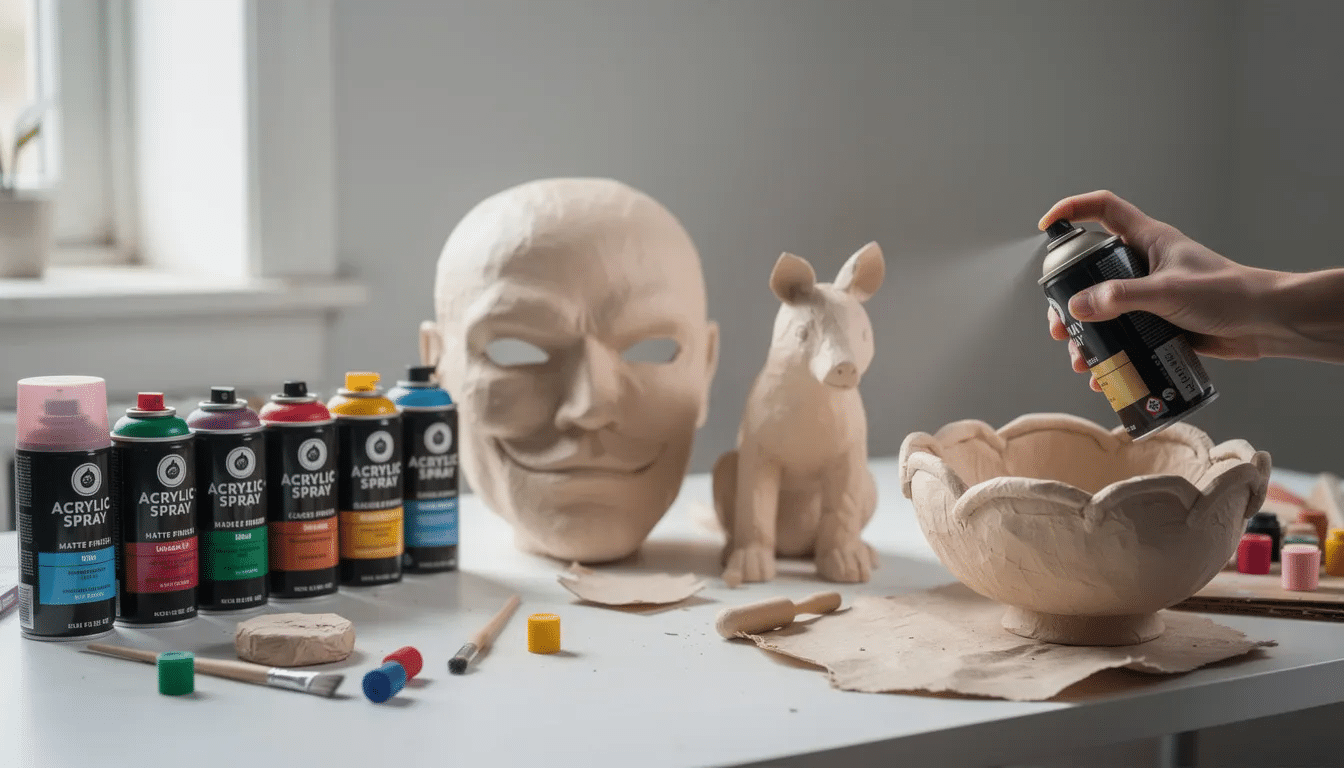
High-quality acrylic spray paints are the best paint for paper mache projects. They flex slightly with the material, bond well to paper fibers, and dry fast enough to prevent warping. Skip the cheap hardware store enamel and invest in formulas designed for art and craft applications.
Here are the top recommendations:
- Montana GOLD Acrylic Professional Spray Paint – Best overall, especially for detailed masks and sculptures where color vibrancy and smooth gradients matter most.
- Krylon COLORmaxx or Krylon Fusion All-In-One – Best widely-available option for beginners and quick decorative projects like party letters.
- Rust-Oleum Painter’s Touch 2X Ultra Cover – Best budget-friendly choice for larger paper mache pieces where you need maximum coverage.
- Montana BLACK or other low-pressure art sprays – Best for artists needing fine control, gradients, and professional-level detail work.
For finishes, matte spray works beautifully on sculptures and character masks, while satin or semigloss looks sharp on decorative letters and glossy household items. All of these should be applied in multiple light coats over fully dry papier mache, ideally primed with gesso first.
Brand | Best For | Finish Options | Price Range |
|---|---|---|---|
Montana GOLD | Serious artists, commissions | Matte, satin, metallic, transparent | $$$ |
Krylon COLORmaxx | Beginners, quick projects | Gloss, satin, flat | $$ |
Rust-Oleum 2X | Large props, budget work | Flat, satin, gloss | $ |
Montana BLACK | Detail work, gradients | Matte, high-gloss | $$$ |
What makes a spray paint “good” for paper mache?
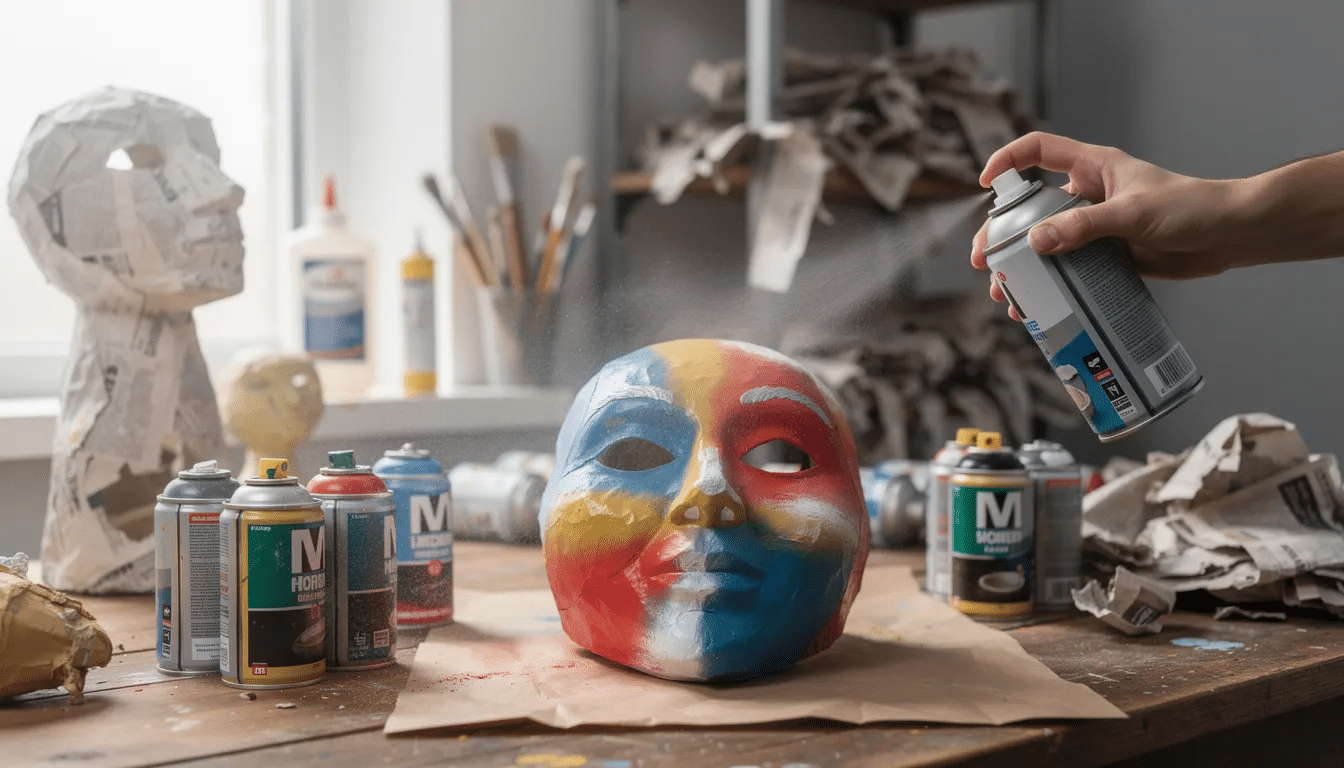
Paper mache is porous and slightly flexible, which creates challenges that other surfaces don’t have. Paint must adhere without soaking too deep, warping the structure, or cracking when the piece flexes. The wrong formula can turn your project into a mess of fuzzy fibers and blotchy color.
Here’s what to look for:
- Paint type: Water-based acrylics are safest and most compatible. Harsh solvent-based enamels can re-soften the paper layers or release chemicals that damage the structure.
- Flexibility: The formula should handle slight bending without flaking—critical for masks, costumes, and letters that might get bumped.
- Coverage: Good pigment load means fewer coats on absorbent paper mache. This saves time and reduces the risk of oversaturating the surface.
- Drying time: Fast-drying is ideal, but not so fast that it becomes powdery or chalky before leveling out.
- Finish options: Matte, satin, gloss, and metallic finishes serve different project types. Having options lets you create the exact look you want.
- Adhesion: The paint should bond well to gesso, Kilz, or white acrylic base coats—not just sit on top waiting to peel.
- Odor and VOC level: Low-odor and low-VOC formulas are essential for indoor or classroom use where ventilation may be limited.
The underlying principle is simple: spray paints atomize fine pigment particles that flow into surface crevices better than brushed paints, reducing waste on absorbent materials like paper mache.
Best spray paint brands and products for paper mache
Availability varies by country, but these lines are widely sold in North America and Europe as of 2026. Each has strengths depending on your project type, skill level, and budget.
Montana GOLD – best overall for serious paper mache artists
Montana GOLD is a professional acrylic spray line that artists consistently recommend for paper mache masks, character heads, and detailed sculptures. The low-pressure output and wide color range make it ideal for smooth gradients and precise shading.
Key features for paper mache work:
- High pigment load delivers vibrant, opaque colors like Shock Black and Shock White without fading over time
- Professional-grade formulation resists crazing—that ugly spiderweb cracking pattern caused by recoating too quickly
- Available in matte, metallic, and transparent finishes for different effects
- Low-pressure spray gives you control on curved and detailed surfaces
- Safety ring under the lid must be removed before first use (twist off the plastic ring beneath the nozzle cap)
Montana GOLD runs more expensive than hardware store brands—expect to pay $10-15 per can covering approximately 15-25 square feet total with multiple passes. Save this brand for keeper pieces and commissions, not bulk classroom projects.
For adding shadows and depth, pair the solid colors with Montana transparent colors. A light dusting of transparent dark brown in eye sockets or under chins creates professional-looking dimension.
Krylon COLORmaxx / Fusion – best for beginners and decorative letters
Krylon COLORmaxx and Fusion All-In-One are common in craft and hardware stores, making them accessible for most projects. They spray well on primed paper mache and offer straightforward directions right on the can.
What makes Krylon work for beginners:
- Semigloss or satin finishes hide small surface imperfections on paper mache letters and party decor
- Simple application process with clear instructions
- Some formulations bond directly to bare cardboard and paper (though priming still gives better results)
- UV-resistant options available for pieces near windows
- Widely available at Walmart, Home Depot, and craft stores
In comparative tests, Krylon UV-Resistant Acrylic Coating achieved expected sheens with less yellowing than competing brands on light-colored bases—making it particularly good for white or pastel paper mache projects.
Apply several light coats with 10-15 minutes between passes. Give the whole thing at least 24 hours of cure time before handling letters or masks.
Rust-Oleum Painter’s Touch 2X – best budget option for big projects
Painter’s Touch 2X is a high-coverage enamel spray that works well on large paper mache props and decor—think big letters, piñatas, and party centerpieces where you need to cover tons of surface area affordably.
Budget-friendly advantages:
- “2X” coverage reduces total cans needed when the piece is properly sealed first
- Available in flat/matte for sculptures, satin for props, and gloss for faux ceramic effects
- One of the most affordable options per square foot of coverage
- Works well on rigid paper mache pieces
The solvent smell is stronger with this brand, so emphasize outdoor spraying or very well-ventilated work areas. Use a respirator for repeated work sessions.
Because Rust-Oleum 2X dries to a harder film, it’s a better fit for rigid paper mache pieces rather than highly flexible costume parts or masks that need to flex without cracking.
Artist-grade acrylic sprays (Montana BLACK, Liquitex, etc.)
For experienced painters who already work with artist-grade materials, Montana BLACK and Liquitex Professional Spray Paint offer premium control and consistency.
These lines feature:
- Low-pressure output for fine detail work
- Replaceable caps for different spray patterns
- Consistent color matching across cans and batches
- Ability to layer over brushed acrylics for shadows, glow effects, and vignettes
- Professional archival quality with minimal yellowing
If you’re already using these brands on canvases or murals, they’ll feel familiar on paper mache. The techniques transfer directly, and you can match colors across different media in the same project.
How to prepare paper mache for spray paint
Good prep prevents warping, soft spots, and blotchy color. Rushing this process is the single biggest mistake that ruins otherwise promising projects.
Step 1: Make sure the paper mache is completely dry
Let paper mache dry at least 24-72 hours after applying one layer—or the second layer and beyond—depending on thickness and weather conditions. Thick pieces or humid environments need the longer end of that range.
How to check for complete dryness:
- Feel hidden spots inside masks and under protrusions for cool, damp areas
- The surface should feel room temperature, not cooler than surrounding air
- Press firmly—there should be no give or soft spots
- Weight should feel significantly lighter than when wet
Trapped moisture causes mold growth or bubbles under spray paint later. You don’t want to discover this problem after you’ve finished painting.
To speed drying, use a fan in a warm, dry room. Never use direct high heat from hair dryers or heat guns, which can warp or crack the paper structure.
Step 2: Smooth and seal the surface
Light sanding with fine sandpaper (220-320 grit) knocks down rough edges, tape seams, and fuzzy newspaper fibers. Don’t skip this step—it makes a visible difference in the final surface quality.
For very rough newspaper textures, consider a skim coat of:
- Paper mache clay
- Joint compound
- Modeling paste
Apply this thin, let it dry completely, then sand smooth before sealing.
Sealing options that work well:
- White acrylic gesso (the most popular choice among artists)
- Kilz Original or Kilz 2 primer applied thinly
- A mix of PVA glue and white acrylic paint as a DIY sealer
Apply 1-2 thin coats, letting each dry fully. This prevents oversaturating the paper while reducing absorbency so spray paint sits on top evenly instead of soaking in and creating fuzzy fibers.
Step 3: Choose the right primer under your spray paint
Most acrylic sprays adhere well to:
- White acrylic gesso
- Acrylic house primers
- A light coat of compatible spray primer from the same brand line
Kilz works particularly well as a stain-blocking primer if you’re using recycled boxes or printed cardboard that might bleed through your paint colors.
Prime in white or very light gray for bright colors. Dark primers can dull neon and pastel spray paints significantly.
Even “paint+primer” combination cans benefit from a separate primer on very porous paper mache. The object absorbs so much that the built-in primer often isn’t enough.
Spray painting technique for paper mache (without drips or warping)
This technique section is critical if you’re coming from brush painting to sprays. The process is fundamentally different, and the skills don’t transfer automatically.
Shake and test the can
Shake the can for at least 2 minutes after the ball starts rattling. In cold weather, extend this to 3-4 minutes. Inadequate shaking is responsible for most spray problems.
Before hitting your project, do a test spray on scrap cardboard or newspaper. You want to see an even, fine mist.
Signs of trouble and what causes them:
Problem | Common Cause |
|---|---|
Spitting or blobs | Inadequate shaking |
Uneven spray pattern | Partially clogged nozzle |
Weak, sputtery output | Cold paint or low pressure |
Paint won’t stick | Wrong surface prep |
If nozzle issues persist, swap the cap with a spare from another can of the same brand. Watch the spray pattern improve immediately. |
Distance, movement, and number of coats
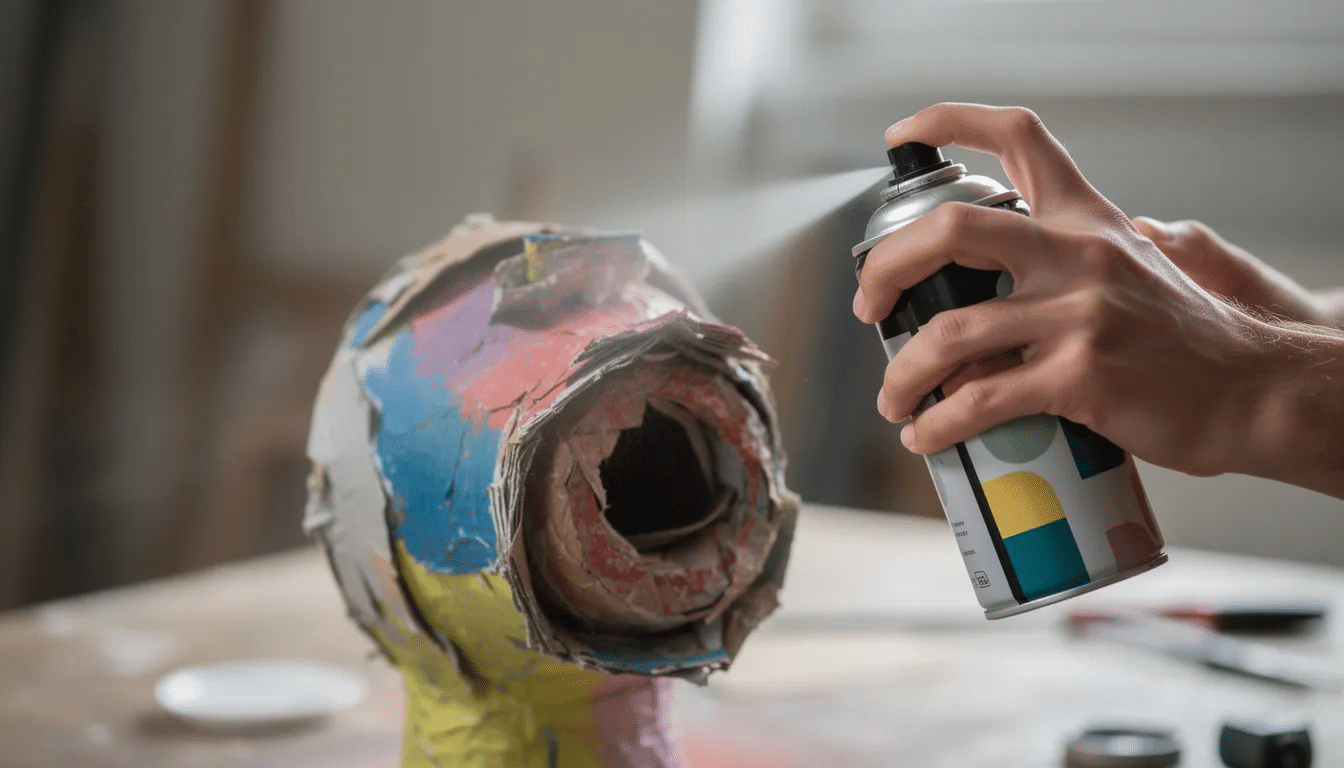
Maintain a working distance of about 6-8 inches (15-20 cm) from the paper mache surface for most brands. For light dusting effects, increase to 10-12 inches.
Keep your hand moving at all times—side-to-side or slight arcs—starting the motion before pressing the nozzle and continuing after releasing. This prevents paint build-up at the start and end of each pass.
Multiple light coats beat one heavy blast every time. Heavy application causes:
- Drips that are nearly impossible to fix
- Uneven gloss across the surface
- Paper re-softening from excess solvent
- Potential for crazing and cracking
Typical timing for paper mache:
- Touch-dry: 10-30 minutes
- Safe to recoat: 1-2 hours (or follow can directions)
- Full cure: 6-24 hours depending on brand and weather
Expert paper mache artist Manning Krull recommends waiting at least six hours—or a full one day—between coats to ensure complete curing. Paint may feel dry in 30-60 minutes but isn’t fully set.
Working safely and protecting your space
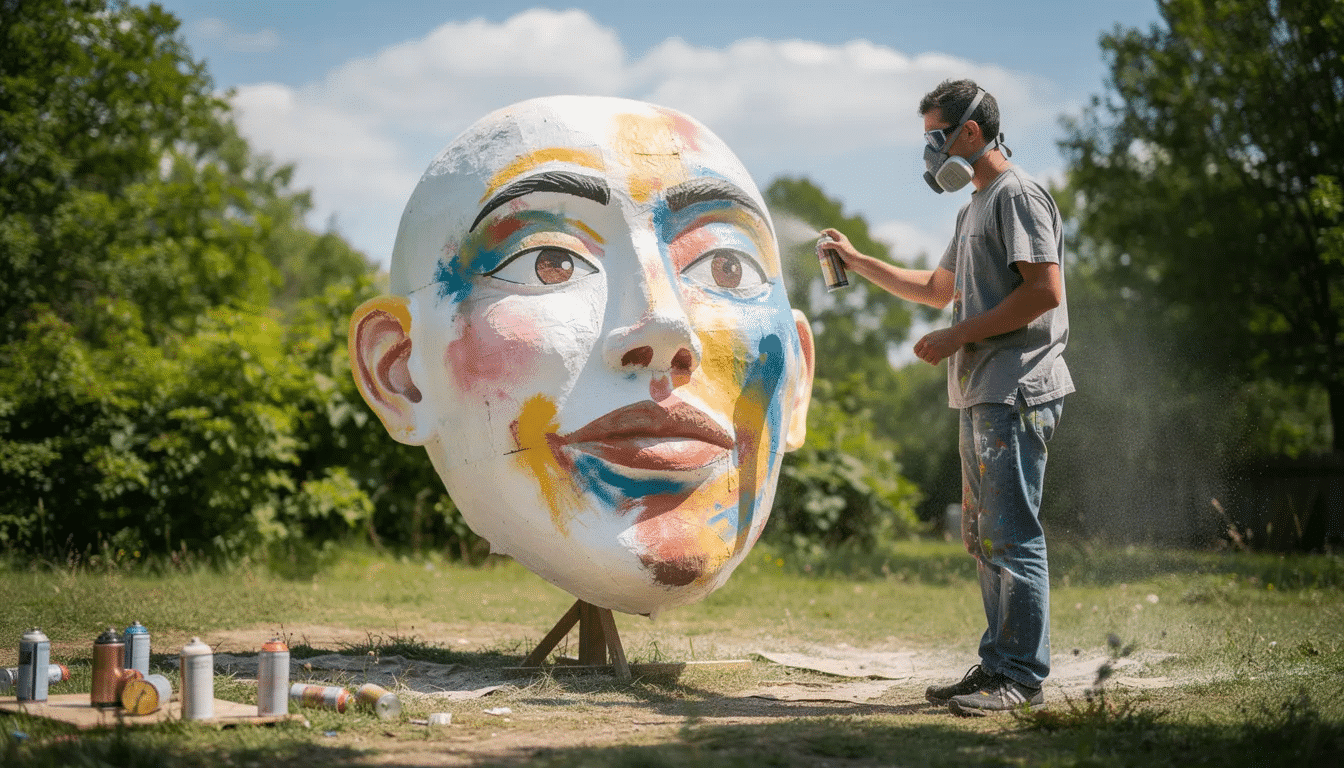
Spray outdoors or in a well-ventilated area, away from flames and heaters. VOCs and fumes pose real health risks with repeated exposure.
Safety essentials:
- Simple respirator or well-fitted mask for frequent spraying
- Disposable gloves to protect your hands
- Eye protection if spraying overhead
Easy ways to protect your work area from mess:
- Fold foam board into a three-sided “spray booth”
- Tape down several layers of newspaper as a floor cover
- Use a cheap plastic shower curtain or drop cloth
- Sit your project on a turntable or lazy Susan to rotate without touching wet paint
An upside-down cardboard box also works as a rotating base—just make sure it’s stable.
Special effects with spray paint on paper mache
These techniques are optional upgrades for artists who’ve mastered the basics and want to create more sophisticated finishes.
Light dusting for age and shadows
The dusting technique creates subtle depth without obscuring underlying colors. Hold the can about 10-12 inches away and move quickly, laying down a translucent layer instead of solid coverage.
Effective applications:
- Black or dark brown to deepen eye sockets on masks
- Dark gray under chins and along creases
- Brown tones for a weathered, antique appearance
- Dust along edges for a slightly spooky or worn look
Several very light passes build the effect gradually. You can always add more, but you can’t easily remove too much. Practice on scrap paper mache before committing to a finished piece.
Metallic and faux-finish effects
Metallic sprays like Rust-Oleum Metallic or Montana GOLD’s metallic series create convincing armor, crowns, and faux metal letters.
Simple faux-metal technique:
- Apply a base coat of flat black
- Lightly mist metallic over raised areas only
- Optionally dust edges with a darker tone for “wear”
- Let the black show through in recesses
Pearlescent or interference sprays over pastel bases work beautifully for fantasy or underwater-themed paper mache decor. The color shifts as light hits different angles.
For fine details that spray paint can’t reach, add paint pens after the spray coats cure. They’re perfect for adding details like eyes, small patterns, or tight spots where spray would create a mess.
Layering colors and using stencils
Build professional gradients by:
- Spraying a mid-tone overall as your base
- Adding darker tones in recesses with light dusting
- Highlighting raised areas with a lighter shade
For stencil work on paper mache:
- Wait 24 hours after the base coat cures
- Secure the stencil with low-tack painter’s tape
- Spray very lightly from directly above to avoid under-spray
- Remove stencil while paint is still slightly tacky
Flexible stencils work better on curved paper mache surfaces like masks and spheres. Rigid plastic stencils can leave gaps on rounded forms.
Drying, curing, and sealing spray-painted paper mache
Understanding the difference between “dry to touch” and fully “cured” will save you from many common mistakes.
How long to let spray paint dry on paper mache
General guidance for drying times:
Stage | Typical Time |
|---|---|
Surface-dry | 15-60 minutes |
Safe to recoat | 1-2 hours (or 24-48 hours if you miss the window) |
Full cure | 24-72 hours |
Brand, coat thickness, and climate all affect these timelines. Humid weather extends drying significantly—sometimes doubling the wait time. |
Adding new coats too soon causes crazing, where rapid recoating makes upper layers crack as lower ones cure slower. This creates an ugly spiderweb pattern that’s impossible to fix without stripping and starting over.
Air projects out in a sheltered location—a covered porch or garage with the door open works well—to reduce lingering odor while protecting from dust and elements.
Sealing and protecting your painted paper mache
Most indoor paper mache pieces sprayed with quality acrylic paint don’t require extra sealer. The paint itself provides reasonable durability. However, sealing adds moisture resistance and longevity for pieces that will be handled frequently.
Clear acrylic spray sealers (matte, satin, or gloss) are the easiest topcoat option. Apply them using the same light-coat technique as colored sprays.
When to use brush-on sealers:
- Matte or gloss Mod Podge for classroom projects
- Water-based polyurethane for durable protective coating
- Diluted PVA glue for quick, budget-friendly sealing
- Acrylic varnish for archival protection
Brush-on products can slightly soften underlying spray layers, so test a small area first. Use soft brushes with light pressure to avoid dragging or marring the paint.
Outdoor display is risky for paper mache regardless of sealing. If attempted, use multiple coats of exterior-grade acrylic sealer and place pieces under cover away from direct rain and sun.
Common mistakes with spray paint on paper mache (and how to avoid them)
Even experienced crafters run into trouble with spray paint on paper mache. Here’s a quick troubleshooting guide:
- Spraying too close, causing drips and wet spots – Fix by increasing distance to 6-8 inches and keeping your hand moving constantly.
- Heavy first coat that soaks the paper – Fix by sealing and priming first, then using very light passes that barely mist the surface.
- Not waiting long enough between coats – Fix by respecting the brand’s recoat window. When in doubt, wait overnight.
- Spraying onto damp or uncured paper mache – Fix by extending dry time and physically checking inner layers before painting.
- Painting in extreme cold or humidity – Fix by warming paint and project indoors, spraying quickly outside, then bringing back in to dry.
- Failing to shake or clear nozzle – Fix by thorough shaking (2+ minutes), test sprays on scrap, and clearing the nozzle by spraying upside down after each session.
- Skipping the primer on porous surfaces – Fix by always applying gesso or primer, even when using “paint+primer” combination products.
- Touching too soon and leaving fingerprints – Fix by waiting the full cure time and using gloves for early handling.
FAQ: choosing and using spray paint on paper mache
Can you use regular hardware-store spray paint on paper mache? Yes, but results vary significantly by brand. Rust-Oleum and Krylon work reasonably well when the surface is properly primed. Avoid ultra-cheap brands and automotive paints, which contain harsher solvents.
Do you have to prime paper mache before spray painting? Technically no, but priming dramatically improves results. Gesso or acrylic primer seals the porous surface, prevents uneven absorption, and helps paint adhere better. For stock classroom projects, you might skip it, but for anything you want to keep, prime first.
Which finish (matte, satin, gloss) looks best on masks and letters? Matte works beautifully on sculptures and character masks, giving them an organic, non-reflective appearance. Satin or semigloss suits decorative letters and container-style projects where you want some sheen without glare.
Is spray paint safe for kids’ paper mache projects? Spray painting should be done by adults only, with children stepping away during application. After full curing (24-72 hours), the painted piece is safe for kids to handle. Low-VOC acrylic formulas reduce fume exposure during the spraying process, and pairing them with high-quality, age-appropriate art supplies for young artists helps keep kids’ creative projects both safe and inspiring.
How long should I wait before handling or shipping a spray-painted sculpture? Wait at least 48-72 hours for full cure before handling extensively. For shipping, wait a full week and wrap in tissue paper (not plastic) to allow any remaining off-gassing and prevent sticking.
Can I spray paint over acrylic brush paint on paper mache? Yes, spray paint adheres well to dried acrylic paint. Make sure the brushed layer is completely dry (24+ hours) before spraying. This technique works great for base coating with brush acrylics then adding spray effects.
Will spray paint make my paper mache waterproof? No. Spray paint provides moisture resistance but not waterproofing. Paper mache remains vulnerable to prolonged water exposure regardless of paint or varnish. For outdoor display, use multiple sealer coats and keep pieces under cover.
What’s the best way to contact brands with questions? Most manufacturers list customer service via e mail on their websites. Montana, Krylon, and Rust-Oleum all have technical support pages where you can submit questions about specific products and applications.
Key takeaways
Choosing the best spray paint for paper mache comes down to matching your project needs with the right formula. Montana GOLD delivers professional results for serious artists. Krylon offers accessible quality for beginners. Rust-Oleum covers large projects affordably.
Whatever brand you choose, the fundamentals stay the same:
- Let paper mache dry completely before painting
- Prime with gesso or acrylic primer for even coverage
- Apply multiple light coats with adequate drying time between passes
- Work in well-ventilated spaces with proper protection
- Allow full cure time before handling
Paper mache is fun, forgiving, and surprisingly versatile. With the right spray paint techniques, your masks, letters, and sculptures will look professional enough to display proudly—or even sell. Bookmark this page for your next project, and don’t miss experimenting with special effects once you’ve mastered the basics.
Now grab a can, set up your work area, and create something worth showing off.