
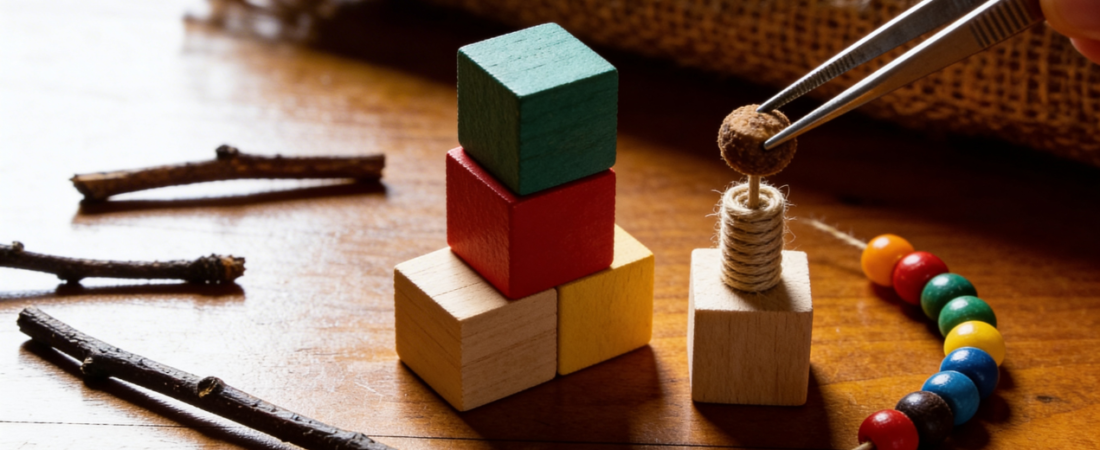

Looking for hands-on ways to support your child’s small muscle development? This guide delivers concrete examples of fine motor activities that families, daycare providers, and preschool teachers can use right away. Whether you’re working at the kitchen table, in a classroom, or enjoying fresh air outside, these ideas use materials you likely already have.
Here are some quick examples to get you started: peeling and placing stickers, threading beads onto a pipe cleaner, wringing sponges in water play, drawing with sidewalk chalk, squishing play dough, dropping coins into a piggy bank, and clipping clothespins onto a paper plate. Each of these fun fine motor activities targets the small muscles of the hands and fingers that children need for everyday tasks.
The activities below are grouped by age focus (toddlers through early school-age) and by skill type—precision, strength, and coordination—so you can quickly find what your child needs. All examples use everyday materials available at dollar stores, grocery stores, or already sitting in your home. These ideas work well for kids roughly 18 months to 7 years old, with easy adaptations for different skill levels. If you’re looking specifically for tidy options, you might also like these no-mess activities for 2-year-olds.
- What Are Fine Motor Skills?
- Fine Motor Activities for Toddlers and Preschoolers
- Fine Motor Precision Activities (Targeted Hand Control)
- Fine Motor Strength Activities (Building Hand Power)
- Fine Motor Games and Toys That Don’t Feel Like “Work”
- When to Watch, When to Support, and When to Seek Help
- Summary: Building Fine Motor Skills Through Everyday Play
What Are Fine Motor Skills?
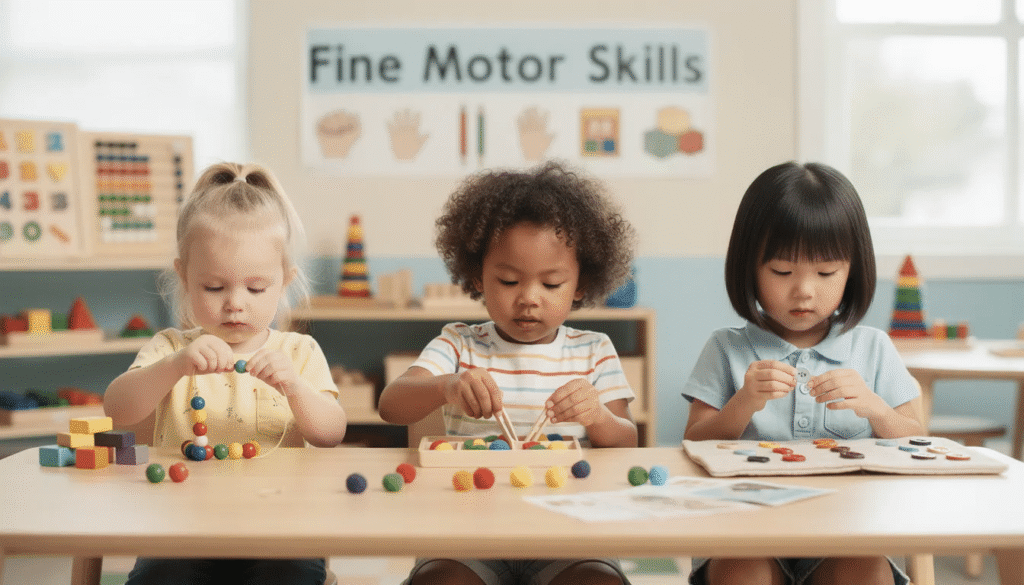
Fine motor skills are the small, precise movements of the hands, fingers, and wrists that work in coordination with the eyes. Fine motor skills are the movements and coordination of the small muscles of the body, typically thought of as the movements that involve the fingers and the hands. These skills power everything from picking up a raisin to writing your name, and they develop through a combination of muscle strength, coordination, and practice.
It helps to understand how fine motor skills differ from gross motor skills. Gross motor skills involve larger muscle groups and whole-body movements like running, jumping, climbing stairs, or throwing a ball. Fine motor skills, by contrast, focus on the controlled movements of smaller muscles.
Here are everyday tasks that rely on fine motor control:
- Buttoning a shirt
- Zipping a jacket
- Drawing with crayons
- Cutting with scissors
- Picking up coins
- Opening lunch containers
- Brushing teeth
- Turning book pages
Fine motor skill development begins in infancy when babies first reach and grasp, and it continues through the school years as children learn to write, tie shoes, and accomplish important tasks independently. The good news? Playful practice through naturally occurring play activities is usually the best way to build these skills.
Fine Motor Activities for Toddlers and Preschoolers
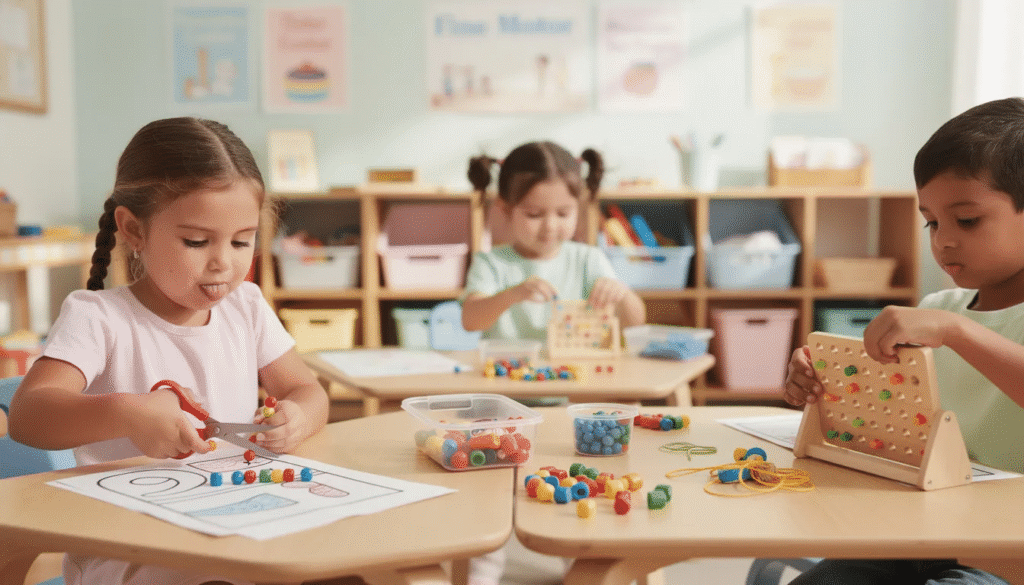
This section focuses on simple, low-cost fine motor skills activities for children roughly ages 2 to 5. These can be done in a living room, at a kitchen table, or in a preschool setting with minimal setup.
A quick safety note: supervision is essential with any small objects like coins, beads, or buttons. For children under 3, swap in larger items to reduce choking risk. When in doubt, if a piece fits through a toilet paper tube, it’s too small for unsupervised play with very young children.
The following activities use common household objects—stickers, cereal, paper, clothespins, chalk, sponges, and dough. Each description highlights which motor skills it targets, helping you choose activities that match your child’s needs and fit into your child’s everyday routine. For more art-focused options, explore these art activities to enhance fine motor skills in children.
Peeling and Placing Stickers
Draw simple shapes like circles, squares, or winding “roads” on a piece of paper. Then have your child peel stickers from a sheet and place them inside the lines or along the paths.
Peeling stickers works on the pincer grasp (thumb and index finger working together), finger isolation, and graded force—the ability to pull gently without tearing. These same skills help with similar everyday tasks like peeling fruit or opening small packages.
Placing stickers inside a target supports visual motor coordination and early pre-writing control. Staying within boundaries is the same skill children need when they later draw lines and draw open circles in kindergarten.
Variations to try:
- Use large dot stickers for 2-3 year-olds
- Switch to smaller reward stickers for 4-5 year-olds
- Create patterns by color or shape for an added cognitive challenge
Stringing Cereal, Pasta, or Large Beads
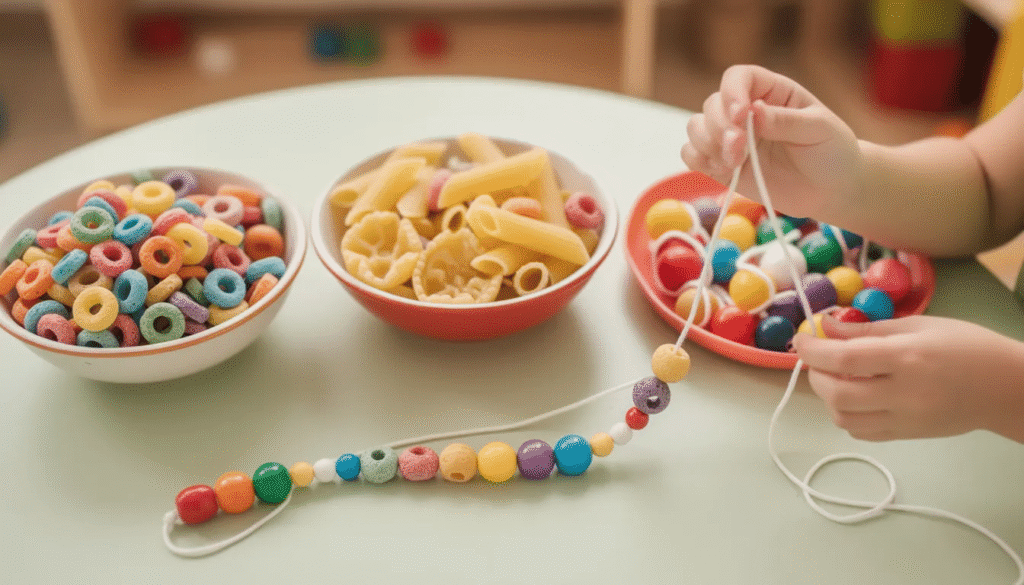
Start with big items like rigatoni pasta or chunky wooden beads on a pipe cleaner or thick shoelace. The stiff end of a pipe cleaner makes threading easier for beginners. As skills improve, progress to smaller cereal like Cheerios on string, then eventually to multi colored beads on thinner laces.
This activity builds bilateral coordination—one hand holds the string steady while the other threads the item. It also develops the visual motor coordination required for tasks like slowly threading laces through shoes or zipping a jacket.
Try making “snack necklaces” with cereal for toddlers. It combines fine motor practice with a tasty reward. Just keep string length short and supervise closely.
To increase the challenge, ask your child to follow a color pattern (red, blue, red, blue) or count out a specific number of pieces per necklace. This adds problem solving and early math practice to the motor skill work.
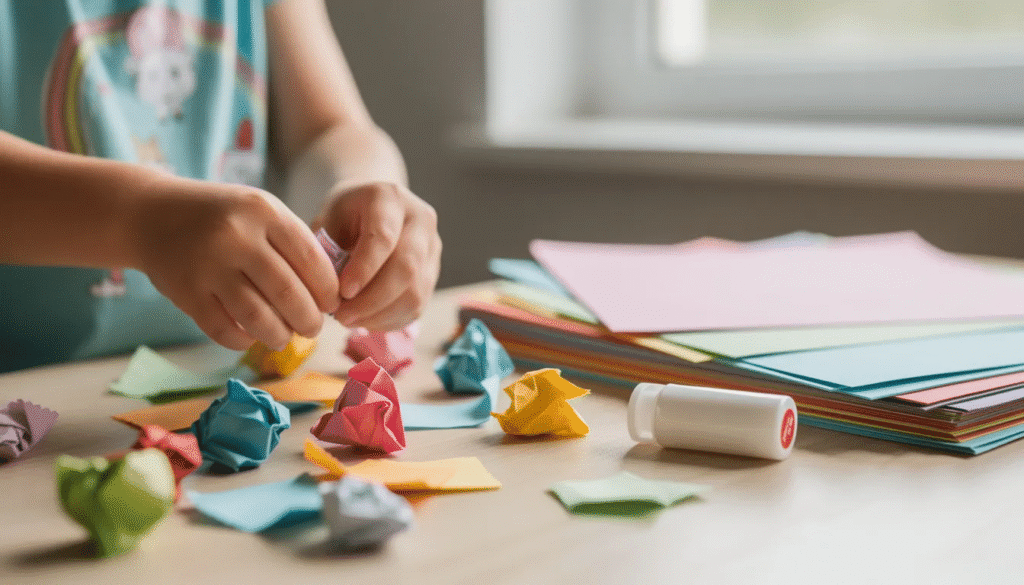
Ripping, Crumpling, and Gluing Paper
Invite your child to rip old magazines, construction paper, or newspaper into small pieces. Then crumple the pieces into balls and glue them onto a simple template—a tree, fish, rainbow, or any shape that interests your child. This type of project also taps into the broader benefits of arts and crafts for child development.
Ripping and crumpling strengthen the small muscles of the fingers and palm. These are the same muscles that support a mature pencil grasp and the hand and finger strength needed for handwriting.
Using two hands to rip paper also encourages coordinated bilateral hand use. This coordination transfers to similar everyday tasks easier—like opening snack bags, pulling on socks, or tearing paper towels.
Water and Sponge Play
Set up a basin of water with a few sponges, washcloths, or small toy cars that need “washing.” This can happen in the sink, bathtub, or outside in warm weather.
Squeezing, wringing, and transferring water between containers builds intrinsic hand strength and grip endurance. These are the muscles deep in the palm that support sustained activities like coloring a whole page or stirring batter.
Concrete activity ideas:
- “Wash the toy cars” by squeezing soapy sponges
- Squeeze water from one bowl into another
- Wipe the table as a real chore that doubles as fine motor practice
Use thick sponges for younger toddlers. For older preschoolers looking for a fine motor strengthening challenge, switch to smaller kitchen sponges or introduce eye droppers and ice cube trays for precise water transfer.
Using Clothespins in Play
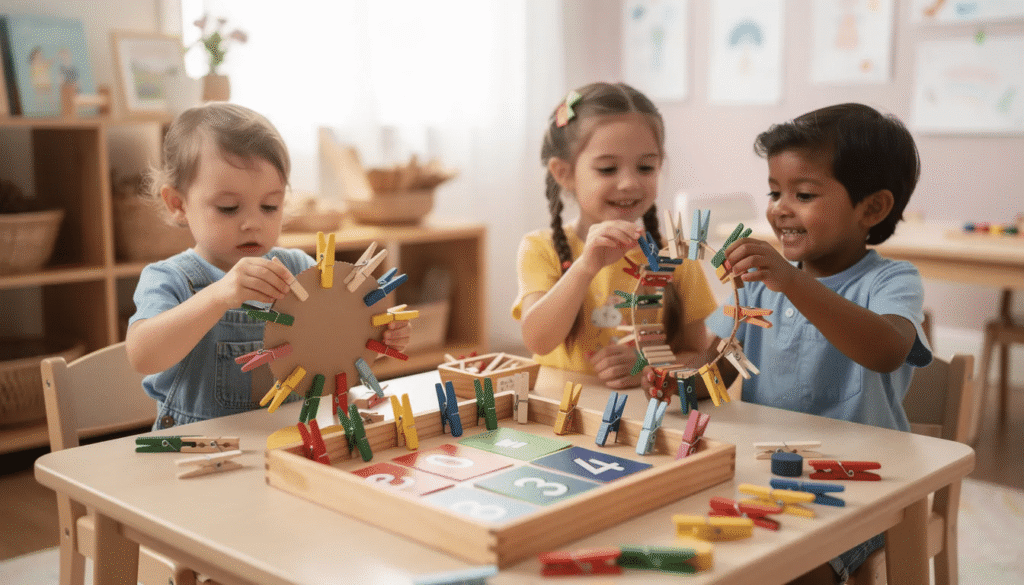
Set up games like clipping clothespins around the rim of a paper plate, along a piece of string stretched between two chairs, or onto your child’s clothing to make a “silly outfit.”
Pinching clothespins with the thumb and index finger (or middle finger) strengthens the same muscles used for scissor skills and pencil grasp. You can have your child attach clothespins as a game, and the repetition builds endurance.
Ways to extend the activity:
- Sort clothespins by color
- Match lettered clothespins to alphabet cards
- Create a pretend “clothesline” for doll clothes
Wooden spring clothespins offer more resistance for a greater strength challenge. Plastic ones work well for beginners or younger children who need an easier starting point. Either way, this activity supports independent dressing skills as children develop the finger placement needed for fasteners.
Sidewalk Chalk and Vertical Surfaces
Use thick sidewalk chalk outside or chunky crayons on an easel, chalkboard, or vertical whiteboard indoors. Drawing on a vertical surface is different from working on a flat table—and that difference matters. The right tools make a big difference, so consider choosing from the best art supplies for young artists.
When children draw on a vertical surface, their wrist naturally extends, and their shoulder works harder to stabilize the arm. This position builds the foundations for mature handwriting posture and makes holding a writing tool more comfortable over time.
Simple drawing prompts:
- Trace around hands
- Draw big roads for toy cars to drive on
- Make hopscotch grids
- Copy basic shapes and letters
The best part? Chalk washes away, making it a low-pressure way for kids to practice pre-writing strokes without fear of “mistakes.” This is perfect for children who get frustrated with pencil-and-paper tasks.
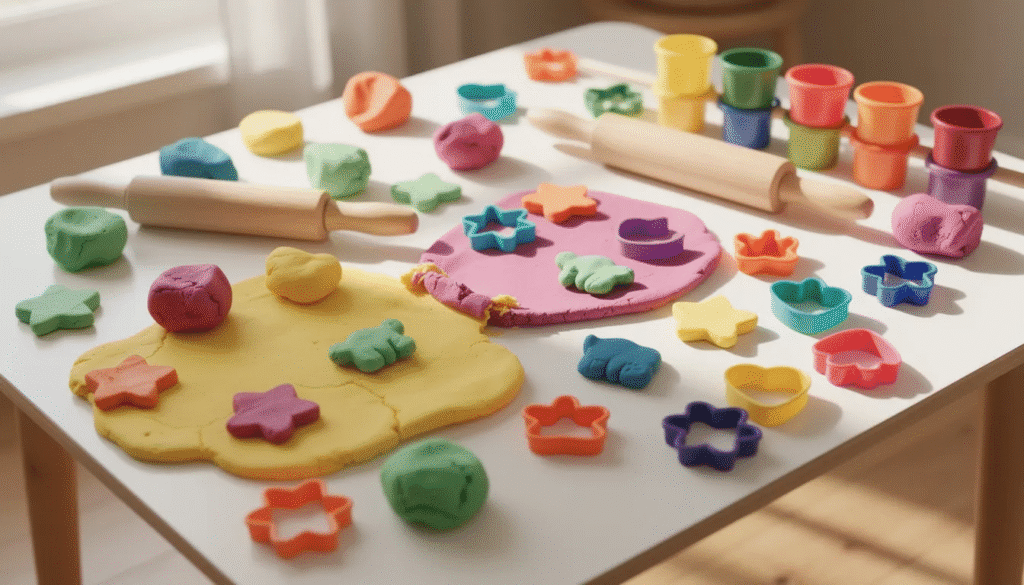
Play-Dough, Putty, and Dough Activities
Play dough is an ultimate child favorite for good reason. Invite children to roll snakes, pinch “pizza crusts,” press cookie cutters, and hide small toys like plastic animals or buttons inside dough to dig out. You can also weave in pretend scenarios drawn from engaging activities for imagination to boost creative thinking while they play.
Kneading, rolling, and pinching build hand strength and finger dexterity. These skills transfer directly to snapping buttons, opening containers, and manipulating small objects throughout the day.
You can use store-bought play dough, homemade salt dough, or even real cookie dough for an edible version. Just establish simple safety rules—no eating non-food dough, and wash hands after play.
Add tools like plastic knives, rolling pins, and child-safe scissors to practice graded pressure and bilateral coordination. Rolling balls of dough between the palms is especially good for overall fine motor development.
Fine Motor Precision Activities (Targeted Hand Control)
Fine motor precision is the ability to move fingers and hands accurately and efficiently toward a small target. Think of threading a needle, placing a puzzle piece, or writing neatly on lines.
This precision supports writing within lines, fastening buttons, manipulating small game pieces, and using utensils accurately. It’s what allows for efficient and targeted movement rather than overshooting or missing the mark.
The next few ideas—mazes, pegboards, and tiny beads—are best suited for older preschoolers and early school-age children (roughly 4-7 years). These fine motor precision activities build on the foundational skills developed through the earlier hands on play.
Keep sessions playful and brief—5 to 15 minutes is plenty. This prevents hand fatigue and keeps motivation high. You can add fine motor fun to daily routines without making it feel like work.
Tracing Paths, Mazes, and Simple Lines
Use printable mazes or draw your own wide “roads” on paper. Have your child visually track the path first, then trace it with a finger, marker, or toy car.
Staying inside the paths builds visual-motor integration and pencil control—exactly what children need for writing on lines in kindergarten and first grade. This is one of the more therapist approved activities for pre-writing preparation.
Progression suggestions:
- Start with finger-tracing on laminated sheets (wipe clean and repeat)
- Move to thick markers or chunky crayons
- Graduate to regular crayons or pencils as control improves
Other ideas include connecting dots, tracing around stencils, or following pre-drawn shapes like circles, squares, and figure-eights for variety. These help foster fine motor efficiency through repetition.
Pegboards and Lite-Brite-Style Toys
Classic pegboards with large pegs work well for younger children, while smaller pegs or light-up peg toys provide more challenge for older kids.
Picking up and accurately placing pegs strengthens the pincer grasp and improves hand-eye coordination. The repetitive motion also builds muscle memory—boosting muscle memory for similar precision tasks.
Try copying simple patterns: rows by color, alternating colors, or creating basic pictures. This adds visual sequencing and early math concepts to the fine motor practice.
Reserve tiny pegs for children who no longer mouth objects, and always supervise their use. The combination of precision and attention required makes this one of the awesome fine motor activities for focused practice.
Small Beads, Buttons, and Perler-Style Beads
Progress from chunky wooden beads to medium plastic beads, then to tiny fuse or Perler-style beads placed on pegboards. Coin and bead sorting activities—like sorting by coin or bead color—add another layer of challenge.
Handling very small items challenges precision, finger isolation, and sustained attention. It’s also excellent for improving finger isolation—the ability to move one finger independently while others stay still.
Tips for success:
- Start with simple stripe patterns
- Use shallow trays to contain beads and reduce mess
- Follow visual pattern cards for added cognitive practice
The added benefit of following a visual pattern supports visual perception and planning, skills that transfer to reading, math, and other academic tasks.
Cutting on Lines and Using Glue on Targets
Introduce scissor skills with a clear progression to improve scissor skills over time:
Scissor Skills Progression Table
Stage | Activity | Skills Targeted |
|---|---|---|
1 | Snipping straws or play dough “snakes” | Opening/closing scissors |
2 | Cutting along thick straight lines | Bilateral coordination |
3 | Following wavy lines | Visual tracking |
4 | Cutting simple shapes | Motor planning |
Scissors work trains bilateral coordination—one hand cuts while the other turns the paper. This strengthens the radial side of the hand (thumb side), which supports pencil grasp.
For glue activities, have children place dots of glue inside small circles or trace a line of glue along a path before adding paper pieces. This targets precision and graded pressure.
Introduce safety scissors around age 3-4 with close supervision and clear rules about what can and cannot be cut (paper yes, hair and clothes no!).
Puzzle Piece Placement and Construction Toys
Start with 2-12 piece wooden puzzles with knobs for younger children. These knobs are perfect for developing the same grasp used with a preferred board book’s pages. Progress to cardboard jigsaw puzzles with interlocking pieces for older kids.
Rotating, flipping, and pressing puzzle pieces into place develops fine motor accuracy and graded pressure control. Children learn to adjust how hard they push based on feedback—not too hard, not too soft.
Small construction toys like Duplo, LEGO, or magnetic tiles also fit here. They require precise placement and push-pull movements that strengthen the child’s hands while building spatial awareness.
Gradually increase piece counts and complexity as tolerance and skill improve. This step by step project approach prevents frustration while continuously challenging development.
Fine Motor Strength Activities (Building Hand Power)
Fine motor strength is the ability of small hand muscles to exert enough force for tasks like squeezing toothpaste, opening lunch boxes, or snapping snaps. Without adequate strength, children tire quickly during coloring, writing, and tool use.
Strong hands support better endurance for all fine motor activities. A child with good hand strength can color an entire picture, write their name, and cut out a shape without their hand getting tired or crampy.
Activities in this section often feel like “heavy work” for hands: squeezing, pinching, pulling, pressing, and twisting. These movements improve fine motor strength by challenging the muscles to work harder than typical daily activities require.
Mix strength activities with precision tasks to create a well-rounded routine that addresses overall fine motor development for preschool and early school-age children.
Syringes, Eye Droppers, and Squirt Bottles
Fill small cups with colored water and have children use clean medicine syringes, turkey basters, or eye droppers to transfer water between containers. Dropping colored water onto coffee filters creates beautiful art while building hand power.
Repeated squeezing strengthens the intrinsic muscles of the hand and improves grip endurance. These are the same muscles that let children hold a pencil without fatigue.
Outdoor variation: Squirt-bottle painting on fences, sidewalks, or easel paper combines bigger body movements with targeted hand strength work. Children love the satisfying spray of colored water.
Safety note: Use only clean, non-medicated syringes and supervise to prevent squirting into eyes. Dollar stores often carry packs of plastic syringes in the craft section.
Hole Punchers, Staplers, and Office-Style Tools
Child-safe single-hole punchers make satisfying confetti while building serious hand strength. Supervised use of low-resistance staplers to make simple books adds variety and purpose.
These tools require significant squeezing and coordination, boosting both strength and motor planning. The resistance is higher than most toys, providing a true fine motor strengthening challenge.
Structured project ideas:
- Make confetti for a celebration
- Create shape garlands by punching along lines
- Punch holes in paper plates to lace with yarn
- Staple pages to make tiny books or coupon booklets
Close adult supervision and clear rules are essential when using any tool with metal parts. But the payoff in hand strength is worth the extra attention.
Kitchen and Baking Activities
Involve children in making simple recipes where they knead dough, press toppings, and roll with a small rolling pin. Pizza, cookies, and bread all offer excellent opportunities.
Pushing, rolling, and pressing food strengthens hands and fingers in a meaningful, real-world context. Children are more motivated when they see the functional task leading to something delicious.
Kitchen tasks that build strength:
- Tearing lettuce for salad
- Snapping green beans
- Stirring thick batter
- Opening and closing plastic containers
- Spreading jam or butter with a kid-safe knife
- Scrubbing vegetables with a brush
This approach provides dual benefits: fine motor practice and practical life skills that support independence. It’s also a natural way to incorporate fine motor work into your child’s therapy program if you’re working with an occupational therapy provider.
Outdoor “Heavy Work” for Hands
Getting outside offers unique opportunities to build hand strength with natural materials, including simple nature stick crafts for kids:
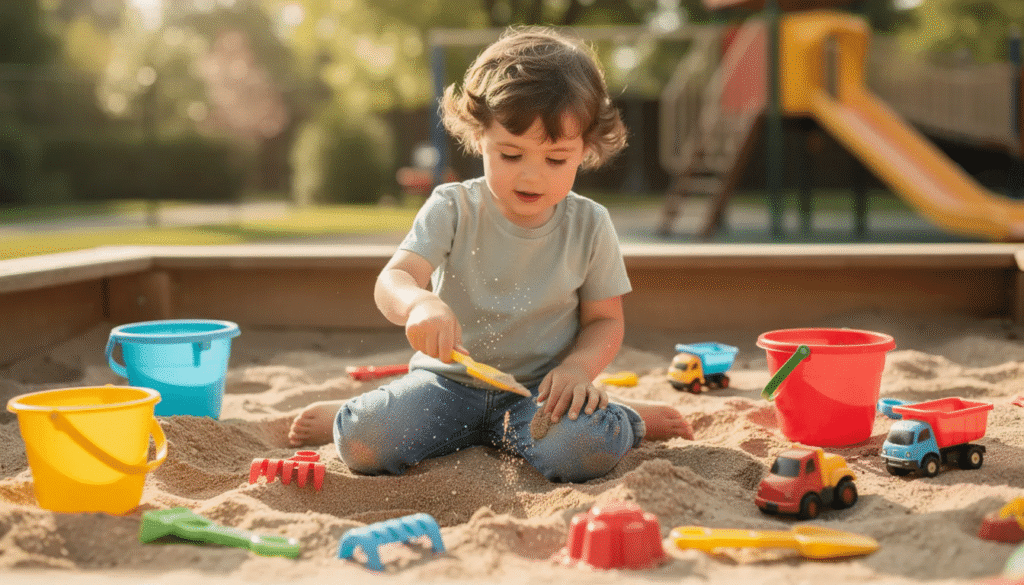
- Digging in a sandbox with small shovels
- Collecting and stacking sticks
- Squeezing spray bottles to water plants
- Pinching clothespins onto an outdoor line
- Pulling weeds from the garden
Sand, dirt, and natural materials provide resistance that builds strength and offers extra sensory feedback. The varied textures engage children differently than indoor toys.
Seasonal ideas:
- Raking small piles of leaves in fall
- Pressing snow into balls in winter
- Using child-sized garden tools in spring and summer
Let kids get messy within reasonable boundaries. The engagement and effort increase dramatically when children can dig, squish, and squeeze without worrying about keeping clean.
Fine Motor Games and Toys That Don’t Feel Like “Work”
Board games and classic toys are a sneaky way to practice fine motor skills while children focus on fun and social interaction. When a child is trying to beat their sibling at a classic game, they don’t realize they’re also working on hand strength and coordination. For social play that targets similar skills, you can also try these engaging group activities for 5-year-olds.
Here are favorite fine motor activities disguised as play:
Game/Toy | Fine Motor Skills Targeted |
|---|---|
Connect 4 | Dropping discs, pincer grasp |
Jenga | Carefully one stick at a time, graded pressure |
Operation-style games | Tweezer use, precision |
Mancala | Scooping small stones, in-hand manipulation |
Mr. Potato Head | Pushing parts, bilateral coordination |
LEGO/Duplo | Pressing, pulling, finger strength |
Kerplunk | Pulling sticks, visual motor coordination |
Choose age-appropriate versions—larger pieces for younger kids, smaller pieces for older ones—to balance challenge and safety. Fine motor skills games work best when they’re fun enough that children ask to play again.
Build short play “doses” into family routines: one round after dinner, a quick game on weekend mornings, or a few minutes while waiting for a sibling’s appointment. These fine motor games become habits rather than chores.
Board and Tabletop Games
Connect 4 requires dropping discs accurately into narrow slots—excellent for precision and release control. Jenga demands steady hands and graded force to remove blocks without toppling the tower. Operation-style games use tweezers for ultimate precision challenges.
Kerplunk involves carefully one stick removal at a time while watching for falling marbles. Mancala develops in-hand manipulation as children scoop and distribute small stones across the board. Each game requires accurate grasp, controlled release, and graded force—all key aspects of fine motor control.
Adaptations:
- Make larger homemade pieces for younger children
- Add time challenges for older kids
- Play cooperatively instead of competitively to reduce frustration
Keep a small selection of fine motor-heavy games within easy reach to encourage frequent, low-pressure use. When games are visible and accessible, children are more likely to choose them independently.
Classic Toys for Fine Motor Practice
Some of the best fine motor toys have been in homes and classrooms for decades:
- Mr. Potato Head: Pushing parts into holes builds bilateral coordination and improves finger isolation
- Building blocks: Stacking and balancing develops hand-eye coordination and graded pressure
- LEGO-style bricks: Connecting and pulling apart builds finger strength
- Nesting cups: Stacking and fitting requires visual-spatial skills and precision
- Lacing cards: Slowly threading laces practices bilateral coordination and patience
Rotate toys every few weeks to keep novelty high. Different toys challenge different skills, so variety across the month creates well-rounded development.
You don’t need expensive specialty items. These classic toys prove that simple is often most effective. Let your child’s journey begin today with whatever you already have on hand.

When to Watch, When to Support, and When to Seek Help
Children develop fine motor skills at different rates, and occasional clumsiness or disinterest in certain tasks is completely normal. Just as children hit developmental milestones for walking and talking at different ages, fine motor development varies too.
Signs that extra support may be helpful:
- Persistent difficulty using utensils by around age 3
- Avoiding drawing, coloring, or other fine motor activities by preschool age
- Trouble manipulating buttons or zippers by kindergarten
- Noticeable fatigue or complaints of tired hands during writing or coloring
- Significantly behind peers in cutting, drawing, or self-care tasks
Practical home strategies:
- Offer 5-10 minutes of fine motor play most days
- Model tasks slowly while talking through steps
- Break complex tasks into smaller parts
- Celebrate small progress rather than expecting perfection
- Choose activities that match your child’s interests
If you have ongoing concerns—especially if delays affect dressing, feeding, or school participation—talk with your child’s pediatrician, teacher, or an occupational therapy professional. Early intervention tends to be more effective than waiting, and therapists can design a customized program specific to your child’s needs.
Summary: Building Fine Motor Skills Through Everyday Play
Fine motor skills are built gradually through daily play, practical chores, and simple games. There’s no need for expensive equipment or rigid practice schedules.
- Activities like stickers, stringing, water play, dough, cutting, puzzles, and board games can be woven into routines at home or in preschool
- Most effective practice happens naturally through a child’s everyday routine rather than formal “therapy sessions”
- Adapting materials to your child’s age and interests keeps motivation high
- Mixing strength, precision, and coordination activities creates well-rounded development
Choose 2-3 activities from this article to try this week. Start with whatever materials you have on hand and whatever seems most appealing to your child. Watch what captures their attention and build from there.
Consistent, playful practice is usually more effective than drills or forced repetition. When fine motor work feels like fun, children engage longer and try harder—and that’s when real progress happens. Support is available if concerns persist, but for most children, these favorite fine motor activities will develop fine motor skills naturally over time.