
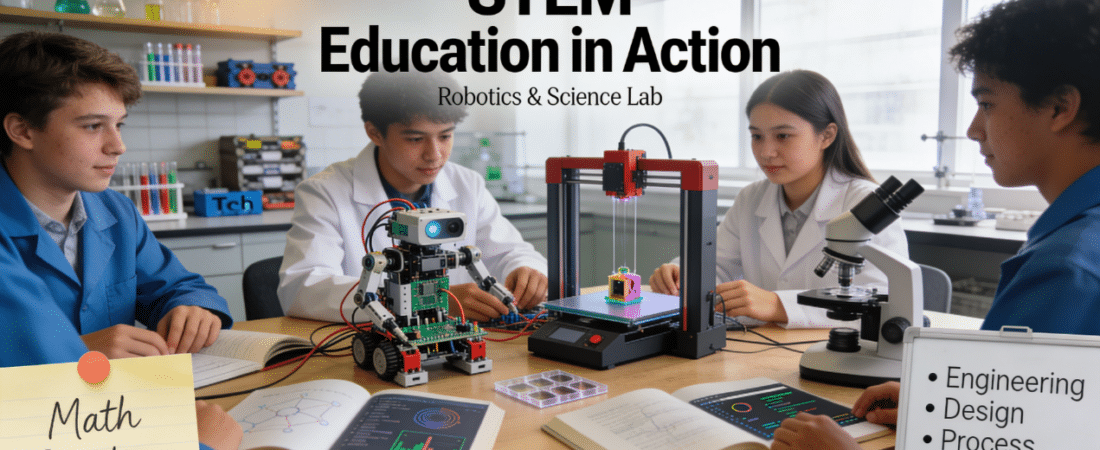

Finding the right example of stem education can transform how your students engage with science, technology, engineering, and mathematics. Whether you’re teaching younger learners or high school students, practical classroom activities make abstract concepts tangible and memorable.
This guide is designed for teachers and educators looking for practical STEM activities for their classrooms. Practical examples help bridge the gap between theory and real-world application, making STEM learning more engaging and effective.
Quick answer: what are concrete examples of STEM education?
STEM education examples include robotics projects, coding lessons, engineering design challenges, science experiments, and real-world problem-solving units. These activities integrate all four disciplines through hands on learning that prepares students for complex problems they’ll encounter in life and future careers.
Here are five specific stem education examples you can adapt for your classroom:
- Grade 5 earthquake tower challenge: Students build structures using spaghetti and marshmallows, then test them on a shaking tray to learn about structural engineering and physics
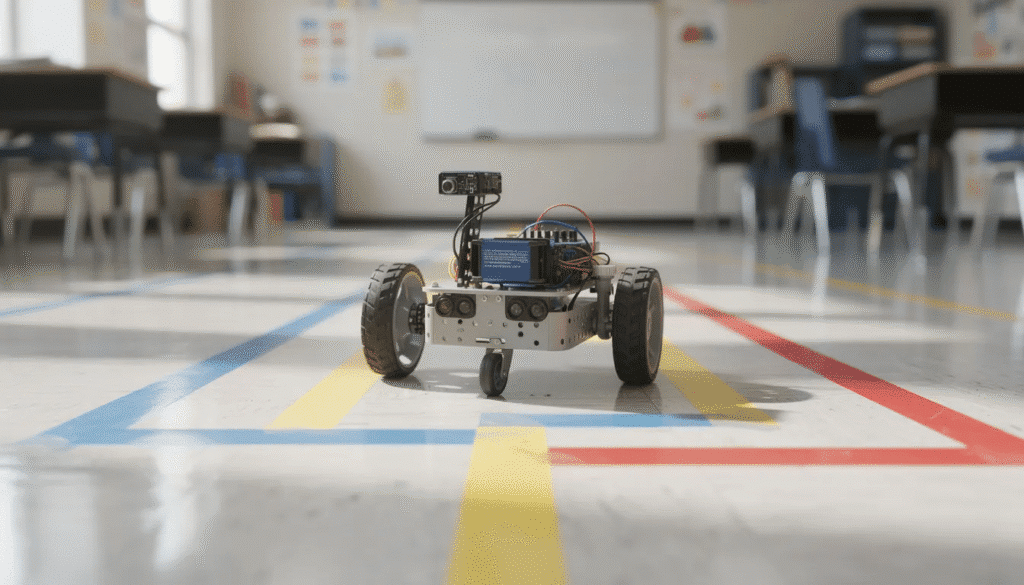
- Middle school robotics club: A 2024 program where students learn programming robots to follow lines and avoid obstacles using sensors and algorithms
- High school solar charger project: Students design and build phone chargers powered by renewable energy, applying electrical engineering and mathematics
- Primary coding unit: Using Scratch to simulate the water cycle, reinforcing both science concepts and computational thinking
- Environmental monitoring project: Students measure local air quality using low-cost sensors, then analyse data with spreadsheets
These examples integrate science, technology, engineering, and maths in collaborative, hands on activities that spark curiosity and build essential skills. The rest of this article breaks down these and other examples in detail, giving you more ideas teachers can adapt immediately for their classrooms.
What is STEM education and why does it matter?
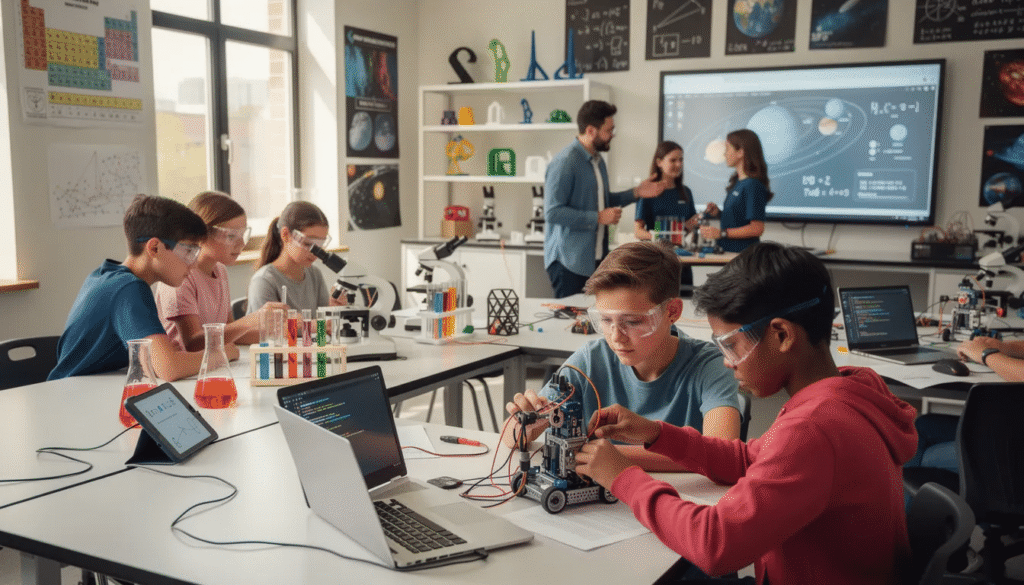
STEM education is an interdisciplinary approach that combines science technology engineering and technology engineering and mathematics in real world, project based learning experiences. Rather than teaching these stem subjects in isolation, this stem approach connects them through authentic problems that mirror how professionals actually work.
STEM stands for:
- Science: the study of the natural world
- Technology: the use of tools and systems to solve problems
- Engineering: the design and building of structures, machines, and systems
- Mathematics: the study of numbers, patterns, and relationships
- STEM goes beyond memorisation to develop critical thinking, creativity, and problem solving skills that students need across all areas of life
- This approach recognises that complex problems in the modern world don’t fit neatly into single subjects—solving them requires drawing on multiple stem disciplines
- In a tech-driven world shaped by artificial intelligence, renewable energy, and data science, stem skills have become foundational knowledge for nearly every career path
- Governments and organisations worldwide have pushed stem programs since the early 2000s—the national science foundation in the US and similar bodies globally have invested heavily to address workforce skills gaps
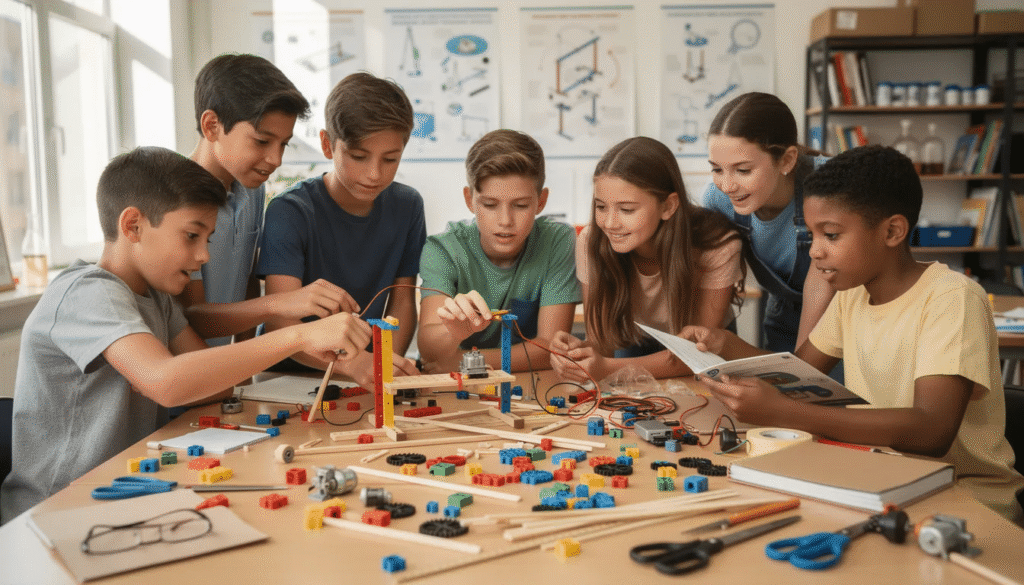
Real-world relevance in STEM classrooms
Strong stem education examples connect abstract concepts to everyday life, helping students understand why what they’re learning matters beyond the classroom. When students see stem in transportation, healthcare, communication, and climate issues around them, engagement naturally increases.
Consider these activities that bring real world applications into your lessons:
- Paper rocket trajectories: Students calculate the launch angle and force needed to achieve maximum distance, then test their predictions on the school field
- Energy comparison spreadsheets: Using real electricity bills, students compare the cost and energy use of LED versus incandescent bulbs over a year
- Classroom temperature monitoring: Using micro:bit sensors, students collect and graph temperature data throughout the school day
- School problem app prototype: Students identify a genuine school issue and sketch a simple mobile app solution, considering user needs and technical requirements
Tasks work best when they use real local data—weather from your city in 2024, local air quality reports, or water usage statistics from your community. This authenticity helps young minds see that stem learning connects directly to the world they live in.
STEM skills for tomorrow’s careers
Today’s students will graduate around 2035-2040 into a workforce that looks dramatically different from today’s. Building stem skills now prepares them for specific careers and fields that are growing rapidly.
Current and emerging fields where students will need strong stem foundations include:
- Artificial intelligence and machine learning
- Cybersecurity and information technology
- Renewable energy engineering
- Biotechnology and medical research
- Space technology and exploration
- Environmental science and climate adaptation
Good classroom examples deliberately build skills such as data literacy, computational thinking, teamwork, and resilience when experiments fail. Labour market projections consistently show stem careers growing faster than average through the 2020-2030 decade.
The goal isn’t just preparing students for stem fields—it’s equipping them with technical skills and problem solving abilities that transfer to any career they choose.
Equity and access in STEM examples
Powerful stem activities can work in both high-resource and low-resource schools. You don’t need expensive labs or the latest equipment to run rich stem programs that tackle real world challenges.
Examples using everyday materials make stem accessible to all schools:
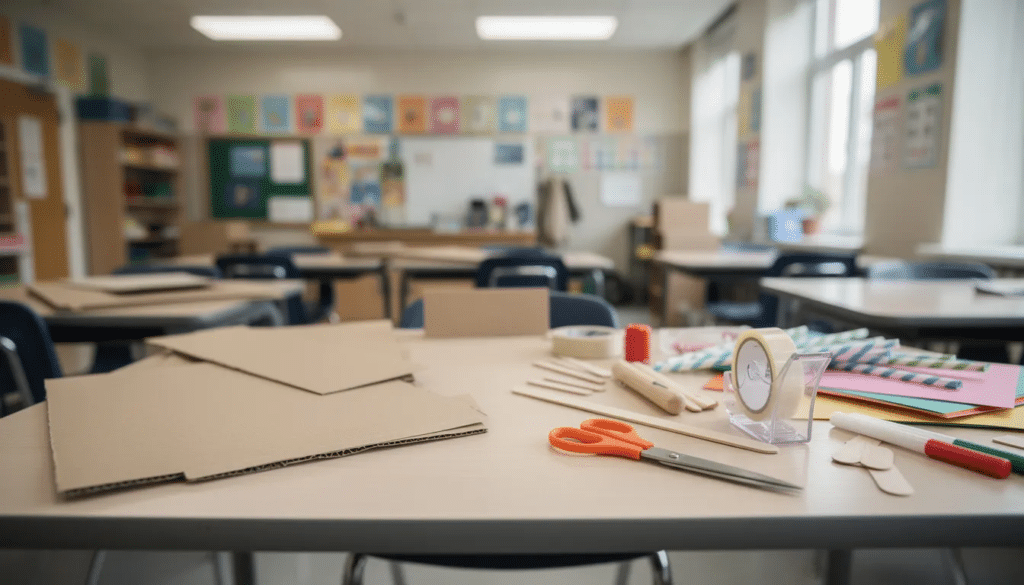
- Cardboard, plastic bottles, tape, and string form the basis of countless engineering challenges
- Free coding tools like Scratch require only basic computers or tablets
- Science experiments can use household items for chemistry and physics investigations
- Simple machines can be built from recycled materials found in any community
Projects that widen access deserve special attention: community engagement through coding clubs in rural areas, girls-only robotics teams to increase representation, and after-school stem clubs in underserved areas all help more students benefit from these learning opportunities.
Inclusive examples actively invite participation from students with different backgrounds, languages, and abilities. When you design activities with multiple entry points and varied ways to demonstrate understanding, more young students can engage at their own pace and find success.
Classroom examples of STEM education projects
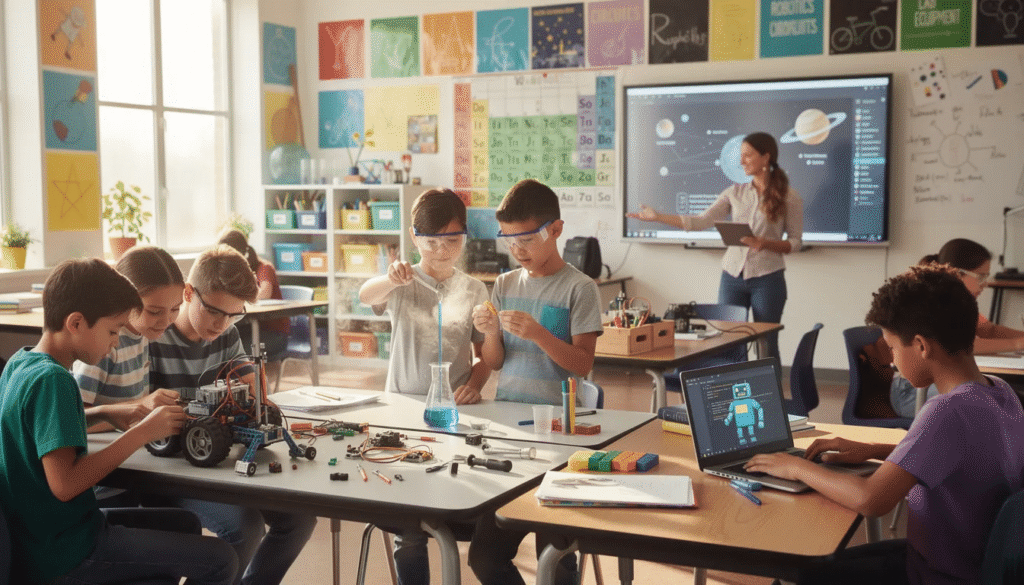
This section provides concrete, classroom-ready examples of stem education arranged by activity type. Each example mentions approximate grade level and the stem disciplines involved, so you can quickly identify what works for your context.
The sub-sections cover four core categories:
- Robotics projects combining coding, engineering, and mathematics
- Coding and programming lessons using accessible tools
- Engineering and building challenges with physical materials
- Science experiments enhanced with technology and data analysis
Robotics projects as STEM examples
Robotics combines coding, engineering design, maths, and problem solving into a single compelling activity. When students build and program robots, they learn to think systematically while getting immediate feedback on their decisions.
Example 1: Line-following robot challenge
A Year 7 class in 2024 uses LEGO Spike or VEX IQ kits to build robots that follow a line and avoid obstacles on a taped maze on the classroom floor. Students must:
- Design a stable chassis that can navigate turns
- Program sensors to detect the line and respond to obstacles
- Calculate wheel speeds and turning angles using mathematics
- Test, debug, and iterate on their solutions
Example 2: Classroom mail delivery robots
A primary school robotics club programs simple robots to deliver “mail” between classrooms. Students calculate distances and angles, program movement sequences, and solve unexpected problems when robots encounter obstacles.
What students learn through robotics:
- Algorithm design and computational thinking
- Sensor operation and feedback loops
- Teamwork and project management
- Iterative testing and improvement processes
Schools without expensive kits can use virtual robotics simulators available free online. These platforms let students program virtual robots using the same logic and skills they’d apply to physical machines.
Coding and programming lessons
Coding is a highly accessible stem example using free tools and modest hardware. Even schools with limited technology budgets can implement effective programming lessons that build computer science skills.
Primary school example: Grade 4 students use Scratch to program an animated story demonstrating the phases of the Moon. They create characters, code movement sequences, and add narration—reinforcing both science content and logical thinking.
Middle school example: Students in 2023-2024 use Python via platforms like Trinket or Replit to analyse real datasets. A class might examine daily temperatures from their city, calculate averages, identify patterns, and create simple visualisations.
Microcontroller projects take coding into the physical world:
- Micro:bit projects where students program LEDs to display patterns
- Building a simple step counter that tracks movement
- Creating weather stations that log temperature and humidity
- Arduino-based projects for older students exploring sensors and motors
Coding examples should progress from visual blocks to text-based languages over several school years. Plenty of debugging practice teaches resilience—students learn that errors are normal and fixing them is part of the process.
Engineering and building challenges
Engineering challenges are hands on tasks where students design, build, test, and improve physical structures. These activities make abstract concepts concrete and let students experience the engineering design cycle firsthand.
Example 1: Earthquake tower challenge (Grade 5)
Students use spaghetti and marshmallows to design the tallest tower that survives a simulated earthquake on a shaking tray. The challenge involves:
- Understanding structural stability and triangulation
- Calculating base-to-height ratios
- Testing designs and recording failure points
- Redesigning based on evidence
Example 2: Paper bridge competition (Lower secondary)
Students design and test paper bridges to hold increasing weights. They use mathematics to calculate load distribution and span ratios, learning why certain shapes and configurations perform better than others.
Example 3: Wind turbine prototyping (2024 sustainability unit)
Students prototype simple wind turbines from cardboard and 3D-printed parts, measuring energy output with low-cost meters. This project connects engineering to renewable energy concepts and environmental awareness.
Each challenge follows an engineering design cycle:
- Ask: Define the problem and constraints
- Imagine: Brainstorm possible solutions
- Plan: Choose an approach and sketch designs
- Create: Build the prototype
- Test: Measure performance against criteria
- Improve: Refine based on results
Science experiments with a STEM twist
Strong stem science experiments integrate data collection, technology, and engineering elements rather than following cookbook procedures. The goal is creating opportunities where students think like scientists and engineers simultaneously.
Water quality investigation: Students test water quality in a local stream by measuring pH and turbidity. They use spreadsheets or simple coding to graph data, identify patterns, and propose filtration solutions based on their findings.
Mini greenhouse experiment: A climate-focused project where students build small greenhouses from recycled bottles and measure temperature differences over several days. They control variables, collect systematic data, and draw evidence-based conclusions.
Balloon-powered cars: A physics activity where students create simple vehicles, then use stopwatches and metre rulers to calculate speed and investigate friction. Different surface materials provide variables for comparison.
Key elements that make science experiments work as stem activities:
- Recording results systematically using technology
- Forming evidence-based conclusions
- Reflecting on experimental errors and limitations
- Proposing improvements or follow-up investigations
Real-world STEM success stories to inspire students
Real world stem innovations show students how classroom projects connect to impactful careers. When learners see that the skills they’re developing lead to genuine innovations solving real problems, student engagement increases dramatically.
This section showcases recent innovations from the past decade that students can research and discuss. Teachers can use short case studies, videos, or news articles as reading and discussion prompts that connect back to classroom activities.
3D-printed houses and sustainable construction
Companies in Texas and elsewhere have used large-scale 3D printers since the early 2020s to build affordable homes more quickly and with less waste. These projects demonstrate stem disciplines working together on a significant social challenge.
The technology draws on multiple areas:
- Engineering design for structural integrity
- Materials science for printable concrete formulations
- Computer modelling and CAD software for precise planning
- Mathematical calculations for costs, timelines, and material quantities
Classroom connection: Students can design small 3D-printed components using free CAD software like Tinkercad. Even without a printer, creating digital models teaches the same design thinking used in full-scale construction.
Discussion questions for students:
- How might 3D-printed housing reduce housing shortages?
- What role could this technology play in disaster recovery?
- What jobs might emerge in this industry by the time you enter the workforce?
Robotics and automation in industry
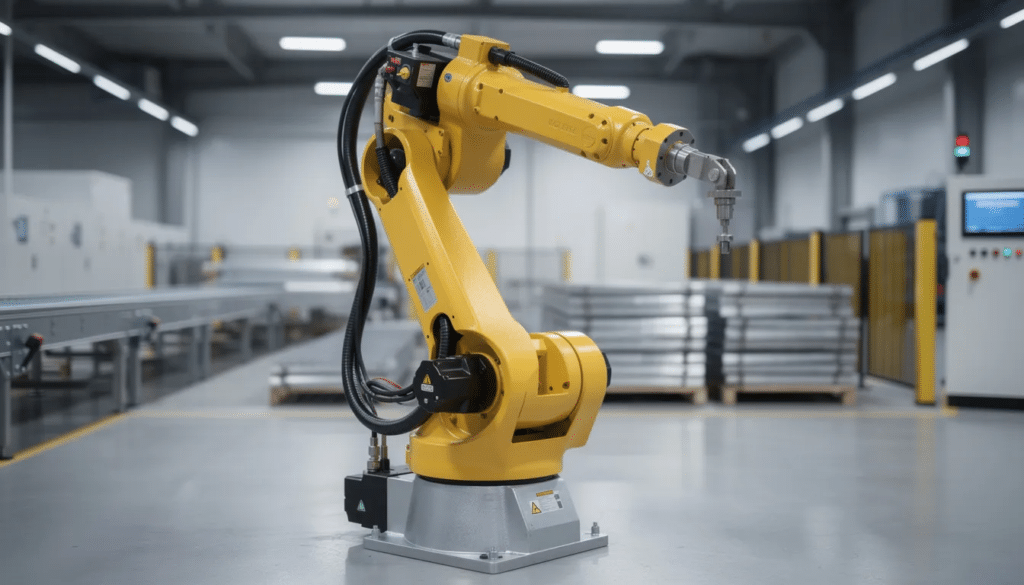
Industrial robotic systems now lay bricks on construction sites, weld components in manufacturing plants, and move packages through massive warehouses. These real world applications connect directly to classroom robotics activities.
Common ideas linking school and industry robotics:
- Sensors detect position, obstacles, and environmental conditions
- Programming determines how systems respond to inputs
- Optimisation improves efficiency over multiple iterations
- Feedback loops allow real-time adjustments
Suggested activity: Students analyse a short video of an industrial robot performing a task, then sketch a simplified classroom version. They identify sensors, actuators, and decision points in the system.
Encourage discussion on benefits and challenges:
- How does automation improve efficiency and safety?
- What happens to workers when robots take over tasks?
- What ethical considerations should guide automation decisions?
This broadens critical thinking skills beyond technical aspects to consider social implications—essential preparation for students who will shape these technologies.
How STEM examples impact student learning
Well-chosen stem activities improve engagement, understanding, and long-term skill development. When students work on meaningful projects that challenge them appropriately, they develop both content knowledge and transferable capabilities.
Evidence-informed benefits of quality stem education include:
- Increased motivation and persistence, especially for students who struggle with traditional instruction
- Resilience and comfort with uncertainty when experiments don’t work as expected
- Deeper conceptual understanding that transfers to new situations
- Improved critical thinking skills that apply across subjects
Consider a class that initially dreaded mathematics—after a bridge-building project requiring load calculations, students suddenly saw purpose in the formulas they’d been memorising. That shift in attitude often persists long after the specific project ends.
Boosting engagement through hands-on work
Physical building and experimenting draw in students who struggle with textbooks alone. When students get their hands dirty with materials, code, or equipment, learning becomes immediate and tangible.
Activities like building simple circuits, coding games, or testing paper rockets keep attention by providing immediate feedback. Students see results—their circuit lights up, their code runs, their rocket launches—and that visible progress motivates continued effort.
Teachers often report:
- Fewer behaviour issues during practical stem sessions
- More on-task discussion and collaboration
- Higher participation from typically disengaged students
- Students voluntarily extending work beyond class time
Engagement peaks when projects have clear, achievable goals and visible outcomes by the end of a lesson or short unit. Breaking larger projects into milestones maintains momentum.
Building collaboration and communication skills
Most stem examples work best in small teams with defined roles. Group tasks require students to negotiate, share ideas, and divide responsibilities—skills that matter in virtually every career.
When designing group activities like robotics projects or science experiments, consider:
- Rotating roles (data recorder, designer, coder, presenter) so each student practises different skills
- Structuring tasks so success requires genuine collaboration, not parallel individual work
- Building in checkpoints where teams must explain their progress to others
- Creating opportunities for community engagement through presentations or demonstrations
Presenting final prototypes or results to peers, parents, or community members strengthens public speaking and reflection skills. When students know they’ll explain their work publicly, they think more carefully about their process and conclusions.
Making learning fun and memorable
Well-designed stem examples often feel like puzzles or challenges rather than traditional assignments. This reframing makes students excited about tackling problems.
Illustrative ideas that generate enthusiasm:
- A “Mars colony” design challenge where teams plan habitats for survival
- A timed bridge-building tournament with increasing weight requirements
- A coding hackathon week where students create simple games for each other
Enjoyable experiences increase long-term memory of concepts, especially when students connect success with effort and iteration. The student who finally gets their robot to complete the maze remembers the underlying principles far better than one who simply read about them.
Allow safe failure and multiple attempts. When students see mistakes as part of the design process rather than evidence of inadequacy, they take more creative risks.
Designing your own STEM education examples
You can adapt or design stem examples without needing advanced equipment or extensive training. Starting with materials already available and problems relevant to your students creates authentic learning opportunities.
Design should begin from a real world problem or question meaningful to your specific group. A school in a coastal area might focus on erosion and flooding; an urban school might tackle air quality or traffic; a rural school might explore sustainable agriculture.
Schools can gradually build a sequence of stem examples across year levels, increasing complexity over time. What begins as simple machines in early grades can evolve into sophisticated engineering projects by high school.
Step-by-step planning framework
Follow this framework when planning a new activity:
- Choose a real-world problem: Select an issue meaningful to students
Example: Classroom overheating in summer - Map concepts: Identify science and maths concepts involved
Example: Heat transfer, temperature measurement, data analysis - Select technologies: Choose appropriate tools for investigation
Example: Temperature sensors, spreadsheets, design software - Define the engineering challenge: Create a design task with constraints
Example: Design a cooling system using only recycled materials - Plan assessment: Determine how you’ll evaluate learning
Example: Performance criteria, process documentation, presentations - Reflect afterwards: Consider what worked and what to adjust
Example: Student feedback, observed engagement, learning outcomes
Write a short driving question to anchor the activity: “How can we keep our classroom cooler in summer without using more electricity?” This gives purpose to all the investigation and design work that follows.
Keep instructions clear but leave room for student creativity in how they approach the solution. Some of the best stem learning happens when students surprise you with innovative solutions you hadn’t considered.
Timing guidance:
- Mini challenges: 1-2 lessons
- Medium projects: 1 week
- Major units: 2-3 weeks
Low-cost tools and resources
Impactful stem examples don’t require advanced labs or expensive equipment. Many excellent activities use materials you already have.
Physical materials:
- Cardboard, string, tape, and recycled materials
- Basic electronics components (batteries, LEDs, wires)
- Household items for science experiments
- Educational toys that demonstrate simple machines
Free or low-cost digital tools:
- Scratch for visual programming
- Tinkercad for 3D design
- PhET simulations for science concepts
- Browser-based Python environments for data analysis
- Virtual robotics simulators
Start with what you already have access to and gradually add new tools as confidence and budgets grow. A single micro:bit or Arduino kit can support dozens of different projects over multiple years.
Conclusion: turning examples into everyday STEM practice
Concrete examples of stem education—robotics, coding, engineering challenges, and science investigations—transform learning from abstract concepts into relevant, engaging experiences. When students tackle real world challenges using the four disciplines together, they develop curiosity, confidence, and skills that serve them throughout life.
Teachers can start small, using simple materials and local issues, then build towards more complex projects as both teacher and students gain experience. You don’t need to overhaul everything at once.
Select one example from this article and adapt it for your next unit or term. Whether it’s a simple bridge-building challenge or a coding project using free tools, taking that first step matters more than getting everything perfect immediately.
Consistent, practical stem experiences help students develop the foundational knowledge and problem solving abilities they’ll need for whatever world they enter as adults. The young students in your classroom today will face challenges we can’t fully predict—but stem education gives them the adaptable skills to meet those challenges with confidence and creativity.