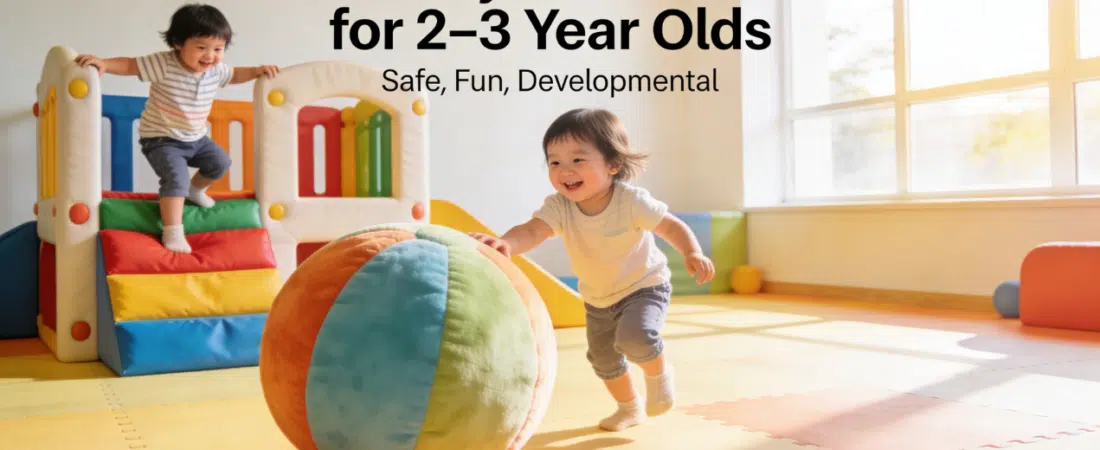

When the weather keeps you stuck inside or your backyard just isn’t an option, keeping your toddler active indoors becomes essential. This guide is for parents and caregivers of 2–3 year olds looking for fun and effective indoor physical activities. The good news? You don’t need fancy equipment or a huge playroom to get your 2–3 year old moving with indoor physical activities for 2–3 year olds. Staying active indoors is crucial for your toddler’s health, development, and happiness, especially when outdoor play isn’t possible. Physical activity for toddlers means any movement that gets their bodies moving, including running, jumping, climbing, and dancing. Toddlers need at least 180 minutes (three hours) of physical activity each day to support their development. This guide covers everything from quick no-prep games to calmer balance activities—all designed for typical home spaces using items you already own.
- Quick Ideas: 15 Easy Indoor Activities to Try First
- Why Indoor Physical Play Matters for 2–3 Year Olds
- Setting Up a Safe Indoor Play Space
- Big-Movement Indoor Games for Toddlers (Gross Motor Fun)
- Quiet(ish) Movement: Balance, Coordination, and Body Awareness
- Music, Dance, and Movement Games
- Indoor Games for Rainy Days, Small Spaces, and Low Energy Parents
- Adapting Activities for Different 2–3 Year Olds
- Closing Thoughts: Making Movement Part of Everyday Indoor Life
Quick Ideas: 15 Easy Indoor Activities to Try First
Here are some simple, no-fuss indoor physical activities for 2–3 year olds that you can start right away. These activities are grouped by type to help you find the best fit for your space and your child’s mood.
Movement Games
- Bubble chase: Blow bubbles and let your toddler pop them while walking, reaching, and stretching.
- Animal walks: Move like a bear, frog, or crab from one wall to another—excellent for large muscle groups and encouraging imaginative play activities that inspire creative thinking.
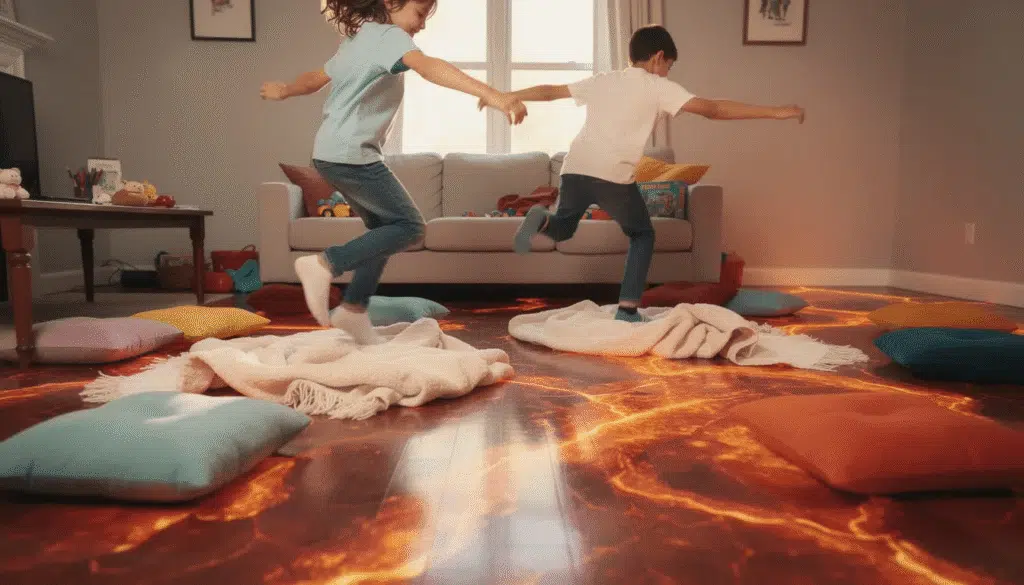
- Hot lava floor: Place soft objects like blankets and cushions as “safe zones” while the floor becomes pretend lava.
- Hide-and-seek (simplified): Take turns hiding and finding—keeps legs moving and builds problem solving skills.
- Rolling a soft ball: Sit across from your toddler and roll a ball back and forth for coordination practice.
Balance Activities
- Painter’s tape balance beam: Lay tape lines on the floor for heel-to-toe walking and balance practice.
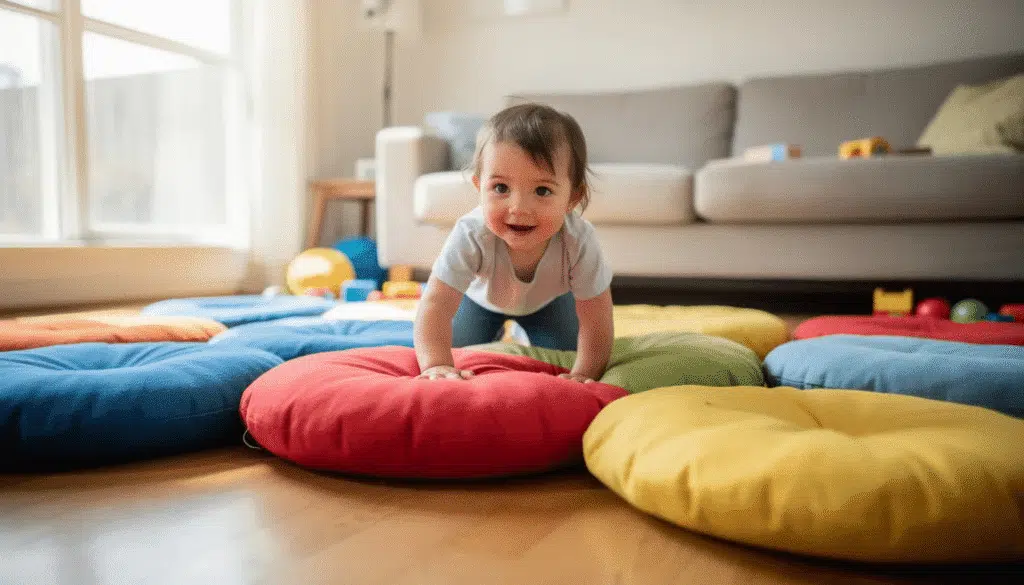
- Pillow stepping stones: Scatter pillows across the floor as “islands” for stepping and jumping practice.
- Simple yoga poses: Try downward dog, cat pose, and child’s pose for flexibility and body awareness.
Creative Play
- Scarf dancing: Wave kitchen towels or scarves to music for big arm movements and rhythm practice.
- Bean bag toss: Toss rolled up socks or bean bags into a laundry basket from a short distance—great for aim and arm strength.
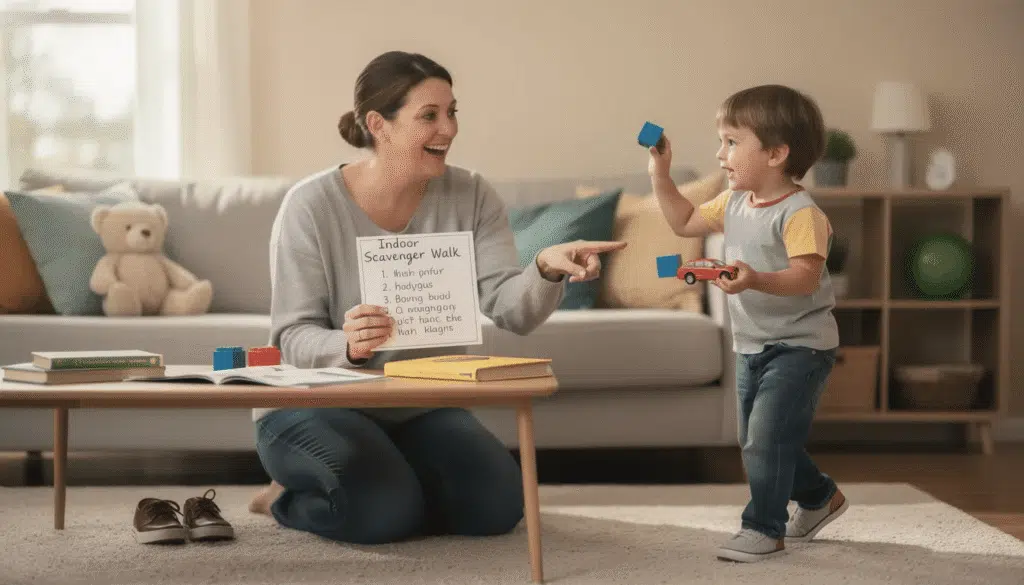
- Indoor scavenger walk: Ask your child to find and bring you specific objects from around the room.
Obstacle and Adventure Activities
- Balloon keep-up: Tap a balloon back and forth to build hand-eye coordination and keep kids moving without needing much space.
- Living room obstacle course: Use couch cushions, chairs to crawl under, and pillows to climb over—perfect for gross motor skills development.
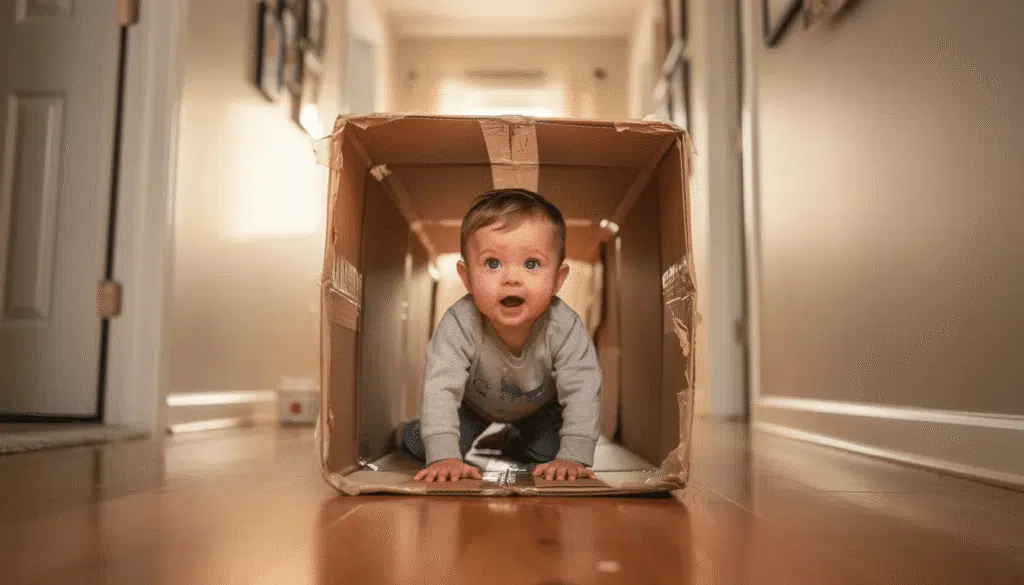
- Cardboard box tunnel: Line up boxes with the ends cut out for endless crawling, building core strength and spatial awareness.
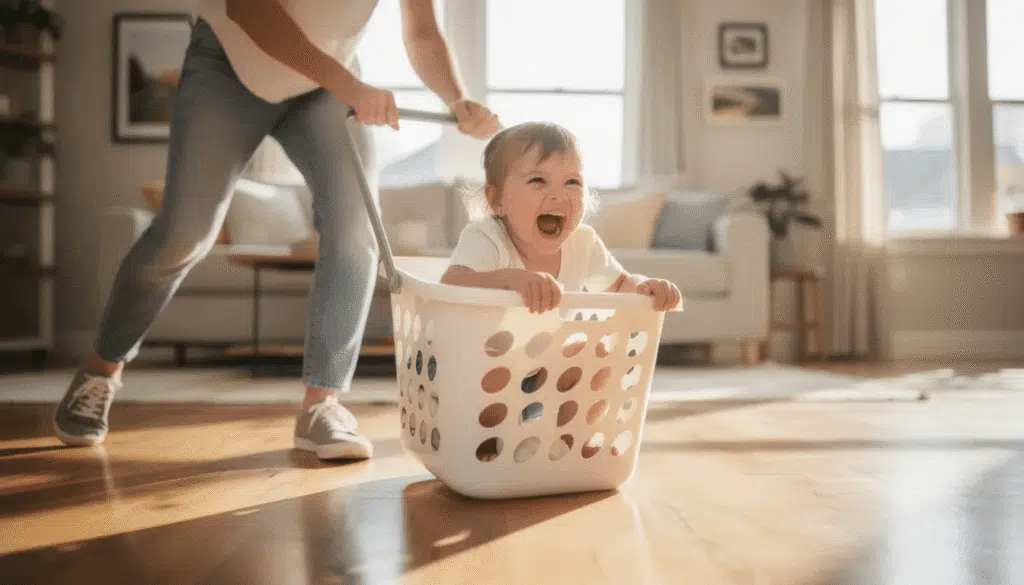
- Laundry basket rides: Pull your child across smooth floors in a basket for core stability and so much fun.
All these activities for toddlers work in apartments, small living rooms, and typical houses. You’ll use common items like cushions, painter’s tape, plastic cups, cardboard boxes, and laundry baskets—nothing to buy, nothing to assemble.
Now that you have some quick ideas, let’s explore why these activities are so important for your toddler’s development.
Why Indoor Physical Play Matters for 2–3 Year Olds
Physical activity is essential for overall health and well-being in toddlers and helps them develop gross motor skills, which involve large muscle groups and are crucial for balance, coordination, and strength. Gross motor skills are skills that involve large muscle groups and are crucial for balance, coordination, and strength. Physical activity for toddlers means any movement that gets their bodies moving, including running, jumping, climbing, and dancing. Toddlers need at least 180 minutes (three hours) of physical activity each day to support their development.
Key Benefits of Indoor Physical Activities for 2–3 Year Olds
Did you know?
Toddlers need at least 180 minutes of physical activity each day to support their development.
Physical activity helps develop gross motor skills, which are crucial for balance, coordination, and strength.
Regular movement supports healthy growth, better sleep, improved mood, and builds the foundation for lifelong healthy habits.
Physical Benefits
- Building gross motor skills: Running, climbing, jumping, and crawling develop the large muscle groups in legs, arms, and core that toddlers need for physical milestones.
- Supporting sleep and appetite: Active kids sleep better and eat better—burning excess energy during the day leads to calmer evenings.
Emotional Benefits
- Improving mood and reducing meltdowns: Physical activities help regulate emotions and reduce frustration that often leads to tantrums in this age group.
- Boosting attention and language: Active play supports brain development, helping with focus and even vocabulary growth through interactive games.
Matching Short Attention Spans
- This age group typically focuses for 5–10 minutes per activity, so indoor games should be simple, repeatable, and easy to reset quickly.
Every activity in this guide works for small spaces and can be adapted for both younger 2-year-olds (still mastering jumping and climbing) and older 3-year-olds (more coordinated and ready for extra fun challenges).
To make the most of these activities, it’s important to set up a safe and inviting play space indoors.
Setting Up a Safe Indoor Play Space
Creating a safe and engaging environment is key to successful indoor physical activities for 2–3 year olds. The concept of a “yes space” works perfectly for this age group. This means creating a corner of your living room or play area where most things are allowed to be climbed on, pushed around, or moved freely without constant “no” from adults.
Tips for Safe Play
- Clear sharp-edged furniture: Move coffee tables with hard corners, or cover edges with foam bumpers during active play time.
- Secure rugs with non-slip pads: Prevent slipping and sliding by anchoring area rugs, or remove them entirely for movement sessions.
- Relocate fragile items: Put breakables on high shelves or in another room before starting any physical activities.
- Block stairs and exits: Use baby gates if needed to create boundaries for your safe environment.
- Supervise while allowing safe risk-taking: Stay close but let your toddler step between couch cushions or climb onto a low mat stack—this builds confidence and coordination.
For surfaces and props, consider laying down yoga mats, old duvets, or folded blankets to cushion falls. Tape lines on floors create instant pathways. Low stools, ottomans, and soft balls work better than hard toys during active indoor time.
Keep a “tidy bin” nearby for quickly tossing toys out of the movement zone. Being able to reset your play area in 1–2 minutes means you can switch between activities for kids without long cleanup breaks.
With your play space ready, you can dive into bigger movement games that help your toddler burn energy and build important skills.
Big-Movement Indoor Games for Toddlers (Gross Motor Fun)
These activities focus on large muscle groups—legs, arms, and core—and are perfect for burning energy when you need to keep kids active indoors. Each game uses everyday household items and can be set up in minutes.
Obstacle Courses and Adventure
- Indoor obstacle course: Build a simple obstacle course using couch cushions for climbing, a low table or chairs to crawl under, and a strip of painter’s tape as the finish line. This classic activity develops coordination, balance, and gross motor skills all at once. Keep paths clear and stay nearby to spot your toddler.
- Tunnel time: Set up a pop-up tunnel, or create your own by draping sheets over chairs or lining up cardboard boxes with ends removed. Crawling through tunnels repeatedly builds arm and leg strength while satisfying the toddler urge to explore enclosed spaces.
Animal and Movement Games
- Animal parade: Call out different animals and have your child walk like them across the room. Bunny hops build leg strength, bear crawls work arms and core, and frog jumps develop explosive power. Kids love pretending to be different animals, and you can make it a fun game by taking turns choosing creatures.
Ball and Balloon Play
- Balloon or beach ball keep-up: Use hands, paper plates as paddles, or a half pool noodle to keep a balloon in the air. This activity achieved over 50% moderate-to-vigorous activity time in studies with preschoolers—it’s genuinely effective exercise disguised as play.
- Indoor kick bowling: Line up empty plastic bottles or cardboard tubes, then let your child kick a soft ball to knock them down. This develops leg coordination, aim, and provides the satisfying crash that kids love without damage to your home.
Imaginative and Sensory Play
- Hot lava floor: Scatter pillows, folded blankets, and soft objects across the floor as “safe islands.” The carpet or hardwood becomes pretend lava that your toddler must avoid by stepping or jumping between safe zones. This builds balance, planning, and leg strength.
- Laundry basket adventures: Pull your child across smooth floors while they sit in a laundry basket—this “sled ride” challenges core stability as they balance against the motion. Alternatively, fill a basket with stuffed animals and let your toddler push it around the room for upper body strength work.
For younger 2-year-olds, shorten distances, slow the pace, and offer hand-holding during challenging movements. For nearly-3-year-olds ready for more, add simple rules, counting challenges, or time-based goals like “Can you crawl through the tunnel three times?”
After some big-movement fun, you might want to try quieter activities that still keep your toddler moving and learning.
Quiet(ish) Movement: Balance, Coordination, and Body Awareness
Not every indoor activity needs to be high-energy chaos. These calmer movement games build balance, coordination, and impulse control in 2–3 year olds while using limited space and keeping noise levels manageable.
Balance and Coordination Activities
- Painter’s tape balance beam: Create tape lines on your floor—start with straight lines, then try zigzag or curvy patterns as your child improves. Practice heel-to-toe walking, tiptoe steps, or walking sideways along the “beam.” This simple setup costs nothing and develops the same balance skills as actual gymnastics equipment.
- Stepping stone path: Arrange pillows or couch cushions as “stones” across a “river” (your floor). Your child walks slowly from stone to stone without “falling in.” This teaches careful foot placement and body awareness while keeping movement controlled.
- Bean bag balancing: Place a bean bag (or rolled up socks) on your toddler’s head, shoulder, or outstretched hand. Challenge them to walk from one wall to another without dropping it. This activity forces slow, controlled movement and builds concentration.
Listening and Following Directions
- Traffic light game: Call out colors—red means stop, green means go, yellow means slow motion. Your child practices walking, marching, or tiptoeing based on your commands. This is excellent for impulse control and following directions.
- Copy-the-leader movements: Stand facing your toddler and perform simple movements for them to copy: reach up high, touch your toes, spin once, hug your knees, squat like a frog, stand on one foot. This builds body awareness and the ability to translate visual information into physical action.
Target and Toss Games
- Target toss: Set up a laundry basket or cardboard box as a target. Have your child toss a soft ball or stuffed animals into it from a short distance—start very close and gradually increase the challenge.
These activities help 2–3 year olds learn where their body is in space, practice waiting and listening, and follow simple one-step and two-step directions. They’re perfect for when you need to keep your toddler moving but can’t handle a full dance party. For more focused hand-strength and coordination work, you can also try art activities to enhance fine motor skills in children.
Ready to add some music and rhythm? The next section brings movement and fun together with dance and song.
Music, Dance, and Movement Games
Toddlers respond naturally to music and rhythm. Combining songs with movement creates some of the most engaging developmental activities while easily helping you meet daily physical activity goals indoors.
Dance and Movement
- Simple dance party: Put on favorite songs and encourage jumping, spinning, clapping, and stomping. There’s no wrong way to do this—just play music and let your child move however they want. This unstructured play builds coordination and lets toddlers express themselves physically.
- Freeze dance: Dance freely while the music plays, then freeze like a statue when music stops. This fun twist on dancing teaches impulse control—the ability to stop your body on command—which is a crucial skill for this age group. Kids find it hilarious to catch each other moving during the freeze.
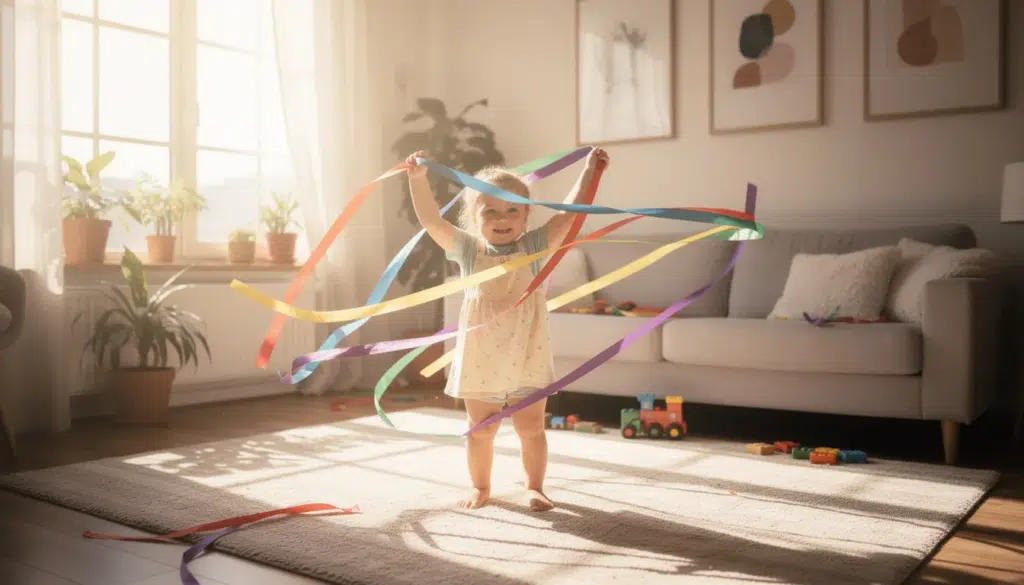
- Ribbon or scarf dancing: Tie kitchen towels or ribbons to wooden spoons, or just wave scarves freely. The flowing fabric encourages big arm movements, reaching, and full-body motion. This works well for children who prefer visual stimulation with their movement.
Action Songs and Yoga
- Action songs: Songs like “If You’re Happy and You Know It,” “Head, Shoulders, Knees and Toes,” and “Shake Your Sillies Out” combine music with specific movements. Exaggerate every motion—stomp loudly, clap dramatically, spin big. These songs teach body part recognition while keeping kids moving.
- Toddler yoga: Try 3–5 very simple poses: cat-cow (arching and rounding the back on hands and knees), child’s pose (kneeling with arms stretched forward), downward dog (hands and feet on floor with bottom in the air), and tree pose (standing on one foot briefly). Hold each for just a few seconds—that’s plenty for this age.
Marching and Parades
- Marching band parade: Grab pots, wooden spoons, simple shakers, or even plastic bottles filled with rice. March around the house making music while stepping high, tiptoeing quietly, or stomping loudly. This combines rhythm, coordination, and the novelty of moving through different rooms.
Each of these activities develops specific skills: rhythm and timing, coordination between hearing and moving, listening and following directions, imitation of demonstrated movements, and early self-regulation through starting and stopping on cue.
Keep playlists short—2–3 songs is usually enough for one session. This helps signal clear boundaries between “movement time” and “quiet time” for toddlers who thrive on routine.
If you’re looking for activities that require even less setup or energy, the next section is for you.
Indoor Games for Rainy Days, Small Spaces, and Low Energy Parents
Some days you’re exhausted, your apartment is tiny, or the weather has been awful for a week straight. These activities keep 2–3 year olds moving without requiring much energy from adults—you can even stay seated for most of them. If you also want ideas that avoid cleanup entirely, explore no-mess activities for 2-year-olds to keep them engaged.
Easy Movement and Scavenger Games
- Color find walk: Ask your toddler to find and bring you 3 red objects, then 2 blue objects, then 1 yellow object. They’ll walk back and forth across the room hunting for items while you rest on the couch. This fun game combines movement with color recognition and counting.
- Indoor scavenger hunt: Create a simple treasure hunt for everyday items—a spoon, a sock, a book with a dog on the cover, something soft. Your child walks or crawls room to room searching while you call out the next item from your seat.
- Hide the teddy: Hide one stuffed animal in easy-to-reach spots around the living room. Your toddler searches while you give “warmer/colder” hints. This keeps legs moving and builds problem solving skills without requiring you to move much.
Low-Energy Ball and Tunnel Play
- Rolling race: Sit on the floor across from your child and roll a soft ball or toy cars back and forth. Encourage your toddler to chase balls that go wide and bring them back. This works fine motor skills and gross motor coordination with minimal adult effort.
- Hallway runway: Clear a short hallway for walking fast, marching, or “airplane arms” running from one end to the other. You can sit at one end and time how fast they go, count repetitions, or just cheer them on.
- Chair tunnel crawling: Drape a blanket over dining chairs to create a tunnel. You stay seated nearby while your child crawls through again and again—toddlers find repetition fascinating even when adults find it tedious.
Ride-On and Push Toys
- Ride on toys indoors: If you have space and smooth floors, ride on toys or push toys provide excellent leg exercise with minimal adult involvement beyond occasional redirecting.
These activities work well in apartments where jumping and loud stomping might bother neighbors. They’re also perfect for keeping kids active during nap time for other kids in the house.
Rather than one long activity session, aim for 5–10 minute “movement bursts” throughout the day. This matches toddler attention spans and prevents the overtired meltdowns that come from pushing too long.
Next, let’s look at how to adapt these activities for different ages and personalities.
Adapting Activities for Different 2–3 Year Olds
Development varies enormously between age 2 and age 3. One child might be jumping confidently at 2, while another is still working on running smoothly. Some toddlers are cautious explorers, while others seem to have no fear at all. As your child grows, you may also be interested in engaging group activities for 5-year-olds to spark creativity and fun. Here’s how to adjust activities to match your specific child.
Younger Toddlers
- Shorten distances—walk across half the room instead of the whole space
- Offer hand-holding during any balancing or climbing activities
- Reduce the number of steps in any sequence
- Slow down the pace and allow plenty of time between movements
- Stay close enough to catch or support as needed
Older Toddlers
- Add simple rules and counting challenges
- Introduce time-based goals: “Can you hop to the wall before I count to ten?”
- Combine activities: animal walks through an indoor obstacle with jumping jacks at each station
- Let them help set up and modify courses
- Increase distances and add more complex movement patterns
Sensory Preferences
- Some children love big crashing movements—let them jump into piles of couch cushions and pillows
- Others prefer gentle, predictable routines—stick with the same few calming activities
- Sensory bins with rice or beans can add tactile elements to movement breaks
- Sensory play that involves pouring and scooping builds fine motor skills while keeping kids engaged
Watch for signs of tiredness or overstimulation: tripping more than usual, crying easily, refusing activities they normally enjoy, or becoming hyperactive rather than appropriately energetic. When you see these signs, switch to calmer movement or snuggle time with a book.
If you have concerns about gross motor milestones—such as a child not walking by close to 18 months, or not attempting to jump by around 2½–3 years—check in with your pediatrician or ask for a referral to a pediatric physical therapist. Early intervention makes a significant difference when there are developmental concerns.
With these adaptations, you can ensure every toddler gets the most out of indoor physical activities, no matter their age or temperament.
Closing Thoughts: Making Movement Part of Everyday Indoor Life
Indoor physical activities don’t require special equipment, a dedicated playroom, or hours of preparation. A few couch cushions, some painter’s tape, a laundry basket, and household items you already own can keep your 2–3 year old active through any weather or living situation.
The key is consistency over perfection. Aim for multiple short bursts of active play throughout the day—mixing high-energy games when your toddler has excess energy, calmer balance activities when things need to settle down, and music-based movement when everyone needs a mood boost. Outdoor physical activities are wonderful when possible, but staying active indoors matters just as much for your child’s development.
Pick 3–4 favorite activities from this guide, rotate them through the week, and stay active alongside your child when you can. Follow their lead when they invent new variations or combine games in unexpected ways—that creative, child-led exploration is exactly what supports healthy development.
And remember: a “successful” movement session isn’t about checking boxes or hitting time goals. If your 2–3 year old laughed, moved their body, and connected with you in the process, that’s a win. These fun ways of being together build more than just gross motor and fine motor skills—they build the foundation of a healthy, active life.