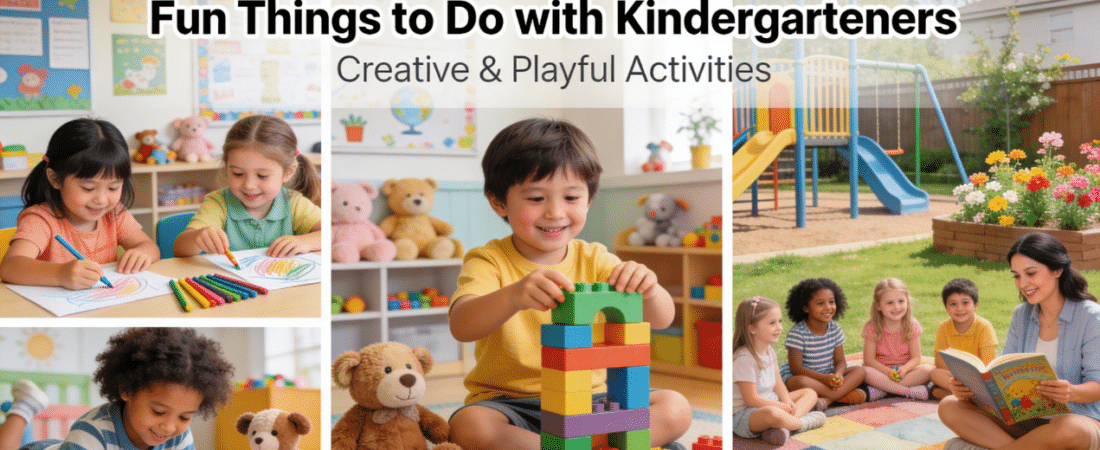

Looking for fun things to do with kindergarteners that don’t involve handing over a tablet? You’re in the right place. This guide is designed for parents, teachers, and caregivers who want to support kindergarteners’ growth through engaging, hands-on experiences that build essential skills. Whether you’re a parent trying to fill a Saturday afternoon or a teacher hunting for fresh classroom ideas, this collection delivers concrete, screen-light activities you can start in the next ten minutes. Educators looking to go deeper can also explore broader creative kindergarten class ideas for setting up an engaging learning environment.
These ideas are grouped by goals—learning, creativity, movement, social-emotional skills—so you can quickly jump to exactly what you need. Most activities use common items like crayons, paper, blocks, kitchen tools, and recyclables, and they take between 10 and 30 minutes to complete. You’ll find literacy games, math challenges, science experiments, creative play setups, outdoor adventures, and character-building routines that young learners genuinely enjoy.
- Fun Learning Activities for Kindergarteners (Literacy, Math & Science)
- Creative Crafts and Art Projects
- Active Games and Gross Motor Play
- Imaginative Play and Dramatic Activities
- Social-Emotional & Character-Building Activities
- Outdoor Adventures & Nature Exploration
- Screen-Free Rainy-Day Fun
- Tips for Making Any Activity a Success
Fun Learning Activities for Kindergarteners (Literacy, Math & Science)
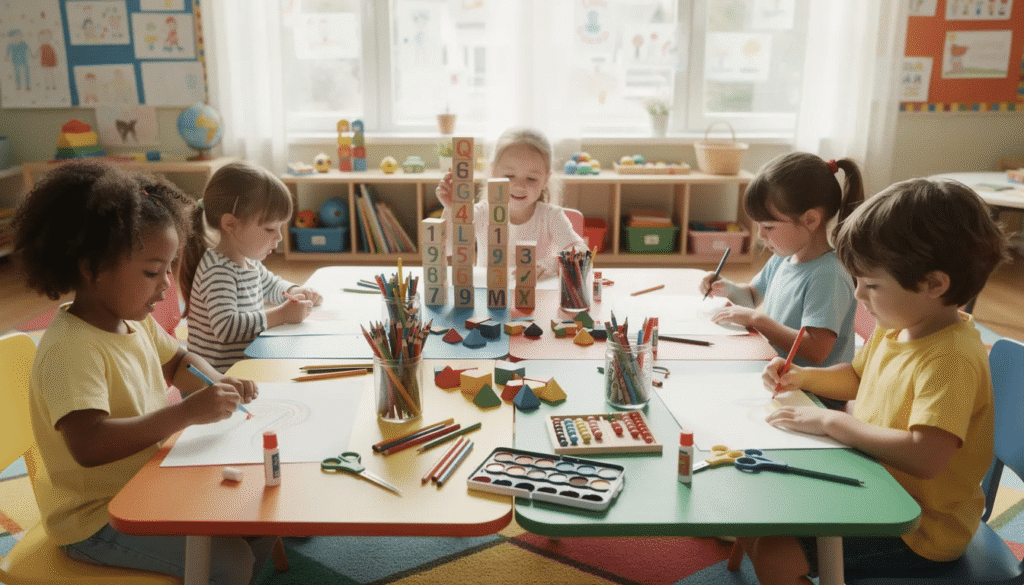
Kindergarten activities should focus on developing fine and gross motor skills and foundational literacy and math. These activities help children develop core skills such as literacy, math, science, and social studies.
Research consistently shows that kindergarteners learn best through play. When you embed literacy, math, and science into games and exploration, kids absorb core skills without realizing they’re “learning.” The activities below sneak in reading, counting, and experimenting through hands-on fun that children love.
ABC Treasure Hunt
Hide sticky notes with letters around the room or house. Give your child an alphabet chart and have them match each found letter to the chart.
- Write individual letters on 10-15 sticky notes
- Hide them at child-eye level around the room
- Provide an alphabet chart or sing the alphabet song together as reference
- Challenge your child to find all the letters before a timer runs out
This activity builds letter recognition while getting young kids moving. For older kids, write sight words instead of single letters.
Build Your Name
Use magnetic letters, letter tiles, or squares cut from construction paper to spell the child’s name and simple CVC words like “cat” or “sun.”
- Gather magnetic letters or cut paper squares with letters written on them
- Start with the child’s name—help your child arrange letters in order
- Progress to three-letter words the child can sound out
- Let the child create new words by swapping beginning or ending letters
This tactile approach helps a child learn letter formation and early spelling through touch and manipulation.
Roll & Count Math Game
Grab a standard die and small objects like buttons, LEGO bricks, or dried pasta for a simple counting game that builds number sense.
- Roll the die and count the dots together
- Have the child gather that exact number of objects
- Roll again and add more objects, counting the total
- Compare quantities: “Which pile has more? Which has fewer?”
For younger children, stick with numbers 1-6. For a challenge, use two dice and practice addition.
Pattern Picnic
Turn snack time into a math lesson using crackers, blueberries, cheese cubes, or any small foods to build patterns.
- Start with simple AB patterns (cracker, blueberry, cracker, blueberry)
- Progress to ABB patterns (cracker, blueberry, blueberry, cracker, blueberry, blueberry)
- Try ABC patterns with three different items
- Let the child create their own pattern, then eat the results
This activity makes abstract pattern concepts concrete and delicious.
Shape Detective
Send your child on a mission to search the classroom or house for circles, rectangles, and triangles.
- Announce one shape to hunt for at a time
- Have the child find 5 objects matching that shape
- Students draw what they find in a small notebook
- Discuss why certain objects are that shape (a clock is round so hands can spin)
This game builds spatial awareness and helps kids notice geometry in everyday life.
Sink, Float, or Melt?
Set up a simple science experiment using an ice cube, a crayon, a metal spoon, and a small toy. Fill a bowl with warm water.
- Ask the child to predict: Will each item sink, float, or melt?
- Test each item one at a time
- Discuss results: “Why do you think the spoon sank but the crayon floated?”
- Record predictions and results with simple drawings
This experiment teaches critical thinking and the basics of scientific observation.
Weather Watcher Chart
Create a daily routine where children check the weather each morning and track it for a full week.
- Draw a simple grid with seven columns (one per day)
- Each morning, look outside together and discuss what you see
- Have the child draw a symbol in today’s box (sun, cloud, raindrops)
- At week’s end, count: “How many sunny days did we have?”
This activity connects to the changing seasons and builds early data-collection skills.
Creative Crafts and Art Projects
Art projects help kindergarteners develop fine motor skills, imagination, and confidence. Exploring the art and craft benefits for child development and growth shows how these kinds of activities also support emotional health, school learning, and long-term skills. When children create something with their hands, they practice problem-solving, make decisions, and experience the pride of completing a project. Keep art supplies for young artists accessible and expectations loose—the process matters more than perfection.
Paper Plate Creature
Try a themed project like this or a crab paper plate craft for ocean units and summer fun.
Transform a simple paper plate into a silly animal or monster.
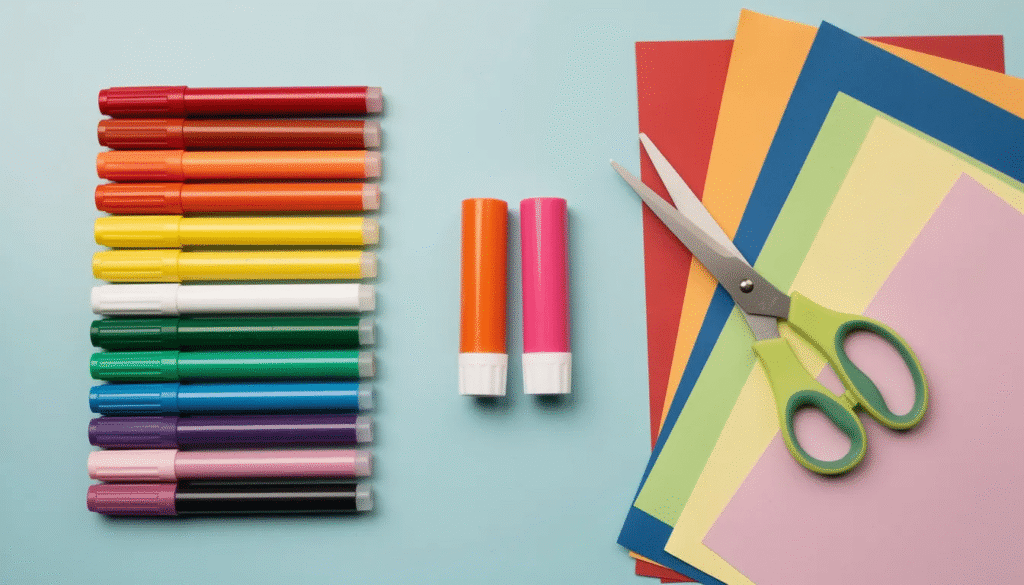
Materials: White paper plate, washable markers, safety scissors, glue stick, colored pencils, scrap paper
- Draw a face on the plate using markers
- Cut ears, horns, or antennae from scrap paper and glue them on
- Add paper teeth, googly eyes, or a tongue
- Name the creature and describe where it lives and what it eats
This project lets every child create something unique while practicing cutting and gluing.
Nature Collage
You can extend this activity with additional nature stick crafts that turn collected twigs into frames, decorations, and more.
Take a nature walk and collect leaves, small twigs, flower petals, and interesting stones.
Materials: Cardboard or thick paper, glue, collected natural items
- During a walk through your backyard or local park, gather 10-15 natural items
- Back inside, arrange items on cardboard to create a scene (forest, garden, lake)
- Glue everything down
- Students write or dictate a sentence describing their scene
This craft connects outdoor exploration with indoor creativity.
Story Stones
Create a set of storytelling tools the child can use again and again.
Materials: Smooth stones or cardboard circles, markers or paint
- Draw simple symbols on each stone: a house, star, dog, tree, sun, person
- Let stones dry completely if using paint
- Take turns drawing stones from a bag and building a story using each image
- Store stones in a special container for repeated use
Story stones encourage language development and creative narrative building.
Shape Robot
For another dimension-building idea, explore simple preschool 3D art projects that turn everyday materials into sculptures.
Combine geometry practice with art in this colorful collage project.
Materials: Construction paper in multiple colors, scissors, glue, marker
- Cut squares, rectangles, triangles, and circles in various sizes
- Arrange shapes to build a robot body on a background paper
- Glue everything in place
- Label body parts: “head,” “arm,” “wheel”
This activity reinforces shape recognition while the child creates something to display proudly.
Season Wheel
Pair this with polar bear winter crafts when you’re focusing on snowy weather and Arctic animals.
Explore the changing seasons with a divided circle craft.
Materials: Large paper circle (paper plate works great), markers, magazines for cutting, glue
- Draw lines to divide the circle into four equal sections
- Label each section: Winter, Spring, Summer, Fall
- Draw or collage items matching each season (snowflake, flower, sun, leaf)
- Discuss favorite activities during each season
Hang the finished wheel where the family can reference it throughout the school year.
Expressive Portraits
Practice emotional vocabulary through self-portraits.
Materials: Paper, crayons or markers, mirror (optional)
- Choose a feeling: happy, proud, surprised, worried, excited
- Look in a mirror and notice what your face does when feeling that emotion
- Draw a self-portrait showing that feeling
- Talk about a time you felt that way
This activity builds emotional awareness and helps young kids identify and express feelings.
Active Games and Gross Motor Play
Kindergarteners need plenty of movement for healthy development and better focus. Research shows that when children have time for physical play, their bodies and minds are better positioned to focus on academics afterward. These games get energy out while building coordination, listening skills, and spatial awareness.
Pillow Path Obstacle Course
Build an indoor obstacle course using items you already have.
Space needed: Living room, hallway, or large bedroom with furniture pushed aside
- Lay couch cushions as stepping stones across the floor
- Use painter’s tape to create a balance beam line
- Set up a chair to crawl under as a tunnel
- Add a designated spot to do three jumping jacks before finishing
Time each run and encourage the child to beat their own record. Adjust the course each week to keep it exciting.
Dice Fitness
Turn exercise into a game with a standard die.
Roll | Action |
|---|---|
1 | Hop on one foot 5 times |
2 | Spin around 3 times |
3 | Crab walk across the room |
4 | Do 5 jumping jacks |
5 | March in place for 10 counts |
6 | Free choice—pick your favorite! |
Take turns rolling and let the child lead the movements. Play for 10-15 minutes. |
Animal Movement Parade
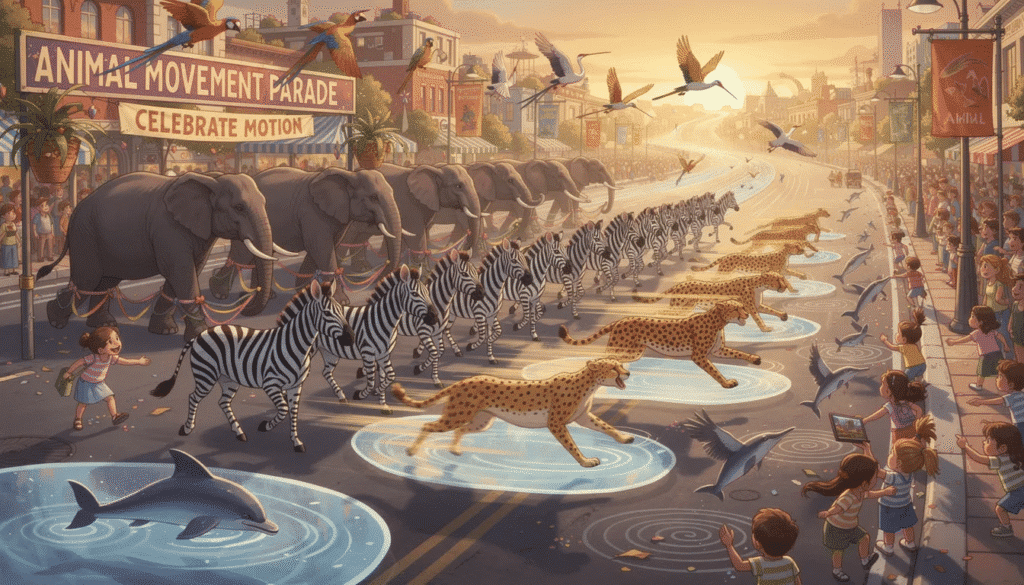
Call out different animals and have children move like that creature from one wall to another.
- “Move like a frog!” (hopping)
- “Move like a flamingo!” (balancing on one leg)
- “Move like an elephant!” (stomping with heavy steps)
- “Move like a snake!” (slithering on the floor)
This game builds gross motor skills while encouraging creativity and listening.
Shape Hopscotch
Draw shapes with chalk outside or use painter’s tape indoors.
- Create a path of different shapes: circle, square, triangle, rectangle, diamond
- Call out a shape and have the child jump to it
- Increase speed as they learn the shapes
- Let the child call shapes for you to jump to
This combines movement with geometry practice.
Balloon Keep-Up Challenge
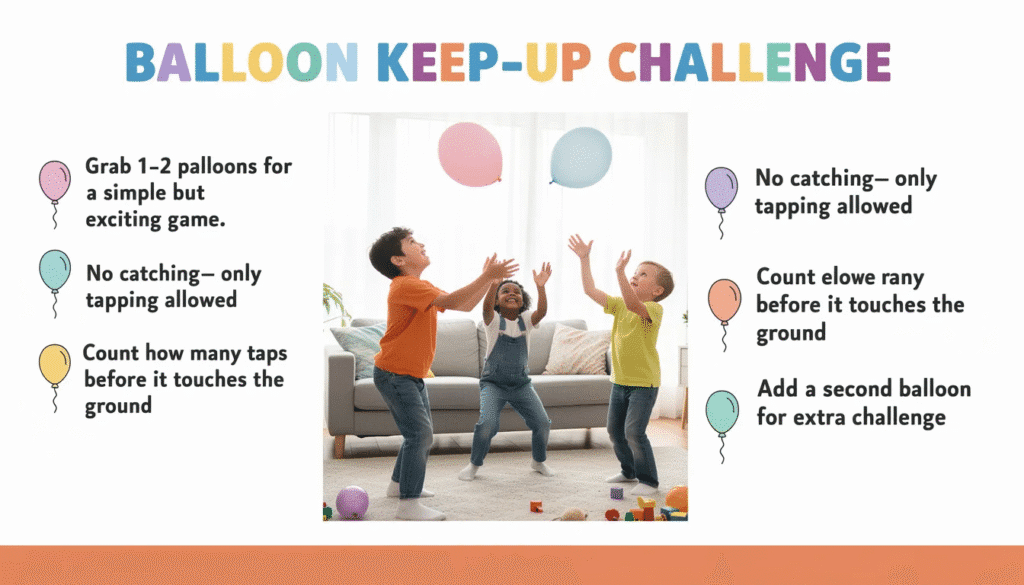
Grab 1-2 balloons for a simple but exciting game.
Rules to try:
- No catching—only tapping allowed
- Use only elbows or knees
- Count how many taps before it touches the ground
- Add a second balloon for extra challenge
Balloons move slowly enough for young children to track and respond, building hand-eye coordination.
Follow the Leader Adventure
Take turns leading an imaginary expedition.
The leader pretends to guide the group through various scenarios:
- Hiking up a steep mountain (high knee marches)
- Crossing a rushing river (big jumps)
- Sneaking through a jungle (tiptoeing quietly)
- Running from a silly monster (fast feet in place)
This cooperative game builds imagination while getting bodies moving.
Imaginative Play and Dramatic Activities
Pretend play helps kindergarteners practice language, problem-solving, and empathy. When children step into different roles, they experiment with new vocabulary, navigate social situations, and develop creative thinking. These setups work at home or in the classroom and use simple props you likely already have.
Kindergarten Café
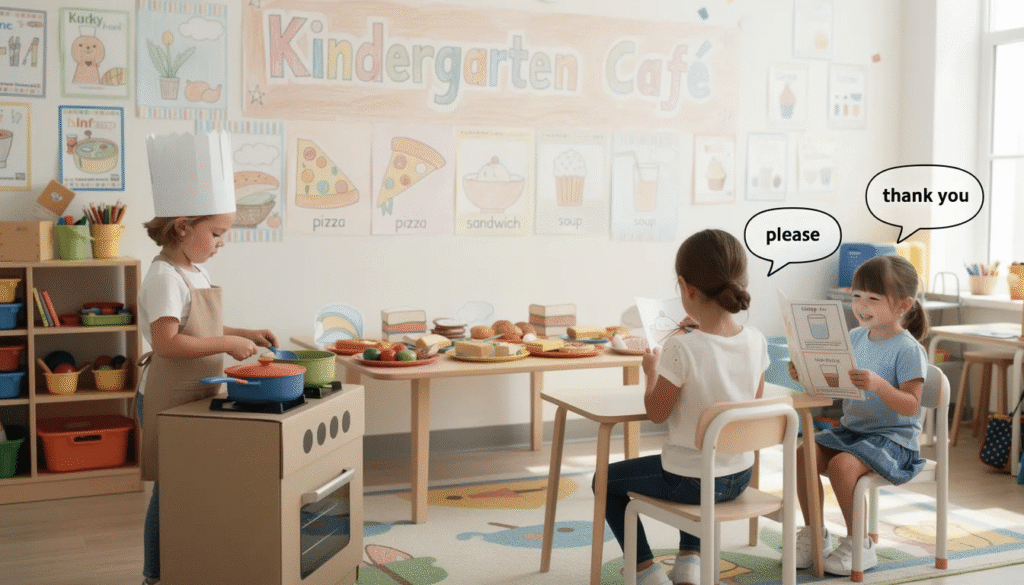
Transform a corner into a restaurant where kids take turns as cook, server, and customer.
Props needed: Play food (or paper cutouts), notepads, pencils, simple menus with picture cues
- Create a simple menu with 4-5 items drawn or glued on paper
- The server takes orders by drawing what the customer wants
- The cook “prepares” the meal
- The customer says “please” and “thank you”
Adult prompts to try: “What would you recommend today?” “How much does this meal cost?”
Mini Grocery Store
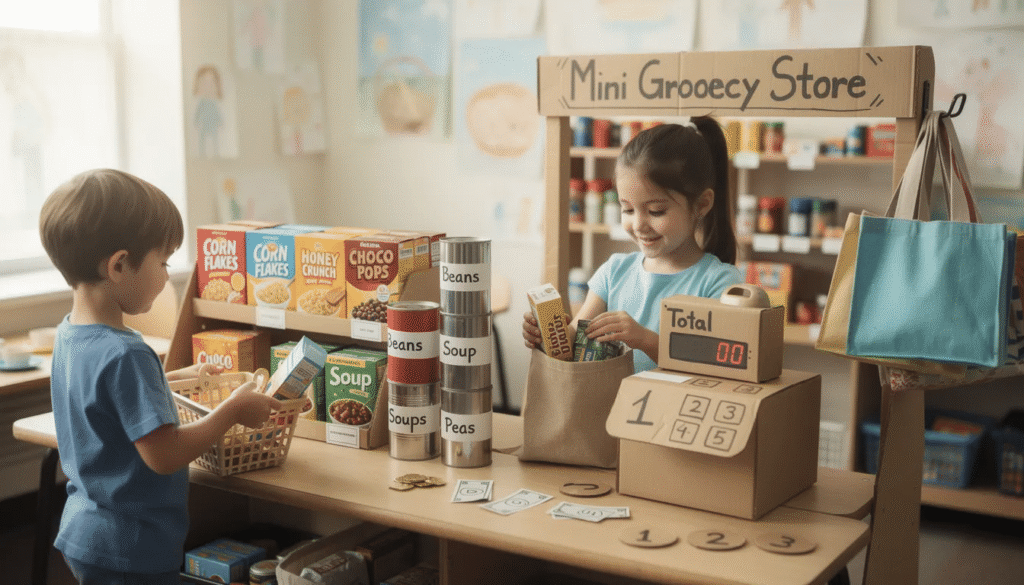
Set up a pretend store using empty boxes and containers from your recycling.
Props needed: Empty cereal boxes, clean cans, pretend money (paper or play coins), reusable bags
- Arrange items on a table or shelf
- One child shops and gathers items
- The cashier scans items and counts money
- Switch roles after each transaction
This game practices counting, turn-taking, and polite conversation.
Stuffed Animal Vet Clinic
Children love caring for their stuffed animals in this nurturing role-play scenario.
Props needed: Stuffed animals, paper strip “bandages,” toy thermometer (or a popsicle stick), notepad
- Check each animal’s “temperature” and listen to its heart
- Wrap paper bandages around any “injuries”
- Write a prescription for rest and hugs
- Explain to the owner (another child or adult) how to care for their pet
Adult prompts: “What’s wrong with this puppy today?” “How can we help this bear feel better?”
Neighborhood Helpers Day
Explore different community roles through dress-up and props.
Role ideas and simple props:
- Firefighter: Red shirt, cardboard tube “hose”
- Teacher: Books, pointer, small whiteboard
- Mail carrier: Bag, envelopes, stamps
- Librarian: Stack of books, date stamp
Children can interview each other: “What do you do at your job?” This builds awareness of community roles while practicing conversation skills.
Puppet Storytime
You can adapt this into family-themed preschool crafts by creating puppets for different family members and acting out everyday routines.
Create simple puppets and use them to retell stories or invent new ones.
Materials: Paper bags, socks, or wooden spoons with faces drawn on them
- Make 2-3 simple puppets together
- Retell a favorite book like a fairy tale
- Create an original story with the puppets
- Perform for family members or classmates
Puppet play reduces performance anxiety while encouraging verbal expression.
Time-Travel Adventure
Announce a time and place, then everyone moves and talks as if they’re really there.
Destination ideas:
- “We’re in a dinosaur valley—watch out for the T-Rex!”
- “We just landed on the moon—walk in slow motion!”
- “We’re at a royal castle—bow to the king!”
- “We’re swimming in the ocean with dolphins!”
This imaginative game stretches creativity and encourages full-body movement.
Social-Emotional & Character-Building Activities
Kindergarten is a significant year for learning about feelings, friendship, sharing, and responsibility. These activities help children develop emotional vocabulary, practice kindness, and build skills for navigating social situations. Use calm, encouraging language and model the behaviors you want to see.
Feelings Faces Chart
Create a daily check-in tool for emotional awareness.
Materials: Paper plates, markers, clothespin
- Draw different faces on separate plates: happy, sad, mad, worried, excited
- Hang plates on a wall or bulletin board
- Each morning, use a clothespin to mark how you feel
- Talk briefly about why you feel that way
This simple practice helps young kids identify and communicate emotions.
Kindness Countdown
Make kindness concrete with a week-long challenge.
Daily kindness ideas:
- Draw a picture for a friend
- Help set the table without being asked
- Share a toy with a sibling
- Compliment someone
- Hold the door for someone
- Pick up something someone dropped
- Give someone a hug
Track completed acts with stickers on a chart. Celebrate at the week’s end.
Gratitude Circle
Build appreciation into your daily routine.
At dinner or classroom closing time:
- Each person shares one thing they’re thankful for from today
- Encourage specific details: “I’m grateful my friend shared the blocks with me”
- Start with the adult modeling thankfulness
- Make it a routine that everyone expects
Research shows gratitude practices boost mood and strengthen relationships.
Calm-Down Corner
Create a designated space for self-regulation.
Items to include:
- Small rug or cushion
- Soft stuffed animals
- Glitter jar or snow globe to watch
- Visual card showing breathing steps (breathe in like smelling a flower, breathe out like blowing a candle)
Teach children to use this space when they feel overwhelmed. It’s not a punishment—it’s a tool.
Sharing Stories Circle
Practice speaking and listening skills with a simple structure.
- Gather in a circle with a “talking object” (small ball, special rock)
- Only the person holding the object may speak
- Each person shares a short story or experience
- Others practice listening without interrupting
- Pass the object to the next person
This builds both confidence in speaking and respect for others’ voices.
Responsibility Chart
Give children age-appropriate tasks they can track independently.
Task | Picture Icon | Done? |
|---|---|---|
Feed the pet | Food bowl | ☐ |
Water the plant | Watering can | ☐ |
Put away crayons | Crayon box | ☐ |
Make bed | Pillow | ☐ |
Use picture icons so children can check off tasks without reading help. Celebrate consistency, not perfection. | ||
 |
Outdoor Adventures & Nature Exploration
Fresh air, open space, and real-world exploration fuel kindergarten curiosity and physical health. These activities work in backyards, playgrounds, and neighborhood walks. Dress for the weather—sneakers, sunscreen in summer, layers in fall—and let children lead the discovery.
Color Hunt
Search for natural objects in specific colors to create a rainbow display.
- Assign color categories: green, brown, yellow, red, white
- Walk through the backyard or local park collecting items
- Line up found objects in rainbow order
- Discuss: “Where else might we find this color?”
This simple activity sharpens observation skills and color recognition.
Listening Walk
Take a quiet walk focused entirely on sounds.
- Walk slowly and silently for 3-5 minutes
- Stop periodically to listen
- Back inside, draw pictures of sounds heard: birds, cars, wind, dogs barking
- Compare: “Which sounds were loud? Which were soft?”
This mindfulness activity builds focus and sensory awareness.
Shadow Tag
On sunny days, play a gentle version of tag using shadows instead of bodies.
Rules:
- Step on someone’s shadow to tag them
- No touching bodies—only shadows
- Tagged person becomes the new chaser
This game teaches concepts about light and movement while getting energy out safely.
Stick Shapes
Kids who enjoy building with natural materials may also love space-themed crafts and activities like rockets and solar system models.
Use twigs and sticks to build shapes, letters, or numbers on the ground.
Challenge ideas:
- Build all basic shapes: square, triangle, rectangle, circle (use curved sticks!)
- Spell your name with stick letters
- Create numbers 1-10
- Build a simple stick person or house
This activity combines outdoor exploration with literacy and math practice.
Mini Garden Scientist
Turn plant care into a science observation project.
- Help water plants together each day
- Notice and discuss changes over a week
- Draw a “before” picture on day one
- Draw an “after” picture at week’s end
- Compare: “What changed? What stayed the same?”
This builds observation skills and introduces the scientific concept of change over time.
Cloud Stories
On especially bright days, try making colorful tissue paper stained glass crafts to hang in a sunny window after cloud watching.
Take advantage of nice weather for a restful imagination activity.
- Spread a blanket in the backyard
- Lie down and look up at clouds together
- Take turns describing what you see: “That cloud looks like a dragon!”
- Create short stories about the cloud shapes
This calming activity encourages creativity and verbal expression while enjoying nature.
Screen-Free Rainy-Day Fun
Rainy or extremely hot/cold days can feel long, but these ideas keep young children busy without relying on screens. All activities use common indoor items like cardboard boxes, couch cushions, and basic art supplies.
Indoor Camping Day
Transform a room into a campsite adventure.
- Build a blanket fort using chairs and sheets
- Pack a “backpack” with a flashlight, a favorite book, and snacks
- Read stories inside by flashlight
- Pretend to spot animals outside the “tent”
This immersive play scenario can fill an entire afternoon.
Cardboard Box Transformation
Turn a large box into anything imaginable.
Ideas:
- Spaceship with drawn buttons and windows
- Train car with wheels cut from paper
- House with a door that opens
- Boat with pipe cleaners as fishing poles
Provide markers, tape, and scrap paper, then let creativity take over.
Kitchen Band
Make music using household items.
Instruments:
- Pots and pans with wooden spoon drumsticks
- Plastic containers filled with rice for shakers
- Two pot lids as cymbals
- Rubber bands stretched over a box for a “guitar”
Practice loud/soft and fast/slow rhythms. March around the house in a parade. A dance party naturally follows.
Treasure Map Game
Create a simple treasure hunt using a hand-drawn map.
- Hide a small toy or treat somewhere in the room
- Draw a simple map showing furniture as landmarks
- Add an X marking the treasure location
- Help the child find the treasure by following the map
This builds map-reading skills and spatial reasoning.
Mystery Bag
Practice descriptive language with a tactile guessing game.
- Fill a pillowcase with 5-6 familiar objects: spoon, toy car, sock, block, ball
- Child reaches in without looking
- Describe what they feel: “It’s smooth, round, and small”
- Guess the object, then pull it out to check
This game builds vocabulary and tactile awareness.
Puzzle & Story Station
Combine puzzle time with storytelling.
- Set up 3-4 simple jigsaw puzzles
- When each puzzle is complete, have the child tell a short story about the picture
- Write down their story or have them draw an additional scene
- Display finished puzzles and stories together
This quiet activity works well for winding down before rest time.
Tips for Making Any Activity a Success
The best activities are ones adults enjoy too. When you’re genuinely engaged, children sense your enthusiasm and respond with their own excitement. It’s perfectly fine to repeat favorites often—children love repetition and deepen their learning through it.
Adjusting difficulty:
- For younger children or those who get frustrated easily, offer fewer steps and more support
- For advanced learners, add extra challenges: “Can you find 20 objects instead of 10?” or “Can you write the word without looking at the letters?”
Watch for overload signs:
- When children start getting silly, distracted, or grumpy, it’s time to wind down
- End activities while they’re still fun rather than forcing completion
- Better to leave them wanting more than to burn out on a good game
Build independence:
- Involve kindergarteners in set-up and clean-up as part of the activity
- Give them real responsibilities: gathering materials, putting away supplies, deciding what to do next
- This builds the rules of responsibility they’ll carry through the school year and beyond
Talk during activities:
- Ask open-ended questions: “What do you notice?” “How else could we do this?”
- Encourage the child to explain their thinking
- These conversations deepen learning and strengthen your connection
The goal isn’t perfection—it’s engagement. Pick one idea from this list and try it today. Notice what sparks joy for both of you. Over time, you’ll build a toolkit of go-to fun things to do with kindergarteners that make everyday moments memorable. Your child will learn, create, move, and grow—and you’ll be right there with them, making learning fun along the way.