
Kindergarten thrives on movement, curiosity, and discovery. This guide walks you through dozens of hands on learning activities designed specifically for 5- and 6-year-olds—covering literacy, math, science, motor skills, and social-emotional growth. Whether you’re a classroom teacher or a parent at home, you’ll find low prep ideas you can start using this week.
Quick Answer: What Is Hands-On Learning for Kindergarten?
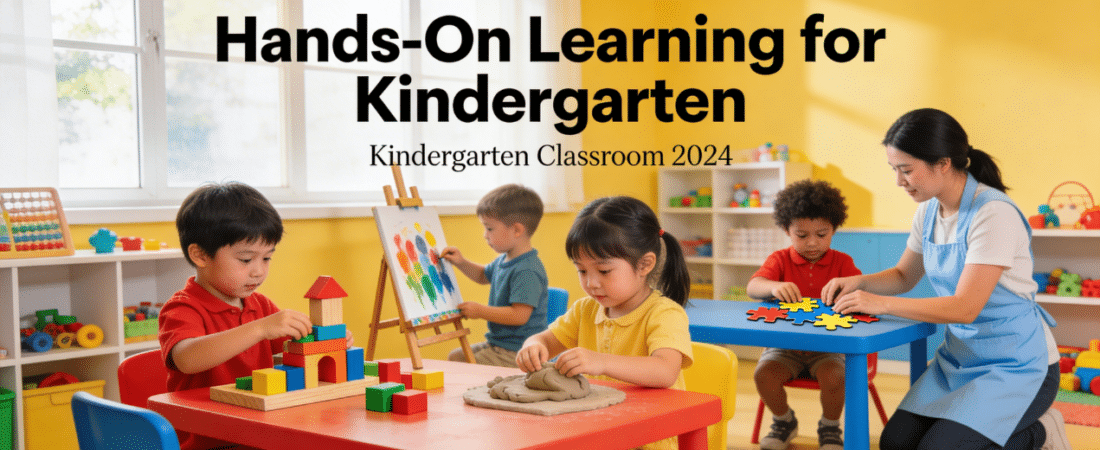
Hands on learning for kindergarten means children learn by doing—touching, building, moving, experimenting, and talking about real objects instead of filling out worksheets. It’s learning that uses all the senses, keeping young learners engaged and making abstract ideas concrete.
Think about the difference between circling a picture of the number 5 versus building a tower of 5 Unifix cubes. One child sits passively. The other child stands, counts aloud, touches each block, and watches the tower grow. That’s hands on learning in action.
Here are some everyday examples:
- Building numbers with linking cubes or counting bears
- Acting out stories with puppets and props
- Planting bean seeds in clear cups during April
- Sorting buttons, shells, or leaves by size, color, and shape
- Playing pretend in a classroom grocery store or doctor’s office
This approach works in a school classroom with 20 students and in a living room with one child. It supports reading, math, science, social skills, and emotional development simultaneously.
The rest of this article gives you specific activity ideas for literacy, math, science, motor skills, and emotions that teachers and parents can use right away—no expensive kits required.
- Why Hands-On Learning Matters in Kindergarten
- Planning Hands-On Learning Across the Kindergarten Year
- Hands-On Literacy Activities for Kindergarten
- Hands-On Math Learning for Kindergarten
- Science and Nature: Simple Kindergarten Experiments
- Sensory, Fine Motor, and Gross Motor Hands-On Activities
- Social-Emotional and Cooperative Hands-On Learning
- Tips for Teachers and Parents Using Hands-On Learning
Why Hands-On Learning Matters in Kindergarten
Brain research tells us something important about children aged 5 to 6: they learn best through active, multi-sensory experiences rather than long periods of seatwork. The kindergarten brain is wired for exploration, and sitting still while listening simply doesn’t create strong neural pathways at this age.
When children manipulate real objects—like counting actual crackers before snack time, building with blocks, or pouring water between containers—they strengthen synaptic connections across multiple brain regions. A University of Chicago study using MRI imaging found that kindergarteners who learned physics concepts through hands on activities showed heightened activation in sensory and motor brain areas compared to children who only observed. Those children also retained the information weeks later, while the observers forgot.
The differences in retention are striking. According to the National Training Laboratories’ learning pyramid, children retain only 5% of what they hear in a lecture and 10% of what they read. But they retain 75% of what they practice doing and 90% of what they immediately apply. For kindergarten, this means building, sorting, counting, and experimenting beats passive listening every time.
Consider a typical comparison. A worksheet asks children to circle the biggest number: 3, 7, or 5. A hands on task gives children three towers made of linking cubes—3 cubes, 7 cubes, and 5 cubes—and asks them to find the tallest. The second approach builds number sense, spatial awareness, and vocabulary all at once. Children can touch the difference, see the comparison, and talk about what they notice.
The benefits extend beyond academics:
- Better attention: A classroom observation noted children sustaining focus for 45 minutes during block-building versus 10 minutes during seated lessons.
- Stronger memory: Physical enactment embeds procedural memory that persists over time.
- Improved language: Children talk more during active play, building vocabulary naturally.
- More confidence: When kids can test ideas physically, they develop a sense of competence.
One kindergarten teacher described the shift in her room after moving to hands on centers: “My students who struggled to focus during carpet time became the most engaged builders at the math table. They weren’t ‘bad at school’—they just needed to learn with their hands.”
Hands on learning aligns with common kindergarten standards in the US and other English-speaking countries for literacy, math, science, and social-emotional learning. It’s not a departure from the curriculum—it’s the most effective way to teach it.
Planning Hands-On Learning Across the Kindergarten Year
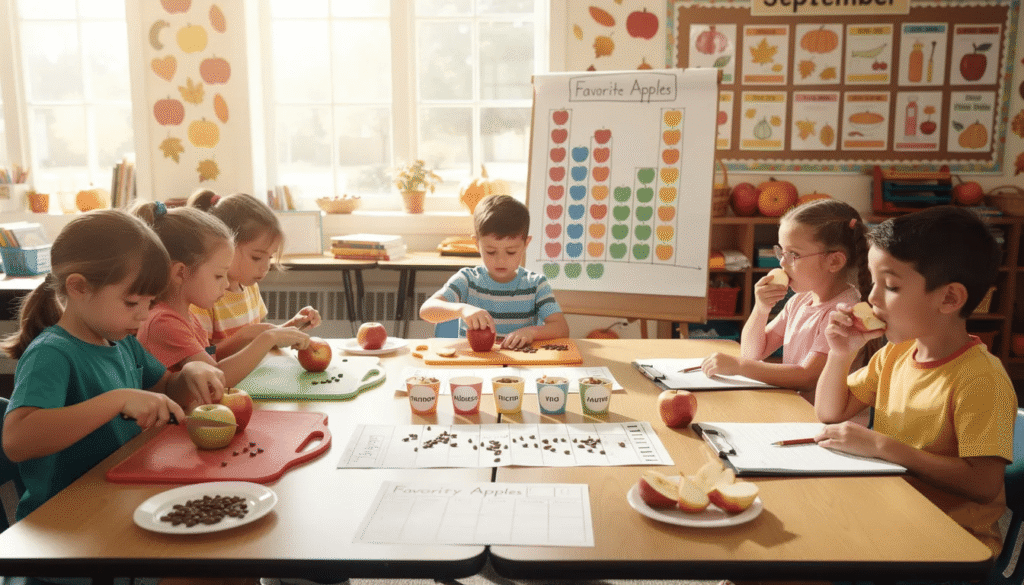
Hands on learning works best when it’s organized around natural anchors: seasons, holidays, and real-life events that give children context for exploration. Planning your school year with monthly themes makes preparation easier and keeps activities fresh.
Consider these yearly anchors for the 2024–2025 school year:
- September: Apple investigations—cutting apples, counting seeds, tasting varieties, graphing favorites
- October: Pumpkin volume—measuring pumpkins with string, scooping seeds, estimating weight
- November: Thankfulness projects—gratitude jars, family recipe books, dramatic play feast
- January: Weather journals—daily temperature charts, rain gauges, snowflake observation
- March: Simple machines—ramps with toy cars, pulley experiments, lever balance scales
- April: Plant life cycles—planting beans in clear cups, observing roots, measuring growth
- May: Community maps—building the neighborhood with blocks, drawing simple maps
Within each week, rotate through learning centers that align with your theme. A typical kindergarten setup includes (and you can find even more creative kindergarten class ideas for engaging learning experiences if you’re setting up a new room or refreshing your space):
- Literacy center: Books, magnetic letters, writing materials tied to the theme
- Math center: Manipulatives, number games, measurement tools
- Science or nature table: Specimens, magnifying glasses, observation journals, and simple nature stick crafts for kids
- Art and maker station: Construction paper, recycled materials, open-ended building such as preschool 3D art projects using clay, recyclables, and natural elements
- Dramatic play area: Props that match the month’s focus
For example, during “Community Helpers Week,” your dramatic play area becomes a doctor’s office with stethoscopes, bandages, and clipboards. During “Space Week,” children build foil-covered planets, count stars on black paper, and sort pictures of rockets by size. During “Ocean Week,” shell sorting and water-table experiments take center stage.
Keep materials low-cost and reusable. Cardboard boxes, recycled containers, bottle caps, buttons, clothespins, and natural materials collected on neighborhood walks provide endless learning opportunities without straining your budget.
Hands-On Literacy Activities for Kindergarten
Early literacy in kindergarten is built through play: manipulating letters, hearing and making sounds, and telling stories with props and puppets. Young learners develop reading and writing skills when they can touch and move the alphabet rather than just look at it.
Letter Builders Station
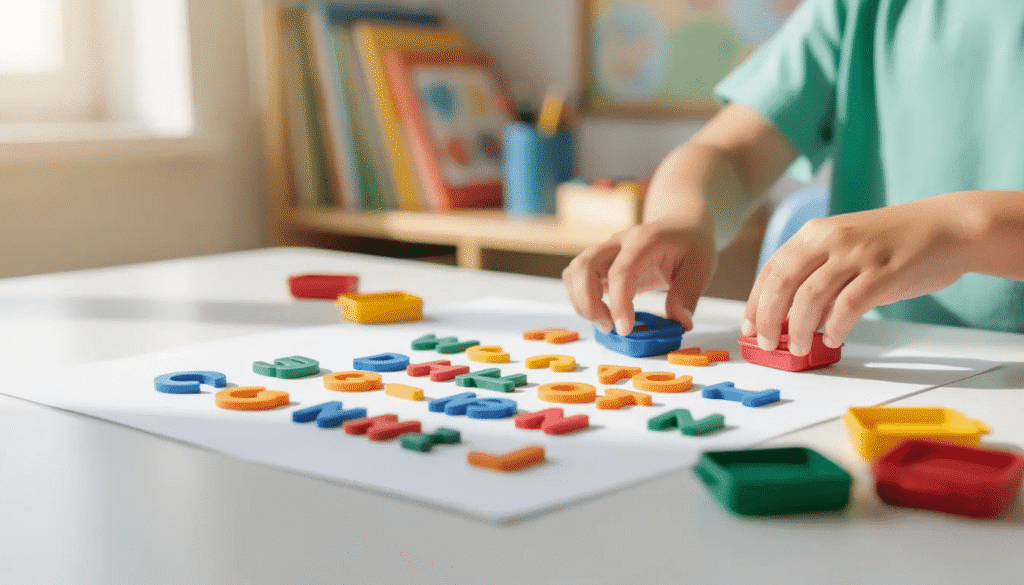
Stock a center with magnetic letters, wooden alphabet blocks, and playdough. Children form their names letter by letter, building all the letters of the alphabet over time. Once comfortable with names, introduce CVC words like “cat,” “sun,” and “dog.” The physical act of creating each letter reinforces the shape and sound connection. Include an alphabet chart nearby so children can self-check their work.
ABC Sensory Bin
Fill a shallow bin with dry pasta, rice, or kinetic sand. Hide plastic letters A–Z throughout. Children dig up letters with scoops or their hands, match each letter to an alphabet chart, and practice saying the sound. This activity combines fine motor work with letter recognition, and students love the treasure-hunt feel. Add themed toys—like small toy animals—and challenge children to find letters that match: “A for alligator, B for bear.”
Story Retell Tray
Choose a familiar picture book like “The Very Hungry Caterpillar” and gather real objects that match the story: toy fruit, a felt caterpillar, a small blanket for the cocoon. Children sequence the events using the objects, retelling the story in order. This builds comprehension, vocabulary, and narrative skills while keeping literacy activities hands on.
Clothespin Word Clips
Write simple CVC words on sentence strips. Create matching picture cards (a picture of a cat, a sun, a cup). Children clip the correct picture to each word, building word-picture association with a tactile reading experience. The clothespin action strengthens hand muscles for writing while reinforcing early literacy skills.
Hands-On Writing Center
Stock a writing center with mini whiteboards, sand trays for finger writing, letter stamps and ink pads, and envelopes for making “mail” to classmates. Children who aren’t ready to write with pencils can still practice letter formation in sand or stamp their way through messages. The goal is making early writing feel like play.
Hands-On Math Learning for Kindergarten
Math in kindergarten should look like building, sorting, measuring, and playing interactive games—not only writing numbers on lined paper. Hands on math activities help children understand essential math concepts through touch and experience.
Counting Towers to 10
To spotlight individual numerals in playful ways, you can mix in focused projects like a number 9 craft activity for preschoolers.
Use colored counting bears or linking cubes. Create numeral cards 0–10 and have children build towers to match each number. A card showing “7” gets a tower of 7 cubes. This teaches one to one correspondence—the understanding that each object gets counted exactly once. Children can compare towers, identify which is taller, and begin adding by combining towers.
Math with Snacks
Before lunch, give each child 10 small crackers or grapes on a plate. Practice “how many now?” stories: “You have 6 crackers. You eat 2. How many now?” Children physically remove crackers and count what’s left. This embeds addition and subtraction in a fun way that feels like a game rather than a lesson.
Shape Hunt Around the Room
Send students on a scavenger hunt to find different shapes in real objects. Clock faces are circles. Books are rectangles. Tissue boxes are rectangular prisms. Glue sticks are cylinders. Children record their findings with quick sketches or by placing objects on a sorting mat. This builds spatial awareness and geometry vocabulary using objects already in the room.
Pattern Pipe Cleaners
Give children beads in 2–3 colors and pipe cleaners. Challenge them to create AB patterns (red, blue, red, blue), then AAB patterns, then ABC patterns. The tactile experience of threading beads reinforces the repeating structure. You can also use leaves and rocks from a fall walk, or plastic bottle caps sorted by color.
Sticky Note Graphing
Create a class graph of favorite fruits or family pets. Each child writes their name on a sticky note and places it in the correct column. Then build a floor graph with colored construction paper strips. Children stand in the “bar” they belong to, physically experiencing what a graph represents. Ask: “Which column has more? How many more?”
Measurement Station
Set up a table with non-standard units: popsicle sticks, LEGO bricks, paper clips. Children measure different objects around the classroom—the width of a book, the length of a shoe, the height of a toy. They record results with quick sketches or tally marks. This introduces measurement concepts without the confusion of rulers.
These hands on math activities teach math through experience, building essential skills that worksheets simply can’t match.
Science and Nature: Simple Kindergarten Experiments
Hands on science for 5- and 6-year-olds is about observing, predicting, and talking about what they see. Children don’t need to memorize facts—they need to ask questions and test ideas.
Sink or Float Investigation
Gather a variety of classroom or home objects: pencils, plastic spoons, coins, corks, small toys, paper clips. Fill a clear tub with water. Before testing, children predict: will it sink or float? They test each item, sort them by outcome, and discuss why some objects sink while others stay on top. This builds critical thinking and introduces density concepts through direct observation.
Plant Growing Project
In March or April, plant bean seeds in clear plastic cups filled with damp cotton or soil. Place cups near a window. Children draw the seeds on day one, then observe and sketch changes weekly as roots grow down and stems grow up. Label parts of the plant together. This teaches life cycles through daily activities that children own.
Classroom Weather Station
From January through March, track weather patterns. Place a simple rain gauge outside (a clear container with measurement marks). Create a daily temperature chart. Each morning, children select picture cards—sunny, cloudy, rainy, snowy—to record the day’s weather. Over weeks, patterns emerge, and children begin making predictions.
Rain in a Jar
Fill a clear jar with very hot water (adult handles this step). Place a plate of ice on top. Watch as water vapor rises, hits the cold plate, and condenses into droplets that “rain” back down. This demonstration teaches the water cycle in a visual, memorable way. Supervise closely and invite children to describe what they see.
Nature Table Exploration
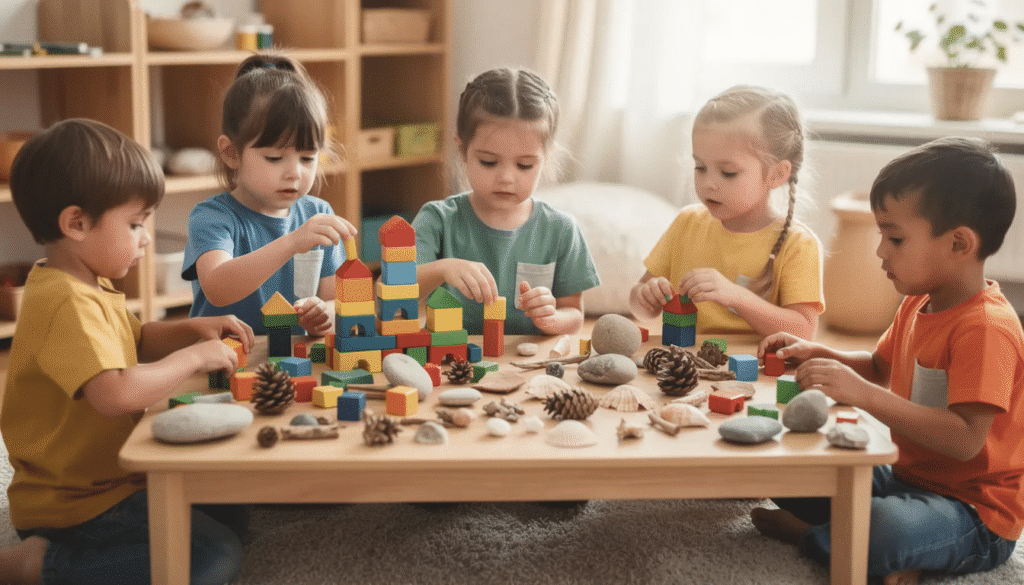
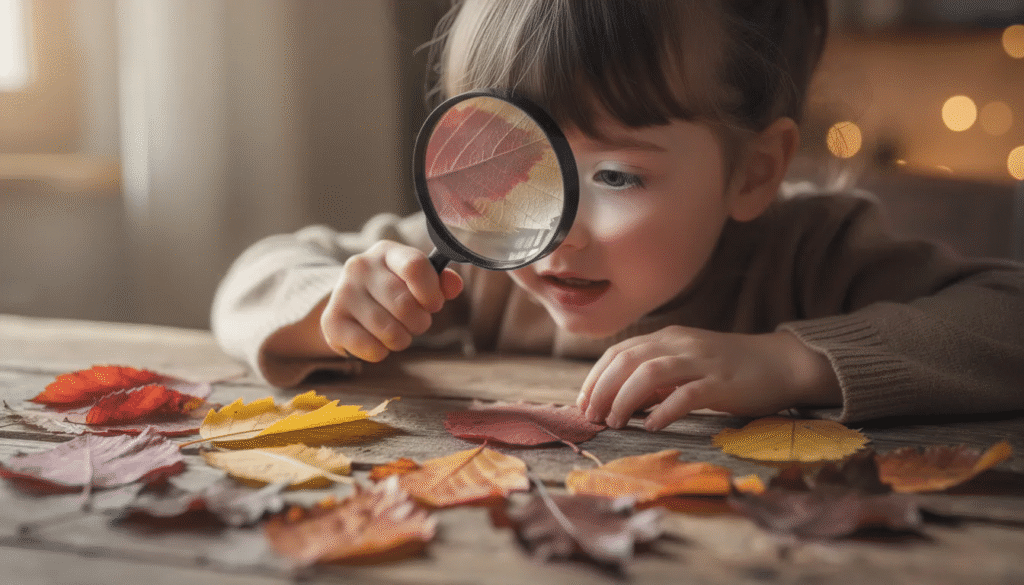
Collect leaves, rocks, shells, and pinecones on neighborhood walks. Place items on a science table with magnifying glasses. Encourage children to sort items by texture, color, and size. Ask questions: “What do you notice? How are these different? Which feels rough? Which feels smooth?” This builds observation skills and vocabulary about the natural world.
Sensory, Fine Motor, and Gross Motor Hands-On Activities
Strong hands and bodies support writing, focus, and self-regulation. Movement is essential to hands on learning, and physical development happens through daily activities that challenge muscles and coordination.
Sensory Bins
Fill bins with rice, kinetic sand, dried beans, or water beads. Add scoops, funnels, small cups, and toys to pour, fill, bury, and dig. Children develop hand eye coordination while building vocabulary through conversation: full, empty, heavy, light, pour, scoop. Rotate bin materials every few weeks to maintain interest.
Fine Motor Tasks with Tweezers and Beads
For additional ideas that combine art and skill-building, you can incorporate art activities that enhance children’s fine motor skills.
Use tweezers to transfer pom-poms into ice cube trays sorted by color. String beads onto chenille stems (pipe cleaners) to make pattern bracelets. Hole punch colored paper strips. These activities strengthen the small muscles in hands and fingers that children need for writing.
Playdough Letters and Numbers
Roll playdough into snakes to form letters. Stamp number molds and press small buttons or gems into each numeral to show quantity—5 buttons on the 5, 3 gems on the 3. This combines fine motor practice with literacy activities and math concepts in one sensory experience.
Indoor Obstacle Course
For more ways to get kids working together while they move, try engaging group activities for 5 year olds that spark creativity and fun.
Create an obstacle course using cushions, tunnels, tape lines to walk, and spots to jump. Add learning elements: tape numerals on the floor and call out “hop to 7!” or draw shapes with sidewalk chalk and say “jump on the triangle!” This builds gross motor skills, spatial awareness, and number recognition while burning energy.
Outdoor Movement Games
On the playground, play games like “freeze dance” to music (developing listening and body control) or “red light, green light” (building inhibition and focus). These simple games develop motor skills and executive function—the brain skills that help children regulate behavior and attention.
These activities require minimal prep and work in small apartments, playgrounds, or school gyms. The key is consistent daily movement woven into learning. If you also care for younger siblings, try age-appropriate no mess activities for 2 year olds alongside these options.
Social-Emotional and Cooperative Hands-On Learning
Kindergarten is a critical year for learning to share, take turns, manage big emotions, and work in groups. These skills develop best through practice, not lectures.
Feelings Station
Set up a mirror, emotion cards showing faces (happy, sad, angry, surprised, worried), and simple props like puppets. Children look in the mirror and match their expression to a card. Teachers model using puppets to act out situations: “This puppet feels angry because someone took his block. What could he do?” This builds vocabulary for emotions and strategies for handling them.
Cooperative Building Challenges
In pairs, children build one tower using a shared set of blocks. They practice negotiation: “Let’s put this one here.” “I think we need a bigger base.” “Your turn to pick a block.” The shared goal teaches turn-taking and problem-solving. Celebrate the tower, not who contributed more.
Gratitude Jar
Each Friday, children draw or write one thing they’re thankful for on small slips of paper. They fold the slips and drop them into a clear jar. Over the school year, the jar fills up. Periodically read slips aloud. This simple practice builds positive focus and community.
Dramatic Play Centers
Dramatic play is also a powerful way to build imagination. For even more ideas beyond the classroom centers below, explore engaging activities for imagination to inspire creative thinking.
Stock role-play centers with real-life props: empty food boxes and a play cash register for a grocery store, stethoscopes and bandages for a doctor’s office, envelopes and stamps for a post office. Children practice social scripts, taking on different roles: customer, clerk, patient, mail carrier. This builds language, empathy, and understanding of the world around them.
Teacher Modeling with Puppets
Use puppets to demonstrate tricky social situations: apologizing after hurting someone, asking to join a game, calming down when frustrated. Show the puppet squeezing a stress ball or taking deep breaths. Children respond to toys and puppets in ways they sometimes can’t respond to direct instruction. Keep puppets available for children to use in their own play.
Tips for Teachers and Parents Using Hands-On Learning
You don’t need expensive kits to create meaningful hands on experiences. Everyday home and classroom items are enough. Here’s how to make it work.
Classroom Organization Tips
- Store materials in clear bins so children can see what’s inside
- Label bins with pictures and words for independence
- Teach cleanup routines explicitly in the first weeks of school
- Model how to use each center before children work independently
- Rotate activities every 1–2 weeks to maintain interest without overwhelming yourself
Home Learning Tips
- Set aside 10–20 minutes daily for one hands on activity
- Keep a “learning basket” stocked with crayons, scissors, playdough, counting toys, and magnetic letters, or add simple DIY kits for creative projects and fun learning experiences
- Invite children to help with cooking (measuring, pouring, counting), sorting laundry by color, or gardening
- Ask questions during everyday moments: “How many forks do we need for dinner?”
Managing the Mess
- Use trays under sensory bins and playdough
- Spread tablecloths or old shower curtains under messy activities
- Set clear rules: “Materials stay on the table” and “We wash hands after messy play”
- Accept that some mess is the price of learning fun
Observing and Talking During Play
The adult’s role is to watch, ask questions, and extend thinking. Use open-ended prompts:
- “What do you notice?”
- “What might happen if…?”
- “How could we change this?”
- “Tell me about what you’re building.”
Resist the urge to correct or take over. Let children test ideas—even when those ideas don’t work.
Documenting Learning
Keep a simple record of growth:
- Quick photos on your phone, organized by month
- Date-labeled drawings showing progression
- Simple charts tracking books read or skills practiced
- Portfolios to share with families at conferences
Consistent, playful hands on learning throughout kindergarten helps children move into first grade curious, confident, and ready for more. The activities in this guide build skills across every domain—literacy, math, science, motor development, and social-emotional growth. Start with one new idea this week, observe how your students or children respond, and build from there.
The best learning happens when kids can touch, build, move, and create. Give them the materials, the time, and the encouragement. Watch what they discover.