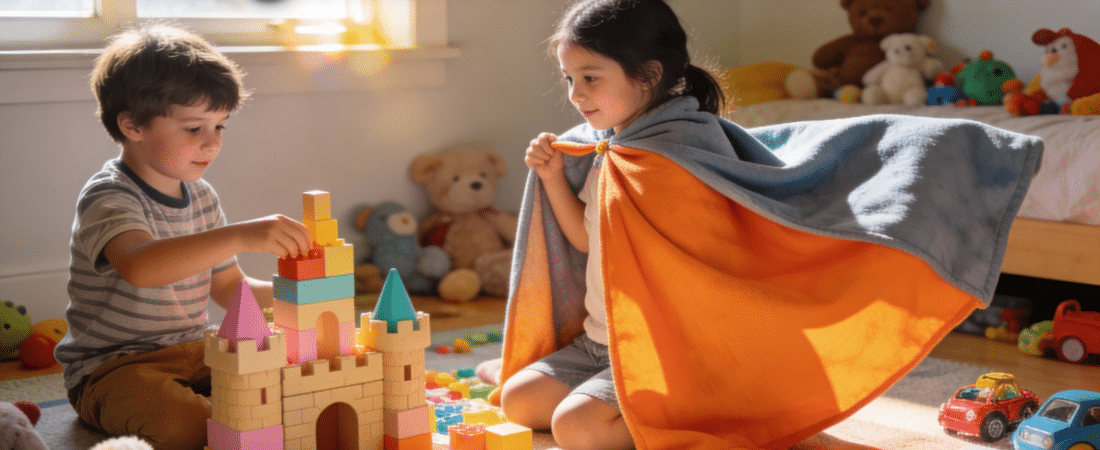

When your child transforms a cardboard box into a rocket ship or hosts a pretend tea party for stuffed animals, they’re doing far more than passing time. They’re building the foundation for social success, emotional resilience, and cognitive flexibility that will serve them for years to come.
Imaginative play benefits extend across virtually every domain of early childhood development. From the toddler years through age seven and beyond, this type of open-ended, child-led play shapes how children learn to think, communicate, and connect with the world around them.
This guide breaks down exactly what imaginative play looks like, when it develops, and how you can encourage pretend play at home without spending a fortune on toys. Whether you’re a parent, caregiver, or early education professional, you’ll find practical strategies backed by developmental research.
- Imaginative play at a glance
- What is imaginative play?
- When does imaginative play develop? (ages and stages)
- Core benefits of imaginative play for child development
- Social & emotional benefits of imaginative play
- Language, thinking, and academic foundations
- Imaginative play and independence, confidence, and creativity
- How to encourage imaginative play at home
- Imaginative play in childcare and early education settings
- Frequently asked questions about imaginative play benefits
Imaginative play at a glance
Imaginative play—also called pretend play, dramatic play, or make believe—is when children create their own scenarios, characters, and stories using their imagination. It happens when a child picks up a baby doll and becomes a parent, builds a tower of building blocks and declares it a castle, or turns dress up clothes into a superhero costume.
This type of play is a vital part of how children grow and learn between ages 2 and 7. Common props include dolls, blocks, cardboard boxes, scarves, toy animals, action figures, and simple household items.
Top benefits of imaginative play:
- Social skills: cooperation, turn-taking, negotiation with other children
- Emotional development: expressing feelings, building resilience, self-regulation
- Language skills: vocabulary expansion, storytelling, conversation practice
- Creativity: flexible thinking, generating new ideas, problem solving
- Cognitive skills: planning, memory, abstract reasoning
- Confidence: independence, decision-making, sense of agency
Research spanning the 2000s through 2020s consistently links rich pretend play experiences with better school readiness and stronger peer relationships. Studies show that children who engage in imaginative play demonstrate enhanced executive function, language development, and theory of mind—the ability to understand different perspectives.
Consider a 4-year-old running a “grocery store” with play food and a toy cash register. In a single play session, they’re practicing counting (cognitive), greeting customers (social), handling a pretend “rush” of shoppers (emotional regulation), and announcing prices (language). That’s several benefits packed into one fun activity.

What is imaginative play?
Imaginative play occurs when children invent roles, stories, and worlds using their imagination. It goes by many names—pretend play, dramatic play, fantasy play, or simply playing pretend—but the core element remains the same: children create scenarios that don’t exist in the moment and act them out.
Everyday pretend vs. fantastical scenarios
Imaginary play falls on a spectrum. On one end, you have everyday pretend scenarios like playing house, caring for a baby doll, or running a pretend restaurant. These draw directly from real life experiences children observe around them.
On the other end, children engage in fantastical play—becoming dragons, astronauts on Mars, superheroes with special powers, or wizards casting spells. Both types are valuable. Everyday pretend helps children process and rehearse real life situations, while fantasy play stretches their creativity and allows them to explore “what if” thinking.
Simple props, big imagination
One of the beautiful aspects of imaginative play is that expensive toys aren’t required. Children naturally use one object to represent another:
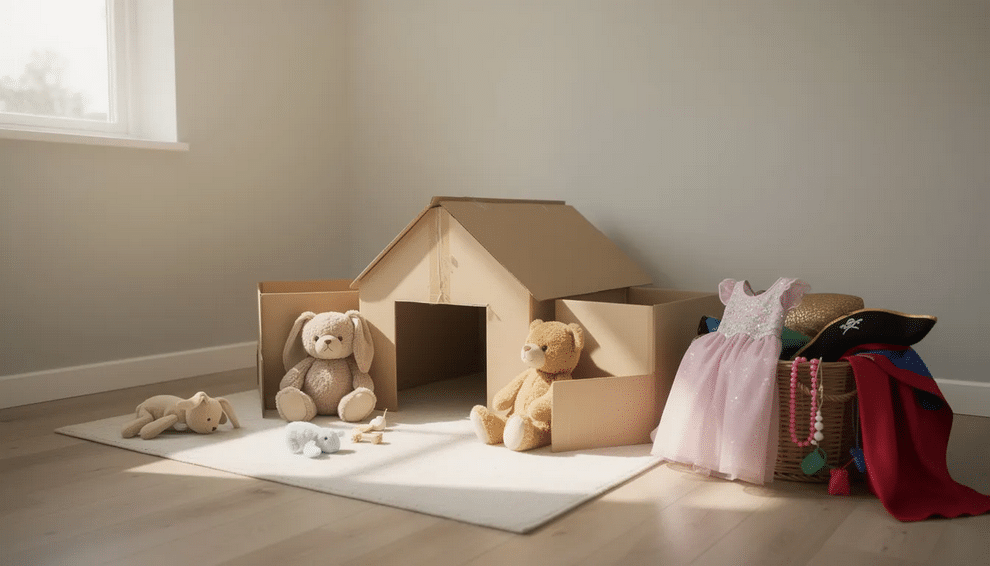
- A cardboard box becomes a spaceship, race car, or house
- A wooden spoon transforms into a microphone or magic wand
- A blanket draped over chairs creates a castle, cave, or camping tent
- Kitchen utensils become doctor’s tools or cooking equipment
This symbolic play—using objects to represent something else entirely—is actually a sophisticated cognitive skill. When a child sees a banana as a telephone, they’re demonstrating abstract thinking.
Key characteristics of imaginative play
What sets imaginative play apart from other activities:
- Child-led: Children decide the rules, roles, and storylines
- Open-ended: There’s no fixed “right way” to play or predetermined outcome
- Flexible: Stories can change direction at any moment
- Voluntary: It happens because children choose it, not because adults assign it
Children can engage in imaginative play solo (talking to figurines, narrating stories), with siblings or parents, or in small groups at preschool. It often overlaps with both symbolic play and dramatic play, making it a rich, multi-layered experience.
When does imaginative play develop? (ages and stages)
Imaginative play unfolds in predictable stages from toddlerhood through early primary school, though individual timelines vary based on temperament, exposure, and cultural factors.
Around 18–24 months: Simple pretend emerges
During the toddler years, children begin showing the first signs of pretend play. You might see a child:
- “Feeding” a teddy bear or stuffed animals with an empty spoon
- Pretending to talk on a toy phone
- “Drinking” from an empty cup
- Making a doll “walk” or “sleep”
These actions are imitative—children copy what they’ve seen adults do. The pretend scenarios are brief and simple, often lasting just a few seconds.
Around age 3: Symbolic play grows
By age three, children develop more sophisticated pretend abilities:
- Using objects creatively (a block becomes a phone, a stick becomes a sword)
- Creating simple storylines with beginnings and endings
- Assigning roles to toys (“You’re the mommy bear, this one’s the baby”)
- Engaging in longer play sequences that unfold over several minutes
This is when you’ll see children begin to create stories that have some internal logic, even if they still jump between ideas rapidly.
Ages 3–5: Socio-dramatic play flourishes
This is the golden age of imaginative play. Pretend play scenarios become more complex and increasingly social:
- Detailed narratives like “school,” “doctor’s office,” “fire station,” or “restaurant”
- Playing with friends or siblings in coordinated roles
- Negotiating who plays which character
- Adding props, costumes, and environmental setups
A child might spend 20–30 minutes building and maintaining a pretend “veterinary clinic” for their toy animals, complete with a waiting room, examination table, and prescribed treatments.
Ages 5–7: Elaborate worlds and rules
As children grow, their imaginative play becomes even more sophisticated:
- Multi-day play themes (a “zoo” or “space mission” that continues over several sessions)
- Incorporating rules and game-like elements
- Complex problem solving within scenarios
- Early “theory of mind”—understanding what characters think and feel
By this stage, children can hold storylines in mind, plan ahead, and adjust their play when unexpected things happen. They’re also better at including other children in their play worlds.
Cultural and family play habits influence how and when pretend play is expressed. Some children may show these milestones earlier or later, and that’s perfectly normal.
Core benefits of imaginative play for child development
Imaginative play isn’t just “extra fun” that happens when the real learning is done. Research consistently shows it’s a major driver of development across multiple domains—cognitive social and emotional growth all at once.
The multi-domain benefit
What makes imaginative play important is how many essential skills it develops simultaneously:
| Domain | Skills Practiced |
|---|---|
| Social | Sharing, turn-taking, negotiating, cooperating with others |
| Emotional | Expressing feelings, coping with frustration, building resilience |
| Language | Vocabulary, storytelling, conversation, narrative structure |
| Cognitive | Planning, flexibility, problem solving, memory |
| Physical | Fine and gross motor skills through active pretend scenarios |
| Self-concept | Confidence, independence, sense of agency |
Multiple skills in action
Consider children running a pretend restaurant together. In this single scenario, they’re:
- Taking orders: practicing language skills and memory
- Dividing roles: negotiating who’s the chef, server, or customer
- Handling “stressful” rush times: building emotional regulation
- Adjusting when “food runs out”: developing problem solving skills
- Greeting customers politely: rehearsing social conventions
This is why experts like David F. Bjorklund characterize pretend play as a “metaphoric multivitamin”—it supports overall cognitive, social, and emotional development in ways that single-focus activities cannot.
Long-term relevance
Skills practiced in pretend play don’t stay in the playroom. They show up later in:
- Group projects at school
- Navigating friendships and peer relationships
- Classroom participation and discussion
- Creative problem solving in academic work
- Emotional resilience during challenges
These benefits appear whether play happens in home settings (the living room floor) or early education environments (preschool dramatic play corners).
Social & emotional benefits of imaginative play
Between ages 3 and 6, children develop rapidly in their understanding of social relationships and emotional regulation. Imaginative play serves as a primary laboratory for this growth.
Role-play as social experimentation
When children take on different roles—parent, baby, doctor, firefighter, teacher, or superhero—they’re experimenting with concepts that are otherwise abstract:
- Power and authority: What does it feel like to be “in charge”?
- Care and nurturing: How do you comfort someone who’s scared?
- Fairness and rules: What happens when someone breaks the rules?
- Responsibility: What does a doctor need to do for their patient?
This safe space allows children to try on these roles without real-world consequences.
Building empathy through character play
Taking on different roles encourages empathy in powerful ways. When a child pretends to be “the patient,” “the puppy at the vet,” or “the scared friend in the storm,” they’re actively thinking about how another being might feel.
Research shows this perspective-taking through pretend play strengthens theory of mind—the understanding that others have thoughts and feelings different from your own.
Processing real-life experiences
Children often use pretend play scenarios to rehearse and process situations that feel big or scary:
- First day of school
- Getting a vaccine at the doctor
- A parent leaving for a trip
- A thunderstorm or other frightening event
- The arrival of a new sibling
By playing through these scenarios with toy animals, dolls, or action figures, children gain a sense of control and work through their emotions at their own pace.
Practicing social skills
Imaginative play with other children requires constant social negotiation:
- Inviting others to join the game
- Deciding who plays which role (“You be the vet, I’ll be the pet owner”)
- Resolving conflicts about rules or storyline direction
- Learning to compromise when ideas clash
These are the same skills children learn in structured settings—but in play, they’re motivated to develop them because they want the fun to continue.
A window into the inner world
Children often express big emotions more freely through puppets, dolls, or toy animals than in direct conversation. A child who won’t talk about feeling scared might have their teddy bear express fear during play.
This gives parents and caregivers valuable insight into what children are thinking and feeling—and opportunities to gently address concerns.

Language, thinking, and academic foundations
Imaginative play functions as a natural “lab” where language development and thinking skills flourish organically, laying groundwork for later academic success.
Language gains through play
When children engage in pretend play, they naturally:
- Narrate stories: “First the princess went to the tower, then the dragon came…”
- Use new vocabulary: Words like “ingredients,” “appointment,” “emergency,” “spaceship launch”
- Practice conversation turns: Speaking as different characters requires back-and-forth dialogue
- Experiment with tone and register: A “teacher” voice sounds different from a “baby” voice
This language practice happens naturally because children are motivated by the play itself—not because an adult is drilling vocabulary.
Cognitive skills in action
Pretend play requires and builds sophisticated thinking abilities:
- Sequencing: “First we check in at the desk, then we sit in the waiting room, then the doctor calls us”
- Memory: Remembering character roles, story details, and play rules
- Cognitive flexibility: Adjusting the story when a sibling wants to change direction
- Abstract reasoning: Understanding that a stick “is” a magic wand
Research shows imaginative play activates the prefrontal cortex and hippocampus—brain regions responsible for higher-order thinking, memory, and spatial navigation.
Early literacy connections
Children often draw from books, movies, or bedtime stories to build their play worlds. You might see them:
- Acting out scenes from a favorite picture book
- “Writing” menus, tickets, or signs for their pretend setups (even if it’s scribbles)
- Creating “books” or “newspapers” as part of elaborate play scenarios
- Incorporating characters from stories they’ve heard
These activities build narrative understanding and print awareness—foundations for later reading success.
Problem solving in the moment
Imaginative play constantly presents problems to solve:
- No toy stove? A cardboard box becomes an oven
- Need a cash register? Stack some blocks and pretend
- Want to include a friend but only have one crown? Take turns or make a second one
These moments of creative problem solving build resourcefulness and flexible thinking—skills that transfer to academic challenges later.
Executive function development
Pretend play builds early executive function skills:
- Self-control: Staying in character even when it’s hard
- Shifting: Moving between different ideas or roles
- Working memory: Holding storylines in mind while playing
Studies suggest that play-based preschool curricula yield long-lasting academic benefits, particularly for children from low-income families, demonstrating how imaginative approaches foster cognitive engagement.
Imaginative play and independence, confidence, and creativity
Pretend play offers children something rare: the chance to be completely “in charge” of their own world.
Being the decision-maker
In imaginative play, children make all the rules. They decide:
- How their “train station” should work
- Who can join the game and what roles they’ll play
- What happens next in the story
- When the play scenario ends
This experience of agency—of having their choices matter—builds independence and self-belief that carries into other areas of life.
Testing ideas safely
When a child decides that in their world, puppies can fly or stores give everything away for free, they’re testing ideas without real-world consequences. This freedom to experiment encourages:
- Risk-taking in thinking
- Willingness to try new ideas
- Comfort with uncertainty
Everyday creativity
Imaginative play trains flexible, creative thinking in practical ways. When children turn:
- Pillows into mountains
- Blankets into oceans
- Kitchen utensils into musical instruments
- Old scarves into superhero capes
…they’re practicing the kind of creative thinking that serves them throughout life.
Fantasy play and “what if” thinking
When children pretend to be wizards, unicorns, superheroes, or talking animals, they’re exploring possibilities that stretch beyond everyday limitations. This fantasy play develops: creative and engaging ideas
- “What if” thinking
- Comfort with abstraction
- Imaginative problem solving
A child who can imagine flying to the moon is also learning to imagine solutions to problems that don’t yet exist.
Long-term confidence
The experience of creating worlds, solving problems within them, and seeing ideas come to life builds lasting confidence. Children who regularly engage in imaginative play often show greater willingness to tackle new tasks at school and approach unfamiliar challenges with curiosity rather than fear.
How to encourage imaginative play at home
Supporting imaginative play doesn’t require expensive toys or complicated setups. The best play materials are often already in your home.
Keep it simple
Start with basics:
- Clear a small, safe space in the living room or child’s imagination-friendly area
- Keep a few versatile items accessible daily
- Resist the urge to buy specialized, single-purpose toys
Stock open-ended props
The best play materials can become anything:
| Category | Examples |
|---|---|
| Building | Blocks, cardboard boxes, cushions, blankets |
| Figures | Stuffed animals, dolls, action figures, toy animals |
| Dress-up | Old scarves, hats, costume jewelry, dress up clothes |
| Household | Pots, wooden spoons, empty containers, play food |
| Nature | Sticks, pinecones, shells, leaves |
Follow the child’s lead
Resist the urge to direct every scenario. Instead:
- Ask open questions: “Who lives in this castle?” or “What does this spaceship need?”
- Let children create stories at their own pace
- Accept play that seems random or illogical—it makes sense to them
- Don’t correct “wrong” ways of playing
Low-prep theme ideas
You can set up simple pretend play scenarios in minutes:
- Grocery store: Pantry items, bags, play money
- Veterinary clinic: Stuffed animals, bandages, a “waiting room” of chairs
- Train station: Chairs lined up, tickets made from paper
- Camping trip: Blanket tent, flashlight, pretend campfire
- Pretend tea party: Cups, plates, stuffed animals as guests
Protect uninterrupted time
Aim for 20–30 minutes of largely screen-free imaginative play blocks when possible. This gives children time to:
- Develop storylines that build over time
- Enter the “flow” state where creativity flourishes
- Work through challenges without adult intervention
Playing together: your role as adult
Many parents feel unsure about how to join pretend play, but your participation can strengthen the parent child relationship while boosting skill development.
Enter as a supporting character
Rather than directing the play, take on a minor role:
- Be the customer, not the store owner
- Be the patient, not the doctor
- Be the passenger, not the train conductor
This keeps the child in the driver’s seat while you engage alongside them.
Model and pause
Show gentle pretend actions—stirring soup, checking a heartbeat, boarding a rocket—then pause and wait. Let the child respond or extend the idea. This teaches play skills without taking over.
Reflect their ideas
Validate creativity by reflecting back what you see: “In your zoo, the lions are friendly and talk to visitors!” This encourages more creativity and shows you’re paying attention.
Short bursts matter
You don’t need hours of play together. Short, frequent bursts—5–10 minutes at a time—can have a big impact on connection and skill-building. Showing interest in their play world matters more than duration.
Creating a play-rich environment
Your home setup can quietly invite more imaginative play every day, even when you’re not actively involved.
Organize a pretend corner
Designate a basket or small area with:
- Dress-up items (old scarves, hats, jewelry)
- Toy dishes or kitchen items
- A few favorite figures or dolls
- Fabric scraps or small blankets
Rotate toys
Swap themes every few weeks to keep play fresh without constant new purchases:
- Week 1-2: Restaurant setup (menus, aprons, play food)
- Week 3-4: Post office (envelopes, stamps, mailbag)
- Week 5-6: Doctor’s office (bandages, toy medical kit)
Limit passive screens in play areas
When TV plays in the background, children’s ideas often follow the screen rather than their own imagination. Keep the main play area screen-free to let children’s creativity drive the stories.
Connect real life and play
After real life experiences, encourage children to express what they observed through play:
- After a doctor visit: Set up a clinic for stuffed animals
- After a bus ride: Create a bus with chairs
- After grocery shopping: Run a pretend store
This helps children process daily life while building play skills.
Imaginative play in childcare and early education settings
High-quality preschool and child care environments recognize that children develop critical skills through play. They intentionally design spaces and activities to foster creativity and support learning through dramatic play.
Typical classroom setups
Early childhood classrooms often include dedicated areas for pretend play:
- Home corner: Play kitchen, baby dolls, table settings
- Doctor’s office: Toy medical kits, bandages, appointment books
- Construction area: Blocks, hard hats, toy tools
- Seasonal themes: Farmers’ market in fall, post office before holidays
These setups rotate throughout the year based on children’s interests and curriculum goals.
Group play benefits
When children play pretend together in early education settings, they practice:
- Cooperating toward shared goals
- Taking turns with popular roles or props
- Resolving conflicts when stories collide
- Building friendships through shared narratives
Teachers guide these interactions when needed but often allow children to work through challenges independently—which builds social development naturally.
Educator observation
Skilled early education teachers observe children’s play to understand:
- What themes interest different children
- What worries or experiences children are processing
- How individual children’s abilities are developing
- Which children might benefit from extra support
This observation informs lesson planning and helps teachers meet children where they are.
Home-school connection
Families can ask teachers:
- “What pretend themes are popular in the classroom right now?”
- “How do you set up your dramatic play area?”
- “What are you noticing in my child’s play?”
Mirroring classroom themes at home—like playing “library” after a class field trip—creates continuity and extends learning.
Frequently asked questions about imaginative play benefits
When should I expect imaginative play to start?
Most children begin simple pretend play around age 2, with skills growing richer between ages 3 and 5. However, individual variation is normal. Some children show earlier interest; others take longer to engage. Watch for signs like using one object as another, “feeding” dolls, or narrating simple scenarios.
Is imaginative play really necessary for development?
While children’s play styles differ, research strongly supports that regular pretend opportunities benefit most children significantly. Imaginative play isn’t the only path to development, but it’s an efficient one—building social and emotional skills, language, and thinking abilities all at once. Children who have fewer opportunities for pretend play may miss valuable developmental experiences.
Should I worry about too much fantasy play?
Fantasy play—superheroes, imaginary friends, magical powers—is typically normal and healthy. Most children naturally distinguish between make believe and reality by age 4-5. If you want to reinforce this:
- Use language like “In our pretend world…” vs. “In real life…”
- Ask questions: “Can people really fly? What could we do instead?”
- Enjoy the fantasy while occasionally grounding in reality
What if my child seems uninterested in pretend play by age 3?
Some suggestions if a child shows limited interest:
- Model simple pretend actions (make a stuffed animal “talk” or “eat”)
- Invite peers or siblings to play—sometimes children learn from watching others
- Offer varied play materials and see what sparks interest
- Don’t force it—some children engage differently
If concerns persist, discussing observations with a pediatrician or child development specialist can provide guidance specific to your child.
How much imaginative play is “enough”?
There’s no magic number, but regular opportunities matter more than duration. Even 15-20 minutes of engaged pretend play daily provides meaningful benefits. Quality—child-led, open-ended, with available props—matters more than quantity.
Imaginative play isn’t a luxury or a break from “real” learning. It’s how children develop the cognitive social and emotional foundations they need to thrive in school and life.
Every cardboard box spaceship, every pretend tea party, every new scenarios invented with action figures adds up to meaningful growth. The best part? Supporting this development doesn’t require expensive toys or complicated activities.
Start simple today. Put out a few open-ended props, follow your child’s lead, and watch their imagination—and their skills—flourish. The ordinary moments of playing pretend are building extraordinary developmental foundations.