Whether you’re a teacher looking for a quick classroom warm-up, a camp counselor filling a rainy afternoon, or a parent hosting a birthday party, circle games deliver reliable fun with almost zero setup. This guide gives you everything you need to run engaging games on circles for any age group and any setting.
- Quick Answer: What Are “Games on Circles”?
- Why Circles Make Such Great Games
- Preparation: Setting Up a Circle That Actually Works
- Classic Circle Games for Kids (Ages 4–11)
- Circle Time Learning Games for Preschool & Early Elementary
- High-Energy Movement Circle Games
- Circle Icebreakers and Party Games for Teens & Adults
- Cooperative & Strategy Circle Games
- Making Circle Games Inclusive and Accessible
- Tips for Leading Circle Games Successfully
- Sample Ready-to-Use Circle Game Sessions
- Wrapping Up: Turning Any Group into a Circle Game Group
Quick Answer: What Are “Games on Circles”?
“Games on circles” refers to group games where participants sit in a circle or stand in a circle formation, plus a handful of games that use literal circle shapes like chalk marks, hula hoops, or cones as boundaries. The format is timeless because it naturally brings people face-to-face, making it easy to explain rules, keep everyone involved, and maintain energy.
This article provides concrete, ready-to-use circle games for classrooms, camps, youth groups, family gatherings, and team-building events. The focus is on low-prep, low-cost activities that work indoors and outdoors, with examples for preschoolers, school-age kids, teens, and adults.
Here’s how the rest of this guide is organized so you can skim quickly:
- Why circles make such effective game formats
- How to set up a circle that actually works
- Classic circle games for kids ages 4–11
- Circle time learning games for preschool and early elementary
- High-energy movement circle games
- Icebreakers and party games for teens and adults
- Cooperative and strategy circle games
- Making circle games inclusive and accessible
- Tips for leading circle games successfully
- Sample ready-to-use session playlists
Why Circles Make Such Great Games
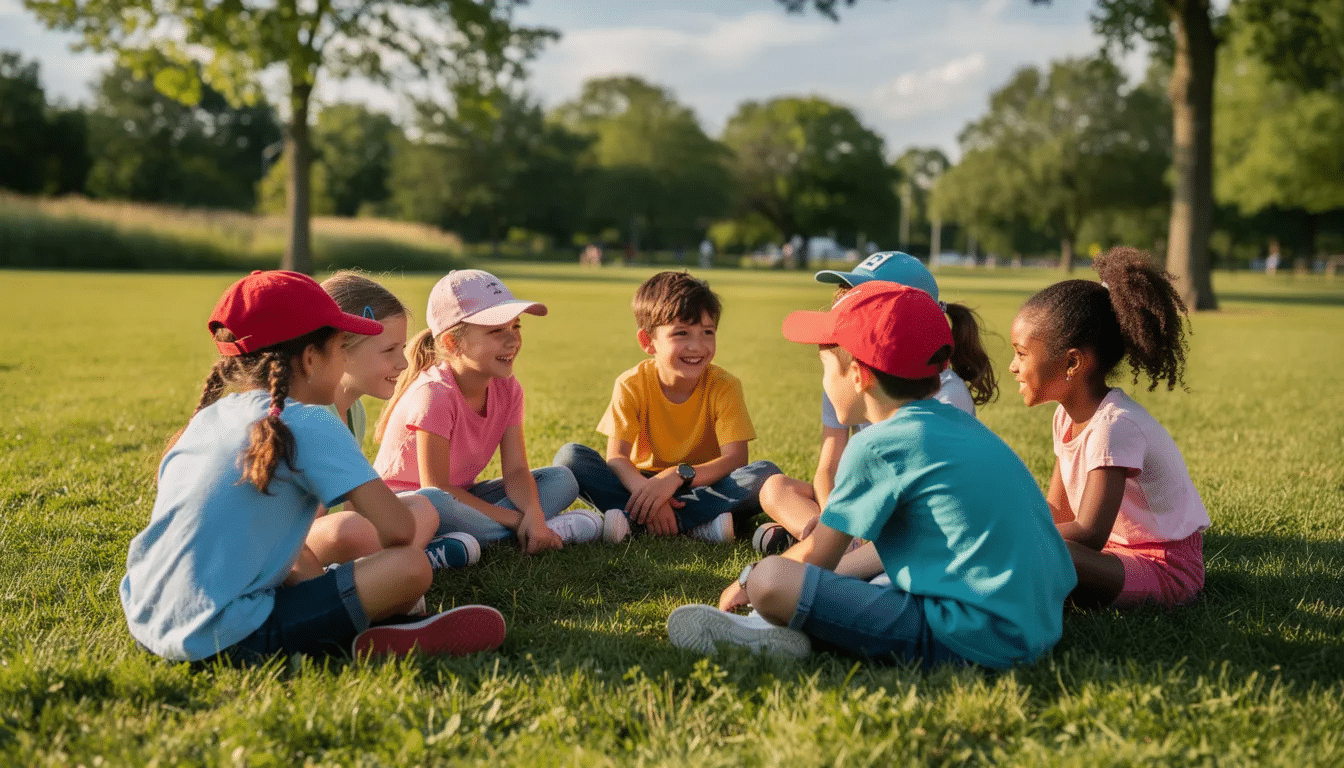
When a group forms a circle, there’s no front row or back row. Everyone is equally visible, which means shy kids can’t hide and no one gets left out of the action. This simple geometry transforms how people interact during a game.
The benefits go beyond fairness:
- Equal participation: Every person has the same view and the same opportunity to contribute, whether passing a ball or answering a question.
- Easy eye contact: Players can see each other’s faces, which builds connection and helps the game leader read the room.
- Simple instructions: A teacher or facilitator can demonstrate once from the center, and everyone sees the same thing.
- Quick setup: Use chairs, carpet spots, chalk marks on asphalt, or simply have the whole group hold hands and step back together.
- Safety and control: Leaders can see all players at once, which helps with behavior management in classrooms and camps. You’ll spot a wandering child or brewing conflict immediately.
- Versatile environments: Circles work in a school hall, church basement, living room, playground, campsite, or even online using virtual “circles” on video calls.
Preparation: Setting Up a Circle That Actually Works
A well-formed circle is crucial for smooth games, especially when you have 10–30 players. If the shape is lopsided or too cramped, instructions get lost and energy fizzles.
Here are concrete methods for forming a clean circle:
- Hold hands and step back: Have the group hold hands in a loose clump, then step backward together until arms are straight. Drop hands, and you have a circle.
- Use a rope loop: Lay a long rope in a circle on the floor and have players stand just outside it.
- Place markers: Set out cones, floor dots, or carpet squares at even intervals.
- Draw a chalk circle: On asphalt or a gym floor, draw a visible boundary so players know where to stand or sit.
Circle size tips:
- For younger kids, keep the circle small enough that all faces are clearly visible—about arm’s length apart.
- For 30+ players, consider two concentric circles or split into two separate circles running parallel games.
Accessibility considerations:
- Leave space for wheelchairs or mobility aids so everyone can join without awkward repositioning mid-game.
- Avoid tight corners or clutter around the circle edges.
- Always have a seated version available for games that typically require standing.
Finally, designate a clear “leader spot”—a teacher’s chair, a marked space on the carpet, or simply the same location each time. When instructions always come from the same visible place, transitions run faster and the group stays focused.
Classic Circle Games for Kids (Ages 4–11)
These are the time-tested favorites that need little or no equipment. They’re ideal for school, birthday parties, camps, and after-school programs. Each description includes age range, group size, equipment, and approximate playtime so you can plan transitions.
Duck Duck Goose (Ages 4–8)
Players sit in a circle on the floor. One player walks around the circle, tapping each person on the head and saying “duck.” When they tap someone and say “goose,” that second person jumps up and chases the first person around the circle. The first person tries to sit in the goose’s empty spot before being tagged. If tagged, they go to the middle and sit until another player is tagged. The game begins again with the new goose walking around the circle. Best for 8–20 players. Equipment: none. Playtime: 5–10 minutes.
Hot Potato (Ages 5–10)
Players sit in a circle and pass a soft ball or beanbag around while music plays. When the music stops, the person holding the object is either “out” or must answer a fun question (spelling word, math fact, trivia) to stay in. This simple game keeps students moving their hands quickly and listening for the music. Best for 6–25 players. Equipment: 1 ball or beanbag, music source. Playtime: 5–10 minutes.
Telephone (Ages 6–11)
Players sit in a circle. The first person whispers a sentence to the next person, who whispers it to the next, continuing around the circle. The last person announces what they heard, and the group compares it to the original sentence. The results are usually hilarious—words transform in fantastic ways. Best for 8–20 players. Equipment: none. Playtime: 5–8 minutes per round.
Button, Button, Who’s Got the Button? (Ages 5–9)
One player closes their eyes in the middle of the circle while another player secretly passes a small object (button, coin, pebble) to someone sitting in the circle. Everyone pretends to pass, hands cupped together. The guesser opens their eyes and gets three chances to point at who has the button. If they guess correctly, they switch places. Best for 6–15 players. Equipment: 1 small object. Playtime: 5–10 minutes.
1-2-3 Look (Ages 7–11)
Players stand in a circle with heads down, looking at their feet. On the count of “1-2-3 LOOK,” everyone looks up directly at one other player. If two players lock eye contact, they’re both out (or they switch places for a non-elimination version). The group continues until only two or three remain. This fun game builds suspense and creates plenty of laughter. Best for 10–30 players. Equipment: none. Playtime: 5–10 minutes.

Circle Time Learning Games for Preschool & Early Elementary
Circle time can combine play with early literacy, math, and social-emotional learning for ages 3–7. These activities work perfectly during morning meeting, pre-K circle time, kindergarten math block, or after-school clubs and can be paired with creative kindergarten class ideas for engaging learning experiences.
Literacy-Focused Circle Games
Sound I Spy: The game leader names a sound (like /s/) and children take turns finding items around the room or naming words that begin with that sound. Go around the circle until ideas run out, then pick a new letter. This builds phonemic awareness while keeping the whole group engaged.
Rhyming Train: One child says a word (like “cat”), and the next person must say a word that rhymes (“hat”). Continue around the circle until someone gets stuck or repeats a word. When the train “crashes,” start with a new word. Kids love the pressure of keeping the train moving.
Story Builders: Pass a soft toy as a “microphone.” Each child holding it adds one sentence to a shared story. The teacher can guide with prompts like “And then what happened?” This game develops narrative skills and teaches children to listen to what came before.
Math-Focused Circle Games
Number Pass: Players pass a ball while counting up by ones. When the ball returns to the leader, count backwards. For older students, count by twos, fives, or tens. You can also stop randomly and ask the person holding the ball to figure out what comes next.
What’s Missing?: Place 5–7 number cards or shape cards in the center of the circle where everyone can see. Have students close their eyes while you remove one. Players raise hands to guess which is missing. This builds memory and number recognition.
Movement-Plus-Learning Games
Syllable Stomp in a Circle: The leader calls out vocabulary words, and students clap or stomp for each syllable while staying in their spots. For example, “elephant” gets three stomps. This game connects phonics to physical movement.
Shape Yoga: The leader names a shape, and children form it with their arms or whole bodies while remaining in place. A circle involves rounded arms overhead, a triangle means arms meeting at a point above the head, and so on. Rest between shapes to build anticipation.
High-Energy Movement Circle Games
These games work best in gymnasiums, fields, or large halls where running and chasing are safe. Use them as 5-minute brain breaks, warm-ups before lessons, or end-of-day energy releases.
Duck Duck Splash (Warm Weather Variant)
This is Duck Duck Goose with water. One player walks around the sitting circle dripping water from a wet sponge onto each person’s head. When they squeeze and “splash” someone, that person jumps up and chases them around the circle. Perfect for outdoor summer programs.
Monkey in the Middle
Players form a wide circle and toss a ball back and forth while one player stands in the center trying to intercept. When the middle player catches the ball, they switch places with whoever threw it. Keep the circle large enough that throws have some distance. Best for similar age/size groups to keep it fair.
Number Freeze / Dance Freeze
Everyone dances within the circle boundary while music plays. When the music stops, the leader calls a number, and players must freeze in groups of that size. For example, if the leader calls “three,” players quickly find two partners and freeze together. Those left without a complete group do a silly action (jump three times, spin around) and rejoin.
Chair of Doom Variants
Players stand in a wide circle around a central object like a trash can or cone. Everyone holds hands and tries to gently pull others toward the center object without touching it themselves. Anyone who touches it sits out and becomes a judge. Stress safety: no yanking, no pushing—gentle, steady pulls only. This works best with teens and adults who can exercise control.
Safety guidance for all high-energy games:
- Establish clear start/stop signals (whistle, clap pattern, or a phrase like “Freeze, circle!”).
- Ensure enough space between players to avoid collisions.
- Remind players: no pushing, no tripping, and stop immediately on signal.
- Keep sessions short—5–10 minutes—so energy stays positive rather than chaotic.

Circle Icebreakers and Party Games for Teens & Adults
Circle games aren’t just for kids. They work brilliantly for youth group retreats, university orientations, workplace team days, and family reunions. The key is choosing games that match the group’s comfort level.
Verbal and Light-Movement Icebreakers
Never Have I Ever (Circle Version): Everyone holds up five or ten fingers. One person makes a statement like “Never have I ever been on an airplane.” Anyone who HAS done that thing puts a finger down. Go around the circle with each person making statements. The last person with fingers up wins. For age-appropriate settings, stick to travel, hobbies, and harmless experiences.
Question Circle Rotate: Form two circles—inner and outer—facing each other so everyone has a partner. The game leader asks a question (“What’s your favorite way to spend a Saturday?”). Partners discuss for 30–60 seconds, then the outer circle rotates one spot to create new pairs. Repeat with new questions. This generates rapid social interaction without awkward mingling.
Lost on a Deserted Island: Each person shares one item they’d bring to a deserted island and explains why. Go around the circle, and encourage follow-up questions. This low-pressure format helps people reveal personality without high stakes.
High-Energy Teen Camp Favorites
Bippity Bop-Bop: One player begins in the middle and approaches someone in the circle, saying “Bippity Bop-Bop-Bop!” That person must say “Bop!” before the middle player finishes. If they fail (or say the wrong thing), they trade places. Add variations: “Elephant!” means the person and their two neighbors must form an elephant shape. The middle player tries to catch someone making a mistake.
Honey, If You Love Me: One person walks up to another in the circle and says, “Honey, if you love me, won’t you please, please smile?” The seated person must respond, “Honey, I love you, but I just can’t smile”—without smiling. If they crack, they become “it.” Keep it lighthearted, and always emphasize that anyone can pass if they’re uncomfortable.
Adapting tone for different groups:
- For classrooms and youth groups, keep prompts school-appropriate and avoid anything too personal.
- For adult retreats or small gatherings, allow deeper questions (“What’s one thing you’ve changed your mind about?”).
- Always give players permission to pass without explanation.
Cooperative & Strategy Circle Games
Not all circle games involve chasing or silliness. Some build memory, focus, and teamwork—perfect for older kids, teens, and adults during rainy-day camp sessions, long bus rides, quiet evening programs, or homeroom advisory periods.
Assassin / Wink Murder
Players sit in a circle. One person is secretly designated the “assassin” (by drawing cards or the leader tapping them while eyes are closed). A “detective” sits or stands in the middle. The assassin “eliminates” other players by making subtle eye contact and winking. Eliminated players dramatically “die” and slump out. The detective gets three chances to identify the assassin before too many are eliminated. This game rewards subtlety and observation.
Two Truths and a Lie
Each person states three things about themselves—two true, one false. The rest of the circle tries to guess which statement is the lie. Go around the circle, and keep track of who fools the most people. This works well for groups getting to know each other.
Logic or Riddle Circles
The leader poses a logic puzzle or riddle. Players take turns asking yes/no questions to gather clues. Continue around the circle until someone believes they can answer. The group celebrates collaborative problem-solving rather than individual competition.
Twenty Questions (Circle Style)
One person thinks of an object, person, or place. Going around the circle, each player asks one yes/no question. After twenty questions total (one per person per round works well), anyone can attempt to guess. If no one guesses correctly, the original player wins and reveals the answer.
Keeping everyone engaged in strategy games:
- Enforce quick turn times—no long pauses.
- Allow short side discussions in pairs for collaborative guessing.
- Assign rotating roles: detective, scorekeeper, timekeeper.
- Cycle through multiple rounds so everyone gets different roles.
Making Circle Games Inclusive and Accessible
Circle games can be adapted so children and adults with different abilities can join in meaningfully. A little forethought makes a big difference, just as innovative creative ideas for classroom engagement and learning can transform how students participate.
Adaptation strategies:
- Seated versions: For games that typically require running, substitute hand signals, passing objects, or verbal responses. Duck Duck Goose becomes a shoulder-tap game where the “chased” person completes a task (name a word, count backward) rather than running.
- Visual supports: Use picture cards or written instructions for players who process language differently. Show a simple picture sequence of what happens in the game.
- Modified “out” rules: Instead of sitting idle when eliminated, players become helpers—the music DJ, scorekeeper, or caller. Everyone stays involved.
Sensory considerations:
- Offer quieter alternatives to loud clapping or shouting. Hand waves, finger snaps, or soft instruments work for signal cues.
- Warn before sudden noises or when music is about to start. A verbal countdown (“Music in 3, 2, 1…”) helps.
- Allow noise-canceling headphones when appropriate, especially for players sensitive to sound.
Group size adjustments:
- A circle of 30 can feel overwhelming. Break into two smaller circles of 12–15 for players who may struggle with large groups.
- For very young children, smaller circles of 6–8 maintain attention better.
The goal is participation, not perfection. When everyone can join in their own way, the game becomes more fun for the whole group.
Tips for Leading Circle Games Successfully
The same game can feel chaotic or magical depending on how it’s led. Strong facilitation turns a simple game into an experience players remember.
Before you begin:
- Always demonstrate once before starting at full speed. Use a quick “practice round” that doesn’t count.
- Give clear, short instructions. State one or two focus rules only (e.g., “Freeze when I clap twice”).
- Establish a start/stop signal everyone understands—a clap pattern, whistle, drum, or phrase like “Ready, circle?”
Timing advice:
- Aim for 5–10 minutes per game with younger children. Attention fades fast.
- For older groups, 10–20 minutes works well, but switch games before energy drops.
- Always end while fun is still high rather than waiting until boredom sets in.
Encouraging player input:
- Once players understand the basic game, invite variations: reverse direction, change the object, add a funny challenge, sing the instructions instead of speaking them.
- Ask, “What could make this harder?” or “What rule should we change?” Kids often have fantastic ideas.
Transitions:
- Have a short cool-down circle game ready (quiet passing game or story circle) to transition back to lessons or quieter activities.
- Use a consistent phrase to signal the game is ending: “Last round coming up!”
Common mistakes to avoid:
- Over-explaining before playing. Keep instructions to 30 seconds, then learn by doing.
- Letting “out” players sit too long. Rotate them back in quickly or give them a helper role.
- Forgetting to repeat success. When a game works well, note it for next time.
Sample Ready-to-Use Circle Game Sessions
These quick “playlists” give you ready-made session structures. Copy them directly or mix and match games from earlier sections using the same format: quick icebreaker, main active game, calm finisher, especially when planning engaging group activities for 5 year olds.
20-Minute Preschool Circle Time
Game | Time | Purpose |
|---|---|---|
Sound I Spy | 5 min | Warm-up and phonics |
Hokey Pokey or movement song | 8 min | Active movement |
What’s Missing? | 5 min | Calm focus activity |
Goodbye song in circle | 2 min | Transition |
Age range: 3–5 years. Group size: 8–15 kids. Setting: Classroom carpet area or outdoor circle. |
30-Minute Youth Group Icebreaker Night
Game | Time | Purpose |
|---|---|---|
Question Circle Rotate | 10 min | Partner introductions |
Bippity Bop-Bop | 12 min | High-energy fun |
Never Have I Ever | 8 min | Group bonding and laughs |
Age range: 12–18 years. Group size: 15–30 teens. Setting: Church hall, camp lodge, or gym. |
15-Minute Classroom Brain Break
Game | Time | Purpose |
|---|---|---|
Dance Freeze | 5 min | Movement release |
Number Pass | 5 min | Active counting |
Telephone | 5 min | Calm, silly transition |
Age range: 6–11 years. Group size: 15–25 students. Setting: Classroom with desks pushed aside or gym. |
10-Minute Family Gathering Warm-Up
Game | Time | Purpose |
|---|---|---|
1-2-3 Look | 4 min | Quick laughs |
Hot Potato | 6 min | All-ages participation |
Age range: Mixed ages, 5–adult. Group size: 8–20 family members. Setting: Living room or backyard. |
Feel free to adjust times based on your group’s energy. The key structure—icebreaker, main game, finisher—works for almost any situation.

Wrapping Up: Turning Any Group into a Circle Game Group
Circles make it easy to see, hear, and include everyone—whether you’re leading preschoolers through their first group activity, energizing teenagers at summer camp, or breaking the ice at a corporate retreat. The format is universal because it puts human connection at the center.
Most of these games need minimal equipment—often just a ball, some music, or nothing at all—and can be taught in under two minutes. That’s the beauty of circle games: low prep, high reward.
Pick 2–3 favorites from this guide and learn them well enough to pull out at a moment’s notice. Keep them “in your back pocket” for last-minute schedule changes, unexpected downtime, or that moment when your group needs energy (or calm) and you need a reliable tool.
Finally, don’t be afraid to experiment. Change the objects, add seasonal themes, mix movement with learning, or let players invent new rules. The games that stick are the ones you make your own. Circles have been bringing people together for as long as humans have gathered—and with the right game, your group will remember the experience long after the last round ends.