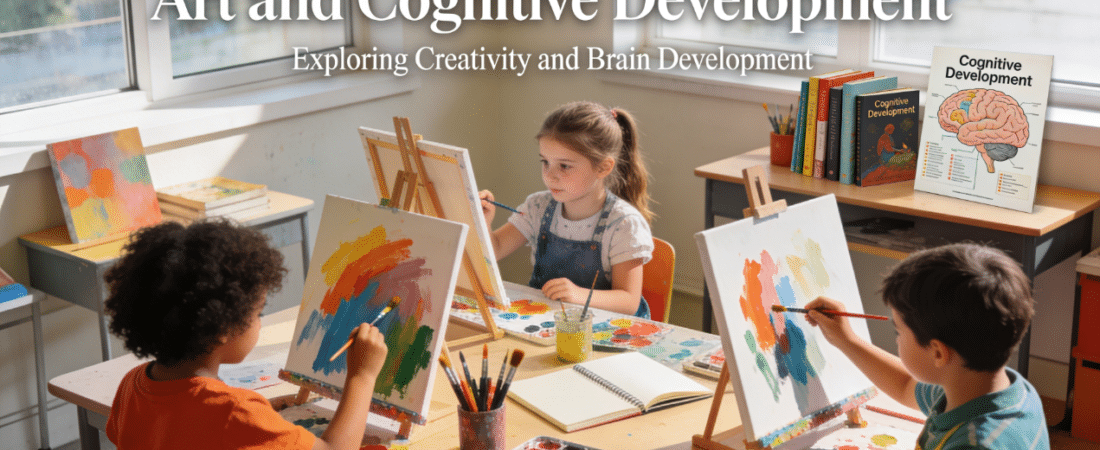

From the moment children are born until around age eight, their brains undergo extraordinary transformation. During this window, regular engagement in art—whether drawing, music, dance, or drama—can significantly boost cognitive growth in ways that extend far beyond what we typically call “creativity.” Cognitive development refers to the growth of mental abilities such as memory, attention, language, reasoning, and executive functions that enable children to learn and solve problems. Research shows that artistic activities enhance executive function, language skills, memory, problem solving, and academic readiness. A 2023 randomized controlled trial launched in Geneva primary schools is now tracking measurable brain and executive function changes following structured arts programs, adding to decades of evidence that art activities shape how young minds develop.
This article focuses on early childhood development through middle childhood (roughly ages 3–12) and explores how different types of art influence specific cognitive domains. Here’s what we’ll cover:
- How brain development responds to artistic engagement during critical windows
- The specific cognitive abilities strengthened by music, visual arts, dance, and drama
- Emotional, social, and motor dimensions that support thinking and learning
- Evidence from recent research on music and visual arts interventions
- Practical ways parents and educators can use art to support cognitive development
- A Brief Historical Perspective: Art and Learning Across Civilizations
- Brain Plasticity and Why Childhood Is a Critical Window
- Core Cognitive Skills Strengthened by Artistic Activities
- Emotional, Social, and Motor Dimensions that Support Cognition
- Evidence from Recent Research: Music, Visual Arts, and the Developing Brain
- Practical Ways to Use Art to Support Cognitive Development
- Conclusion: Investing in Art to Build Smarter, More Adaptable Minds
A Brief Historical Perspective: Art and Learning Across Civilizations
Art has long been intertwined with how ancient societies educate and socialize children. This connection stretches back to the earliest human communities and persists across every major civilization.
Consider the prehistoric cave paintings at Lascaux, created around 17,000 BCE. Scholars believe these images weren’t merely decorative—they shaped early symbolic thinking and storytelling within groups, teaching young people to represent the world through visual symbols. This capacity for symbolic representation remains foundational to language skills and abstract reasoning today.
In 5th and 4th century BCE Athens, education seamlessly mixed geometry, music instruction, and drama to cultivate reasoning and rhetoric. Greek philosophers understood that musical training disciplined the mind while theatrical performance developed empathy and communication. Across the ocean, Mesoamerican cultures used visual narratives to transmit complex ideas to the next generation. The Teotihuacan murals (1st–7th centuries CE) taught young people about cosmology, social roles, and cultural values through imagery—a form of visual arts education embedded in daily life. From Indian classical music training beginning in early childhood to Renaissance apprenticeships where young artists learned alongside masters, diverse perspectives across cultures consistently positioned art as central to mental discipline rather than a leisure “extra.”
Brain Plasticity and Why Childhood Is a Critical Window
Neuroplasticity—the brain’s remarkable capacity to reorganize its connections in response to experience—operates at peak intensity from birth to around age eight to ten. Neuroplasticity enables the brain to adapt and form new connections, which underlies the cognitive development supported by artistic activities. During this period, the brain is exceptionally responsive to environmental input, making early years particularly important for establishing cognitive foundations.
Several brain regions are especially involved in the connection between art and cognitive development. The prefrontal cortex manages planning, inhibition, and cognitive flexibility. Parietal regions handle spatial reasoning and mathematical thinking. Temporal areas process auditory information and support language development. The visual cortex responds to images and artistic mediums, while the corpus callosum facilitates communication between brain hemispheres—a structure that structural plasticity research shows can be enhanced through musical training, particularly in professional musicians who began studying in early childhood.
By ages six to eight, much of the brain’s structural scaffolding is in place, yet circuits linked to executive function and abstract reasoning continue refining through adolescence. Imaging studies from large projects—including the Swiss National Science Foundation–funded research (SNSF no. 100014_214977) approved in 2023—are tracking how intensive musical and visual arts training over two years can alter white-matter connectivity and activation patterns linked to working memory and attention. This research represents a pivotal role in understanding exactly how creating art reshapes the developing brain.
Core Cognitive Skills Strengthened by Artistic Activities
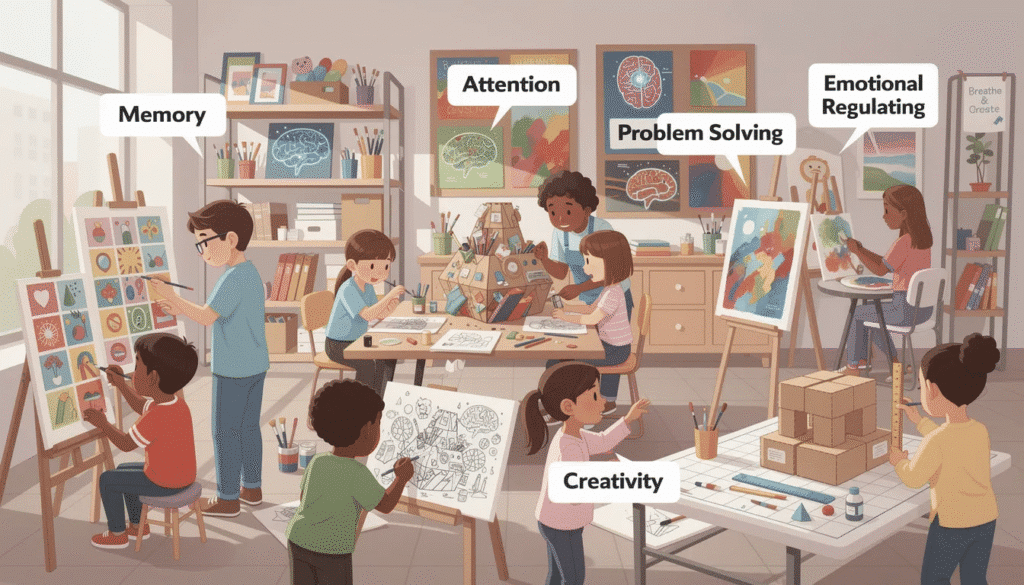
When we talk about cognitive development, we’re referring to the practical mental capabilities that underpin learning: attention, memory, language, reasoning, and executive functions. In this article, ‘art’ includes music, visual arts, dance, and drama as forms of creative expression. These cognitive abilities determine how effectively children learn in school and navigate daily challenges.
Different art forms recruit overlapping but distinct cognitive systems. Playing violin requires reading notation (visual processing), coordinating finger movements (motor control), listening for pitch (auditory processing), and tracking one’s place in the music (working memory). Drama demands understanding characters’ emotions (social cognition), memorizing lines (memory), and projecting voice and movement (motor skills). Visual arts like painting require careful observation, spatial reasoning, and planning. Research since the early 2000s—including longitudinal and randomized controlled trials—connects sustained arts participation with improved performance in math, reading, and problem solving, even after controlling for socioeconomic status.
Executive Functions: Planning, Inhibition, and Cognitive Flexibility
Executive functions are the mental skills that help children learn to focus, switch between tasks, control impulses, and plan ahead. These abilities serve as the air traffic control system of the brain, managing the flow of information and action.
Musical instrumental practice offers particularly powerful executive function training. When a seven-year-old learns violin in a group setting, they must sustain attention across extended practice periods, monitor their own errors, and inhibit the impulse to play until their cue arrives. These demands directly exercise the same cognitive skills needed for classroom learning. Randomized classroom-based music programs—such as “Orchestra in Class” trials conducted in Switzerland during the 2010s, with new cohorts starting in 2024—have demonstrated gains in working memory and cognitive flexibility compared to non-arts controls. Children in these programs show improved ability to hold instructions in mind and adapt when circumstances change.
Visual arts projects similarly strengthen executive function through different mechanisms. Consider a third-grader undertaking a multi-step printmaking project: they must plan the design, execute each step in sequence, and adapt when the print doesn’t turn out as expected. This creative process demands the same planning, sequencing, and flexible thinking that supports problem solving across academic subjects. The cognitive benefits extend beyond the art room, supporting critical thinking skills children need in math class and beyond.
Language, Communication, and Symbolic Thinking
Art fundamentally involves symbolic representation—using shapes, sounds, and gestures to stand for ideas. This capacity is foundational for language skills and literacy development, making artistic endeavors powerful tools for communication growth.
Consider a kindergarten classroom where children learn through story-based drama. Five-year-olds working together to create a picture book must negotiate plot elements, practice skills like taking turns, and translate their mental images into drawings and words. This process expands vocabulary, develops narrative structure awareness, and strengthens self expression. The child who draws a scene and then explains “What’s happening here?” is practicing the same language skills needed for reading comprehension and writing.
Research confirms these connections. Children regularly engaged in arts-based literacy activities show improved narrative comprehension and expressive language by ages six to seven. Music training, especially singing in groups, sharpens phonological awareness—sensitivity to the sounds within words—which is one of the strongest predictors of reading success. When young children clap syllables, sing rhyming songs, or learn simple melodies, they’re building the auditory discrimination skills that support decoding written text.
Spatial Reasoning and Early Mathematical Thinking
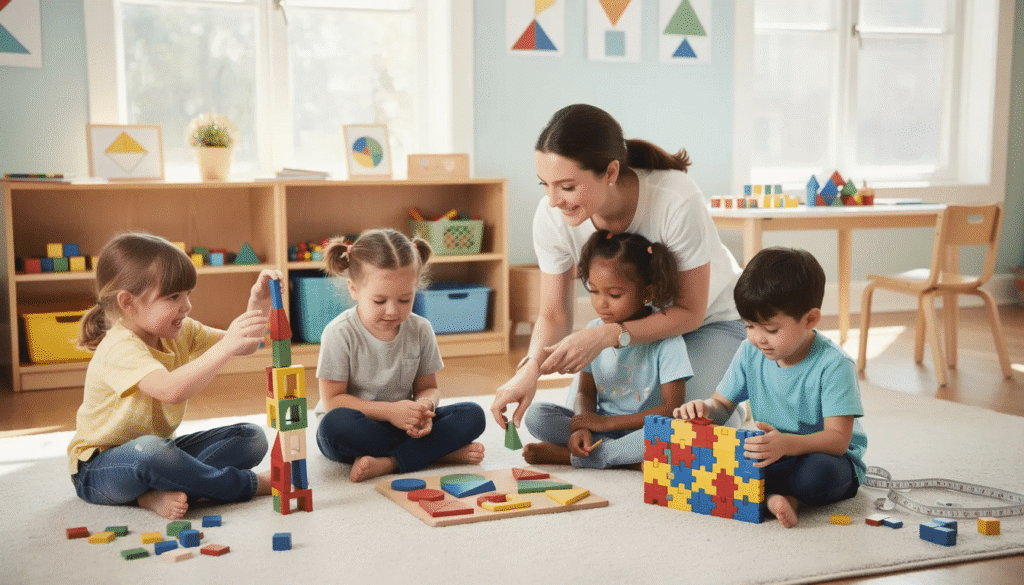
Spatial reasoning—understanding shapes, positions, and transformations—has well-documented links to later success in STEM fields. Many artistic activities directly strengthen these cognitive skills.
Block-based sculpture requires children to visualize three-dimensional forms and understand how pieces fit together. Collage with geometric cut-outs develops recognition of shapes and spatial relationships. Perspective drawing in ages seven to ten strengthens mental rotation and spatial visualization—the ability to imagine how objects look from different angles. A child building a cityscape from cardboard boxes is practicing the same spatial reasoning they’ll need for geometry and engineering.
Music contributes to this development through different pathways. Reading musical notation involves decoding symbols arranged across a horizontal line—a spatial skill similar to reading graphs or maps. Rhythmic patterns support sequencing and pattern recognition, cognitive foundations for early arithmetic. When children learn that four quarter notes equal one whole note, they’re engaging with mathematical relationships through a creative expression that feels like play rather than drill. Research from the 2010s and 2020s indicates that children exposed to structured visual arts and design tasks often show better performance on spatial and geometry tests in primary school.
Memory, Attention, and Processing Speed
Working memory—holding information in mind while using it—and sustained attention are essential for classroom success. Art activities directly exercise these systems through engaging, meaningful practice skills.
Consider what happens when a child memorizes choreography for a short dance performance. They must encode the sequence of movements, rehearse until it becomes automatic, and retrieve the steps during performance while managing stage nerves. This process exercises the same memory systems needed to remember multi-step math procedures or follow complex instructions. Similarly, memorizing lines for a play or learning a simple piano piece requires encoding, rehearsal, and retrieval—directly strengthening memory capacity.
Randomized musical training studies published since around 2015 have reported faster reaction times and improved selective attention in children who practiced instruments weekly over one to two years compared with controls. Visual arts can support attentional control through different mechanisms. Detailed observational drawing of natural objects—leaves, shells, insects—encourages sustained focus on fine details for extended periods. A child who can concentrate on capturing the exact curves of a seashell is building the same attentional muscles needed for careful reading and other tasks requiring focus.
Emotional, Social, and Motor Dimensions that Support Cognition
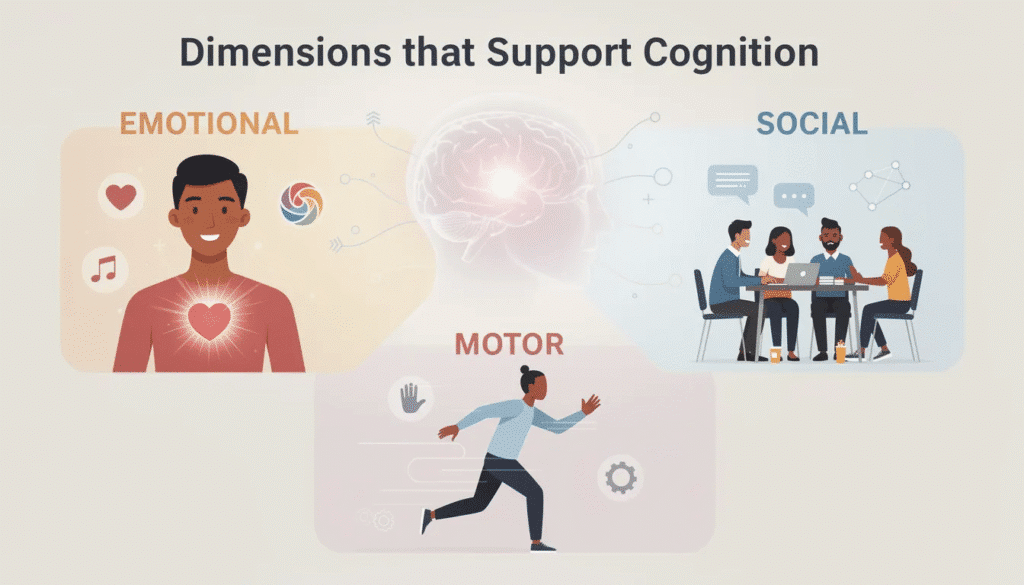
Cognitive development doesn’t happen in isolation. Emotional regulation, social interaction, and motor control all feed into how effectively children think and learn. Art experiences uniquely engage feelings, relationships, and movement simultaneously, creating rich contexts where cognitive skills consolidate more effectively.
Young minds develop best when thinking, feeling, and moving work together. The child who paints while processing complex emotions, collaborates on a mural with classmates, and develops hand eye coordination through brushwork is building integrated capacities that support all learning. These dimensions deserve closer examination.
Emotional Expression, Self-Esteem, and Stress Regulation
Art offers children safe ways to express complex emotions they may not yet have words for. A child who cannot articulate feeling overwhelmed might paint with dark, swirling colors or pound clay with particular intensity. This emotional intelligence—recognizing and processing feelings—develops through artistic expression in ways that support overall mental well being.
Completing an art project or performance builds a sense of competence and self esteem. When a shy eight-year-old sees her drawings displayed in the school hallway, she experiences herself as capable and valued. When a child who struggles academically excels in theater club, she discovers strengths that balance challenges elsewhere. These experiences of mastery support emotional resilience—the ability to persist through difficulty.
Educators and child psychologists have used art-based techniques to help children cope with stress, trauma, or anxiety since the late twentieth century. A child who learns to calm down through drawing or music develops emotional regulation skills that directly support executive function performance. The student who can manage frustration during a challenging art project applies that same regulation when facing difficult math problems.
Collaboration, Empathy, and Social Cognition
Group artistic activities demand social skills that transfer to all collaborative contexts. Creating a community-themed mural requires children ages seven to nine to negotiate roles, consider peers’ perspectives, and resolve disagreements about design choices. These are the same skills needed for effective group work in academic subjects.
Consider a third-grade class working on a mural about their neighborhood. They must decide what to include, who will paint which section, and how to handle differing visions. One child wants to feature the park; another insists on the fire station. Navigating these differences develops perspective-taking and empathy—understanding others’ viewpoints even when they differ from your own.
School-based art programs from the 2000s and 2010s consistently show improved peer relationships, empathy, and reduced behavioral problems among participants. These social connections support collaborative problem solving and group learning across all subjects. The child who learns to listen to ensemble partners’ ideas in music class brings that same collaborative capacity to science group projects.
Fine and Gross Motor Skills as Foundations for Learning
Motor development and cognitive development mutually reinforce each other throughout child development. Fine motor skills—small, precise hand and finger movements—develop through activities like holding brushes, cutting with scissors, shaping clay, and threading beads. Gross motor skills—whole-body movement and coordination—grow through large-scale painting, creative movement, and drama games.
The connection between grasping pencils effectively and physical development has profound implications for school readiness. Children with well-developed fine motor control by ages four to seven are better prepared for writing, drawing graphs, and manipulating math tools like rulers and compasses. The three-year-old who finger paints and tears paper is building the same hand muscles needed for handwriting at age six.
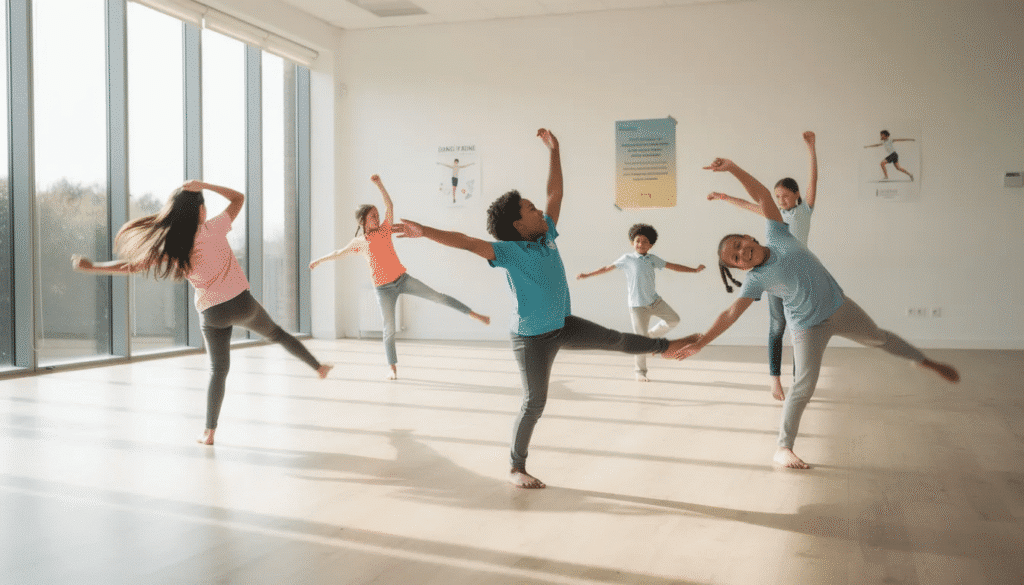
Dance and creative movement develop gross motor skills while building spatial orientation and body awareness. A child who learns to move confidently through space during drama class carries that coordination and confidence into physical education and classroom navigation. These motor foundations support the kind of engaged, active learning that characterizes successful young learners.
Evidence from Recent Research: Music, Visual Arts, and the Developing Brain
Many claims about art’s role in cognitive growth are now backed by controlled studies, including randomized controlled trials launched in Europe and North America over the last two decades. This research moves beyond anecdote to demonstrate measurable impacts on brain development and academic achievement.
Musical training effects have been studied most extensively, with visual arts research growing more recently. Both show measurable cognitive benefits, though sometimes in different domains. The 2023 Swiss National Science Foundation–funded project (SNSF no. 100014_214977) in Geneva represents the current frontier of this research, comparing intensive musical instrumental practice, visual arts, and a control group in 150 children aged six to eight over two years, using advanced brain imaging to track changes.
Musical Training and Executive Function Gains
Classroom-based “Orchestra in Class” interventions represent one of the most thoroughly studied art form approaches. Children learn string instruments—violin, viola, cello—in groups, typically starting around ages six to ten with weekly sessions over two academic years. The programs emphasize ensemble playing, regular practice, and gradual skill progression.
Prior randomized controlled trial findings published in the 2010s consistently show that children in Orchestra in Class programs improve more in working memory, cognitive flexibility, and sometimes school grades than peers doing non-musical creative activities. Jaschke et al.’s influential 2.5-year study found that music enhanced inhibition, planning, and verbal IQ compared to both visual arts groups and controls.
The mechanisms behind these gains involve simultaneous engagement of auditory, motor, visual, and reward systems. The brain’s auditory system processes input faster than any other sense, stimulating dopaminergic reward pathways that reinforce learning. Playing an instrument demands constant error correction while synchronized group activity requires focused attention on both one’s own playing and others’. New cohorts in Geneva primary schools since late 2023 are undergoing MRI scans to track structural changes in brain connectivity related to these executive function gains, promising to clarify the neural mechanisms at play.
Visual Arts Programs and Cognitive Outcomes
Systematic research on visual arts interventions—drawing, painting, sculpture, design—has expanded more slowly than music studies but is growing rapidly. These art classes typically involve weekly sessions focused on observation, composition, and experimentation with artistic mediums, sometimes integrated with science or social studies projects.
Preliminary findings indicate that visual arts programs can improve visual-spatial skills, attention to detail, and planning. A 2015 Ohio State University study linked regular visual arts exposure to elevated creative thinking scores. The 2018 University of Arkansas research demonstrated that pre-teens in art activities exhibited heightened brain activity in brain regions associated with focus, planning, and critical thinking.
In the Swiss randomized controlled trial, visual arts groups serve as an active comparator to music groups, helping researchers distinguish effects unique to music from those common to all structured art experiences. While music often shows the strongest executive function effects, visual arts contribute significantly to spatial reasoning, divergent thinking, and persistence on complex tasks. A key finding from earlier research: while music groups excelled in inhibition and planning, visual arts groups showed advantages in visuospatial memory—demonstrating that different art forms offer different developmental benefits.
Integrated Arts Approaches in Schools
Integrated arts programs weave music, drama, dance, and visual arts into core subjects like language arts, science, and history. Rather than treating art as a separate subject, these approaches use artistic expression to deepen understanding across the curriculum.
Practical examples abound in elementary schools implementing integrated approaches:
Subject | Integrated Arts Activity | Cognitive Skills Engaged |
|---|---|---|
History | Tableau and role-play to explore historical events | Perspective-taking, memory, embodied learning |
Science | Diagrammatic drawing of ecosystems or life cycles | Observation, spatial reasoning, conceptual understanding |
Math | Composing simple songs to remember multiplication facts | Auditory memory, pattern recognition, encoding |
Language Arts | Creating graphic novels or illustrated stories | Narrative structure, visual-verbal integration, planning |
Evidence from research spanning the early 2000s through 2020s indicates that integrated arts curricula can enhance engagement and deepen understanding, especially for children who struggle with traditional lecture-based instruction. These approaches may be more feasible for resource-limited schools because they use existing teachers and classroom time rather than requiring separate specialist hours. The holistic development these programs support—cognitive, creative, and emotional—reflects how children learn best: through meaningful, connected experiences rather than isolated skill drills. |
Practical Ways to Use Art to Support Cognitive Development
Meaningful cognitive benefits come from regular, process-focused art experiences rather than expensive materials or advanced talent. The key is consistency, open-ended exploration, and conversation about the creative process. Whether at home or school, adults can support cognitive growth by providing opportunities for children to explore, create, and reflect.
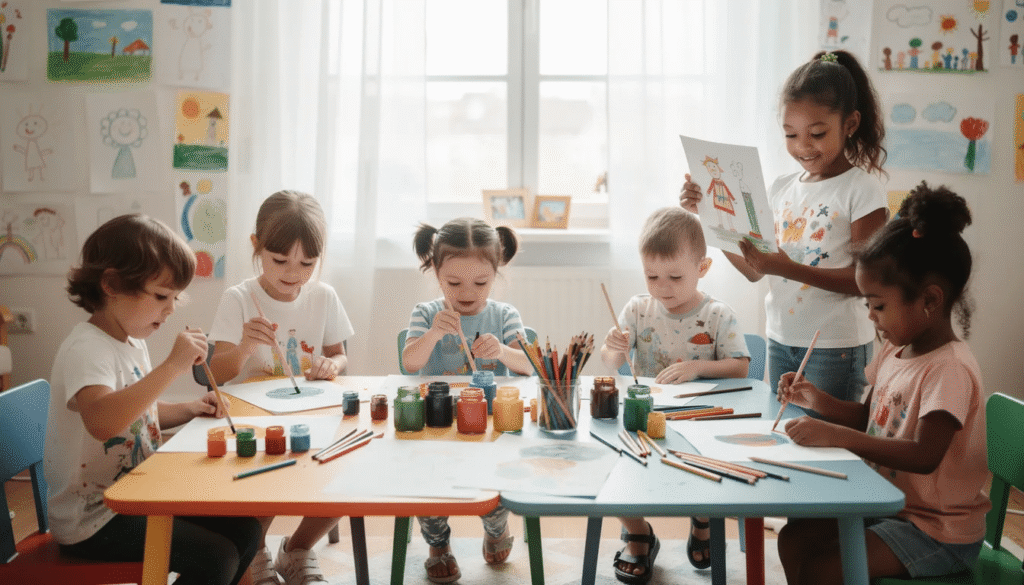
Activities should be age-appropriate and emphasize the process rather than the final product. A child who experiments freely with color mixing learns more than one focused solely on producing a “correct” result. Discussion and reflection amplify benefits—asking children about their choices and observations develops metacognitive skills alongside artistic ones.
At Home: Everyday Art Habits for Thinking Skills
Setting up a small, permanent art corner with accessible materials encourages sustained experimentation. When crayons, washable paints, recycled cardboard, glue, and child-safe scissors are predictably available, children engage more regularly with art activities. The materials need not be expensive—imagination matters more than art supplies.
Consider age-appropriate activities that build cognitive skills:
Ages 2–4:
- Finger painting with naming colors and shapes (language, sensory integration)
- Scribbling with discussion about what the marks “mean” (symbolic thinking)
- Tearing and gluing paper (fine motor skills, spatial awareness)
Ages 4–7: For ideas to encourage creativity and group play, check out these engaging group activities for 5 year olds.
- Story drawing followed by narration (language skills, narrative structure)
- Simple book-making with folded paper (sequencing, planning)
- Building with recycled materials (spatial reasoning, problem solving)
Ages 8–12:
- Comic creation with plotted stories (narrative planning, visual-verbal integration)
- Stop-motion videos using toys or clay figures (sequencing, technology skills)
- Designing and building functional objects (engineering thinking, persistence)
Parents support cognitive growth by talking with children about their creations. Open-ended questions work best: “What’s happening in this picture?” “How did you decide to use that color?” “What would you do differently next time?” These conversations develop language, reflection, and metacognitive skills—thinking about one’s own thinking.
Integrating art with reading and math amplifies benefits. Children might illustrate favorite stories, create maps of imaginary worlds, or design board games involving counting or simple probability. These activities make abstract concepts concrete while building innovative thinking skills that support academic achievement.
In Educational Settings: Designing Classrooms that Think Through Art
Teachers can embed art across the timetable rather than confining it to isolated art class periods. Drawing storyboards supports language arts instruction. Modeling molecules in clay makes chemistry tangible. Choreographing movements to represent life cycles or historical timelines creates embodied understanding that lectures cannot match.
Structuring at least one longer-term art project per term directly practices executive functions:
- Class murals require planning, role division, and revision
- Short plays demand memorization, collaboration, and performance under pressure
- Collaborative animations involve sequencing, patience, and group decision-making
These projects mirror real-world work: identifying goals, allocating responsibilities, managing setbacks, and celebrating collective achievement. The vital component is process focus—what children learn through creating matters more than the final product displayed on the wall.
Collaboration with local cultural institutions enriches arts education without straining school resources. Attending a children’s concert, visiting a hands-on gallery workshop, or hosting a local artist for a demonstration exposes children to art as a living practice rather than a school subject. These experiences expand diverse perspectives and demonstrate that artistic endeavors matter in adult life.
Assessment should focus on process rather than only final products. Reflection journals, peer feedback sessions, and guided discussions help children develop metacognition and emotional growth alongside artistic skills. When a child articulates why they made certain choices and what they might try differently, they’re building the critical thinking that transfers to all academic work. Arts education aligned with existing curriculum standards can satisfy accountability requirements while delivering the broader developmental benefits that art serves throughout childhood.
Conclusion: Investing in Art to Build Smarter, More Adaptable Minds
Art in early childhood and middle childhood is not merely decorative—it is a powerful driver of cognitive, emotional, social, and motor development. From the prehistoric caves at Lascaux to contemporary Geneva classrooms, humans have recognized that creative activities shape how young minds grow. The evidence accumulated over the last two decades—including rigorous randomized controlled trials involving weekly arts instruction and multi-year follow-up—confirms what intuition long suggested: art plays a crucial role in strengthening executive function, language skills, spatial reasoning, and academic outcomes.
The long-term perspective matters most. Children whose creativity, focus, and problem solving are nurtured through art arrive at adulthood better equipped for complexity and change. In a world demanding innovative thinking and emotional resilience, the cognitive flexibility built through artistic practice becomes an integral part of success. The research is clear, the mechanisms are understood, and the path forward is evident. Parents, teachers, and policymakers who treat art as a core, evidence-based component of education—rather than an optional extra to be cut when budgets tighten—invest in stronger minds and more adaptable futures. The question is not whether we can afford arts education, but whether we can afford to neglect it.