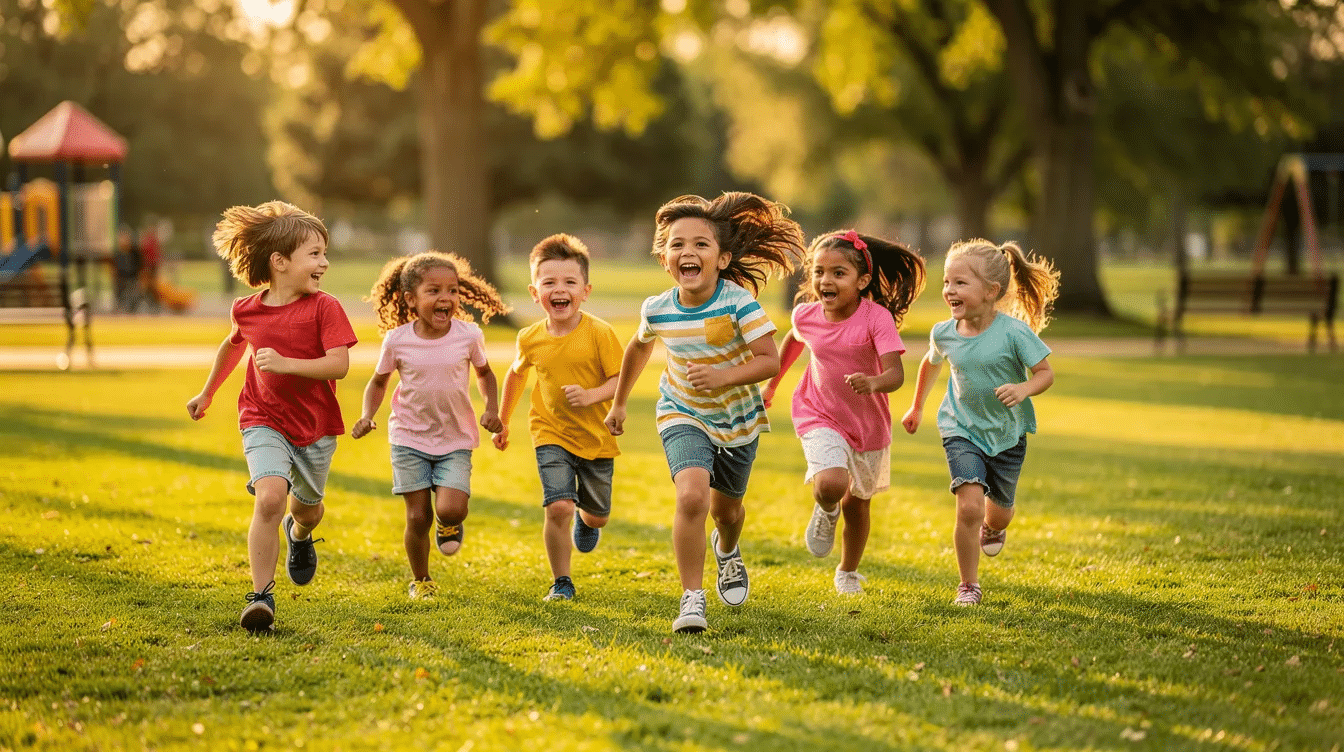
If you need outdoor activities for kids no equipment needed, the good news is that the best ideas are often the simplest. A safe play area, a few clear rules, and a little imagination can turn a backyard, schoolyard, sidewalk, or local park into a full afternoon of outdoor fun.
Equipment-free outdoor play matters because it helps children move more, solve problems, practice independence, and interact with other kids without relying on screens, toys, or structured programs. Outdoor play helps improve children’s physical health, social skills, and creativity while reducing screen time.
In this blog post, we’ll cover the best categories of outdoor games that require no gear, including classic outdoor games like tag, hide and seek, Duck, Duck, Goose, Simon Says, Red Light, Green Light, animal races, and i spy. We’ll also look at how to choose the right activity based on age, group size, energy level, safety, and how long the game is likely to keep kids entertained.
- How We Chose the Best Equipment-Free Outdoor Activities
- Safety and age-appropriateness as primary considerations
- Level of physical activity and energy burning potential
- Social interaction and teamwork opportunities
- Ease of explanation and setup for parents/caregivers
- Adaptability for different group sizes and ages
- Educational value and skill development benefits
- Fun factor and likelihood to hold children’s attention
- Top 7 Categories of Equipment-Free Outdoor Activities for Kids
- Quick Comparison of the Best Activity Types
- How to Choose the Right Activities for Your Kids
- Which Activities Are Best for You?
- Final Thoughts
How We Chose the Best Equipment-Free Outdoor Activities
The best no-equipment games are easy to start, safe to supervise, and flexible enough for younger kids, older kids, and mixed ages. We chose activities based on seven practical factors.
Safety and age-appropriateness as primary considerations
A good outdoor game gives children room to explore without exposing them to unnecessary danger. Running, jumping, climbing over roots, and balancing on one foot can be healthy forms of challenge, but traffic, deep water, broken glass, steep drops, and crowded hard surfaces are hazards to avoid.
Before any game starts, set boundaries. Children should know where the play area begins and ends, where they can hide, and when they need to stop. This is especially important for energetic kids who may run at full speed during classic tag, freeze tag, or racing games.
The CDC recommends that children ages 6 to 17 get at least 60 minutes of moderate-to-vigorous physical activity each day. Younger children ages 3 to 5 should be active throughout the day. No-equipment outdoor games can help families work toward those goals without buying anything.
Level of physical activity and energy burning potential
Some games are vigorous, such as tag, animal races, and Red Light, Green Light. Others are calmer, like cloud watching, i spy, or a nature scavenger hunt. A balanced outdoor session usually works best:
- Start with a simple game to warm up.
- Move into a high-energy activity.
- End with a quieter game to help kids reset.
Engaging in physical activities such as running, jumping, and playing tag helps develop cardiovascular fitness, strength, and coordination in children.
Social interaction and teamwork opportunities
Outdoor games for children can encourage activity, teamwork, and imagination. Games that require teamwork or turn-taking help children learn how to cooperate, share, and negotiate, which are essential social skills.
That means the best activities are not always the ones with a winner. Sometimes the most valuable game is the one where multiple players have to agree on rules, help a younger child join in, or work as two teams toward a shared goal.
Ease of explanation and setup for parents/caregivers
The strongest no-equipment activities have simple rules. If you can explain the activity in a few minutes, children are more likely to start quickly and stay engaged.
For example:
- “Run when I say green light and stop when I say red light.”
- “One child counts while the other kids hide.”
- “Players stand in a circle, and one player walks around tapping heads.”
- “The last person to move after freeze dance is out, or everyone stays in and keeps dancing.”
The goal is not to over-direct. Adults should create safe boundaries, then let children own the play.
Adaptability for different group sizes and ages
The same activity should work for small families, neighborhood play, school recess, and family gatherings. Some games work with only two children. Others work better with a whole group.
A good list also needs options for:
- solo play
- pairs
- small groups
- large groups
- younger children
- older kids
- mixed ages
- children who need lower-intensity options
Educational value and skill development benefits
Outdoor play builds more than muscles. It supports listening, memory, vocabulary, observation skills, social confidence, emotional regulation, and problem-solving.
Games that require teamwork or turn-taking help children learn how to cooperate, share, and negotiate, which are important social skills. Imaginative play encourages children to invent new games or modify existing ones, fostering creativity and problem-solving skills.
Fun factor and likelihood to hold children’s attention
A game can be healthy, but if kids do not enjoy it, it will not last. We prioritized activities that kids love because they include suspense, choice, movement, role-playing, or a fun twist.
The best no-equipment outdoor games are easy to repeat but never exactly the same twice.
Top 7 Categories of Equipment-Free Outdoor Activities for Kids
1. Tag Game Variations
Tag is one of the most familiar playground games because it needs nothing but space and willing players. In classic tag, one child is “it” and tries to tag the other kids. Once tagged, another player becomes “it,” and the game continues.
Creative variations of tag include Freeze Tag, Shadow Tag, and Rock Paper Scissors Tag. These versions change the pace, reduce contact, or add strategy.
Here are a few easy versions:
- Classic tag: One player chases the others and tags someone to become the new chaser.
- Freeze tag: Tagged players freeze in place until another player unfreezes them.
- Shadow tag: Instead of touching another player, the chaser steps on someone’s shadow.
- Toilet tag: A frozen player crouches like a toilet, and another player “flushes” them to free them.
- Rock Paper Scissors Tag: Players pair up, play rock paper scissors, and the winner chases the other player to a boundary.
- Blob tag: Tagged players join hands with the tagger until the blob grows.
If you are playing rock paper scissors tag with multiple kids, have the kids line up in pairs first. After each round, the winner runs while the other player chases for a set distance.
Why It Stands Out
Tag combines cardio exercise with quick decisions. Children have to watch space, predict movement, change direction, and manage speed.
Research on modified playground games has found that reducing elimination and waiting time can increase moderate-to-vigorous physical activity. One study using LET US Play principles found that modified tag-style games produced about 20% more moderate-to-vigorous activity than traditional versions.
If you want more movement, avoid rules where kids sit out for long periods. Keep everyone active.
Best For
Tag games are best for active children ages 4 to 12 who enjoy running, chasing, and competitive play.
They are especially useful for:
- energetic kids who need to burn energy
- large groups at recess
- siblings with similar mobility levels
- children who enjoy quick rounds
Key Strengths
- Builds cardiovascular endurance and agility
- Develops quick decision-making and spatial awareness
- Easily adaptable rules for different group sizes
- Works well at a local park, open field, or schoolyard
- Can become more inclusive when no one is permanently out
Possible Limitations
Tag may be too intense for very young children or children with mobility limitations. It also requires enough open space to avoid collisions.
To make tag safer:
- Set clear boundaries.
- Avoid concrete or crowded areas.
- Use shadow tag for a no-contact option.
- Add walking-only rounds for younger children.
- Stop before children become exhausted.
The game ends when children are tired, when everyone has had a turn as “it,” or when the group is ready to switch activities.
2. Hide and Seek Games
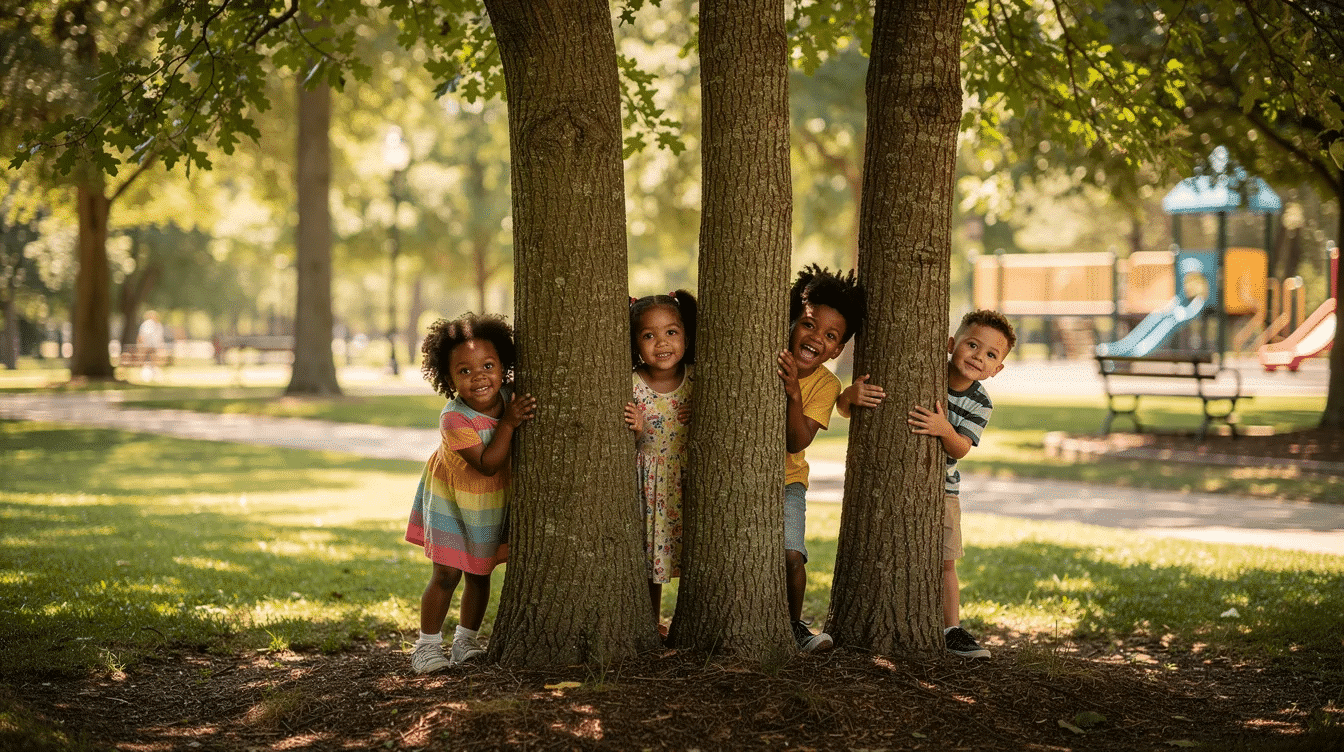
Hide and Seek is a timeless classic where one player counts while others hide, and then seeks to find them, making it a favorite among children for generations.
The basic version is simple:
- One child closes their eyes and counts at the starting line or home base.
- The other kids hide within the boundaries.
- The seeker calls out when counting is done.
- The seeker tries to find all the hidden players.
- The game ends when all hidden players are found or everyone reaches base safely.
Classic games for children include Sardines and Red Light Green Light. Sardines is one of the best hide and seek variations for groups.
The game of Sardines is a reverse of hide-and-seek where players join the hider upon finding them. One hidden person hides first, and then everyone else searches. When a player finds the hidden person, they quietly squeeze into the same place. Eventually, all the hidden players are packed together like sardines.
Other variations include:
- Classic hide and seek
- Sardines
- Kick the can without a can, using a tree or base instead
- Home base hide and seek
- Silent hide and seek
- Partner hide and seek for younger kids
Why It Stands Out
Hide and seek games combine problem-solving with movement. Children have to think about visibility, distance, sound, and timing.
They also practice patience. Players hide quietly, wait without giving themselves away, and decide when to move. The seeker develops scanning, memory, and observation skills.
Best For
Hide and seek games work well for children ages 3 to 10 who enjoy quiet strategy mixed with excitement.
They are especially good for:
- shaded yards
- parks with trees
- safe playground edges
- mixed ages
- children who prefer suspense over constant running
Key Strengths
- Encourages creative thinking about hiding spots
- Builds patience and quiet movement skills
- Works in various outdoor environments
- Lets younger kids participate without needing advanced rules
- Helps children learn boundaries and spatial awareness
Possible Limitations
Hide and seek requires clear safety rules. Children should never hide near roads, water, locked spaces, vehicles, construction areas, or anywhere adults cannot access.
It may also not provide enough physical activity for high-energy children. If most kids want more movement, combine hide and seek with tag by adding a safe home base that players can run to.
A simple rule helps: if the seeker calls “all in,” everyone comes out immediately.
3. Circle and Group Games
Circle games are ideal when you need a simple game for younger children, mixed ages, or a group that needs to calm down while still moving.
Games such as Duck, Duck, Goose and Red Light, Green Light are classic outdoor games that require no equipment and are suitable for children of various ages.
Duck, Duck, Goose is a classic game where players sit in a circle, and one player walks around tapping heads, calling them “duck” until they choose one to be the “goose”, who then chases them around the circle.
You can also include:
- Ring Around the Rosie
- London Bridge
- Miss Mary Mack
- Circle clapping games
- Follow-the-song movement games
For London Bridge, children form an arch with their arms while others walk underneath. The “bridge” lowers at the end of the rhyme, often on the phrase fair lady. It is easy to adapt by making sure no one is grabbed roughly.
With Miss Mary Mack, children clap in rhythm and build coordination, memory, and social connection. It is calm enough for transitions but engaging enough to keep kids engaged.
Why It Stands Out
Circle games are strong because they naturally teach social participation. Players stand or sit where they can see each other, and everyone understands where they fit in the group.
These activities are less about winning and more about rhythm, turn-taking, anticipation, and shared laughter.
Best For
Circle and group games are best for younger children ages 3 to 8 and mixed-age groups that need inclusive activities.
They work well for:
- preschool groups
- family gatherings
- birthday parties
- camps
- children who need structure
- groups with different physical abilities, especially when you’re planning engaging group activities for 5 year olds
Key Strengths
- Promotes turn-taking and following directions
- Includes singing and rhythm elements
- Easy for adults to supervise and participate
- Keeps the whole group together
- Reduces the chance that shy children are left out
Possible Limitations
Circle games may feel too simple for older kids. They also require enough participants to form a proper circle.
To add a fun twist for older children, let them invent new rhymes, change movement patterns, or create speed rounds. For example, in Duck, Duck, Goose, the chaser might have to hop on one foot instead of running.
4. Action and Movement Games
Action games are perfect when children need movement, but adults want a little more control than a full-speed chase game provides.
This category includes:
- Simon Says
- Red Light, Green Light
- Follow the Leader
- Freeze Dance
- Charades
- Captain’s orders
- Hot Potato without an object, using claps or a spoken word instead
Simon Says is a popular game where one player gives commands that others must follow only if prefaced with “Simon says”, promoting listening skills and fun.
Red Light, Green Light is a classic game where one player acts as the traffic light, calling out “green light” for players to run and “red light” for them to stop, enhancing listening skills and quick reactions.
Games like Duck, Duck, Goose and Red Light, Green Light are ideal for younger children, promoting physical activity and quick reaction skills while allowing for group participation.
To play red light green light:
- One child stands at the finish line as the traffic light.
- The other players line up at the starting line.
- The traffic light says green light, and players move forward.
- The traffic light says red light, and players stop.
- If someone moves after red light, they go back to the start or take three steps back.
- The first player to reach the traffic light becomes the next leader.
For a gentler version, children walk instead of run. This is useful for younger kids, crowded yards, or uneven grass.
To play freeze dance, no speaker is required. One leader can sing, hum, clap, or call “dance” and “freeze.” Create an imaginary dance floor in the grass. When the leader says freeze, everyone stops. The last one moving can do a silly challenge instead of being eliminated.
You can also play freeze dance with animal poses, superhero poses, or balance poses. For example, players freeze on one foot, crouch like a frog, or stretch like a cat.
Playing games like Charades encourages creativity and teamwork as players act out phrases and words for others to guess.
Why It Stands Out
Action games develop listening skills while providing controlled physical activity. They are especially helpful for impulse control because children have to move, stop, wait, listen, and respond.
These games also let adults adjust intensity quickly. If kids are too wound up, use slower commands. If they need energy burn, add jumping, skipping, or running.
Best For
Action and movement games are best for children ages 3 to 10 who need help with impulse control, listening, and following instructions.
They work well for:
- small groups
- large groups
- younger children
- mixed ages
- school recess
- backyard play
- rainy-day breaks when the ground is still safe
Key Strengths
- Improves attention span and reaction time
- Can be played in small or large groups
- Easily modified for different skill levels
- Gives children leadership opportunities
- Helps kids moving without chaos
Possible Limitations
Elimination-style games may frustrate some children. If the last person out has to sit, they may disengage.
Instead of having kids sit out, try these options:
- Players who move on red light do five jumping jacks and rejoin.
- In Simon Says, a missed command means the player becomes a helper.
- In freeze dance, standing wins only if the group wants a competitive round.
- The last one standing wins in one round, then everyone joins the next round immediately.
This keeps multiple players involved and avoids long waiting time.
5. Running and Racing Activities
Running and racing activities are excellent when children need maximum energy burn. They are simple, fast to explain, and easy to repeat with new challenges.
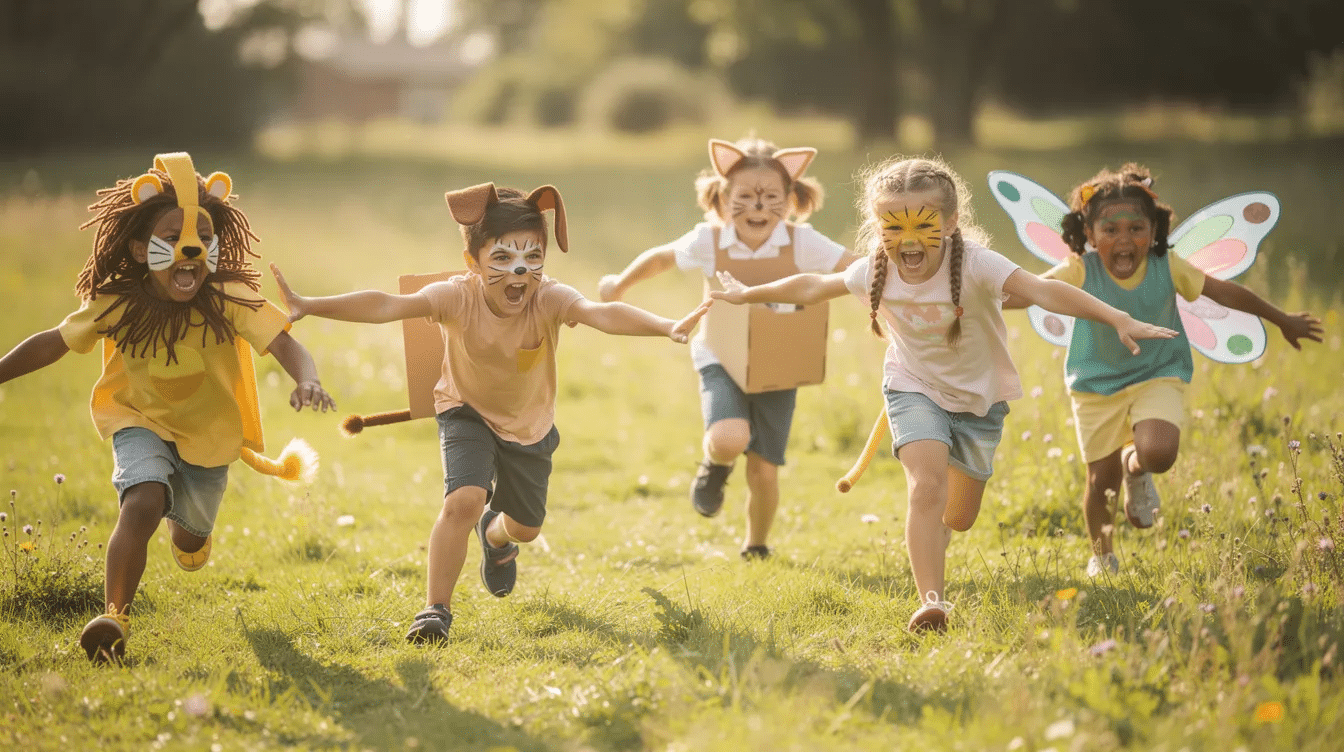
Outdoor games like Animal Races encourage children to use their imagination by mimicking their favorite animals while racing, promoting physical activity without any equipment needed, and they complement the best no mess activities for 2 year olds when you want options for younger siblings.
Try these no-equipment races:
- Animal races: hop like frogs, waddle like ducks, gallop like horses, crawl like bears.
- Backward walking races: slow and silly, not full-speed.
- Crab walk races: great for strength.
- Balance races: walk heel-to-toe or on an imaginary line.
- Nature obstacle course: go around a tree, step over a root, touch a fence, and return.
- Relay variations: two teams take turns running to a tree and back.
- Slow-motion races: the last person to cross the finish line without stopping wins.
Animal races are especially good because they combine physical activity with imagination. Children might roar like lions, stretch like giraffes, or leap like kangaroos.
If you have a group, players line up behind the starting line. When the leader calls an animal, everyone moves like that animal to the finish line. For relays, two teams race one player at a time.
Why It Stands Out
Running and racing provide the highest energy burn of any category on this list. They help develop speed, coordination, balance, strength, and endurance.
They also allow children to experience healthy challenge. A short race gives quick feedback, and then the game continues with a new round.
Best For
Running and racing activities are best for high-energy children ages 4 to 12 who love competition and physical challenges.
They are useful when:
- children have been sitting for a long time
- you have open space
- older kids need something more intense
- a group wants fast rounds
- everyone needs a break from screens
Key Strengths
- Excellent cardiovascular workout
- Encourages creativity through animal movements
- Can incorporate learning about animals and nature
- Works with two children or multiple kids
- Easy to scale up or down
Possible Limitations
Running games require significant open space. They can also lead to exhaustion if not properly managed.
Use short rounds, water breaks, and calmer games between races. A few minutes of intense racing is often enough before switching to i spy, cloud watching, or a slow scavenger hunt.
Do not race near traffic, hard edges, wet pavement, or crowded playground equipment.
6. Creative and Imagination Games
Creative games are ideal for children who enjoy stories, pretend worlds, and dramatic play. These games do not require toys, props, craft supplies, washable paint, sidewalk chalk, a hula hoop, jump rope, bean bag, or bean bag toss setup. Those items can be fun on other days, especially for engaging activities for imagination to inspire creative thinking, but they are not needed here.
This category includes:
- The Floor is Lava
- Captain on Deck
- Nature storytelling
- Charades
- Explorer missions
- Pretend restaurant, zoo, forest, or spaceship
- Rock kingdom or fairy village using imagination only, which can lead naturally into creative nature stick crafts for kids
Games like “The Floor is Lava” transform ordinary spaces into imaginative play areas, where children must navigate without touching the ground.
The Floor is Lava is a popular outdoor game where players must avoid touching the ground, fostering creativity and physical agility in children.
To play outside, choose safe “islands” such as tree stumps, flat stones, patches of shade, or imaginary circles. Children can also make the rule that grass is lava and dirt paths are safe, or that shadows are safe zones.
Captain on Deck is another fun game. One leader calls commands such as:
- “Captain on deck!” – salute.
- “Climb the mast!” – pretend to climb.
- “Swab the deck!” – pretend to clean.
- “Storm!” – crouch low.
- “Shark!” – jump to a safe island.
For storytelling games, one child begins a story about the outdoor space. The next player adds a sentence. The game continues until the group creates a shared adventure.
Engaging in imaginative play, such as creating a scavenger hunt, allows children to explore their environment while using their creativity. This kind of open-ended creativity pairs well with arts and crafts activities that support child development and growth. A no-equipment scavenger hunt can use spoken clues instead of a written list: “Find something rough,” “Find something that smells fresh,” or “Find something shaped like a heart.”
Why It Stands Out
Creative games combine movement with imagination. Children are not just running; they are escaping lava, exploring forests, acting out clues, or solving pretend problems.
This makes them especially useful for children who are less interested in pure competition.
Best For
Creative and imagination games are best for children ages 5 to 12 who enjoy dramatic play, role-playing, and storytelling.
They also work well for:
- siblings with different interests
- mixed ages
- children who enjoy making rules
- quieter children who still need movement
- outdoor play in smaller spaces, including creative kindergarten class ideas for engaging learning experiences
Key Strengths
- Develops creative thinking and adaptability
- Can be themed to children’s interests
- Encourages cooperative play and role-playing
- Helps children practice communication
- Makes ordinary spaces feel new
Possible Limitations
Some children may feel self-conscious about dramatic play. Others may need adult guidance to get started.
A simple way to help is to offer the first prompt, then step back:
- “You are explorers crossing a jungle.”
- “The grass is lava, but tree shadows are safe.”
- “You are animals escaping a storm.”
- “You are detectives looking for signs of a hidden creature.”
Once children take over, let them modify the rules.
7. Observation and Quiet Games
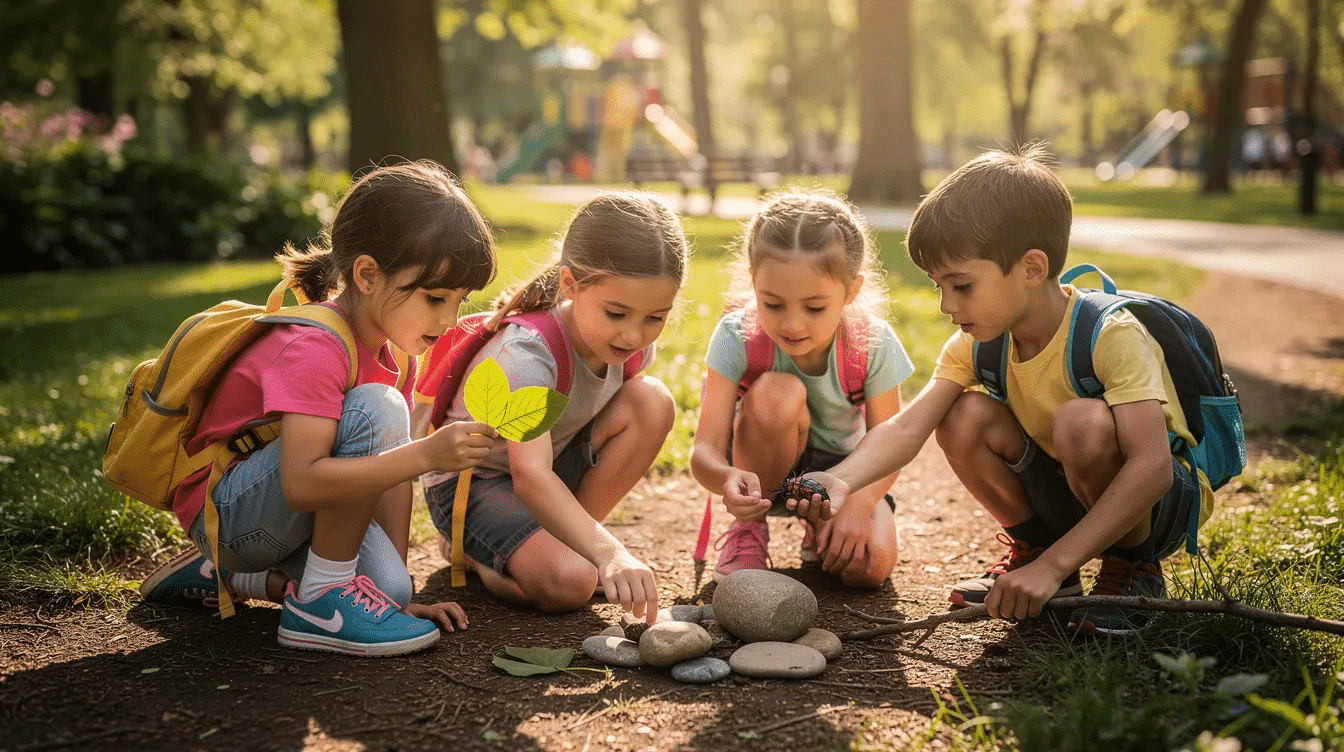
Not every outdoor activity needs to be loud or fast. Quiet games help children slow down, notice details, and connect with their surroundings.
This category includes:
- I Spy
- Nature scavenger hunt
- Cloud watching
- Bug watching
- Sound safari
- Shadow tracing with fingers only
- Color hunt
- Texture hunt
- “What changed?” memory game
I spy is one of the easiest no-equipment games. One player says, “I spy with my little eye something…” and gives a color, shape, or clue. The other players guess the object.
A nature scavenger hunt can be completely verbal. You do not need paper, pencils, or blank spaces to fill in. Call out prompts such as:
- Find something smooth.
- Find something green.
- Find something that moves.
- Find something taller than your hand.
- Find something that makes a sound.
- Find something that belongs to a bird, insect, or tree.
Cloud watching is even simpler. Children lie down safely or sit in shade and describe what they see. A cloud might become a dragon, whale, mountain, or castle.
Why It Stands Out
Observation games are excellent for calmer moments while still engaging children with their environment. They build vocabulary, patience, focus, and curiosity, and can inspire kids to use the best art supplies for young artists later to draw or paint what they notice outside.
They also support a different kind of attention from fast games. Instead of reacting quickly, children look closely, which can lead naturally into owl crafts for kids that turn observations into art projects.
Best For
Observation and quiet games are best for children ages 3 to 10 during wind-down time or mixed with more active games.
They are helpful:
- after racing or tag
- before leaving the park
- when children are tired
- for children who prefer calm play
- when adults need lower-supervision movement
Key Strengths
- Develops observation and vocabulary skills
- Can be educational about nature and surroundings
- Works well for children who need breaks from high-energy activities
- Can be played solo, in pairs, or with the whole group
- Encourages curiosity without equipment
Possible Limitations
Observation games may not provide enough physical activity on their own. They also work best in an interesting environment.
If the space feels plain, add categories:
- colors
- textures
- shapes
- sounds
- smells
- shadows
- tiny living things
- signs of weather
According to UNICEF, children who spend more time outside tend to get more moderate-to-vigorous physical activity. Quiet games can be part of that outdoor habit, even when they are not the most active option.
Quick Comparison of the Best Activity Types
Use this table when you need a fast way to choose the right activity.
Activity type | Best for | Energy level | Group size | Main skill built |
|---|---|---|---|---|
Tag Games | High-energy cardio and competitive play | High | 3+ | Agility and spatial awareness |
Hide and Seek Games | Strategic thinking and patience building | Medium | 2+ | Problem-solving and self-control |
Social skills and inclusive group play | Low to medium | 5+ | Turn-taking and cooperation | |
Action Games | Listening skills and controlled movement | Medium | 2+ | Attention and reaction time |
Running Activities | Maximum energy burn and creative movement | High | 2+ | Endurance and coordination |
Creative Games | Imagination and dramatic play | Low to high | 1+ | Creativity and adaptability |
Observation Games | Quiet engagement and nature connection | Low | 1+ | Focus and vocabulary |
Here is the quick version: |
- Tag Games – Best for high-energy cardio and competitive play
- Hide and Seek Games – Best for strategic thinking and patience building
- Circle Games – Best for social skills and inclusive group play
- Action Games – Best for listening skills and controlled movement
- Running Activities – Best for maximum energy burn and creative movement
- Creative Games – Best for imagination and dramatic play
- Observation Games – Best for quiet engagement and nature connection
If you only have a few minutes, choose a simple game like Simon Says, i spy, or Red Light, Green Light. If you have a larger group and more time, choose freeze tag, Sardines, Duck, Duck, Goose, or animal races.
How to Choose the Right Activities for Your Kids
Choosing the right activity is mostly about reading the group. The same children may need freeze tag in the morning, cloud watching after lunch, and hide and seek near the end of the day.
Choose Based on Energy Level
If children are restless, loud, or full of energy, start with a high-movement game.
Best high-energy options:
- classic tag
- freeze tag
- animal races
- Red Light, Green Light
- relay races
- The Floor is Lava with safe movement zones
If children are tired, overstimulated, or arguing, choose calmer games.
Best low-energy options:
- i spy
- cloud watching
- nature scavenger hunt
- Simon Says with slow movements
- storytelling
- Miss Mary Mack
If children are mixed, combine both. For example:
- Play freeze tag for a few minutes.
- Switch to Simon Says.
- End with i spy or a nature scavenger hunt.
This gives children movement without pushing them into exhaustion.
Choose Based on Group Size
Different games work better with different numbers of players.
Group size | Best choices |
|---|---|
Solo play | Cloud watching, nature scavenger hunt, pretend explorer, i spy with an adult |
2 children | Simon Says, Follow the Leader, animal races, hide and seek |
3–5 children | Tag, freeze dance, The Floor is Lava, Sardines |
6+ children | Duck, Duck, Goose, Red Light, Green Light, circle games, two teams relay races |
Large whole group | Shadow tag, Captain on Deck, circle games, group charades |
For multiple kids, choose games with short turns so no one waits too long. For multiple players with different abilities, use roles such as leader, caller, seeker, traffic light, storyteller, or judge. |
Choose Based on Age and Development
Younger kids need simple rules, short rounds, and visible boundaries. They often do best with games like Duck, Duck, Goose, Simon Says, Follow the Leader, and Red Light, Green Light.
Younger children may also need adults to model what to do first. Show them how to freeze, walk slowly, hide safely, or take turns.
Older kids usually enjoy more complex rules, strategy, and competition. They may prefer Sardines, Rock Paper Scissors Tag, obstacle-style races, or creative role-play with missions.
For mixed ages:
- Pair older kids with younger kids.
- Avoid harsh elimination.
- Make the play area smaller.
- Let older children lead rounds.
- Give younger children extra chances.
- Use walking versions when needed.
Most kids enjoy having some control. Let them vote on the next game or create one new rule.
Which Activities Are Best for You?
The best choice depends on your children, your space, and the moment.
Choose Tag Games if your kids love competitive, high-energy play. Freeze tag, shadow tag, and classic tag are great when children need to run, laugh, and release energy.
Choose Circle Games if you have mixed ages or need inclusive activities. Duck, Duck, Goose, Ring Around the Rosie, London Bridge, and Miss Mary Mack help children participate together without much setup.
Choose Creative Games if your children enjoy dramatic play and storytelling. The Floor is Lava, Charades, Captain on Deck, and pretend explorer games are strong choices when you want imagination and movement together.
Choose Observation Games if your children need a calm reset. I spy, cloud watching, and nature scavenger hunt ideas help kids notice the world around them.
Choose Running Activities if your children need maximum physical activity. Animal races, relay variations, and natural obstacle courses work well when you have open space and safe ground.
Choose Action Games if your children need listening practice. Simon Says, Red Light, Green Light, Follow the Leader, and freeze dance build attention while keeping kids moving.
You do not need playground equipment, a ball, a jump rope, a hula hoop, sidewalk chalk, washable paint, craft supplies, or a bean bag toss board to create a fun game outside. You can blow bubbles another day, bring a bean bag for a carnival-style activity another time, explore top DIY kits for creative projects and fun learning experiences, or use chalk when you want art. But meaningful outdoor play can happen with no equipment at all.
The key is to rotate between active, social, creative, and quiet games.
Final Thoughts
The best outdoor activities for kids no equipment needed are simple, flexible, and easy to adapt. A classic game like hide and seek can build patience and spatial thinking. A running game like freeze tag can support physical fitness. A creative game like The Floor is Lava can turn an ordinary yard into an adventure.
No-equipment outdoor games help children move, think, cooperate, negotiate, imagine, and build confidence. They also give families and caregivers an easy way to keep kids entertained without buying more things or planning a complicated activity.
Start with one game today. Set a safe boundary, explain the rules in a few minutes, and let the children take it from there.