
If you’ve ever stared at a pattern calling for a “size H-8 hook” while holding a hook marked only “5.0 mm,” you already know the confusion that crochet hook sizes can cause. Three different sizing systems exist worldwide—US letters and numbers, UK numbers, and metric millimeters—and patterns may use any of them depending on when and where they were written.
This article provides a complete crochet hook conversion chart you can reference while shopping or working through patterns. Modern patterns published from 2000 onwards typically list hook sizes in mm alongside US or UK terms, but older patterns and imported hooks often don’t. Using the correct hook size matters because it directly affects your fabric’s drape, stitch definition, and whether your finished project matches the pattern measurements.
Standard Crochet Hook Size Conversion Chart (US, UK, Metric)
Most everyday crochet hooks—aluminum, plastic, bamboo, or ergonomic handles—fall into this standard chart. Steel lace hooks use a separate system covered later in this article.
Metric (mm) | US Size | UK/Canadian Size |
|---|---|---|
2.25 mm | B-1 | 13 |
2.75 mm | C-2 | 12 |
3.25 mm | D-3 | 10 |
3.5 mm | E-4 | 9 |
3.75 mm | F-5 | 8 |
4.0 mm | G-6 | 8 |
4.5 mm | 7 | 7 |
5.0 mm | H-8 | 6 |
5.5 mm | I-9 | 5 |
6.0 mm | J-10 | 4 |
6.5 mm | K-10.5 | 3 |
8.0 mm | L-11 | 0 |
9.0 mm | M/N-13 | 00 |
10.0 mm | N/P-15 | 000 |
11.5 mm | P-16 | — |
15.0 mm | P/Q | — |
Popular beginner sizes include 4.0 mm (G-6), 5.0 mm (H-8), 5.5 mm (I-9), and 6.0 mm (J-10). These work with the most common yarn weights you’ll find at craft stores.
Note that different brands can label hooks slightly differently. One company might stamp “H/8” while another shows only “5.0 mm.” The package millimeter measurement printed on the hook or packaging is always the most reliable reference for accurate measurement.
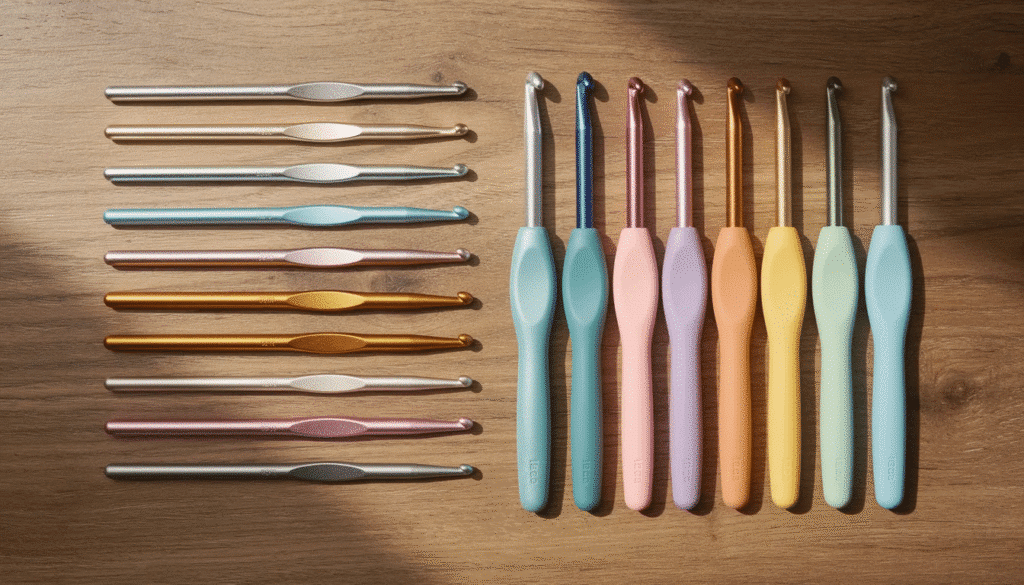
Understanding Crochet Hook Sizing Systems
Hook size refers to the diameter of the shaft in millimeters, which controls how large each loop of yarn will be when you pull it through. A larger diameter creates bigger stitches; a smaller diameter creates tighter ones.
The US System
US hooks use letters from A through at least P/Q, often paired with numbers. Letters closer to A indicate smaller hooks, while letters further along the alphabet mean larger hooks.
Concrete examples:
- B-1 = 2.25 mm
- H-8 = 5.0 mm
- K-10.5 = 6.5 mm
The number portion can sometimes cause confusion because it doesn’t follow a perfectly logical sequence. For example, I-9 is 5.5 mm while J-10 is 6.0 mm.
The UK/Old British System
UK sizing historically used numbers where a higher number meant a smaller hook—the opposite of what you might expect. A UK size 13 is tiny (2.25 mm), while a UK size 3 is much larger (6.5 mm).
Most modern UK designers now specify metric sizing first, but vintage patterns from before the 1990s may show only UK numbers. If you find an old British pattern calling for a “No. 9 crochet hook,” you’ll need the conversion chart to find that it corresponds to approximately 3.5 mm.
The Metric (mm) System
Metric sizing measures the hook shaft diameter in millimeters and has become the international standard. This system provides the most precise measurement because there’s no ambiguity—a 4.0 mm hook is exactly 4.0 mm regardless of brand or country of origin.
When converting between systems, the mm measurement should always be your guide. If a US pattern calls for an I-9 hook and you only have metric hooks, the chart tells you to pick the 5.5 mm option.
What Happens If You Use the Wrong Size Hook?
Using a larger hook than recommended creates loose stitches with visible gaps between them. Your fabric will have more drape but less structure, and garments will come out larger than the pattern measurements. Conversely, using a smaller hook produces tight, stiff fabric with reduced drape—hats become too small, blankets feel rigid, and the yarn can be difficult to work with.
Here’s a quick example: a worsted weight sweater pattern written for a 5.0 mm (H-8) hook will turn out noticeably larger and looser if you use a 6.5 mm (K-10.5) hook without adjusting your stitch count. The change in hook size affects every single stitch, compounding across thousands of stitches.
That said, using the “wrong” size on purpose can be a design choice. Some crocheters deliberately use an oversized hook with fine yarn to create airy, lace-like shawls. The key is understanding the effect before you start.
How to Pick the Right Size from the Chart
Follow these steps to choose the correct hook for your next project:
- Check your yarn label for the recommended hook size in mm and/or US letter. This is printed on most yarn bands produced after 2004.
- Read your pattern’s gauge information to find the specified hook size. Patterns typically list this near the beginning alongside yarn weight and finished measurements.
- Use the conversion chart to translate any unfamiliar sizes. If the pattern lists “use a size I-9 hook,” the chart shows this corresponds to 5.5 mm, so you can pick any brand’s 5.5 mm hook.
This process is especially handy when working with older patterns from pre-1990s UK or US booklets, or when using imported hooks that only show metric sizing.
Steel Crochet Hook Size Chart (For Lace and Thread)
Steel crochet hooks—often silver or nickel-colored with narrow shafts—are designed for very fine cotton crochet thread. They’re used for lace doilies, delicate edgings, and bead crochet rather than yarn projects.
Steel hooks use a completely separate numbering system where a larger number typically means a smaller hook. This is pretty much the opposite of standard hook sizing, which can cause real confusion for beginners.
Steel Size | Approximate mm |
|---|---|
14 | 0.75 mm |
12 | 0.75-1.0 mm |
10 | 1.15-1.3 mm |
8 | 1.4-1.5 mm |
6 | 1.6-1.8 mm |
4 | 1.75-2.0 mm |
2 | 2.1-2.25 mm |
0 | 2.7-3.0 mm |
Note that steel hook sizing varies by manufacturer, so these measurements are approximate. Again, rely on the mm value when it’s available.
A typical beginner thread project might use a 1.75 mm steel hook with size 10 crochet thread for vintage-style doilies.
When to Use Steel Hooks vs Regular Hooks
Steel hooks are ideal for:
- Vintage lace patterns from the early to mid-1900s
- Delicate table runners, snowflakes, and heirloom trim
- Fine crochet thread labeled size 3, size 10, or finer
Standard aluminum or ergonomic hooks work best for modern garments, blankets, toys, and accessories made with yarn labeled lace weight through super bulky. Most beginners will start with standard hooks in sizes around 4.0–6.0 mm and can safely ignore steel hooks until they’re ready to tackle thread work.
Patterns usually specify “steel hook size” or call for a thread weight that signals when a steel hook is expected, so you won’t accidentally buy the wrong thing.
Choosing Yarn by Crochet Hook Size (and Vice Versa)
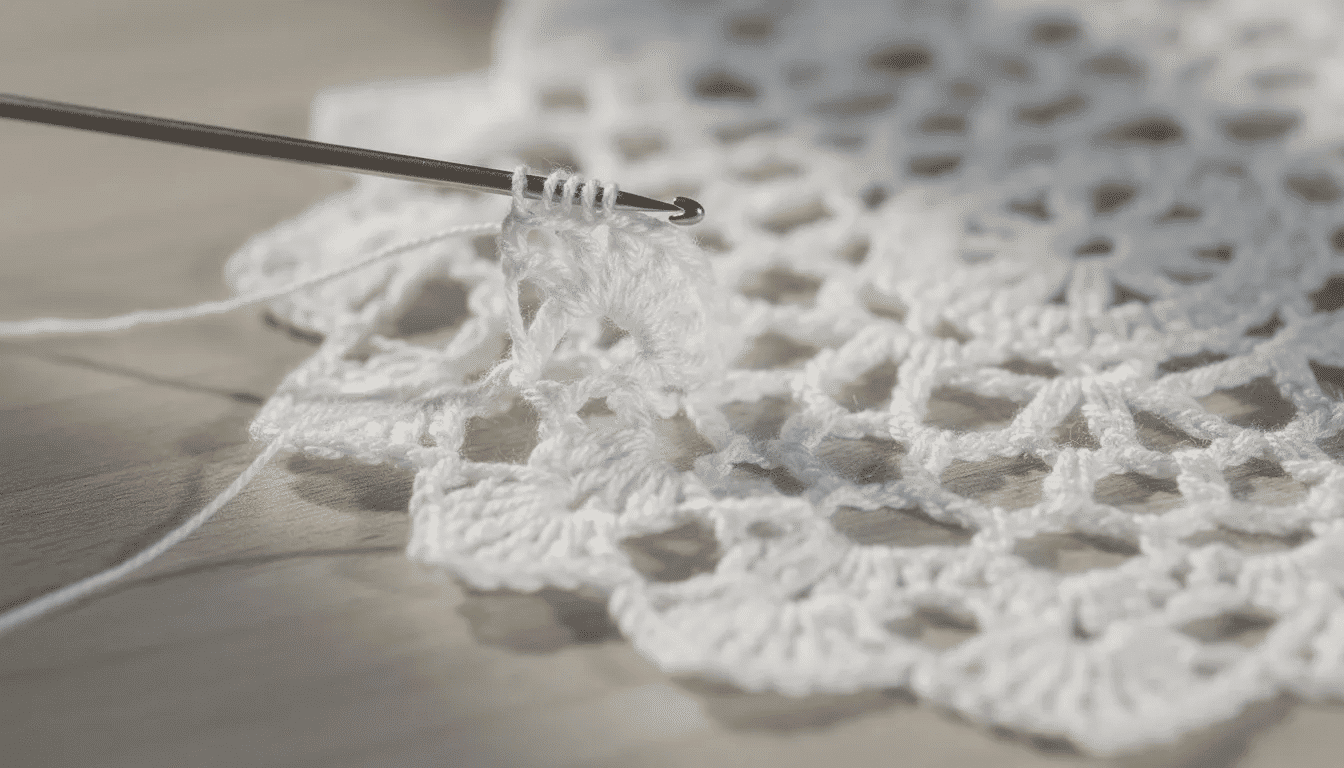
Yarn weight and hook size work together: thinner yarns need smaller hooks, thicker yarns need larger ones. The Craft Yarn Council standardized yarn weights on a 0–7 scale, and each weight pairs with a typical hook range.
Yarn Weight | Category | Typical Hook Size Range |
|---|---|---|
0 | Lace | 1.5–2.25 mm |
1 | Fingering/Sock | 2.25–3.25 mm |
2 | Sport/Baby | 3.25 mm – 3.75 mm |
3 | DK/Light Worsted | 3.5–4.5 mm |
4 | Worsted/Aran | 5.0–5.5 mm |
5 | Bulky/Chunky | 5.5–8.0 mm |
6 | Super Bulky | 8.0–11.5 mm |
7 | Jumbo | 12.0 mm and up |
Yarn labels printed after about 2004 often include a small hook symbol showing a recommended size in mm. Remember that this is a starting point, not a strict rule—your pattern gauge information should take priority.
When your yarn label shows millimeters but your pattern uses US or UK terms, the crochet hook conversion chart in this article makes it easy to match them up.
Beginner-Friendly Hook and Yarn Combinations
If you’re starting out and not sure what to buy, these combinations are widely available and recommended in beginner books:
- Worsted weight (4) acrylic or cotton with a 5.0 mm (H-8) hook for scarves, dishcloths, or practice swatches
- DK weight (3) yarn with a 4.0 mm (G-6) hook for baby items or lightweight shawls
- Bulky weight (5) yarn with a 6.5 mm (K-10.5) hook for quick blankets or hats
These pairings give you a nice balance of stitch visibility and comfortable hand tension while you learn the basic stitches.
Gauge, Swatching, and Adjusting Hook Size
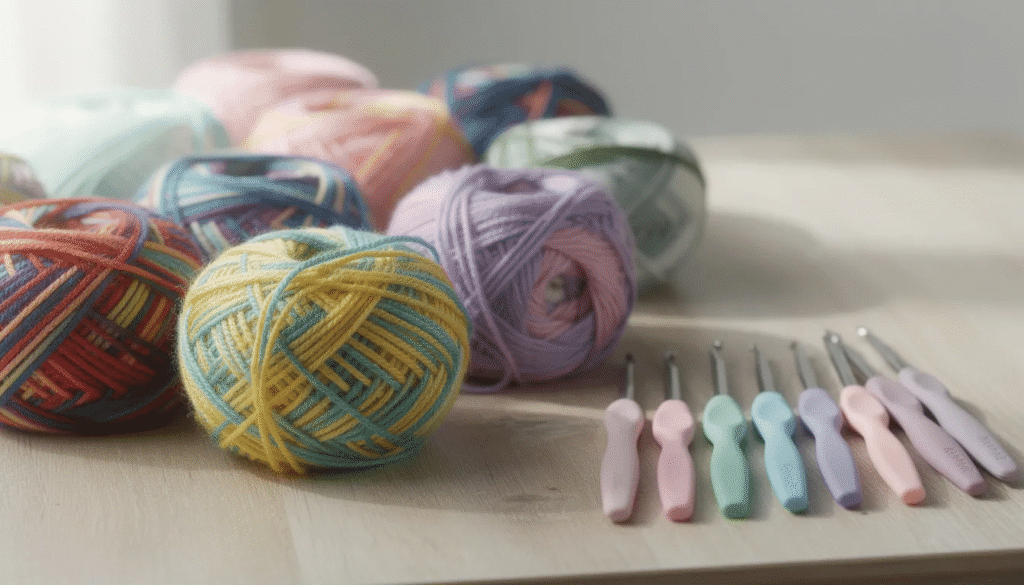
Gauge is the number of stitches and rows within a 4-inch (10 cm) square. It determines whether your finished project matches the pattern’s intended size—and it’s the most important thing to check before starting any sized garment.
Even when two crocheters use the same 5.0 mm H-8 hook, their tension may differ. One person might crochet loosely while another pulls each stitch tight. A gauge swatch is the only way to confirm your work will match the pattern.
How to make a gauge swatch:
- Chain enough stitches to exceed 4 inches—typically 20–25 chains depending on yarn weight
- Work several rows in the pattern stitch (usually single crochet or the main stitch used in the project)
- Block lightly if the pattern recommends it
- Lay flat and measure stitches and rows over the center 4-inch area
How to adjust your hook size:
- If you get more stitches per 4 inches than the pattern calls for (fabric too tight), move up to a larger hook size
- If you get fewer stitches per 4 inches than the pattern (fabric too loose), move down to a smaller hook size
For example, if a hat pattern expects 20 stitches per 4 inches with a 5.0 mm hook, but your swatch shows 22 stitches, you’ll need to redo the swatch with a larger hook—maybe 5.5 mm—to loosen your tension.
Using the Chart When Gauge Doesn’t Match
Sometimes the pattern recommends a 4.5 mm hook but you only own 4.0 mm and 5.0 mm. The chart helps you pick the closest available size and understand the US/UK equivalents for shopping.
Moving up or down one step on the chart—for instance, from G-6 to size 7 to H-8—is a reasonable way to adjust gauge without drastically changing fabric structure. Make a quick second swatch each time you change hook size and compare the results.
Over time, you’ll build a personal reference for how your tension works with different hooks and yarns. This is pretty handy knowledge that makes future projects go faster.
Frequently Asked Questions About Crochet Hook Sizes
Can I mix brands of hooks if the sizes match in mm?
Yes. If two hooks both measure 5.0 mm, they’ll produce the same gauge despite being different brands. The mm measurement is the important thing, not the brand name.
My hook only shows a letter, not mm—how do I know what size it is?
Check the conversion chart to find the corresponding mm measurement. For example, an H hook without any number is typically 5.0 mm. If the markings have worn off completely, you can obtain a hook gauge tool (a small card with holes) to measure the shaft diameter.
Do I have to buy every single size, or which sizes should I start with?
You don’t need every size right away. A solid starter set includes 4.0 mm (G-6), 5.0 mm (H-8), 5.5 mm (I-9), and 6.0 mm (J-10). These cover the most common yarn weights and will handle the majority of beginner patterns.
Why does my vintage pattern from the 1970s list only a “No. 9 crochet hook”?
Older UK patterns used the British numbering system. The chart shows that a UK size 9 corresponds to about 3.5 mm or US E-4. When in doubt, check the pattern gauge information and swatch to confirm you’re getting the right number of stitches per inch.
What if my yarn label and pattern recommend different hook sizes?
Always rely on the pattern gauge information for sized projects like garments. The yarn label gives a general starting point, but the pattern designer tested with a specific hook to achieve the correct measurements. Make a gauge swatch with the pattern’s recommended hook and adjust from there if needed.
Save this chart for quick reference whenever you choose yarn, compare needle sizes, or download a new pattern. The mm measurement is always your most reliable guide—and with this conversion chart handy, you’ll never have to live with hook-size confusion again.