

Writing craft techniques are the toolbox of skills that transforms a raw idea into a compelling, readable story. Every writer—whether working on a novel, a short story, a memoir, or an essay—relies on these same foundational skills to create pages that keep readers turning. This guide is for writers at any stage who want to strengthen their storytelling skills and understand the essential techniques that make stories work. The good news? Craft is learnable. It improves with practice, feedback, and deliberate study. This guide will move quickly from definitions to concrete, actionable techniques you can apply in your next draft. We’ll start with immediately usable skills, then deepen into structure, style, and revision. Mastering fundamental techniques improves writing craft.
Core Craft Techniques Every Writer Should Learn First
The primary elements of fiction are plot, setting, characters, conflict, symbols, and point of view. If you’re just starting out—or looking to strengthen your foundation—don’t try to master everything at once. Focus on a small set of high-leverage techniques that will give you the biggest return on your effort. Techniques for effective writing include showing instead of telling, controlling pacing, and developing deep characters.
This section covers four essentials:
- Showing vs. telling
- Point of view (POV)
- Concrete detail
- Scene construction
Each technique will be defined simply and tied to a specific action you can take in your next draft. We’ll keep the examples clear and skip the jargon.
Show, Don’t Just Tell
You’ve probably heard “show, don’t tell” a thousand times. But what does it actually mean in practice?
Telling is summary or labeling. It’s the author saying “She was angry” and expecting readers to feel that anger. Showing is demonstration through actions, dialogue, and sensory detail—letting readers experience the emotion rather than being told about it.
Before (Telling): “She was furious.”
After (Showing): “She slammed the folder on the desk, sending papers scattering across the floor.”
The second version lets readers sense the fury without the narrator announcing it. The dialogue and body language carry the subtext.
Quick tips to apply this:
- Replace emotion labels with specific actions
- Use strong, precise verbs instead of weak verb + adverb combinations
- Let dialogue reveal what characters feel rather than stating it in narration
Mini-exercise: Choose one page of your current draft. Find three instances of telling and convert them into showing. Watch how the page comes alive.
Choosing and Controlling Point of View (POV)
Point of view determines who is telling the story and from what distance. Your choice of POV shapes every sentence you write—and inconsistent POV confuses readers and breaks immersion.
Here’s the essential breakdown:
| POV Type | Pronouns | Access to Thoughts |
|---|---|---|
| First Person | “I” | Limited to narrator |
| Close Third | “He/She/They” | Limited to one character per scene |
| Omniscient | “He/She/They” | Unlimited—narrator knows all |
| The head-hopping problem: When you shift between characters’ internal thoughts within a single scene without clear transitions, readers lose their footing. One paragraph we’re in Sarah’s head, feeling her anxiety. The next, we’re suddenly knowing what Tom thinks about her dress. This is called head-hopping, and it’s a common mistake that weakens your narrative. |
How to fix it: Decide on your POV before drafting. Write it on a sticky note and keep it beside your workspace. For each scene, ask: “Whose story is this moment? Whose perspective gives readers the most tension and investment?”
Concrete Detail and Sensory Specificity
Vague description makes scenes forgettable. Specific sensory details make them vivid and memorable.
Concrete detail means naming particular objects, textures, sounds, dates, and places. Instead of “cold weather,” write “January wind off Lake Michigan.” Instead of “an old car,” write “a rust-spotted ‘87 Civic with a cracked dashboard.”
Before: “The room smelled bad.”
After: “The room smelled of cigarette ash and yesterday’s fish.”
A few sharp details per scene work better than overloading every paragraph with description. Readers remember one vivid image more than five generic ones.
Line-edit exercise: Highlight all adjectives on a page. Replace half of them with more concrete, image-based specifics. Cut the rest if they’re not earning their place.

Building Effective Scenes
Scenes are the basic units of narrative. A scene equals a change—in situation, emotion, or understanding. If nothing changes, you don’t have a scene. You have filler.
Use this simple structure to evaluate every scene:
- Goal: What does the POV character want in this scene?
- Conflict: What obstacle stands in their way?
- Consequence: What changes by the end?
Every scene should have at least one clear desire or objective driving the protagonist. Without that engine, the scene stalls.
Practical checklist for revising scenes:
- Can I identify the goal in 1-2 sentences?
- Is there an obstacle creating tension?
- Does the situation change by the scene’s end?
If a scene doesn’t pass this test, it’s a prime candidate for revision or deletion. Readers feel the difference between scenes with forward momentum and scenes that spin in place.
The fiction you want to write is waiting. The skills to write it are within reach. Now it’s time to practice.
Writing Craft Techniques for Kids and Young Writers
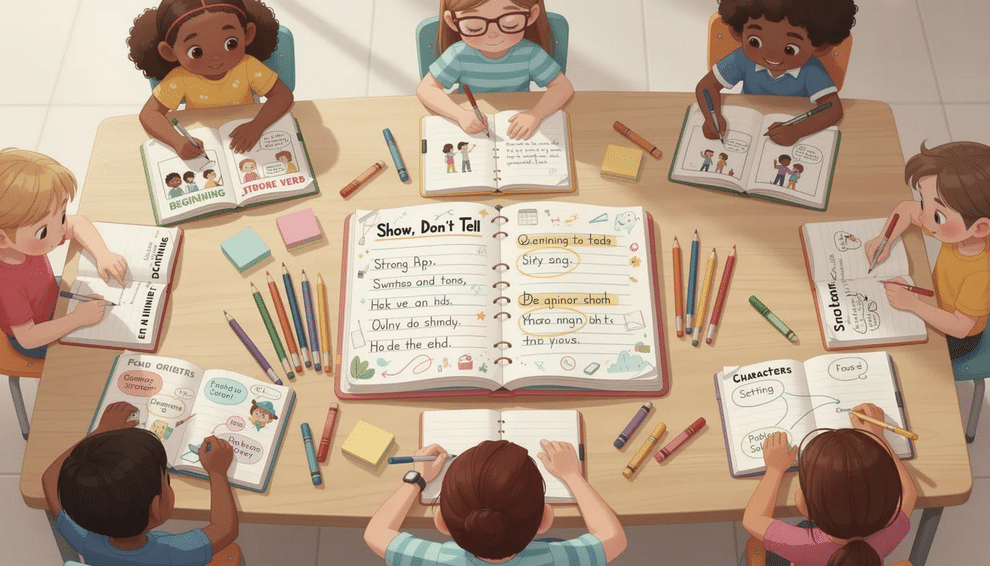
Writing is a fun and creative activity for kids, and learning craft writing techniques early can help young writers develop their skills and confidence. For kids, the focus is often on basic storytelling elements and making writing enjoyable.
Here are some kid-friendly craft writing techniques:
- Start with a simple story structure: Teach kids to think about a beginning, middle, and end. This helps them organize their ideas and create a clear story.
- Show, don’t just tell: Encourage kids to describe actions and feelings instead of just saying them. For example, instead of “She was sad,” they can write “She wiped away a tear and looked down.”
- Use strong verbs and vivid words: Help kids choose exciting words that make their story come alive, like “sprinted” instead of “ran” or “gigantic” instead of “big.”
- Create interesting characters: Ask kids to think about what their characters want and what problems they face. This makes stories more engaging.
- Practice writing dialogue: Kids can write conversations between characters to show how they feel and what they think.
- Make writing a habit: Encourage kids to write regularly, even if it’s just a little bit each day. Writing often helps build skills and confidence.
- Read stories together: Reading helps kids see how stories are made and inspires their own writing.
Teaching these techniques in a fun and supportive way helps kids develop their ability to tell stories and express themselves through writing. It also builds a foundation for more advanced craft writing techniques as they grow.
Character Craft: Building People Who Feel Real
Compelling characters are usually the main reason readers keep turning pages. Plot matters, but characters who feel real matter more.
This section focuses on characterization techniques: desire, flaws, arcs, dialogue, and interiority. The key principle? Character decisions should drive plot, not the other way around. When your protagonist acts, readers should understand why—even if they disagree with the choice.
Desire, Flaws, and Motivation
Every major character needs a clear desire—what they want right now—and a motivation—why they want it.
Example: A detective wants to solve a murder case (desire) because the victim was his childhood best friend (motivation).
Internal flaws create the most interesting tension. Fear, misguided beliefs, and old wounds can drive a wedge between what characters want and what they actually need. A character might want revenge, but need forgiveness. That gap is where story lives.
Practical tool: Write a one-sentence “want/need” statement for your protagonist:
“She wants to prove her father wrong, but she needs to accept that his approval won’t make her whole.”
Revision questions to ask:
- Can I clearly state this character’s want in this chapter?
- Is their action consistent with their motivation?
- What fear or wound might be blocking them from getting what they need?
Character Arcs and Emotional Change
A character arc is the internal change a character undergoes between the beginning and end of the story. This emotional journey is what makes readers feel invested.
Three types of arcs:
- Positive arc: Character overcomes flaw, grows (e.g., a cynic learns to trust)
- Negative arc: Character succumbs to flaw, deteriorates (e.g., a good person corrupted by power)
- Flat arc: Character’s core values stay constant, but they change the world around them (e.g., a moral compass in a corrupt town)
To develop strong character arcs, map 3-5 turning points where your character’s belief or self-understanding shifts. Tie these internal turning points to external plot events so emotional change feels earned, not arbitrary.
Revision prompt: “What specific scene marks the moment your protagonist can’t go back to who they were?”
Dialogue That Reveals Character
Effective dialogue serves multiple functions simultaneously: it reveals character, advances plot, and adds subtext. When authors talk about dialogue that “does work,” this is what they mean.
Give each character a distinct speech pattern. Consider vocabulary, rhythm, formality. A teenager from Brooklyn doesn’t speak like a Victorian governess. Let readers identify who’s speaking even without dialogue tags.
Avoid on-the-nose dialogue. Real people rarely say exactly what they feel. They imply, deflect, and avoid. Use implication and conflict instead of characters announcing their emotions.
Quick revision tip: Remove at least 30% of greetings, small talk, and filler words from your dialogue. “Hi, how are you?” “Fine, thanks for asking” rarely contributes to the story.
Read dialogue aloud. Your ear catches what your eye misses. If it sounds wrong when spoken, it’ll feel wrong on the page.
Interiority: Thoughts, Feelings, and Internal Narrative
Interiority is the portrayal of a character’s inner thoughts, feelings, and reactions. Well-balanced interiority deepens reader empathy and clarifies why characters act as they do.
The technique is simple: pair external actions with brief internal reactions in important moments. What does the character notice? What do they fear? What do they decide?
But there’s a trap. Constant introspection stalls scenes. A person overthinking every tiny detail becomes exhausting to read. Focus interiority on turning points and moments of tension—places where the internal reaction genuinely matters.
Revision question: “After each major line of dialogue or action, does the reader know what the POV character makes of it?”
If readers are confused about why your protagonist just did something, you may need more interiority. If the story feels bogged down in rumination, you probably need less.

Story Structure and Narrative Movement
Structure gives stories shape. Without it, you get sagging middles, rushed endings, and readers who check out halfway through.
This section focuses on macro-level techniques: inciting incident, escalation, midpoint, climax, and resolution. You can adapt any structural model—three-act structure, hero’s journey, Save the Cat—but the underlying principles remain the same: buildup and payoff.
Solid structure supports creativity. It doesn’t stifle it.
Inciting Incident and Central Question
The inciting incident is the event that disrupts the protagonist’s ordinary world and forces a choice. It’s the moment the story truly begins.
Example: In The Hunger Games, the inciting incident is Katniss volunteering to take her sister’s place. This single moment raises the central dramatic question: Will Katniss survive the Games?
Every story needs this pivot point early. If readers are fifty pages in and still waiting for something to happen, you’ve buried your inciting incident.
Revision prompt: “After the inciting incident, can I clearly state what the story is ‘about’ in one sentence?”
If you can’t answer that question, neither can your reader.
Escalation, Complications, and Stakes
Escalation means increasing difficulty or risk as the story progresses. Stakes are what the character stands to gain or lose.
Design a chain of complications where each new problem arises logically from previous choices. This creates a cause-and-effect structure that feels inevitable rather than arbitrary.
Specify both types of stakes:
| External Stakes | Internal Stakes |
|---|---|
| Job, safety, money | Self-worth, identity |
| Reputation, freedom | Relationships, beliefs |
| Physical survival | Moral integrity |
| Mapping exercise: List 5-7 major complications in your story. For each one, note how it raises the stakes from the previous complication. |
If an episode neither escalates conflict nor deepens character stakes, cut it. The reader won’t miss what never contributed.
Climax, Resolution, and Thematic Payoff
The climax is the decisive confrontation where the main dramatic question is answered. It’s the moment everything has been building toward.
Your climax should force the protagonist to act based on what they’ve learned or become throughout the journey. The resolution shows immediate consequences and provides emotional closure—not just plot closure.
Here’s where theme matters most. The final outcome should connect to what your story is really about. What changes? What is affirmed? What is lost?
Revision question: “Does the climax require a meaningful choice from the protagonist, and does the resolution reflect that choice?”
If your protagonist is passive in the climax—saved by coincidence or other characters—the ending will feel hollow. Make them earn it.
Style, Voice, and Language Choices
Style is how the story is told. Story is what happens. Both matter, but writers often neglect style in favor of plot mechanics.
Style emerges from many micro-choices: sentence length, word choice, rhythm, figurative language, and narrative distance. Clear, effective prose is more valuable than flashy language for most projects. Your goal isn’t to impress readers with vocabulary—it’s to make them feel something.
Finding and Refining Voice
Voice is the distinctive personality and worldview that comes through in narration. It’s what makes Stephen King sound like Stephen King and Ursula K. Le Guin sound like herself.
There’s a difference between authorial voice (consistent across your works) and character/narrator voice (specific to a particular story). Both require attention.
How to develop voice:
- Rewrite a short scene in multiple voices—formal, humorous, cynical—to see what fits
- Pay attention to consistency: vocabulary, tone, and attitude should align with POV and genre
- Read books by authors with strong voices analytically to see how they achieve their effects
Writers like Zora Neale Hurston and Raymond Chandler are pure gold for studying voice. Notice their word choices, sentence rhythms, and how personality infuses every line.
Word Choice, Imagery, and Clarity
Precise word choice improves clarity and impact more than rare vocabulary ever will. Favor strong verbs and concrete nouns over piles of adverbs and adjectives.
Well-chosen metaphors and similes condense complex sensations into a single memorable image. But watch out for:
- Mixed metaphors: “He was drowning in a sea of flames” (pick one)
- Clichés: “Her heart skipped a beat” (find a fresh comparison)
Draw comparisons from your character’s story world and experiences. A mechanic doesn’t think in poetry—she thinks in engines and oil.
Line-edit tip: For each page, cut at least three unnecessary modifiers and replace one bland image with something specific and surprising.
Rhythm, Pacing, and Sentence Variety
Rhythm at the sentence level affects how fast or slow a passage feels. Shorter sentences create urgency. Longer ones allow reflection and detail.
Short: He ran. The door slammed. Silence.
Long: The afternoon stretched out before her like a highway with no exits, each minute bleeding into the next as she waited for news that might never come.
Vary your sentence openings and lengths to avoid monotony. Read crucial passages aloud to catch awkward phrasing.
Revision exercise: Mark a high-tension scene. Intentionally trim or break up sentences to quicken the pace. Then find a reflective moment and let the sentences breathe.

Practical Techniques for Drafting and Revision
Craft writing techniques develop both while drafting and during structured revision. The key is separating these phases: drafting is for creating, revision is for refining. Mixing them leads to self-censorship and stalled projects.
Anne Lamott’s famous instruction about “shitty first drafts” is helpful here—give yourself permission to write badly in order to write at all. You can fix bad pages. You can’t fix blank ones.
Setting a Writing Routine
Set a realistic, consistent writing schedule. For most writers, 20-60 minutes per day, 4-5 days a week, is sustainable. Scaling from beginners’ 10-minute daily sessions to professionals’ 2000-word quotas happens over time—don’t expect to start at the finish line.
Make practice deliberate:
- Occasionally focus sessions on one craft technique (dialogue day, description day)
- Use prompts or constraints to challenge yourself (only dialogue, no adjectives, timed sprints)
- Keep a brief log noting what was practiced and insights gained
Progress tracking matters more than word count perfection. The goal is building sustainable habits that last.
Multi-Pass Revision
Revise in layers. Big-picture first, then scenes, then lines and words.
- Developmental Pass: Focus on plot, character arcs, and theme. Key questions: Does the inciting incident work? Are stakes escalating? Is the climax earned?
- Scene Pass: Focus on goals, conflict, and change. Key questions: Does each scene have a clear purpose? Does something change?
- Line Pass: Focus on language, rhythm, and clarity. Key questions: Are verbs strong? Is there clutter to cut? Does dialogue sound natural?
Take a short break between passes to regain objectivity. Save older drafts separately so you can experiment boldly without fear of losing previous work.
Seeking Feedback and Ongoing Learning
Outside feedback spots blind spots you can’t see in your own writing. Other writers catch plot holes, character inconsistencies, and unclear passages that you’ve become blind to through familiarity.
Where to find feedback:
- Trusted beta readers
- Local workshops or school writing programs
- Online writing groups
- Professional editors (for later stages)
When requesting feedback, be specific: “Please focus on pacing and whether the main character’s motivation is clear.” Vague requests get vague responses.
Continue studying. Read craft books alongside practice—texts like Ursula K. Le Guin’s Steering the Craft or Natalie Goldberg’s Writing Down the Bones offer other tools and perspectives that can transform your understanding of what’s possible.
Even teachers become students again. Experienced authors keep learning, revising, and refining their techniques throughout their careers.
Key Takeaways
- Craft writing techniques are learnable skills, not innate talents—they improve through deliberate practice and revision
- Master foundational techniques first: showing vs. telling, POV control, concrete detail, and scene construction
- Character development drives reader investment—clarify desire, motivation, and internal flaws for every major character
- Structure prevents sagging middles and rushed endings—identify your inciting incident, escalate stakes, and earn your climax
- Style emerges from micro-choices—sentence rhythm, word selection, and voice all contribute to how your story feels
- Separate drafting from revision—create first, refine later, and use multi-pass editing to address different elements systematically
Conclusion
The elements of writing craft aren’t mysterious. They’re identifiable, practicable, and improvable. Every technique in this guide—from showing instead of telling to building characters who feel real—can be learned through focused effort and honest revision.
Start with one technique. Apply it to your next writing session. When it becomes natural, add another. This is how craft grows: not through passive reading about writing, but through the active work of putting words on the page and making them better.