
Starting your sewing journey doesn’t require a craft room full of expensive equipment. In fact, most beginners overcomplicate things by buying tools they won’t need for months—or years. The truth is simpler: a focused collection of reliable basics will carry you through your first dozen projects and beyond.
This guide answers the question every new sewist asks: what do I actually need to buy first? You’ll learn exactly which tools belong in your starter kit, why each one matters, and how to avoid wasting money on gadgets that gather dust.
- Quick-start essentials for your first sewing project
- Core sewing tools every beginner needs
- Beginner-friendly sewing machine
- Needles for hand and machine sewing
- Thread you can rely on
- Fabric scissors and thread snips
- Pins, clips, and a safe place to store them
- Measuring tape, rulers, and seam gauge
- Marking tools that wash away
- Seam ripper: your mistake eraser
- Iron, ironing board, and pressing tools
- Cutting and layout equipment
- Smart extras that make sewing easier
- Notions and haberdashery: the small parts that finish a project
- Setting up and maintaining your sewing space
- Choosing your first projects with these essentials
Quick-start essentials for your first sewing project
If you’re eager to start sewing this week, you don’t need to spend days researching or hundreds of dollars shopping. A streamlined set of core tools will get you cutting, stitching, and finishing your first project with confidence.
Here’s what belongs in your beginner sewing kit before you cut your first piece of fabric:
- A reliable sewing machine with straight and zigzag stitches
- Universal sewing needles (both machine needles and hand sewing needles)
- All-purpose polyester thread in neutral colors
- A dedicated pair of fabric scissors
- Straight pins or sewing clips
- A flexible measuring tape
- A marking tool like tailor’s chalk
- A seam ripper for quick fixes
- A steam iron and pressing surface
These sewing supplies form the foundation of every sewing project you’ll tackle. You can absolutely upgrade later as your skills develop and you discover which specialty tools match your interests. For now, focus on quality basics over trendy accessories. A good pair of scissors and a dependable machine will serve you far longer than a drawer full of gadgets you don’t know how to use.
Core sewing tools every beginner needs
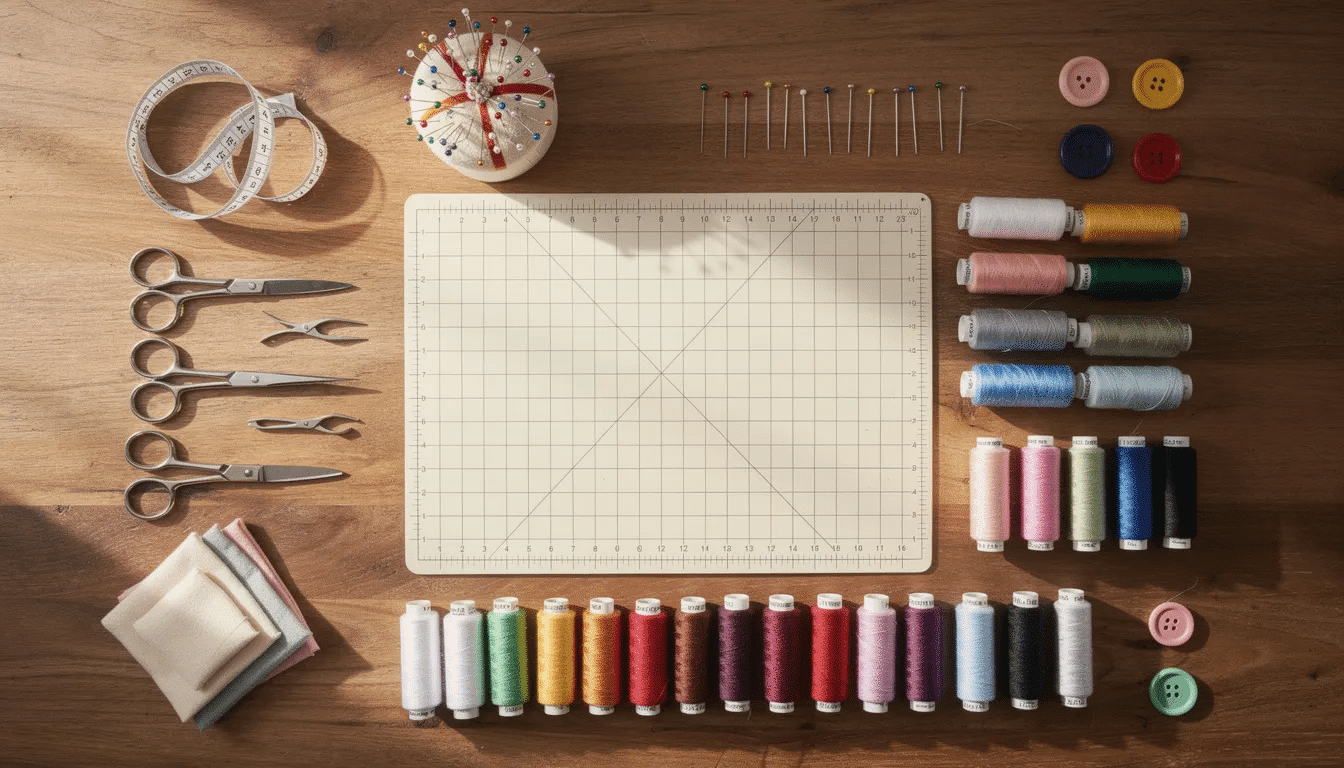
Think of this section as your starter toolbox—the essential sewing tools you should gather before threading your first needle. These are the items that will see constant use, project after project.
There’s an important distinction between true essentials and “nice-to-have” extras. The tools listed here are non-negotiable for most projects. Specialty items like pinking shears, rotary cutters, and curved rulers? Those come later, once you understand when you’ll actually use them.
With just these core tools, you’ll be equipped to complete simple projects like a tote bag, pillowcase, drawstring pouch, or elastic-waist skirt. Keep everything together in one box or drawer near your sewing space so you’re not hunting for pins when inspiration strikes.
Beginner-friendly sewing machine
A straightforward mechanical or entry-level computerized machine remains the best choice for beginners in 2024. You don’t need 200 decorative stitches or an LCD touchscreen. You need a machine that does the basics reliably and teaches you fundamental skills.
Here’s what actually matters when choosing your first sewing machine:
Feature | Why It Matters |
|---|---|
Straight stitch | Your primary stitch for seams and topstitching |
Zigzag stitch | Essential for stretch fabrics and finishing edges |
Adjustable stitch length/width | Lets you customize for different fabrics |
Easy bobbin loading | Reduces frustration during setup |
Clear manual | Your lifeline when things go wrong |
Expect to spend around $120–$250 for a reliable new entry-level machine. Brands like Singer, Brother, and Janome all offer solid beginner-focused models at this price point. Borrowing from a friend or buying secondhand is perfectly acceptable—many vintage machines outperform cheap modern ones. |
Learn to clean and change needles on your machine from day one. Most beginners blame the machine when stitches skip or fabric puckers, but the real culprit is often a dull or wrong-size needle. Developing good maintenance habits early prevents hours of frustration later.
Needles for hand and machine sewing
Understanding needle types prevents a surprising amount of beginner heartache. Machine needles fit into your sewing machine and do the heavy lifting, while hand sewing needles handle finishing touches like sewing on buttons, closing linings, and quick repairs.
For your first needle purchase, grab these machine needle sizes:
- Size 80/12 universal needles: Perfect for lightweight woven fabrics like cotton lawn and poplin
- Size 90/14 universal needles: Handles medium-weight cotton, linen, and light denim
Universal needles work beautifully for most projects involving woven fabrics. Specialty needles exist for specific situations—ballpoint needles for knits, denim needles for sewing denim and heavy canvas, microtex for pile fabrics and silks—but you can add those as your projects demand them.
Pick up one small pack of assorted hand needles. You’ll reach for them more often than you expect, especially when finishing garments by hand.
Pro tip: Change your machine needle at the start of each new garment or after about 8 hours of stitching. A fresh needle with a sharp point makes a noticeable difference in stitch quality.
Thread you can rely on
Good-quality polyester all-purpose thread is the most versatile choice for beginners. It works with most fabrics, stretches slightly without breaking, and comes in every color imaginable.
Start your thread collection with these essentials:
- White
- Black
- Light grey
- Beige or tan
- One or two colors matching your current projects
Poor-quality thread causes problems that look like machine malfunctions. If your stitches keep breaking, your tension looks uneven, or lint builds up constantly, cheap thread might be the culprit—not your sewing machine.
Signs of quality thread:
- Smooth, consistent thickness along the entire spool
- Minimal fuzz or fibers when unspooled
- Clean, even color without thin spots
Cotton thread works well for quilting and natural-fiber projects, but polyester handles the widest range of different fabrics for general sewing. Specialty threads for topstitching and embroidery can wait until you’re ready for decorative edges and advanced techniques.
Fabric scissors and thread snips
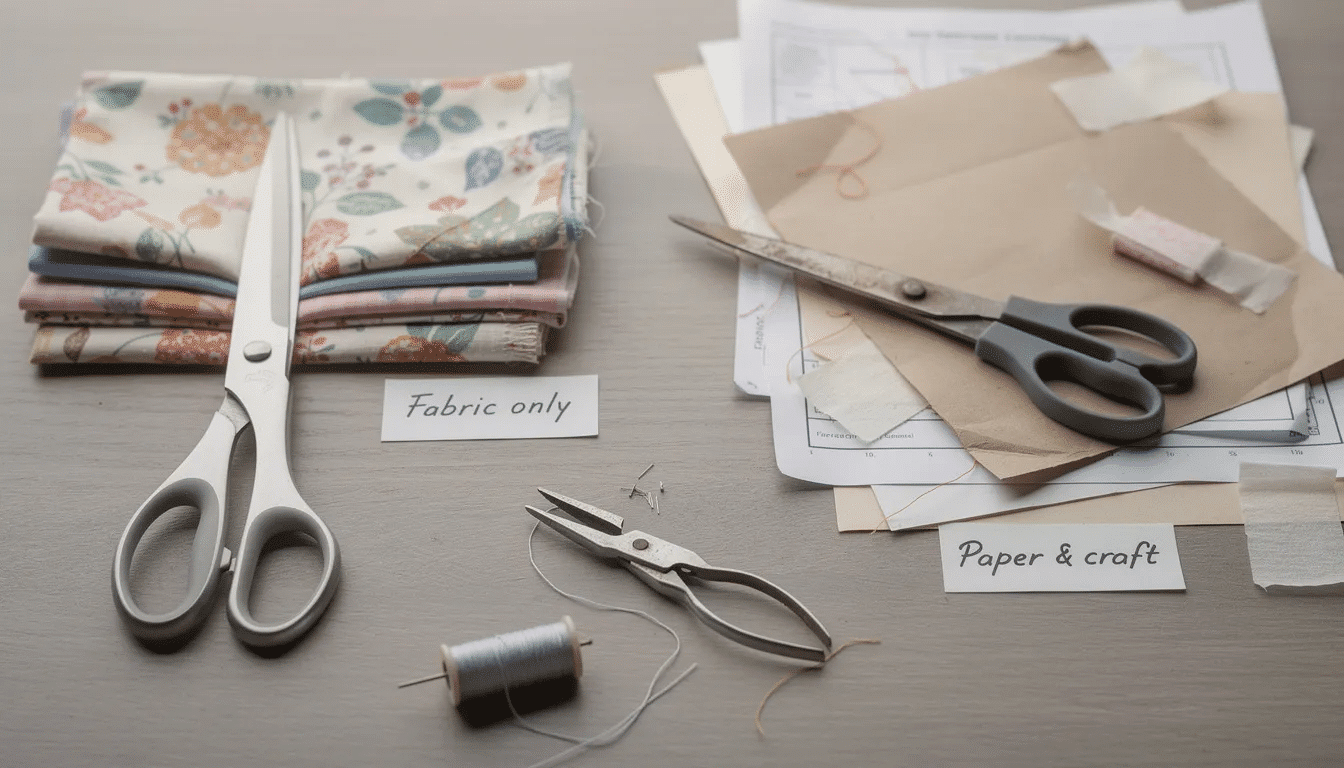
Your scissors can make or break your sewing experience. A dedicated pair of fabric scissors—typically 8–9 inches long with sharp blades—belongs in every sewing kit. The critical rule: these scissors touch fabric only. Never paper, never tape, never cardboard.
Why the strict separation? Cutting fabric requires a specific blade edge that paper quickly destroys. Using craft scissors on fabric results in ragged cuts, frayed edges, and endless frustration. Keep a separate, cheaper pair for paper patterns, packaging, and anything else that isn’t fabric.
When shopping for fabric shears, look for:
- Comfortable handle that fits your grip
- Strong pivot screw (the blade tightness should feel solid)
- Blades that close fully without gaps
- Smooth cutting action without catching or dragging
Small thread snips or embroidery scissors make a handy tool for clipping threads at the machine. They’re not essential, but once you try them, you won’t want to reach for full-size scissors to trim every thread tail.
Keep your blades clean by wiping them after cutting and storing with blades closed. Sharp scissors are safe scissors—dull blades require more force and slip more easily.
Pins, clips, and a safe place to store them
Sewing pins hold layers of fabric together before and during stitching. Standard straight pins with glass or colored heads work for most projects, and the glass-headed variety can handle ironing heat up to 400°F without melting.
Fine pins penetrate lightweight cotton and delicate fabrics without leaving visible holes. Thicker pins work better for heavier materials but can mark delicates. Starting with fine pins gives you the most versatility.
Sewing clips offer a great alternative to pins for specific situations:
- Thick layers of fabric that bend pins
- Vinyl, leather, or laminated fabrics that show pin holes
- Quilt binding and bag construction
- Projects involving children who appreciate fewer sharp points, especially when you’re also stocking age-appropriate art and craft supplies for young artists
For storage, choose what suits your workflow:
- Wrist pincushion: Keeps pins accessible while you work
- Classic tomato pincushion: Traditional, stable, and easy to find
- Magnetic dish: Catches dropped pins and speeds cleanup
A brief safety reminder: keep sharp items stored safely away from pets and children. Scattered pins on the carpet become a hazard faster than you’d expect.
Measuring tape, rulers, and seam gauge
Precise measurements separate “it almost fits” from “it fits perfectly.” Taking measurements accurately is the foundation of garment construction and pattern work.
A flexible measuring tape at least 60 inches (150 cm) long handles body measurements, curved seams, and pattern adjustments. Look for one with clear markings and a sturdy but flexible material that won’t stretch over time.
Add at least one rigid ruler to your kit—a clear quilting ruler or basic 12–18 inch ruler works well. Rigid rulers excel at:
- Drawing straight lines
- Checking grainlines
- Measuring seam allowance
- Precision cutting with rotary cutters
A sewing gauge—that small metal or plastic ruler with a sliding pointer—might be the most underrated essential sewing tool for accurate measurements. It makes marking hems, seam allowances, and buttonhole spacing fast and consistent.
Set your seam gauge at commonly used measurements like 1.5 cm or 5/8 inch (the standard seam allowance for commercial patterns) and leave it there for quick reference while sewing.
Marking tools that wash away
Transferring pattern markings to fabric—darts, notches, hemlines, placement points—requires marking tools that disappear after sewing. Permanent marks on your finished garment would defeat the purpose.
Several options work well for beginners:
Marking Tool | Best For | Removal Method |
|---|---|---|
Tailor’s chalk | Most woven fabrics, easy removal | Brushes or washes off |
Water-soluble pencils | Precise lines, detailed marking | Rinse with water |
Air-erasable pens | Temporary marks, quick work | Fades in 24-48 hours |
Heat-erasable pens | Visible marks during sewing | Disappears with iron heat |
Always test your marking tool on a scrap of the exact fabric before marking your final pattern pieces. What washes out of cotton might leave ghost lines on synthetic materials. |
A word of caution: heat-erasable markers can leave faint “ghost” lines on synthetic fabrics if over-ironed. These marks sometimes reappear in cold temperatures. Test thoroughly before using on various fabrics you’ll want to wear outdoors.
Keep your marking lines light and minimal. Heavy marks take longer to remove and can show through on lighter-colored fabrics.
Seam ripper: your mistake eraser
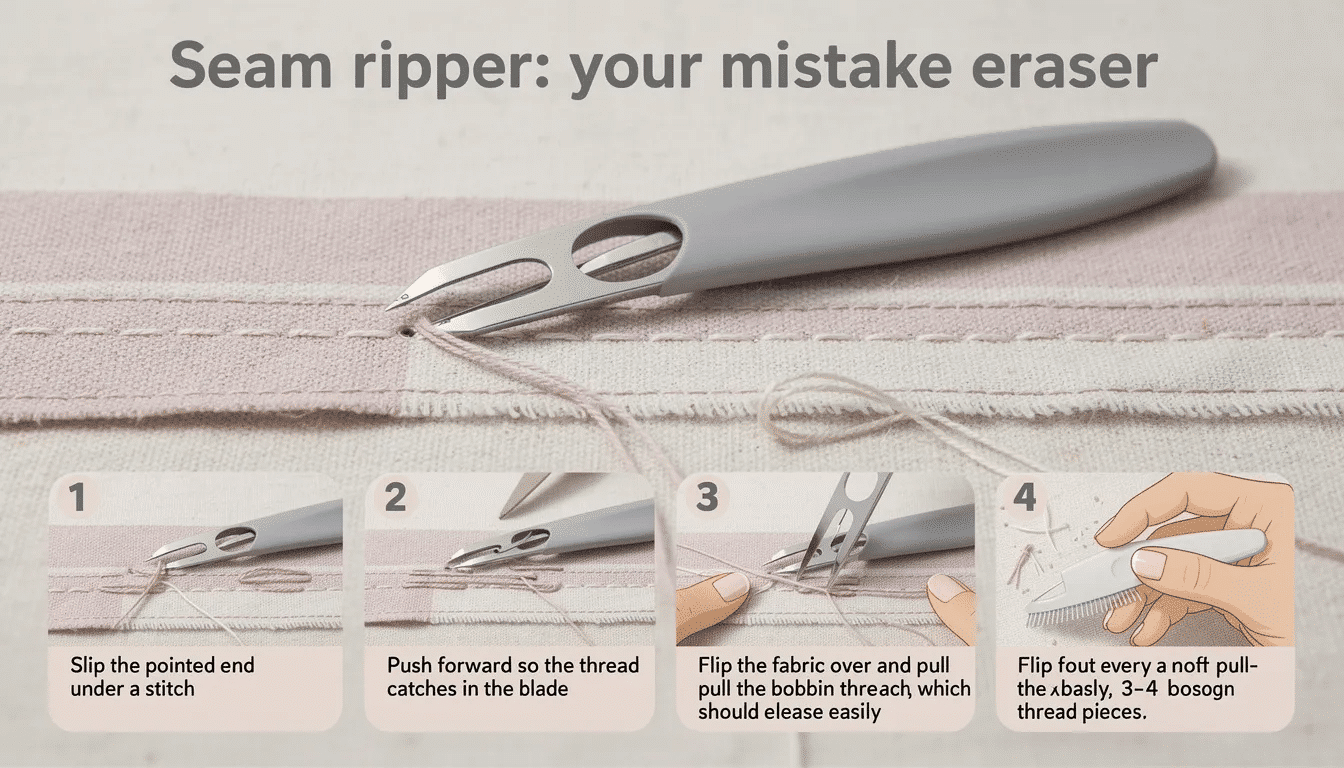
Every sewist uses a seam ripper regularly. It’s not a sign of failure—it’s a sign that you’re learning and willing to fix mistakes rather than live with them. Even experienced sewers reach for this handy tool multiple times per project.
A seam ripper has a simple design: a handle, a pointed end for slipping under stitches, and a small cutting blade nestled between two prongs. The blade sits in a curved cutout that hooks thread and slices it cleanly.
Here’s a safe, efficient way to unpick a seam:
- Slip the pointed end under a stitch
- Push forward so the thread catches in the blade
- Cut every 3–4 stitches along the seam
- Flip the fabric over and pull the bobbin thread, which should release easily
- Brush away loose thread pieces
Keep at least one seam ripper stationed near your machine and a spare in your travel kit. They’re small, inexpensive, and have a talent for disappearing. Replace your seam ripper when the blade dulls—you’ll notice it starts tearing threads instead of slicing them cleanly.
Iron, ironing board, and pressing tools
Here’s a secret that transforms beginner sewing: press seams as you go, not just at the end. The difference between homemade-looking and professional-looking results often comes down to pressing.
There’s a distinction between ironing and pressing. Ironing involves sliding the iron across fabric to remove wrinkles. Pressing means lifting the iron and setting it down with pressure to shape seams and flatten fabric. In sewing, pressing matters more.
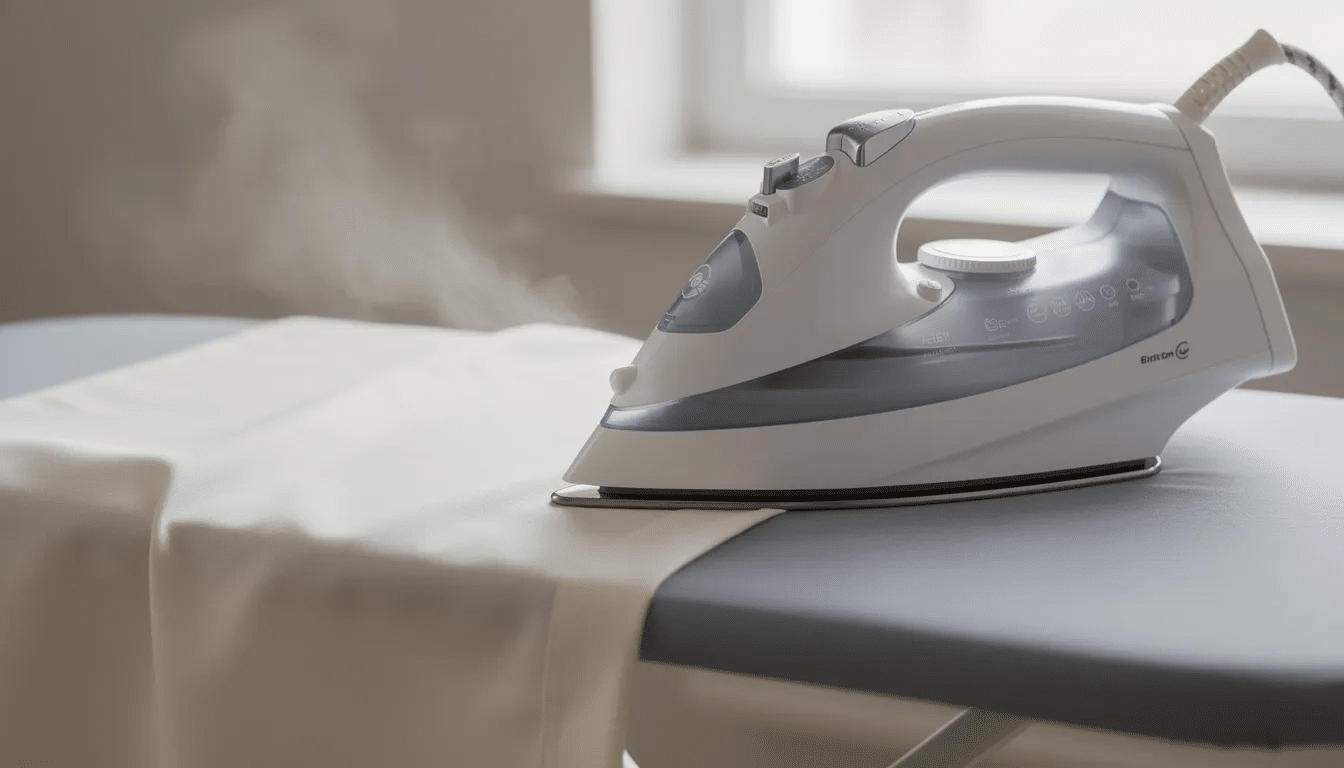
A basic steam iron with adjustable temperature handles most projects beautifully. You don’t need a professional-grade iron to start—you need one that heats evenly and produces reliable steam.
Set up a stable ironing board or padded pressing surface close to your sewing machine. Walking across the room to press every seam gets old quickly. Some sewers use a tabletop pressing mat right next to their machine for convenience.
As you advance, consider adding:
- Pressing cloth: Protects delicate fabrics from direct heat
- Tailor’s ham: Curved surface for pressing shaped seams and darts
- Sleeve roll: Helps press sleeves without creating creases
Press seams open or to one side as your pattern directs. This single habit will elevate your sewing more than almost any tool purchase.
Cutting and layout equipment
Accurate cutting fabric is the foundation of smooth sewing. Every wonky seam, misaligned pattern piece, and frustrating fit issue often traces back to cutting errors. Investing time in proper cutting technique and equipment pays dividends in every project.
While fabric scissors are enough to begin your sewing journey, rotary cutters and cutting mats become game changers as your projects grow larger. Quilters, in particular, find these tools indispensable for precision cutting through multiple layers.
Safe cutting habits matter from day one:
- Work on a flat, stable surface
- Keep movements controlled and deliberate
- Store all sharp blades closed or retracted
- Cut away from your body when possible
Rotary cutter and self-healing cutting mat
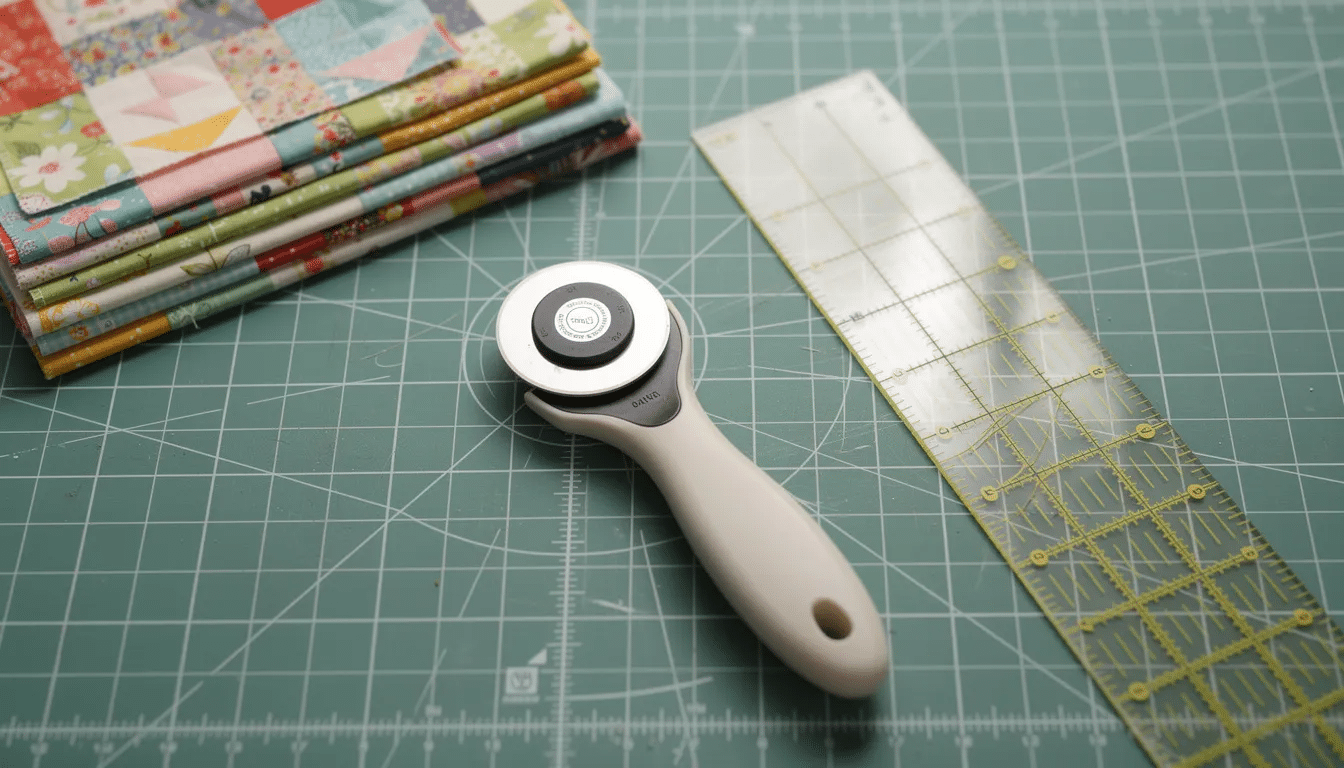
A rotary cutter looks like a pizza cutter for fabric—a circular blade mounted on a handle that rolls smoothly through material. It excels at long, straight cuts and slices through multiple layers of fabric effortlessly.
For beginners, a medium-size cutter (around 45 mm blade) offers the most versatility. It handles everything from cotton quilting squares to straight lines in garment construction. A 45mm blade can cut through up to 6 fabric layers cleanly, making it ideal for batch cutting pattern pieces.
A self-healing cutting mat serves two purposes: it protects your table from blade damage and preserves your blade’s sharpness. The mat’s surface absorbs cuts and “heals” to stay smooth, extending blade life significantly.
Most cutting mats feature printed grids and angle markings that help align fabric and patterns accurately. A 24” x 36” mat accommodates most projects while fitting on a standard table.
Safety first: Always retract the blade immediately after cutting. That exposed blade is razor-sharp. Cut away from your body, keep fingers clear of the blade path, and never leave a cutter open where others might reach for it.
Pattern weights and layout tools
Pattern weights hold pattern pieces in place without pins—especially useful when using rotary cutters, since you’re not lifting and repositioning fabric around pins.
You don’t need to buy specialty pattern weights to get started. Simple DIY alternatives work perfectly:
- Large metal washers from the hardware store
- Clean, smooth stones
- Small canned goods
- Anything heavy enough to hold paper flat
When laying out pattern pieces, follow the pattern layout diagrams carefully. Pay attention to:
- Grainline arrows (should run parallel to the selvage)
- Fold lines (pattern placed on folded fabric)
- Directional prints (all pieces facing the same direction)
- Nap direction for pile fabrics like velvet or corduroy
For slippery fabrics like satin or rayon, pins or sewing clips along edges help prevent shifting during cutting. Some sewers find that cutting single-layer rather than double-layer gives them more control with difficult materials—check your pattern instructions for guidance.
Smart extras that make sewing easier
The tools in this section aren’t required on day one, but they’re worth knowing about. As you complete your first few projects, you’ll naturally identify which extras would save you time or improve your results.
Think of these as “level up” tools—items to add gradually as specific project needs arise. There’s no rush. Many sewers acquire these pieces over months or years, often as gifts or during seasonal sales.
Keep a wish list as you sew. When a project makes you think “this would be so much easier with a French curve” or “I really need pinking shears for this fabric,” write it down. You’ll make smarter purchases than if you bought everything upfront.
Seam gauge and specialized rulers
A small metal or plastic seam gauge speeds up repetitive measuring tasks dramatically. Set the slider to your desired measurement—5/8 inch seam allowance, 2-inch hem, 1-inch buttonhole spacing—and mark consistently across your entire project.
As your skills develop, specialized rulers become genuinely useful:
Ruler Type | Best For |
|---|---|
French curve | Adjusting necklines, armholes, curved seams |
Hip curve | Drafting patterns, adjusting side seams |
Long quilting ruler | Cutting strips and blocks with rotary cutter |
Curved hem ruler | Marking even curved hems |
Quilters benefit from long, clear acrylic rulers for straight cuts and precise measurements. Garment sewers gravitate toward curves. Choose based on your interests. |
Look for rulers with both metric and imperial markings for flexibility—pattern instructions vary. Transparent rulers make it easier to see fabric and markings underneath while you work.
Pinking shears and fray prevention
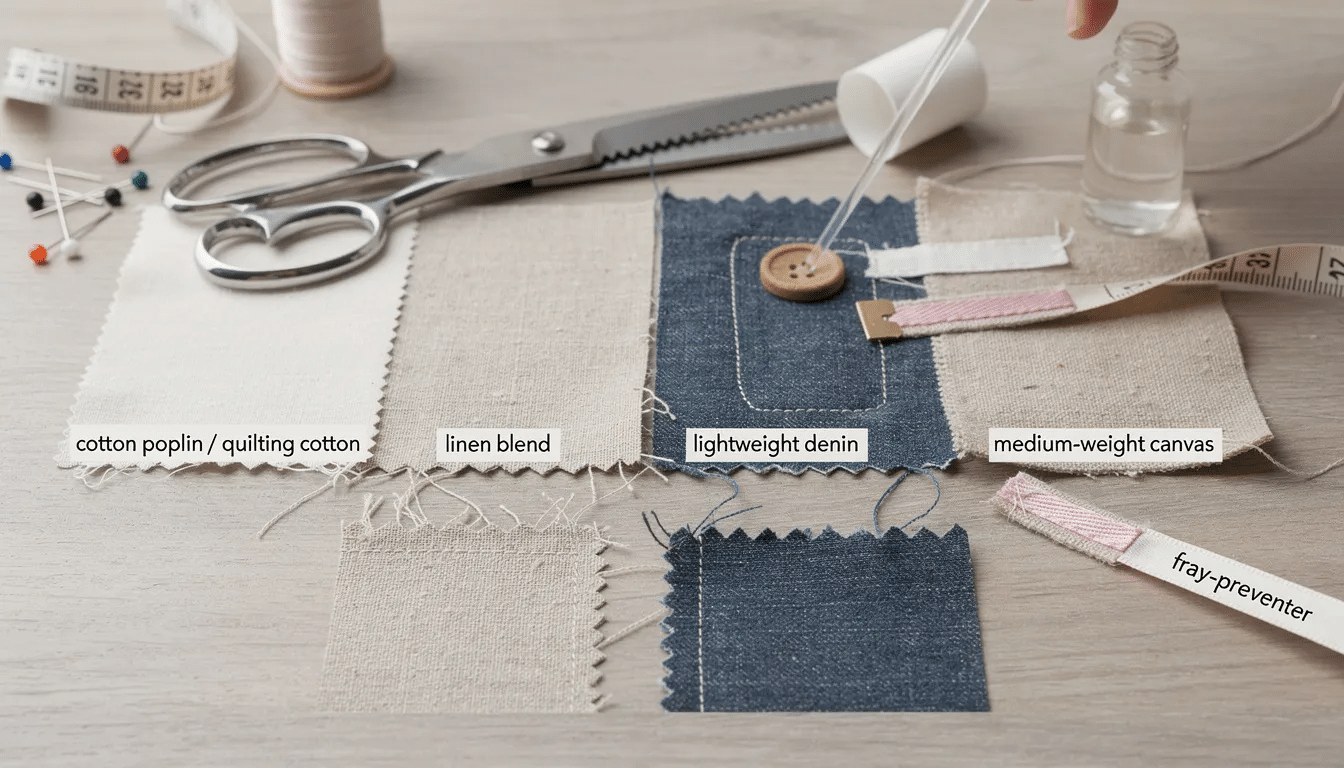
Pinking shears feature zigzag-cut blades that create decorative edges while reducing fraying on many woven fabrics. They’re a simple alternative to a serger for finishing raw edges on beginner projects.
Fabrics that respond well to pinked edges include:
- Cotton poplin and quilting cotton
- Linen and linen blends
- Lightweight denim
- Medium-weight canvas
Pinking doesn’t prevent fraying entirely—it just slows it down by disrupting the straight edge that unravels easily. For high-wear seams, you’ll eventually want to learn proper seam finishes. But for practice projects and casual garments, pinked edges work fine.
Liquid fray-preventers offer another option for small areas like buttonholes and ribbon ends. Apply sparingly—the liquid can stiffen fabric and darken some colors.
Like fabric scissors, pinking shears need dedicated care. Keep them sharp and use only on fabric.
Clips, elastic threaders, and other helpers
Sewing clips deserve another mention here because they become increasingly useful as projects get more complex. Bulky seams, quilt bindings, laminated fabrics, and bag construction all benefit from clips over pins.
An elastic threader or bodkin simplifies feeding elastic or drawstrings through casings. Without one, you’re safety-pinning elastic to a loop turner and hoping it doesn’t slip loose halfway through. With one, the job takes seconds.
Other helpers worth adding as needed:
- Loop turners: For turning narrow fabric tubes like spaghetti straps
- Point turners: For pushing out sharp corners on collars and bags
- Needle threaders: For hand sewing needles that fight your attempts to thread them
Add these tools as your projects begin to include waistbands, bags, home decor items, and garment construction with professional details.
Notions and haberdashery: the small parts that finish a project
Notions and haberdashery are the small components that give garments their function and polish—buttons, zippers, elastic, interfacing, snaps, ribbons, and similar items. They’re what transforms fabric from flat material into wearable, functional clothing.
These finishing elements provide closures, structure, and stretch. A beautifully sewn dress means nothing if it won’t zip up. A perfect waistband fails without elastic.
Build a small stash of basic notions so you don’t have to stop mid-project for a supply run. Pattern instructions usually include a checklist of required notions right on the envelope or PDF front page—check it before starting and gather all the essentials.
Buttons, zippers, and elastic
Each closure type serves specific purposes in garment construction:
Closure | Common Uses |
|---|---|
Buttons | Shirts, cardigans, decorative accents |
Zippers | Skirts, dresses, pants, bags |
Elastic | Waistbands, cuffs, gathered details |
For beginners, start with simple centered zippers before tackling invisible or lapped zipper techniques. Centered zippers are forgiving and visible stitching hides small imperfections. |
Elastic comes in different widths and strengths. For waistbands, common sizes like 1–2 cm (3/8–3/4 inch) work for most projects. Braided elastic stays flat in casings, while knit elastic offers better recovery and comfort against skin.
Keep a small variety pack of basic buttons in neutral colors—white, black, brown, cream. You’ll use them for repairs, replacements, and simple projects. Decorative buttons can come later when you want specific statements.
Practice installing closures on scrap fabric before sewing them into your garment. A confident test run prevents nervous mistakes on your finished piece.
Interfacing, trims, and finishing touches
Interfacing adds structure and stability where fabric alone would flop or stretch. You’ll find it in collars, cuffs, waistbands, button plackets, and bag openings.
Two main types exist:
- Fusible interfacing: Iron-on adhesive backing, easiest for beginners
- Sew-in interfacing: Stitched in place, preferred for delicate fabrics
Start with fusible interfacing in light and medium weights. Match interfacing weight to your main fabric—lightweight interfacing for cotton blouses, medium-weight for bag construction and structured collars.
Simple trims add personality to projects:
- Bias tape: Finishes raw edges or creates decorative bindings
- Ribbon: Adds color, texture, and embellishment
- Ready-made piping: Creates professional-looking seams on cushions and bags
Experiment with trims on small items like pouches or cushion covers before applying them to garments. The stakes are lower, and you’ll learn how different trims behave without risking a whole dress.
Setting up and maintaining your sewing space
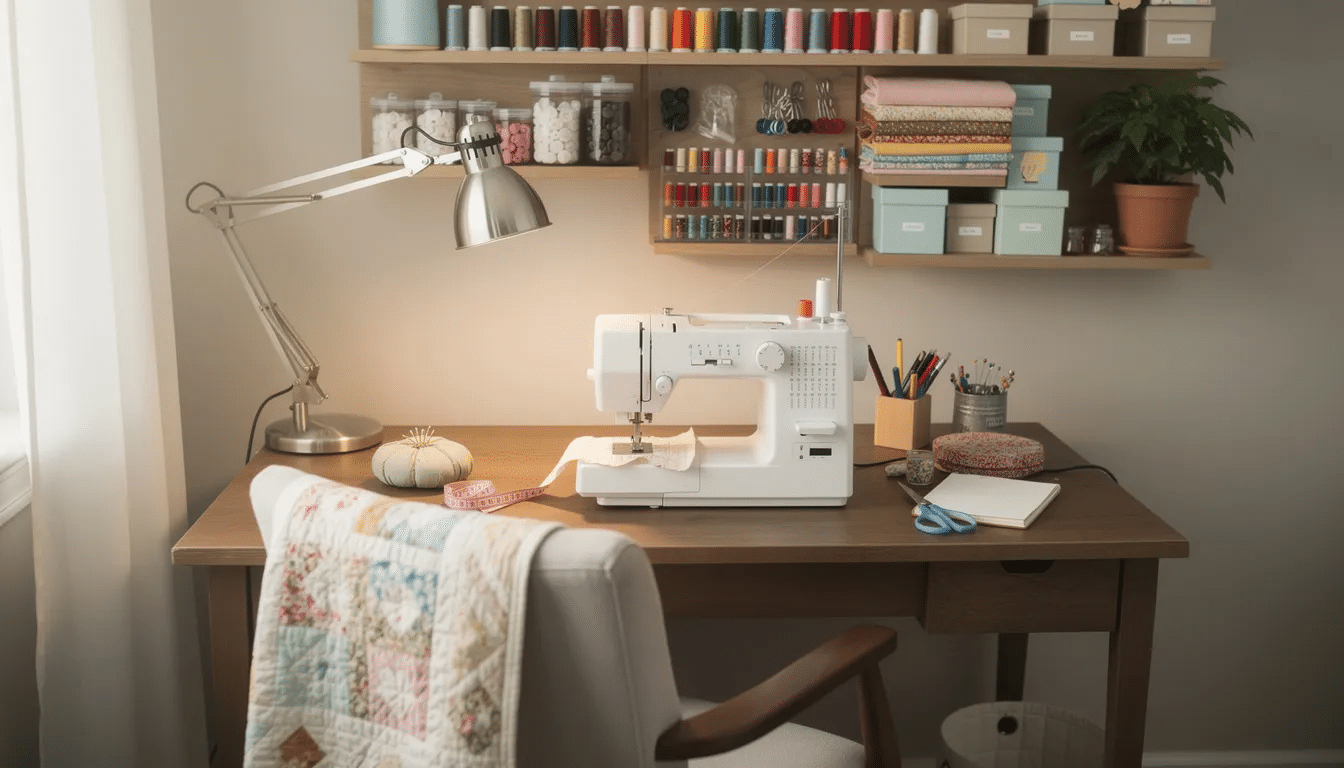
A comfortable, organized space makes sewing more enjoyable and more likely to become a lasting hobby. You don’t need a dedicated sewing room—even a small corner or folding table works beautifully in a 2024 apartment or home.
Good setup divides into two themes: comfort (chair height, lighting, layout) and maintenance (cleaning, storage, safety). Getting both right means you’ll actually want to sew rather than avoiding your machine because the space feels cramped or chaotic.
Keep your most-used sewing tools within arm’s reach of the machine. Constantly standing to grab scissors or pins wastes time and breaks your flow. Once you have a setup that works, take a quick photo—it makes replicating the arrangement after cleaning or rearranging furniture much easier.
Ergonomics, lighting, and storage
Poor ergonomics turn a relaxing hobby into a literal pain. Adjust your chair and table height so your elbows sit roughly level with the machine bed. Your feet should rest flat on the floor, and you shouldn’t hunch forward to see your work.
Bright, adjustable task lighting near the needle area makes threading, detailed work, and color matching dramatically easier. The overhead light in most rooms casts shadows exactly where you need to see clearly. A dedicated task lamp solves this problem.
Simple storage solutions keep your space functional:
- Clear boxes for notions (see what you have without opening everything)
- Jars or divided containers for buttons sorted by size or color
- Small trays or pegboards for frequently used tools
- Labeled containers for different needle types, bobbins, and small parts
A quick tidy-up routine after each sewing session keeps the area inviting for your next project. Five minutes of cleanup prevents the discouraging mess that makes you avoid the machine entirely.
Cleaning and caring for your machine and tools
Regular maintenance keeps stitches even and prevents unexpected breakdowns mid-project. Your sewing machine is a precision tool that needs attention, not a set-and-forget appliance.
Basic cleaning routine for domestic machines:
- Unplug the machine
- Remove the needle and bobbin case
- Use a small brush (often included with your machine) to sweep lint from the bobbin area
- Wipe down surfaces with a soft cloth
- Oil only if your manual specifically recommends it—many modern machines are self-lubricating
Skip the compressed air. It seems helpful but actually blows lint deeper into the machine’s workings, causing problems you can’t see or fix.
Keep your manual, spare needles, and extra bobbins together in a box or folder near your machine. When something goes wrong, you’ll have everything you need for troubleshooting in one place.
Schedule a professional service every year or two, depending on how frequently you sew. A technician catches developing issues before they become expensive problems and keeps your machine running smoothly for decades.
Choosing your first projects with these essentials
With all the essentials gathered, you’re ready to put them to use. The right tools deserve the right projects—ones that build skills progressively while producing items you’ll actually use.
Consider this project progression, each using your core sewing tools:
- Simple drawstring bag: Straight seams, basic casing, immediate satisfaction
- Cushion cover with envelope back: Introduces measuring, hems, and simple finishing
- Basic tote bag: Multiple seams, handles, optional pockets
- Elastic-waist skirt or pajama pants: First wearable garment, forgiving fit
Each project reinforces the same fundamental skills—measuring accurately, cutting precisely, stitching straight lines, and pressing seams—while gradually introducing new techniques.
Shop your stash before buying new fabric. Old sheets, tablecloths, and thrift-store finds make excellent practice materials. You’ll learn faster when you’re not afraid to make mistakes on precious fabric.
Here’s what matters most: gather your sewing essentials, clear a small workspace, and start stitching today. Don’t wait for the perfect setup, the ideal machine, or a free weekend with no interruptions. Your first sewing project is simpler than you think, and every expert sewist started exactly where you are now.
Happy sewing begins with these fundamentals in hand. Your next step? Pick your first project, thread that needle, and discover why millions of people find joy in creating something with their own hands.