

Key Takeaways
- This guide shows how to make a simple paper diamond kite with printer paper, sticky tape, wooden skewers or a dowel, and kite string.
- The project takes about 30–40 minutes and is fun for kids ages 6+ with adult help, especially when using scissors or a punch.
- You’ll learn how to measure, cut, reinforce, tie, decorate, and finish a kite that can actually fly.
- A steady breeze matters: lighter kites need less wind than heavier ones, and tail length affects stability.
- The FAQ covers newspaper, indoor versions, safe string, and storage.
Introduction: A Simple Paper Kite You Can Make Today
Flying a kite on a March weekend or an October school holiday is simple, cheap fun. This page explains how to make a kite out of paper using a classic diamond design that is light enough for a calm, breezy day.
A paper kite is a tethered flying craft with a paper sail. The kite string is the flying line you hold, and a paper diamond is the traditional diamond shape many beginners learn first. No special kit is needed: regular paper, cardstock, and construction paper can create many kite designs, but this one uses basic household items.

Materials: What You Need for a Basic Paper Diamond Kite
First things first: the right materials help your kite fly better and survive more than one windy afternoon.
You’ll need:
- One piece of lightweight paper such as A4, Letter size, or newspaper. Printer paper works; light cardstock around 160–200 gsm is stronger but needs more wind.
- Two wooden skewers, bamboo skewers, or thin stick dowels about 30 cm / 12 inch long. A diamond kite frame can be made using two stick dowels or bamboo skewers.
- Lightweight kite string or cotton twine, which is essential for flying a kite. Soft cotton string is best for kids; thin fishing line under 10 lb can work but may cut hands.
- Clear tape, masking tape, or sticky tape.
- Child-safe scissors, ruler, pencil, and optional glue.
- Ribbon, crepe paper, or a strip of plastic for the tail; 6 to 10 feet works depending on material.
- Markers, crayons, or small stickers to decorate.
- A cardboard tube or reel for the flying line.
To make a simple paper kite, you will need a piece of paper, a wooden skewer or straw, kite string, ribbon, scissors or a hole punch, and tape. Kites can be constructed using just paper and tape for a lightweight, simple design that can still achieve good flight performance, though spars make this version stronger.
Step‑by‑Step: How to Make a Kite Out of Paper
Clear a flat table, lay out your supplies, and help younger children with measuring and cutting. These instructions create a beginner size kite about 25–30 cm wide; scale up only if you keep the same proportions.
Step 1: Shape the Paper Diamond
- Fold the paper in half lengthwise, long edge to long edge, to find the center line.
- Mark one point on the folded edge about 4–5 cm from the top. Mark another point on the open edge about 4–5 cm from the bottom.
- Draw straight lines from the top corner to the lower mark, and from the bottom corner to the upper mark.
- Cut along the lines through both layers.
- Unfold the paper to reveal a symmetrical diamond sail.
Start by folding the paper in half and marking points to create the shape of the kite, then fold the corners down and tape the seams if any edges lift.
Step 2: Build the Wooden Frame
- Measure the vertical length of the paper diamond.
- Trim one skewer or dowel so it runs from top point to bottom point; this is the spine.
- Measure the widest part and cut the second stick slightly shorter for the cross spar.
- Place the cross spar about one-third down from the top. Put the spine over its center so the sticks cross in the middle.
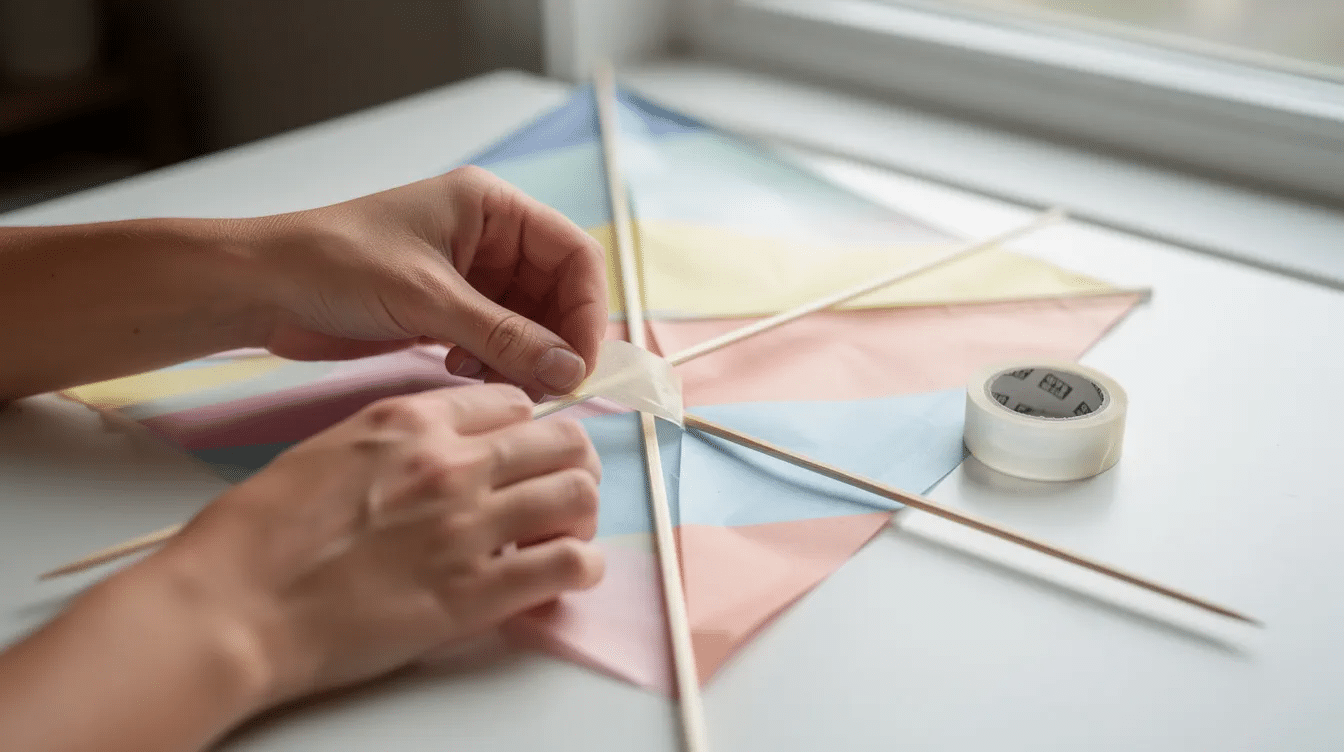
- Tape the crossing tightly, then tape both sticks to the paper with short strips along their length and at the corners.
Attach a skewer across the kite for support, tape it in place, and make sure no sharp end passes beyond one side of the paper.
Step 3: Punch the Bridle Hole and Tie the Kite String
- Turn the kite face down so the frame is visible.
- Reinforce a small piece of paper near the crossing with tape on both sides, about 2.5 cm wide.
- Use a hole punch, or carefully poke a small hole about 1–1.5 cm below the cross spar.
- Cut 30–40 cm of string, thread it through the hole, and tie a tight knot to create a loop.
- Attach the longer kite string to that loop.
This bridle point helps the kite meet the air at the right angle.
Step 4: Add and Decorate the Kite Tail
The tail keeps a light paper kite from spinning or diving.
- Tape ribbon, crepe paper, or light plastic to the bottom point.
- Use a tail about 1.5–3 m, or 5–10 feet, long.
- Add small paper rectangles or triangle shapes every 15–20 cm for color and weight.
- If the kite nose dives, lengthen the tail. If it struggles to lift, trim the tail slightly.
- Decorate the front with bright colors, patterns, animals, superheroes, or geometric designs.
Kite tails can be made from lightweight materials such as ribbon or crepe paper, which help stabilize the kite during flight. Adding a tail made from crepe paper or ribbon can also enhance decoration while improving stability in the air. Remember: lighter tails can be longer, while heavier tails should be shorter.
Step 5: Final Checks Before Flying
- Press down every tape strip.
- Check that no dowel or skewer end sticks out.
- Gently pull the kite string to confirm the knot is strong and not tearing the paper.
- Sight along the spine from top to bottom; if anything looks wrong or twisted, retape it.
- Wind 20–30 m of line onto a reel or cardboard tube.
Your kite is now ready.
How to Fly Your Paper Kite Safely
Choose an open site: a park field, weekend school playground, or wide beach with clear sky above. Avoid trees, power lines, roads, airports, rain, and thunderstorms.
Kites generally require a steady breeze to fly effectively, with lighter kites needing less wind than heavier ones. Aim for about 8–20 kph, or 5–12 mph, where leaves move but branches are not bending hard.
For the best way to launch, use two people. One holds the kite at shoulder height facing the wind. The other walks back with the string. When the wind fills the sail, let go gently. If the kite starts to fall, reeling in some string can help stabilize it, while letting out more string can assist if the kite is tugging hard in the wind.
Quick Troubleshooting for Paper Kites
- Kite spins in circles: add tail length or check that the frame is centered.
- Kite shoots straight down: move the bridle hole slightly up the spine.
- Kite won’t lift: use lighter paper, shorten a heavy tail, or wait for steadier wind.
- Paper diamond bends in the middle: reinforce weak lines with tape or use a stronger spar.
Test one change at a time. Small uneven cuts can unbalance the design, so check left and right sides carefully.
Simple Variations on the Basic Paper Kite
Once this paper diamond flies, try another design or switch to a fun fabric kite craft for kids that uses similar flying principles with sturdier materials.
- Mini paper kite: use half a sheet of A5 or 5.5”×8.5” paper for indoor hallway tests with a gentle fan.
- Larger weekend project: use wrapping paper or newspaper and reinforce the edges and spine.
- Sled-style kite: uses folded paper rather than sticks; it is light but more sensitive to gusts.
Kite designs such as the Paper Sled, Paper Diamond, and Paper Delta have been developed and refined to ensure they can fly effectively in various wind conditions. The MBK Minimum Sled kite requires just a single sheet of A4- or Letter-sized copier paper and is designed for light winds, with reports of it flying high for extended periods. The MBK Paper Diamond kite design requires a bit more work on the spars and has been successfully flown for up to 3 hours in ideal conditions. The MBK Paper Rokkaku kite is designed to float down on its face in stable fashion when the breeze drops below 12 kph, while still being able to stay in the air in fresh wind conditions. The MBK Paper Delta kite design has a complex spar structure that allows it to hover low in around 12 kph of breeze and float up to a line angle of 45 degrees in moderate wind.
Care, Storage, and Re‑Use of Paper Kites
Reel the kite in gently so it does not drag across rough ground. Store it flat or hang it by the spine, away from moisture and direct sun.
Repair small tears with clear tape on both sides. Reinforce worn bridle holes before they rip. Keep the kite string wound neatly so knots do not form between sessions.
If you post photos, a short video, or a link to your finished project, include the size, tail length, and wind conditions so others can learn from what worked. I hope your first flight is the start of many more.
FAQ: Common Questions About Making Paper Kites
Can I make a paper kite from old newspaper or magazine pages?
Yes. Newspaper is light and works well, but it needs extra tape at the edges and frame contact points. Glossy magazine paper can work too, but press the tape firmly because the surface is slippery.
What is the safest kind of kite string for kids?
Use soft cotton or polyester string that is comfortable to hold. Avoid very thin fishing line for young kids because it can cut fingers. For younger ages, limit the line to about 15–20 m.
How big should the tail be for a small paper diamond kite?
Use a tail 4–6 times the height of the kite. For a 30 cm kite, that means about 1.2–1.8 m. Adjust after the first flight.
Can I fly a paper kite indoors?
A full-size kite is made for outdoor air, but a mini kite can be tested indoors in a gym or large room with a gentle fan. Keep the string short and stay clear of lights and furniture.
How long will a paper kite last?
A well-made paper kite can last multiple sessions if it stays dry and is handled carefully. After each flight, check for tears and tape them before the next breezy day.