

If you’re wondering how to make a toy car from cardboard, this tutorial gives you two practical builds: a small rolling cardboard car and a larger box car kids can sit in or wear. It is cheap, creative, and a nice way to turn one day’s delivery box into a week of play.
Key Takeaways
- You can build a simple toy car from a recycled cardboard box in about 45–60 minutes with scissors, skewers or pencils, tape, and glue.
- This project covers a small rubber-band powered cardboard car and large cardboard box cars for pretend driving.
- Kids learn wheels, axles, friction, propulsion, measurement, and design while they decorate with paint, markers, headlights, and license plates.
- Sturdy 2024–2026 shipping boxes, including Amazon-style corrugated cardboard, help save money and reduce waste.
- The FAQ at the end covers safety, durability, smoother wheels, and storage.
- Why Make a Toy Car from Cardboard?
- Materials and Tools You’ll Need
- Planning Your Cardboard Car Design
- Building a Simple Rolling Cardboard Toy Car
- Making a Rubber Band Powered Cardboard Car
- Creating a Large Cardboard Box Car Kids Can Sit In
- Details that Make Cardboard Cars Look Real
- Painting and Decorating Your Cardboard Car
- Ideas for Playing and Learning with Cardboard Cars
- Safety Tips and Cardboard Car Durability
- FAQ
Why Make a Toy Car from Cardboard?
Cardboard cars are fun because kids can race them, push them, or climb inside them for pretend play. In 2026, many families have regular parcel deliveries, so using upcycled materials like cardboard for toy car projects teaches children about sustainability and conserving resources.
Cardboard toy cars are cheap to build, easy to repair, and recyclable when your child outgrows them. Engaging children in the process fosters creativity and lets them express individuality through design choices. Encouraging children to take the creative lead also builds problem-solving skills and confidence.
This project works for parents, teachers, and youth leaders who need a low-prep activity for rainy days, STEM clubs, or birthday parties, and it pairs well with curated DIY kits for creative projects and fun learning.
Materials and Tools You’ll Need
Gather everything first so you do not have to stop mid-step.
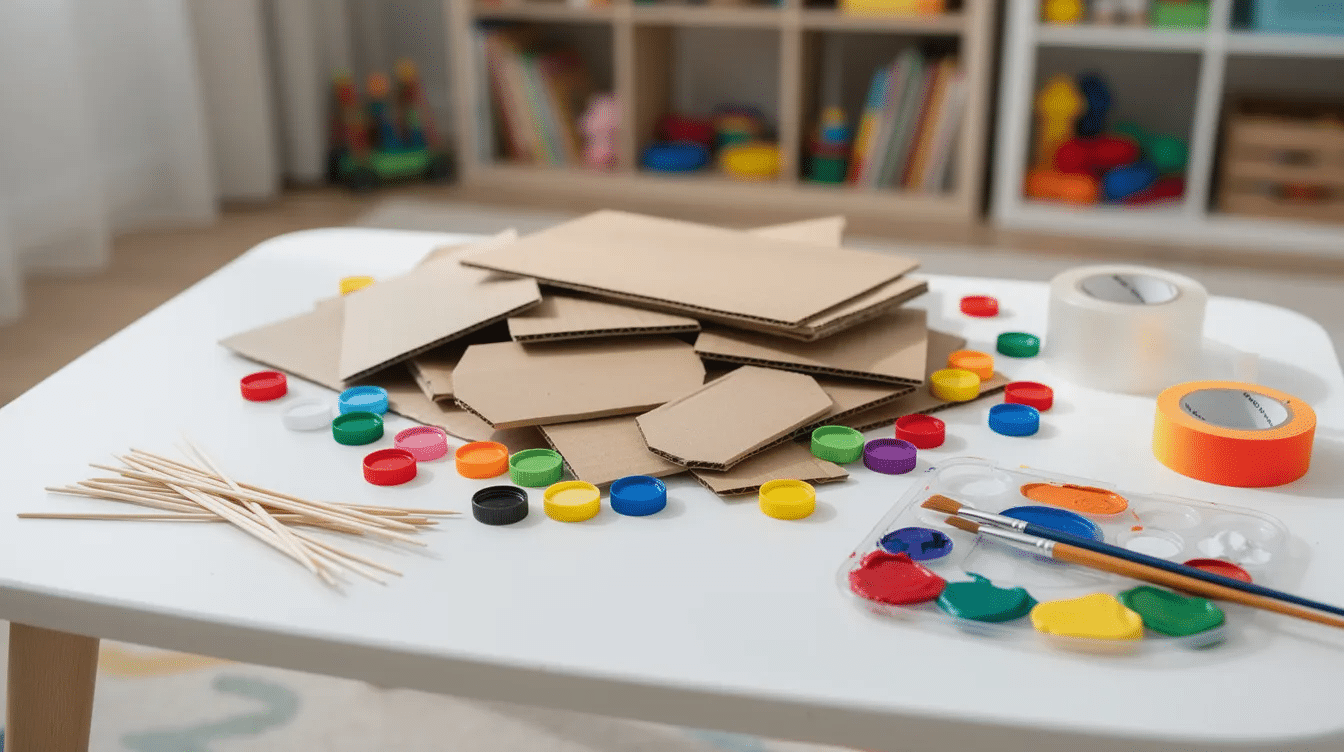
You’ll need:
- A small to medium cardboard box, cereal boxes for trim, and thicker corrugated cardboard for the base
- Plastic bottle caps or stacked cardboard circles for wheels
- Wooden skewers, barbecue skewers, bamboo sticks, or unsharpened pencils for axles
- Straws for axle sleeves
- Craft knife for adults, scissors, ruler, pencil, and wire cutters
- Hot glue, white glue, or strong craft tape
- Masking tape and clear tape
- Acrylic paint, markers, stickers, colored paper, aluminum foil, reflective tape, bottle caps, and license plates
Materials required for making a cardboard toy car include a small to medium cardboard box, plastic bottle caps, wooden skewers, craft knife, scissors, and hot glue or strong craft tape. Common materials for making cardboard toy cars include cardboard boxes, barbecue skewers, straws, and hot glue.
Use a low temperature glue gun around kids; it operates at around 75 degrees cooler than standard glue guns, reducing burn risk. A low-temperature glue gun is also recommended because it helps children learn to handle tools with skill, especially when tackling projects like a step-by-step cardboard sword craft. Use wire cutters for cutting barbecue skewers, since they are safer and easier than scissors for that job.
Planning Your Cardboard Car Design
Before you cut, decide whether you want a small rolling car, a rubber band powered cardboard car, or a large sit-inside cardboard box car. Match the size to action figures, toy animals, or the height of a specific child.
Sketch a side view and top view. Plan the shape of the hood, roof, trunk, wheel placement, and where the door will open. Kids can choose a race car, taxi, police car, fire truck, or a 1950s classic inspired by a 1957 Chevy Bel Air.
Families are encouraged to let children take the creative lead in designing their cardboard cars, choosing colors, shapes, and features. Leave room for windows, headlights, a steering wheel, and custom license plates with a name, number, or birth year.
Building a Simple Rolling Cardboard Toy Car
This basic car is ideal for grade 1 to grade 4. According to Science Buddies, simple rubber-band car builds often take 20–30 minutes before testing and decoration.
- Cut an 8” × 4” rectangle from a sturdy box. Fold or glue low sides to create the chassis.
- For extra support, start with a couple of 3-inch squares of cardboard and glue them together with the flutes perpendicular to one another.
- Glue two straw pieces underneath as axle sleeves. Keep them parallel so the toy car rolls straight.
- Trace four circles, about 3–4” wide, for wheels. Glue layers together for strength.
- When constructing the wheels for a cardboard car, use a matching square to find the center of the circle; this makes it easier to poke holes for the axle.
- Slide skewers or pencils through the straws. Attach the wheels to each end, gluing only the outer side so each wheel can turn freely.
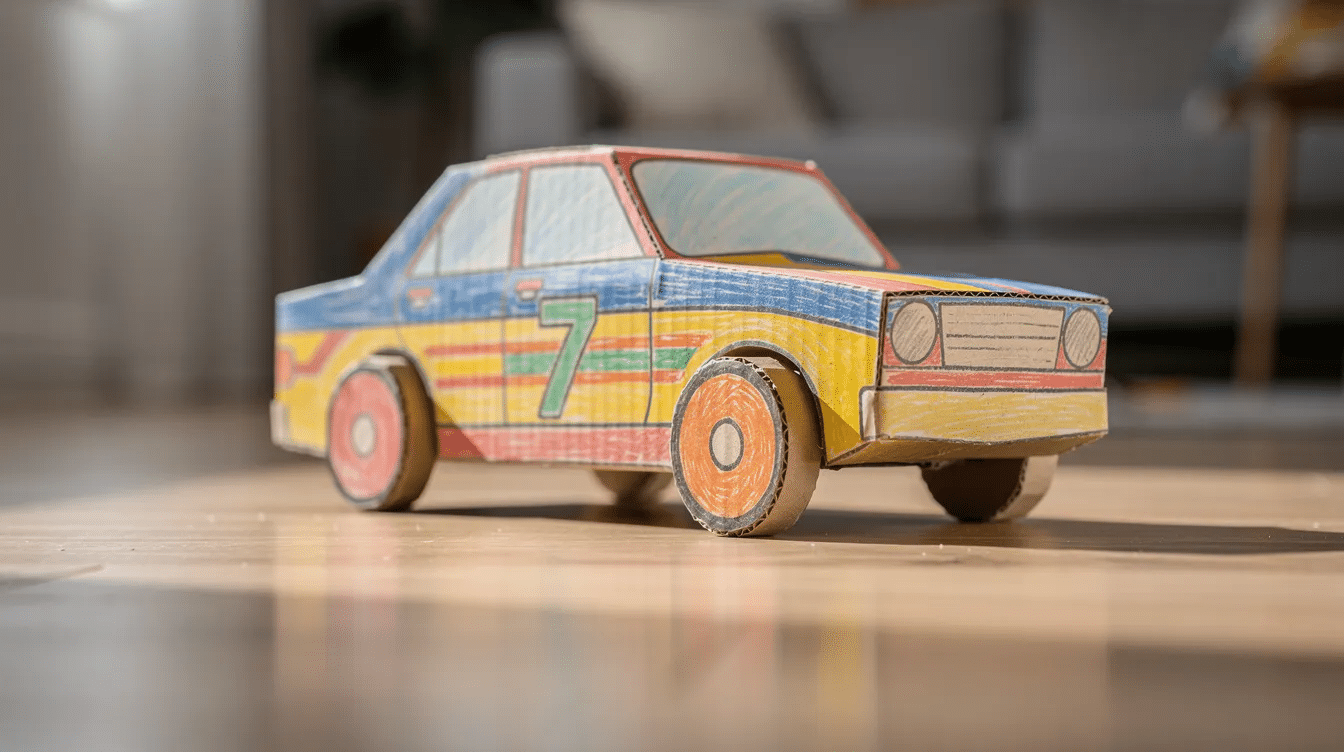
A cardboard toy car can be built using a cardboard box, bottle caps or stacked circles for wheels, and wooden skewers for axles. Test it in a hallway or on a wooden ramp. If it veers left, check whether the axles match and the wheels are not rubbing the edge.
Making a Rubber Band Powered Cardboard Car
This version adds a motor so the cardboard car launches forward. NASA’s cardboard rover lesson uses rubber bands to test how more turns affect distance.
Reuse the same chassis, but leave room between the rear axle and front center. Cut a small reinforced notch or hook at the front. Loop one end of the rubber band there, then wrap the other end around the rear axle.
Twist the axle backward several turns, place the car on the floor, and release. Keep fingers away from the wheels. Do not test on tables. Try 3, 6, 9, and 12 turns, then record how far it travels. This quick experiment shows elastic potential energy becoming motion.
Creating a Large Cardboard Box Car Kids Can Sit In
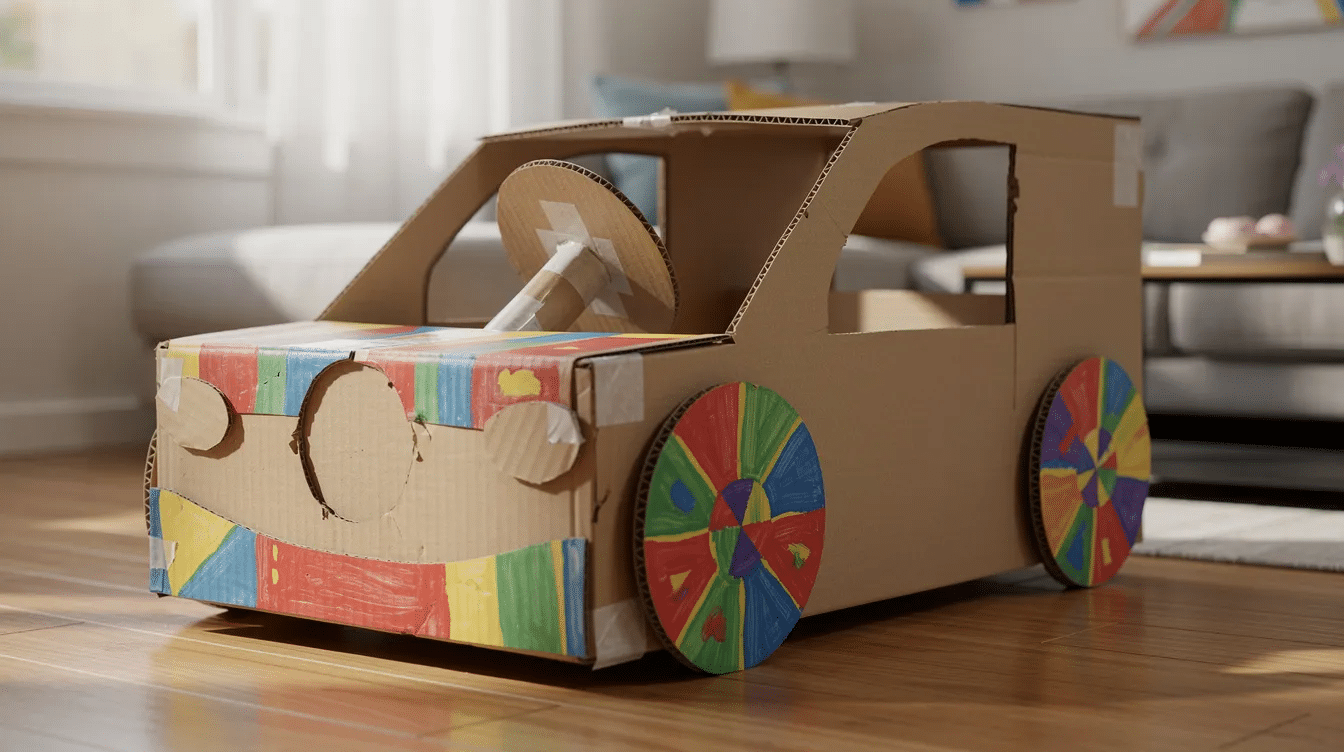
For life-size cardboard box cars, choose a moving box or appliance box that reaches roughly from the child’s knees to chest when sitting inside. Tape the bottom flaps securely and add cross-bracing if the floor sags.
Adults should mark and cut a door with a craft knife, leaving a sturdy frame for stability. If the car will be worn as a costume, attach wide ribbon or fabric straps and reinforce the holes with tape.
Use large paper circles or a paper plate cut in half as decorative wheels. These are for looks, not support. Add a dashboard and steering wheel inside at a comfortable height.
Details that Make Cardboard Cars Look Real
Finishing touches turn plain cardboard into a completed car kids feel excited to show.
Add:
- Headlights and tail-lights from plastic lids, colored paper circles, aluminum foil, or reflective tape
- Windows, grille lines, bumpers, mirrors, and door handles
- License plates: print or draw rectangles, then tape one plate to the front and one to the back
- Windshield wipers from thin cardboard strips
- A cardboard key, keyhole, and pedals drawn on the floor
Cardboard toy cars can be customized with stickers, paint, and additional features like headlights and tail-lights made from everyday items.
Painting and Decorating Your Cardboard Car
For the best color, paint the main cardboard car body first with acrylic or tempera paint. Wait a few hours, or overnight, until dry before adding details.
For a faster same-day project, cover sections with colorful paper, washi tape, or masking tape. Using colorful paper or paint to cover cardboard boxes makes the toy cars look more festive and personalized.
Encourage kiddos to design logos, racing numbers, or sponsor decals from scrap paper. A thin coat of diluted white glue or craft sealer can help the design last through repeated play.
Ideas for Playing and Learning with Cardboard Cars
Play extends the value of the project beyond the build. Mark a hallway track with masking tape, race several cardboard cars, and compare speed, distance, and stability.
Create a pretend town with signs, parking spaces, and a gas station. Large cardboard box cars are perfect for a drive-in movie night where kids sit in their cars with popcorn, or you can expand the theme with an imaginative cardboard time machine build for time-travel adventures.
Teachers can connect the activity to forces and motion, recycling, community helpers, and measurement. For seasonal themes, you might rotate in polar bear winter craft activities alongside cardboard cars. For older kids, ask them to take a picture of each test run and save results in a simple account or notebook.
Safety Tips and Cardboard Car Durability
Adults should handle sharp tools and hot glue while kids decorate, measure, and assemble safe pieces. Keep box cutters at one supervised station, and have children stand back while adults cut windows, doors, and difficult shapes.
Use rounded scissors, low-temp glue guns, and non-toxic paints or markers. Reinforce weak points such as wheel mounts, doors, strap holes, and corners with extra cardboard and strong tape.
Store the finished car indoors, away from damp walls. Flatten or partially disassemble large cars if you need more room.
FAQ
How long does it take to build a cardboard toy car?
A basic rolling cardboard car usually takes 45–60 minutes. A large sit-inside box car with paint and details may take 2–3 hours across one or two days because glue and paint need drying time.
What age group is this cardboard car project best for?
Children ages 5–10 can participate actively. Younger kids can decorate and choose the design, while older kids can help measure, trace, cut with supervision, and test the axles.
Can cardboard cars really last, or will they fall apart quickly?
With well-taped seams, double-layered wheel supports, and dry indoor storage, a frequently used toy car can last several weeks to a few months. Moisture and rough outdoor play shorten its life.
How can I make the wheels spin more smoothly?
Slightly enlarge each hole, use straw sleeves between the axle and cardboard body, and add a tiny amount of candle wax to reduce friction. Also make sure the wheels do not rub the chassis.
Is it safe to let kids wear cardboard box cars as costumes?
Yes, if the box is light, straps are wide and secure, and adults check that the child can walk without tripping. Use Velcro or quick-release knots so kids can get out easily.
Now that you know how to make a toy car from cardboard, give your family one clear build session, let the kids lead the design, and share your best idea in the comments on this post.