Starting a scrapbook can be a rewarding way to preserve memories without needing advanced art skills or a room full of tools. In this blog post, you’ll learn how to start a scrapbook for beginners with a simple project, a small kit, and a repeatable process you can use for every album after this one.
Key Takeaways
- Scrapbooking is a simple way for new scrapbookers to turn printed photos, paper, memorabilia, and journaling into a story-filled album. You can create meaningful scrapbook pages with just a few basic tools, even if you have never made a craft project before. The goal is not perfection; the goal is preserving memories in a format family members can hold, read, and enjoy.
- The essentials for a first project are an acid free album with page protectors, cardstock, patterned paper, a paper trimmer, scissors, adhesive, a fine-tip archival-safe pen, and 20–40 photos printed.
- The basic workflow is: choose a theme, organize photos, print more photos if needed, plan simple layouts, add decorative elements, and protect finished pages.
- Start small with one album or mini album, such as “Summer 2024 with family members,” instead of trying to document your entire life at once.
- Imperfect pages are normal at the beginning of your creative journey. Practice matters more than owning lots of fancy scrapbook supplies.
- What Is Scrapbooking & Why It’s Perfect for Beginners
- Step 1: Choose Your First Scrapbook Project
- Step 2: Gather and Print Your Photos
- Step 3: Pick the Right Album (and Size) for Your First Scrapbook
- Step 4: Essential Supplies for New Scrapbookers
- Step 5: Organize Your Workspace and Photos
- Step 6: Plan Your First Page Layout
- Step 7: Assemble the Page – From Photos to Finishing Touches
- Step 8: Protect and Store Your Finished Pages
- Step 9: Grow Your Skills and Try Different Scrapbook Formats
- Common Beginner Mistakes (and How to Avoid Them)
- FAQ
- How many photos should I print for my very first scrapbook?
- Do I really need acid free supplies, or can I use regular paper and glue?
- What if I don’t like my handwriting on scrapbook pages?
- Can I start with a digital or hybrid scrapbook instead of traditional paper?
- How long does it take to finish a beginner scrapbook album?
What Is Scrapbooking & Why It’s Perfect for Beginners
Scrapbooking is the process of arranging photos, paper, journaling, and other elements into story-based pages kept in photo albums, mini albums, or scrapbook albums. People scrapbook a 2024 family vacation, a child’s first school year, a wedding in June 2023, or a “best friends” album filled with pictures, ticket stubs, and important dates.
Modern scrapbooking grew from simple photo albums into creative layouts using patterned paper, stickers, die cuts, stamps, and decorative elements. Traditional scrapbooking is especially beginner-friendly because it is hands-on, relaxing, and helps you unplug from screens while preserving memories for future family members. This beginner’s guide focuses on the easiest way to make your first album without advanced art, mixed media, or expensive tools.
Step 1: Choose Your First Scrapbook Project
Before you buy albums or supplies, choose one clear theme. A focused theme helps you decide which photos printed to use, what colors fit the story, and which scrapbook embellishments make sense.
Good first scrapbook ideas include:
- “Family Highlights 2023–2024”
- “Our Wedding Day – 15 June 2024”
- “Baby’s First Year”
- “Weekend Adventures”
- “Pets of the House”
- “My Creative Journey in 2025”
- “Best Friends Summer Trip”
The best way to begin a diy scrapbook is to choose a time-limited project: one trip, one year, one event, or 12 favorite moments.
This keeps your first page, title page, and next few pages manageable.
Step 2: Gather and Print Your Photos
For many beginners, getting photos printed is the hardest step, but it is also the most important. Organizing your photos before starting a scrapbook can save you time and help you focus on the stories you want to tell.
Start with 20–40 printed photos. When selecting photos for your scrapbook, it’s recommended to choose 1 to 4 photos from a single event to keep the focus clear and manageable. For stronger visual impact and more space for journaling, limiting the number of photos on a scrapbook page to one or two often works best.
Sort digital images into folders by date or event, such as “Summer 2024,” “Christmas 2023,” or “School Year.” Then print 4×6 inch and 3×4 inch photos so you can mix sizes in your layouts. You can print at a pharmacy, supermarket kiosk, online printing service, or home photo printer with good paper. Print a few more photos than you expect to use so you have flexibility when designing.
Step 3: Pick the Right Album (and Size) for Your First Scrapbook
Beginners should choose a simple, sturdy album with page protectors rather than custom bookbinding. A scrapbook album is essential for beginners, with popular sizes being 12”x12” and 8.5”x11”, as most scrapbooking papers and page protectors are designed for these dimensions.
Common sizes include:
- 12×12 inches: best for traditional layouts with more photos and more space.
- 8.5×11 inches: feels like a notebook and is easy to store.
- 6×8 or 8×8 inches: great smaller albums that fill quickly and feel less intimidating.
Pairing a 12”x12” binder with clear plastic page protectors helps keep layouts safe from fading and fingerprints. Page protectors are clear, plastic sleeves that fit over each scrapbook page to protect it from fingerprints, smudges, and discoloration, ensuring the longevity of the scrapbook.
Choose albums, sheet protectors, and pocket pages labeled acid free and photo safe. According to the National Archives, safe plastics for photo storage include polyester, polypropylene, and polyethylene, while PVC should be avoided.
Step 4: Essential Supplies for New Scrapbookers
You do not need a whole craft room to enjoy scrapbooking for beginners. The foundation of a scrapbook includes an album, page protectors, cardstock, acid-free adhesive, and cutting tools like scissors or paper trimmers.
Here are the basic supplies to gather:
- Sharp scissors, a ruler, and a pencil
- A paper trimmer; using a guillotine trimmer can ensure straight cuts for photos and paper in scrapbooking
- Acid free adhesive, such as a tape runner, double sided tape, glue dots, or liquid glue
- Solid cardstock for backgrounds and photo mats
- Coordinated patterned paper for color and texture
- A fine-tip archival-safe pen for journaling
- Stickers, washi tape, die cuts, stamps, colored pencils, or a few embellishments
Cardstock is a fundamental scrapbooking supply, serving as the base for pages and decorative elements, and should be acid-free and lignin-free to prevent fading over time. Acid-free cardstock and patterned paper are recommended to protect photos from yellowing. Adhesives are crucial for scrapbooking, with options including glue dots, double-sided tape, and liquid glue, and it’s important to choose long-lasting and acid-free types to preserve the scrapbook.
A tape runner is recommended for adhering flat items in scrapbooking, while foam squares can be used for adding dimension. Keep your first craft store trip simple: choose one color palette, such as navy, white, kraft, and one accent color.
Building a Simple Beginner Scrapbooking Kit
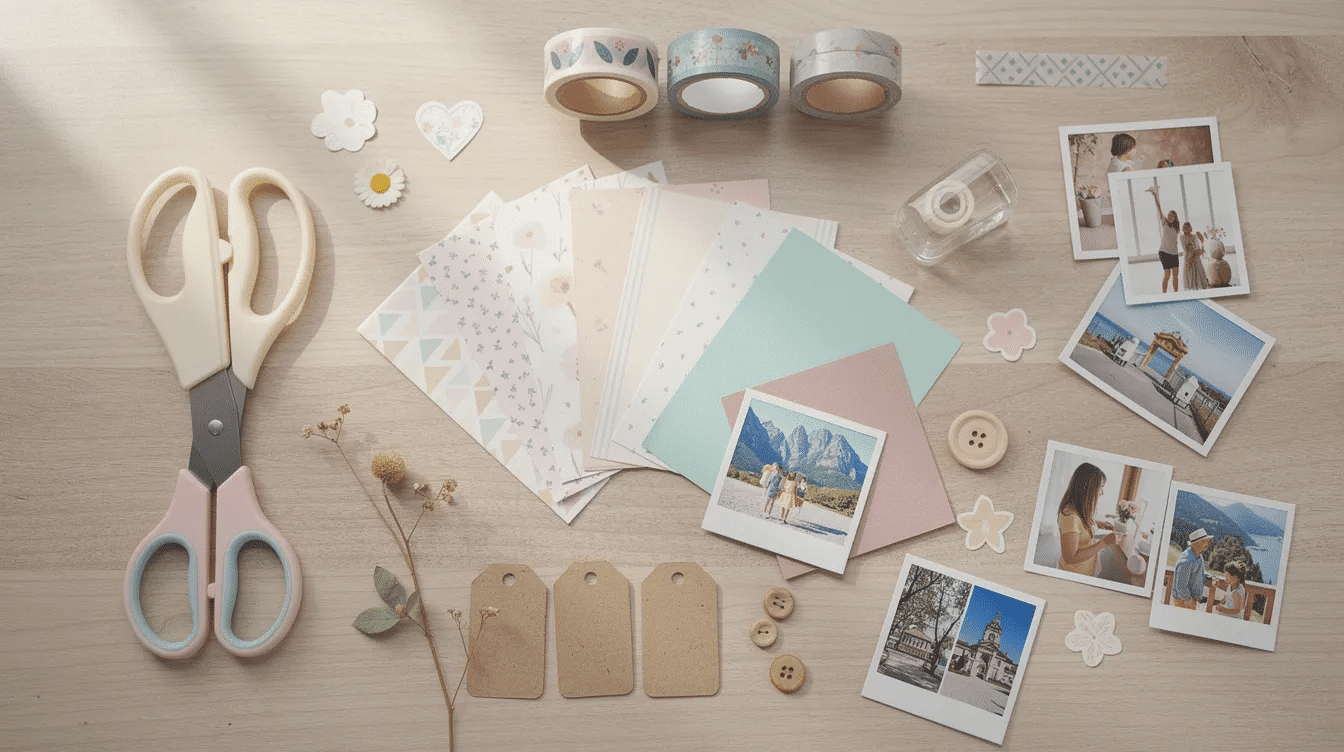
Create a “day one” kit in a box or small caddy. Include one album with page protectors, 15–20 sheets of neutral cardstock, 8–10 sheets of patterned paper, one black journaling pen, one adhesive, and a paper trimmer.
Add a small envelope or tin for tiny embellishments like brads, sequins, die cuts, and paper scraps. Shop your home before buying more supplies: envelopes, tags, fabric scraps, newspaper clippings, ribbons, and ticket stubs can all become meaningful details.
Step 5: Organize Your Workspace and Photos
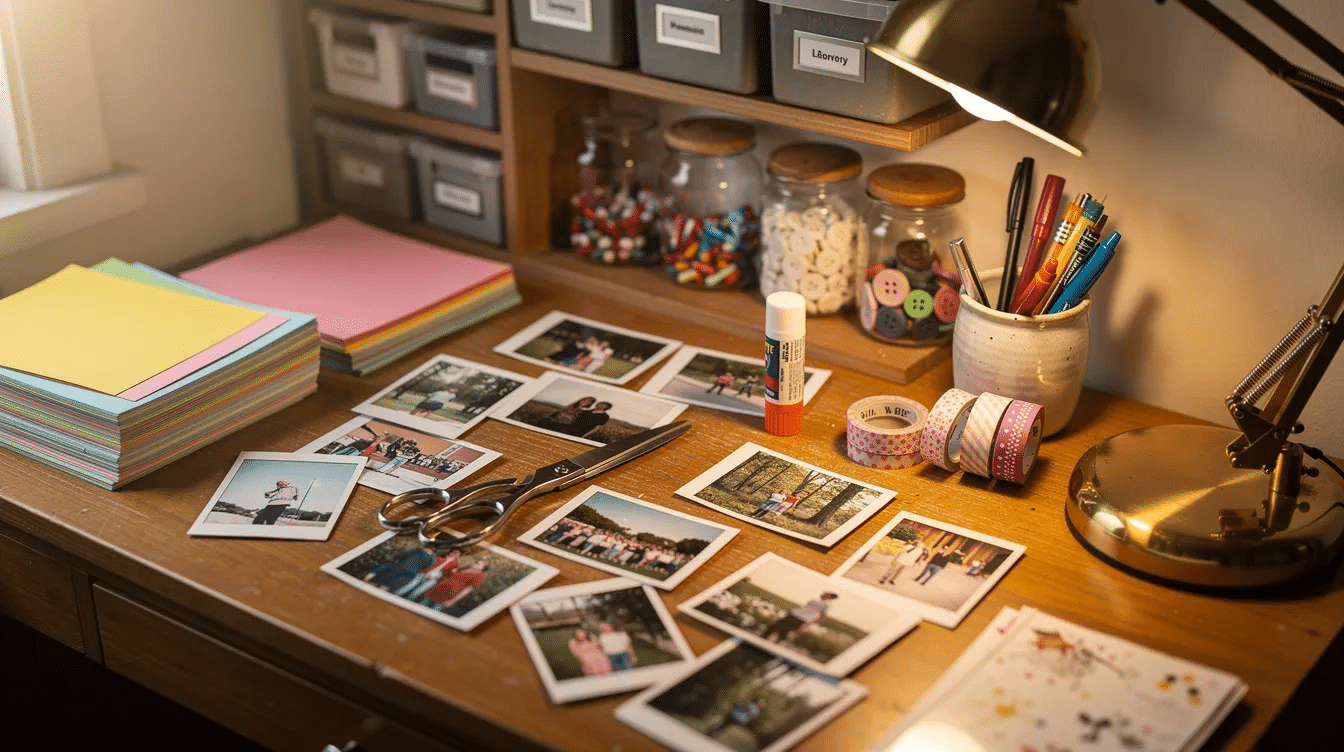
A small organized space makes scrapbooking faster and more fun, especially if you also enjoy holiday crafting projects and DIY decorations. You can work at a dining table, fold-out card table, or small desk near natural light.
A helpful method for organizing photos is to use clear plastic bins labeled by categories such as family members, vacations, or events. Keep papers in a magazine file or large zip bags sorted by color or theme, such as “bright summer” or “neutral basics.”
Use a shallow tray for current project supplies so you can pack away quickly between sessions. Good lighting, such as a desk lamp or LED strip, helps with cutting, color matching, and aligning pictures.
Step 6: Plan Your First Page Layout
Planning before gluing helps you avoid frustration and wasted supplies. A common approach for beginners is to use a simple formula of five elements per page to create a balanced and visually appealing layout:
- One title
- One to three photos
- One journaling area
- Two or three decorative elements
- One background or photo mat
Before adhering any elements to your scrapbook page, it’s beneficial to lay them out temporarily to experiment with the layout without committing to glue. When planning your scrapbook layout, it’s recommended to start by temporarily arranging your photos and elements on the page without adhesive to find the best composition.
Creating visual triangles with related embellishments across a page can guide the viewer’s eye through the layout. Visual balance in scrapbooking can also be achieved using the Rule of Thirds by placing focal points along the intersecting lines of a 3×3 grid.
Start with single-page layouts before trying two pages or double-page spreads.
Using Sketches and Templates
Scrapbook sketches are simple drawings that show where photos, titles, journaling, and embellishments go. They help new scrapbookers make layout design decisions faster.
Search online for “12×12 scrapbook sketches” or “6×8 layout ideas,” then save two or three references near your workspace. You can rotate, mirror, or simplify scrapbook sketches to fit your photos.
Step 7: Assemble the Page – From Photos to Finishing Touches
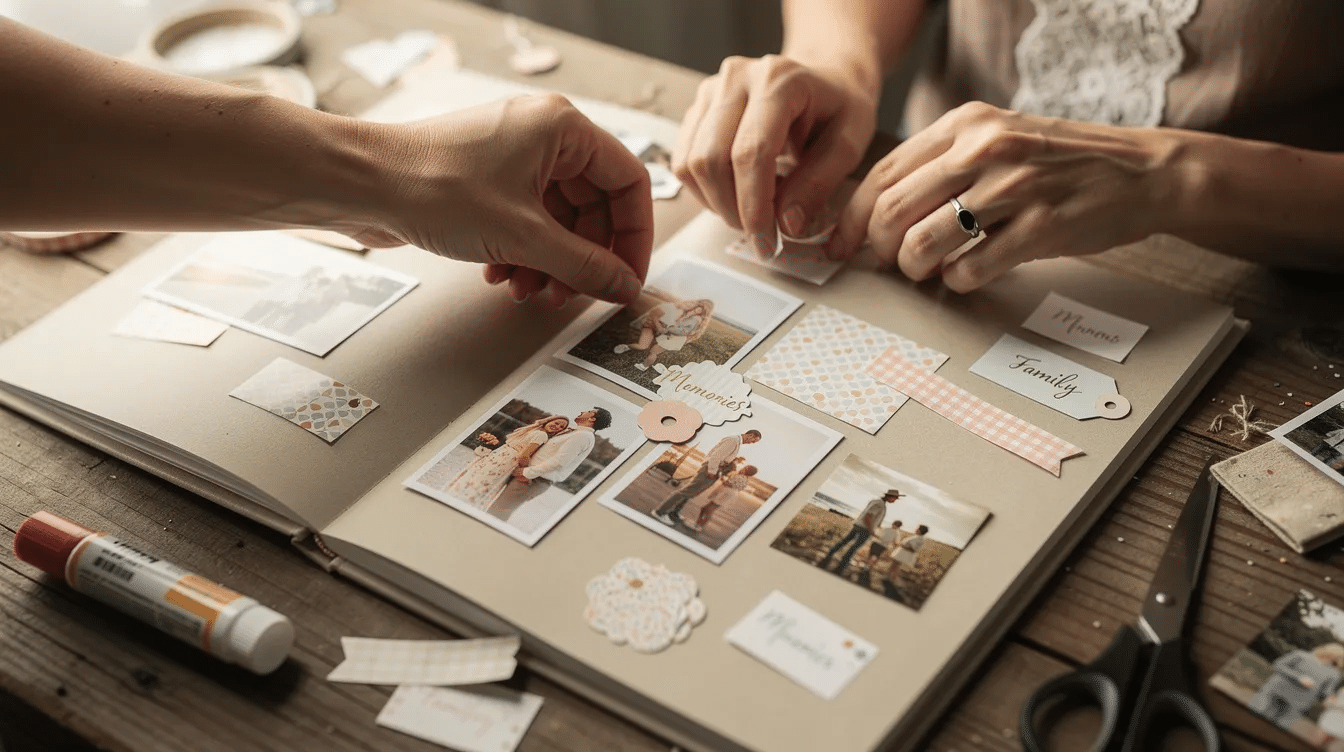
Assemble in this order: background first, photo mats, photos, journaling, then decorative elements. Use your paper trimmer for straight edges and glue the largest pieces first.
To mat a photo, adhere it to slightly larger cardstock or complementary colored patterned paper. To enhance the visual appeal of your scrapbook pages, consider using complementary colored patterned paper to matte your photos, which helps them stand out.
Add journaling on cards, tags, envelopes, or directly on the background. Embellishments such as stickers, washi tape, and die-cut shapes can match the theme of a scrapbook page. To enhance the visual appeal of scrapbook pages, consider using embellishments like stickers, die-cuts, and layered elements, but avoid overcrowding the page to maintain focus on the photos.
Before calling a page finished, step back and view it from arm’s length. If your eye goes to the photos first, the layout is working.
Simple Journaling for Beginners
Journaling in scrapbooking allows you to capture the emotions and stories behind the photos, providing context that images alone cannot convey. Intentional journaling in scrapbooks should include the “Who, What, Where, and When” of events.
Incorporating journaling into your scrapbook pages can be as simple as adding a few sentences about the event, including names and dates, which will be appreciated in the future.
Use this caption formula:
On [date], [who] went to [where] and [what happened]. I felt [emotion] because [short reason].
Creative ways to include journaling in your scrapbook include writing directly on the cardstock, using tags, or hiding notes in envelopes on the page. If you dislike cursive, print clearly. Always date the page, even if it is just “July 2024.”
Step 8: Protect and Store Your Finished Pages
Page protectors and safe storage keep finished pages beautiful for years. Slide fully dry pages into clear page protectors, watching for thick embellishments that may catch or bend.
If a layout is dimensional, trim a tiny strip from the page edge so it fits smoothly. The State Archives of Florida also recommends photo-safe materials and careful storage for long-term preservation.
Store albums upright on a bookshelf in a cool, dry room away from direct sunlight. Label the spine with the album title and date range, such as “Family Album 2023–2024.”
Step 9: Grow Your Skills and Try Different Scrapbook Formats
Once your first album is complete, try new formats. Mini albums are small themed books, such as “Weekend in Paris – April 2025,” and they make quick gifts.
Pocket-style albums use divided pocket pages that hold 3×4 and 4×6 photos, journaling cards, and other elements in a structured way. Hybrid or digital scrapbooking is another option if you enjoy designing on a computer and then printing pages to slip into albums.
Keep a running collection of future ideas so your next creative project is ready when inspiration hits.
Common Beginner Mistakes (and How to Avoid Them)
Every scrapbooker makes mistakes. They are part of learning, and they often make your scrapbook feel more personal.
Avoid these common issues:
- Overspending before making one page: set a modest budget and use home materials first.
- Overloading layouts: tell one small story per page instead of an entire event.
- Using non–acid free materials near photos: ordinary tape and low-quality glue can cause yellowing or damage.
- Waiting for the perfect layout: start with what you have today.
- Adding too many embellishments: let the photos remain the focus.
Your first scrapbook does not need to be impressive. It needs to be finished enough that you want to make the next one.
FAQ
How many photos should I print for my very first scrapbook?
For a first project, 20–40 photos are usually enough to fill a small 6×8 or 8×8 album with simple layouts. Start with 4×6 prints from one year, trip, or event, then add more photos later if your album needs them. A few meaningful pictures used well are better than every image from your phone.
Do I really need acid free supplies, or can I use regular paper and glue?
If you want albums to last for years or be passed to family members, acid free and photo safe products are strongly recommended. Acidic materials can cause photos and paper to yellow, become brittle, or stick to plastic over time. Occasional memorabilia like a ticket stub is fine, but the main papers, adhesives, and page protectors should be acid free.
What if I don’t like my handwriting on scrapbook pages?
Write your journaling on a separate piece of paper first, then rewrite it neatly on a card or strip. You can also type journaling on a computer, print it on regular paper or sticker paper, and trim it with a paper trimmer. Even messy handwriting often becomes one of the most cherished parts of an album.
Can I start with a digital or hybrid scrapbook instead of traditional paper?
Yes. Digital scrapbooking uses software to design pages that are printed later, while hybrid scrapbooking combines printed digital elements with physical supplies. If you are short on storage space, try one printed digital collage inside a traditional album before committing fully.
How long does it take to finish a beginner scrapbook album?
A small 6×8 album can take a few evenings or weekends if your theme and photos are already chosen. Set a simple goal, such as one layout per week, so progress fits around work and family life. There is no deadline; the goal is to enjoy the process and build a habit of printing photos and preserving stories over time.