A great recycled materials art project kindergarten activity does more than keep little hands busy. It gives children a fun way to create, explore, reuse, and see ordinary recyclables as materials with a second life.
Recycled materials art projects use items such as cardboard boxes, cereal boxes, paper towel rolls, toilet paper rolls, bottle caps, plastic bottles, milk cartons, old magazines, and egg carton pieces instead of brand-new supplies. These art projects can spark creativity in children while teaching them about sustainability and environmental responsibility.
In this blog post, we’ll look at the best recycled art projects for kindergarten based on safety, engagement, learning value, clean-up needs, and how well each project connects to real classroom goals.
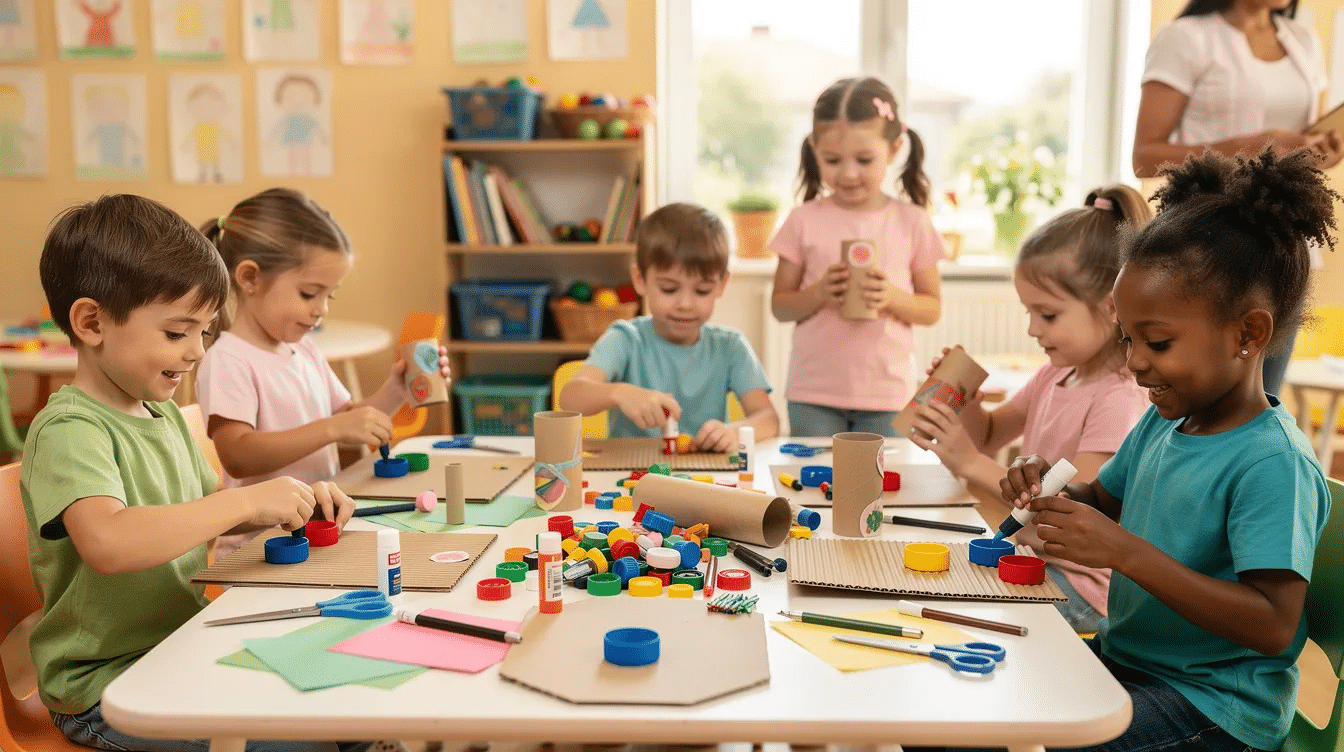
Recycled art matters because it blends creativity with practical learning. Using everyday materials for creative projects helps children learn about recycling and the importance of reducing waste. It also gives teachers a low-cost way to build art, science, math, literacy, and social-emotional learning into the same activity.
There’s also a developmental reason to include these projects. Fine motor skills are linked to later reading, writing, and math achievement, according to research published in Child Development on kindergarten readiness and academic outcomes. When kids cut, glue, tape, paint, sort caps, or twist pipe cleaners, they practice the hand strength and coordination needed for school tasks, and targeted art fine motor skill activities can further support that development.
Environmental learning is another benefit. A systematic review of early childhood environmental education found positive outcomes in environmental literacy, cognitive development, and social-emotional growth when young children participated in play-based environmental programs. Activities like nature walks and creating art from natural materials can enhance children’s understanding of their environment and promote ecological awareness.
The best projects below were chosen because they are:
- Safe with adult planning
- Engaging for 5- and 6-year-old children
- Flexible enough for different skill levels
- Affordable for home or classroom use
- Meaningful beyond the finished product
- How We Chose the Best Recycled Art Projects
- Top 7 Recycled Materials Art Projects for Kindergarten
- 1. Cardboard Box Castle Building
- Why It Stands Out
- Best For
- Key Strengths
- Possible Limitations
- 2. Bottle Cap Mosaic Art
- Why It Stands Out
- Best For
- Key Strengths
- Possible Limitations
- 3. Egg Carton Animal Sculptures
- Why It Stands Out
- Best For
- Key Strengths
- Possible Limitations
- 4. Paper Roll Telescope Making
- Why It Stands Out
- Best For
- Key Strengths
- Possible Limitations
- 5. Tin Can Wind Chimes
- Why It Stands Out
- Best For
- Key Strengths
- Possible Limitations
- 6. Magazine Collage Self-Portraits
- Why It Stands Out
- Best For
- Key Strengths
- Possible Limitations
- 7. Plastic Bottle Garden Planters
- Why It Stands Out
- Best For
- Key Strengths
- Possible Limitations
- Quick Comparison of the Best Recycled Art Projects
- How to Choose the Right Recycled Art Project
- Which Project Is Best for You?
- Final Thoughts
How We Chose the Best Recycled Art Projects
Not every recycled art idea is right for kindergarten. Some crafts look amazing online but require too much adult cutting, unsafe tools, or long drying times. Here’s the practical filter we used.
Safety considerations for 5-6 year old children
Safety comes first. Use clean recyclables, avoid containers that held chemicals, check for sharp edges, and choose non-toxic paint, crayons, glue, and markers. Art safety organizations recommend using certified non-toxic supplies and avoiding unknown materials when children are involved.
For kindergarten, teachers and parents should:
- Wash and dry bottles, caps, cartons, and cans before use
- Pre-cut thick cardboard or metal when needed
- Avoid sharp metal lids and cracked plastic
- Supervise small parts such as bottle caps and googly eyes
- Use child-safe scissors and low-tack tape when possible
Recycled tin cans can be useful, but only if the rims are smooth or covered. Plastic bottles may need adult cutting. Small caps should not be used with children who still mouth objects.
Fine motor skill development potential
Creative, eco-friendly art projects for kindergarteners enhance fine motor skills and encourage sustainability. The strongest activities involve cutting, pinching, threading, squeezing glue, painting details, and assembling parts.
Kids can improve scissor skills by cutting newspapers and creating layered art with glue and paint. That simple process strengthens hand muscles while giving children a low-pressure way to experiment with texture, color, and shape.
Creative expression opportunities
The best recycled art is open-ended. Emphasizing the process of creation rather than the final product can enhance children’s creativity. A cardboard box can become a castle, rocket, cave, puppet stage, animal home, or garden shed depending on a child’s imagination.
Encouraging children to think about repurposing items can foster imaginative art projects. Instead of saying, “Make this exact bird,” try asking, “What could these materials become?”
Material accessibility and cost-effectiveness
Common materials for eco-friendly art projects include cardboard boxes, toilet rolls, and plastic bottle caps. These items are easy to collect over a week or two with family help.
Setting up a recycling art bin in the classroom encourages the collection of materials for future projects. Add labels such as:
- Clean paper
- Cardboard
- Tubes
- Caps
- Bottles
- Fabric scraps
- Natural materials
Natural materials like twigs and leaves can be collected to create textured collages. A short nature walk can fill a small basket with leaves, bark, seed pods, and flowers while helping children notice the world around them, or you can extend the experience with creative nature stick crafts that turn found sticks into art.
Clean-up and classroom management ease
Good kindergarten projects need clear boundaries. A large cardboard castle is wonderful, but it needs space. A bottle cap mosaic is easier to manage at tables but requires trays so caps do not roll everywhere.
Before starting, plan:
- Where wet paint will dry
- How children will share glue and tape
- Where unfinished creations will go
- Which materials must stay on trays
- How long clean-up will take
Educational value and curriculum connection
Recycled art can support:
- Math: sorting, counting, patterns, shapes, measurement
- Science: plants, animals, sound, light, habitats, earth care
- Literacy: storytelling, labeling, describing creations
- Social-emotional learning: self-portraits, collaboration, patience
- Engineering: building, testing, revising, balancing
These benefits mirror the broader art and craft benefits for child development, where creative work builds cognitive, social, and emotional skills alongside academics.
Environmental awareness teaching potential
Recycled art becomes more meaningful when children connect the project to real choices. Ask:
- What would have happened to this bottle if we did not reuse it?
- How can recycling help the earth?
- What materials can we save instead of throwing away?
- What can our classroom do to reduce waste?
That short conversation turns crafts into a meaningful lesson about responsibility.
Top 7 Recycled Materials Art Projects for Kindergarten
1. Cardboard Box Castle Building
Cardboard boxes are versatile crafting materials that can be used to create imaginative structures like castles, encouraging creativity and spatial awareness in kids. Use cardboard boxes in various sizes, cereal boxes, paper towel boxes, and small packaging to build towers, walls, doors, bridges, and secret rooms, or even transform a large box into a cardboard time machine craft for imaginative role-play.
Children can paint the castle, add flags with paper, tape on windows, and use crayons to draw stones or vines. They can also add toy people, birds, dragons, or other creatures for storytelling.
Cereal boxes can be transformed into portable puppet theaters by cutting a window for decoration. That makes a great extension if your class wants to turn the castle into a stage for fairy-tale play.
Why It Stands Out
This project combines 3D construction with creative storytelling and imaginative play. A box is not just a box here. It becomes a structure children can design, revise, and use for play after the art session ends.
Best For
Kindergarten classes focusing on fairy tales, medieval themes, homes, communities, engineering, or spatial reasoning skills can also connect this castle work to broader preschool 3D art project ideas that use recycled and sculptural materials.
Key Strengths
- Develops spatial awareness and engineering thinking
- Encourages collaborative group work that feels similar to other engaging group activities for 5 year olds
- Provides hours of extended imaginative play after creation
- Gives children practice with planning, balancing, and problem-solving
- Works well as a week-long classroom project
Possible Limitations
- Requires a large workspace and storage for finished projects
- May need adult supervision for cutting and assembly
- Large builds can be hard to send home
- Too much tape can make clean-up slower
2. Bottle Cap Mosaic Art
Bottle cap mosaic art uses collected bottle caps to create bright patterns, pictures, names, flowers, fish, rainbows, or abstract designs. Children sort caps by color, arrange them on cardboard, and glue them into place.
Kids can create colorful fish using plastic bottle caps by painting them and assembling them into a school of fish. This turns a simple sorting activity into a lively ocean display.
Why It Stands Out
Bottle cap mosaics teach color sorting, pattern recognition, and fine motor precision. They also help children slow down, make choices, and notice how small parts create a bigger design.
Best For
Math-integrated art lessons and students who enjoy detailed, focused work.
Key Strengths
- Enhances color recognition and pattern-making skills
- Uses readily available household recyclables
- Creates vibrant, lasting artwork for display
- Supports counting, grouping, and comparing
- Gives children a chance to experiment with symmetry and repetition
Possible Limitations
- Requires pre-collection of sufficient bottle caps
- Small pieces may pose a choking hazard for some children
- Strong glue may need adult help
- Caps can scatter if trays are not used
3. Egg Carton Animal Sculptures
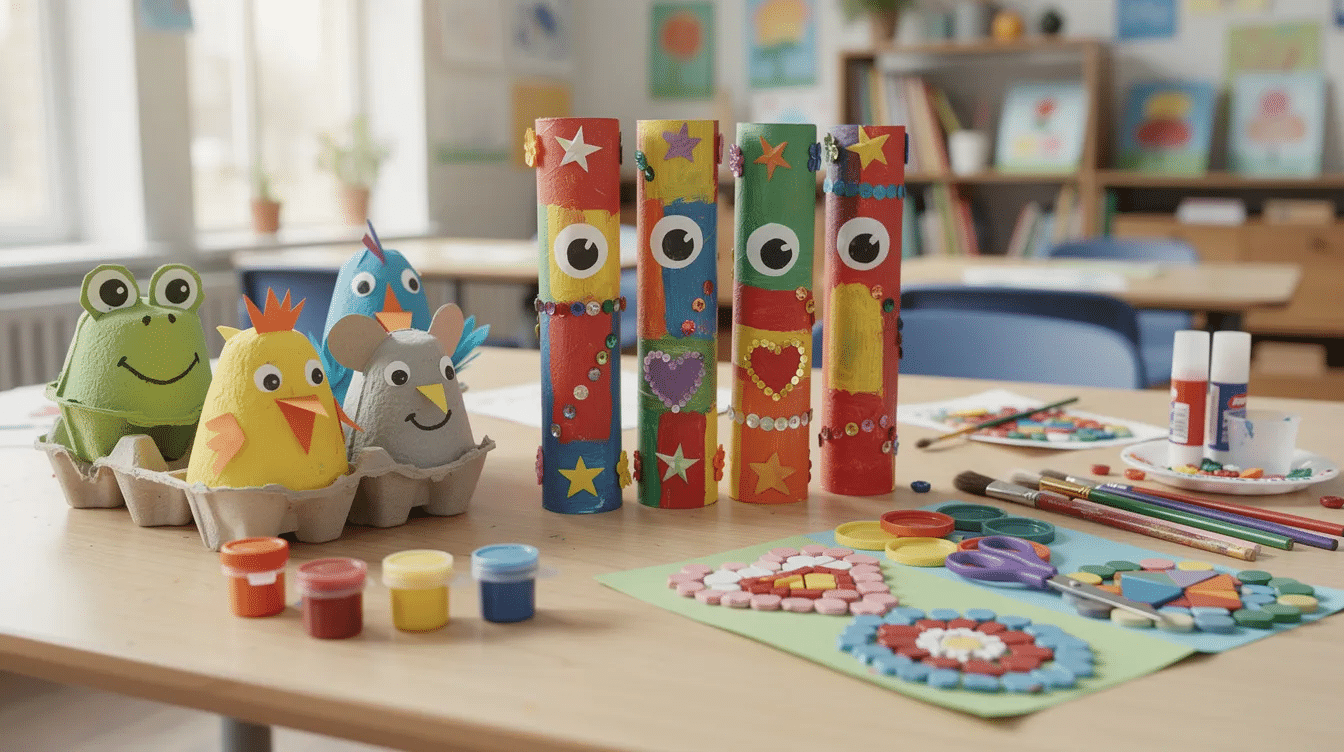
An egg carton is one of the most useful recycled materials for animal crafts. Children can cut the cups apart and turn them into turtles, caterpillars, owls, ladybugs, frogs, chicks, or imaginary creatures.
Egg cartons are a popular crafting material that can be repurposed into various animal figures, fostering creativity and imaginative play among children. Add paint, paper wings, pipe cleaners, and googly eyes to bring the animals to life.
Egg cartons can be transformed into various animal figures, allowing kids to explore their creativity while learning about different animals.
Why It Stands Out
This project combines science learning about animals with hands-on sculpture creation. Children can talk about habitats, body parts, movement, camouflage, and life cycles while they build.
Best For
Science units on animals, habitats, insects, birds, ocean life, or life cycles.
Key Strengths
- Develops cutting and gluing fine motor skills
- Connects to curriculum topics about animals and nature
- Produces adorable take-home creations
- Encourages children to describe animal features
- Works well with books about animals
Possible Limitations
- Limited by availability of egg cartons
- Requires careful supervision with scissors
- Cardboard egg cartons should be clean and dry
- Paint may need time to dry before details are added
4. Paper Roll Telescope Making
Paper roll telescopes are simple, satisfying, and perfect for young learners. Use toilet paper rolls for small telescopes or paper towel rolls for longer versions. Children can wrap the tube in paper, decorate it with crayons, add foil or cellophane at one end, and use tape to secure details.
Cardboard tubes can be used to make sculptures such as robots or binoculars. That makes this project easy to adapt if children want to create space tools, explorer gear, or robot arms instead.
This is also a strong fit for pretend exploration. Children can look for shapes in the classroom, observe clouds outside, or imagine they are astronauts, especially if you pair the activity with other space-themed crafts and projects to extend the learning.
Why It Stands Out
Paper roll telescopes create functional tools that extend learning into science exploration. They do not truly magnify like a real telescope, but they focus children’s attention and invite observation.
Best For
Space themed units, outdoor exploration activities, camping themes, bird-watching lessons, or a nature walk.
Key Strengths
- Easy material collection from household items
- Encourages outdoor observation and exploration
- Simple construction suitable for all skill levels
- Builds vocabulary such as near, far, observe, sky, moon, and stars
- Can be paired with books about space
Possible Limitations
- Paper construction may not be very durable
- Limited actual magnification capabilities
- Tubes can bend if heavily painted
- Children may need reminders not to walk while looking through the tube
5. Tin Can Wind Chimes
Tin can wind chimes turn recycled tin cans into sound-making outdoor art. Adults should prepare the cans first by removing sharp edges and making holes. Children can paint the cans, decorate them with paper shapes, and help string safe hanging pieces.
Empty cans can be decorated to create functional pencil holders for art projects. If wind chimes feel too complex or noisy, pencil holders are a calmer alternative using the same material, and stocking them with age-appropriate art supplies for young artists can turn them into inviting creative stations.
For wind chimes, hang the cans from a stick, hanger, or sturdy branch. Children can experiment with different sizes and notice how sound changes.
Why It Stands Out
This project integrates music, art, and science concepts about sound. Children see that materials can be reused in creative ways and that objects make different sounds depending on size, shape, and movement.
Best For
Music integration lessons, sound science exploration, garden art, or outdoor classroom decoration.
Key Strengths
- Combines visual art with musical sound experimentation
- Creates functional outdoor decorations
- Teaches cause-and-effect through sound creation
- Encourages listening and comparison
- Can become a class gift for a school garden
Possible Limitations
- Requires careful handling of metal edges
- May be noisy in classroom settings
- Adult preparation is essential
- Hanging pieces must be secure
6. Magazine Collage Self-Portraits
Magazine collage self-portraits use old magazines, newspapers, paper scraps, and glue to help children represent themselves. They can choose colors, textures, clothing images, foods, animals, letters, or objects that show who they are.
This can be a fun process art activity because there is no single correct result. Some children may create a face. Others may create a collage of favorite things. Both approaches are valid.
Why It Stands Out
This project develops self-awareness and identity exploration through art. It gives children a creative way to say, “This is me,” even if they are still developing writing skills.
Best For
Social-emotional learning units, “All About Me” themes, family lessons, classroom community building, or back-to-school displays.
Key Strengths
- Enhances scissor skills and spatial planning
- Promotes self-reflection and identity awareness
- Uses abundant magazine materials typically available
- Supports conversation and oral language
- Encourages children to explain their choices
Possible Limitations
- Requires pre-screening of appropriate magazine content
- May be challenging for children with limited cutting skills
- Small paper scraps can create messy tables
- Some children may need help starting their design
7. Plastic Bottle Garden Planters
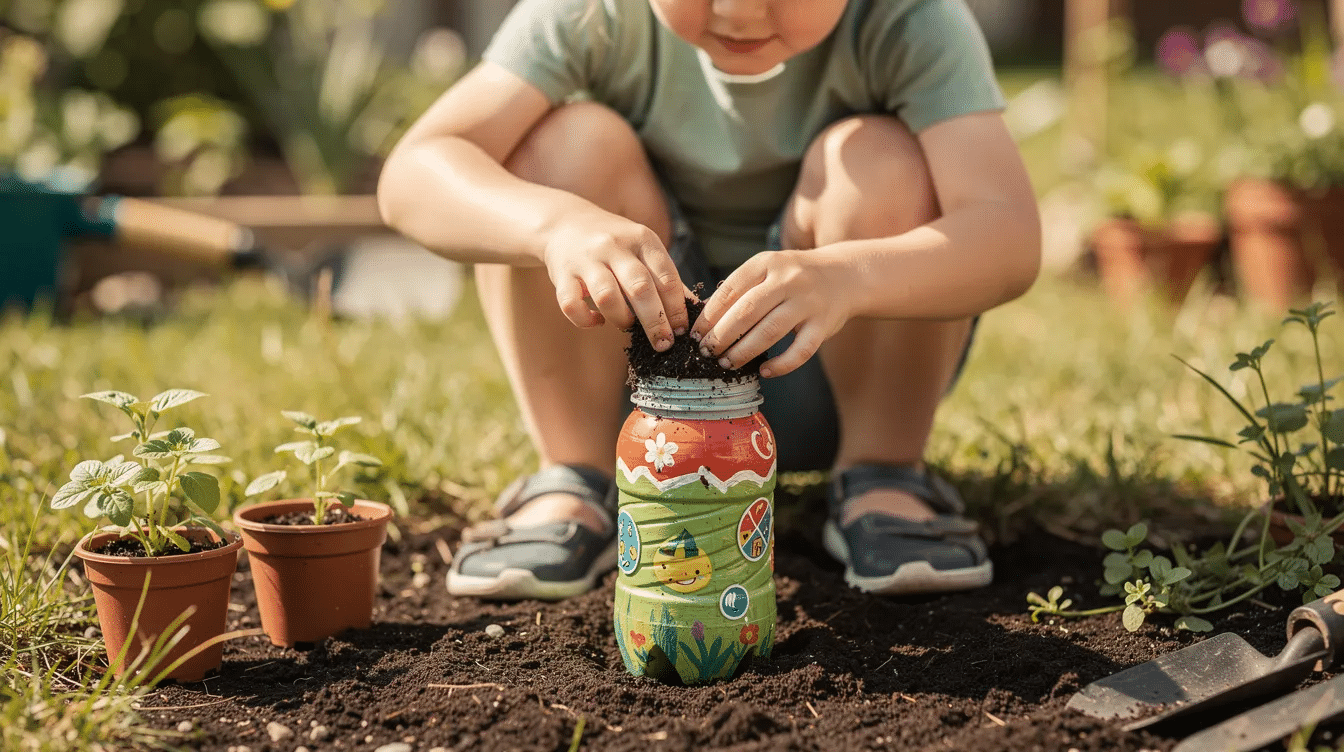
Plastic bottle garden planters turn bottles into small homes for plants. Adults can cut the bottles, then children decorate the outside, fill the planter with soil, add seeds, water gently, and observe growth over time.
Plastic bottles can be transformed into unique planters, allowing kids to engage in gardening while learning about recycling and plant care. Recycled plastic bottles can be turned into unique planters, providing a fun way for kids to engage in gardening and learn about plant care.
These planters are especially useful in spring, during an earth day lesson, or when you want to celebrate earth day with a project that continues after the art dries.
Plastic bottle bottoms can be used to make flower-shaped stamps on paper. Before turning bottles into planters, children can dip the bottoms in paint and stamp flowers for garden labels or thank-you cards, or even use similar materials to create a playful recycled Christmas wreath during the holiday season.
Why It Stands Out
This project combines art creation with ongoing science observation of plant growth. Children do not just make something; they care for something living.
Best For
Spring science units on plants, growth, gardens, recycling, sustainability, or Earth Day celebrations.
Key Strengths
- Creates long-term learning through plant care responsibility
- Connects environmental awareness with hands-on gardening
- Produces functional items children can take home
- Helps children observe roots, stems, leaves, and flowers
- Encourages patience and daily care
Possible Limitations
- Requires ongoing care and watering commitment
- Limited to appropriate seasons for plant growing
- Adult cutting is needed
- Overwatering can be an issue in a classroom
Quick Comparison of the Best Recycled Art Projects
- Cardboard Box Castles – Best for imaginative play integration. Use when you want children to build, create stories, and play with their finished structure.
- Bottle Cap Mosaics – Best for math and pattern skill development. Use when your focus is sorting, color, counting, and careful placement.
- Egg Carton Animals – Best for science curriculum connections. Use when children are learning about animals, habitats, birds, insects, or life cycles.
- Paper Roll Telescopes – Best for simple construction and exploration. Use when you need a low-prep project that supports space, nature, or outdoor observation.
- Tin Can Wind Chimes – Best for music and sound science integration. Use when your class is ready to explore sound, vibration, and outdoor art.
- Magazine Collage Portraits – Best for social-emotional learning. Use when children are exploring identity, feelings, family, or classroom community.
- Plastic Bottle Planters – Best for ongoing science observation. Use when you want a project that connects art, recycling, plants, and responsibility.
How to Choose the Right Recycled Art Project
Choose Based on Available Materials
Start with what you already have. If families send in cardboard, build castles. If you have many caps, make mosaics. If the recycling bin is full of bottles, create planters or flower stamps.
Good collection items include:
- Cardboard boxes
- Cereal boxes
- Toilet paper rolls
- Paper towel rolls
- Plastic bottles
- Bottle caps
- Milk cartons
- Old magazines
- Egg carton pieces
- Clean cans
- Scraps of paper
- Natural materials from a nature walk
Ask families to send clean recyclables on a specific day. Keep the request simple so planning does not become overwhelming, and remember that ready-made DIY craft kits for creative projects can fill gaps when certain recycled items are hard to collect.
Choose Based on Learning Objectives
Pick the project that matches your lesson goal.
If your focus is math, choose bottle cap mosaics for sorting and patterns. If your focus is science, choose egg carton animals, paper roll telescopes, tin can wind chimes, or plastic bottle planters. If your focus is literacy, use cardboard castles for storytelling or cereal box puppet theaters for retelling books.
For environmental learning, ask children to explain how they reused the material. That reflection is what turns recycled art into a sustainability lesson.
Choose Based on Skill Level and Supervision Needs
Some projects allow more independence than others. Magazine collages and paper roll telescopes are usually easier for kindergarten children to manage. Tin can wind chimes and plastic bottle planters need more adult preparation.
Use this quick guide:
- Low supervision: paper roll telescopes, magazine collages, simple cap sorting
- Medium supervision: bottle cap mosaics, egg carton animals, cardboard castles
- High supervision: tin can wind chimes, plastic bottle cutting, large cardboard construction
For preschoolers or children with developing fine motor skills, offer pre-cut pieces, larger materials, and fewer steps. For children who need a challenge, invite them to plan, measure, label, or revise their creations.
Which Project Is Best for You?
Choose Cardboard Box Castles if you want extended imaginative play value. This is the best option when you have space, extra cardboard, and time for children to build over more than one session.
Choose Bottle Cap Mosaics if you’re integrating math pattern concepts. This project is ideal when you want a quiet, focused activity that reinforces color, counting, and design.
Choose Magazine Collages if you’re focusing on self-awareness themes. This is a strong choice for social-emotional learning because children can show their personality, preferences, and sense of identity.
Choose Plastic Bottle Planters if you want long-term science observation. This project works well when your class can water plants, observe changes, and connect art to real life in the garden.
Choose Egg Carton Animals if your class is learning about nature. Children can imagine animals, create creatures, and connect their work to habitats and life cycles.
Choose Paper Roll Telescopes if you need a quick, fun exploration project. They are easy to make and can lead directly into a nature walk, space lesson, or outdoor observation.
Choose Tin Can Wind Chimes if you want art that children can hear. This project is amazing for sound experiments, but it needs careful adult setup.
Final Thoughts
The best recycled materials art project kindergarten activity depends on your learning goals, available materials, classroom space, and supervision needs. A simple paper roll telescope may be perfect for one day, while a cardboard castle may become the highlight of an entire week.
All of these recycled art projects help children reuse materials, explore creativity, and understand that small choices can help the earth. They also bring joy to the classroom because children get to experiment, imagine, build, and share their work with others.
Focus on the process, not perfect products. When kids are free to test ideas, change plans, and create in their own way, recycled art becomes more than crafts. It becomes a meaningful practice in creativity, problem-solving, and care for the world.
Start with one box of recyclables, choose one project, and let your children show you what those materials can become.