Empty cereal boxes are perfect for crafting and can be transformed into engaging toys and art projects. Instead of tossing a box into the recycling bin right after breakfast, kids can turn it into an aquarium, robot, dollhouse, game, guitar, or handy organizer.
Crafting with cereal boxes teaches children about sustainability by showing them how to upcycle materials, fostering a sense of responsibility and creativity. It also helps children develop fine motor skills as they cut, glue, paint, fold, and manipulate materials, improving dexterity and coordination, echoing many of the broader art and craft benefits for child development.
These cereal box craft ideas for kids were selected for age-appropriateness, educational value, skill development, and engagement level. The goal is simple: low-cost fun that helps kids create, play, and learn.
- How We Chose the Best Cereal Box Craft Ideas
- Top 6 Cereal Box Craft Ideas for Kids
- 1. Cereal Box Aquarium
- Why It Stands Out
- Best For
- Key Strengths
- Possible Limitations
- 2. Cereal Box Robot
- Why It Stands Out
- Best For
- Key Strengths
- Possible Limitations
- 3. Cereal Box Dollhouse
- Why It Stands Out
- Best For
- Key Strengths
- Possible Limitations
- 4. Cereal Box Storage Organizer
- Why It Stands Out
- Best For
- Key Strengths
- Possible Limitations
- 5. Cereal Box Board Game
- Why It Stands Out
- Best For
- Key Strengths
- Possible Limitations
- 6. Cereal Box Guitar
- Why It Stands Out
- Best For
- Key Strengths
- Possible Limitations
- Quick Comparison of the Best Cereal Box Crafts
- How to Choose the Right Cereal Box Craft
- Which Craft Is Best for You?
- Final Thoughts
How We Chose the Best Cereal Box Craft Ideas
A good cereal box craft should be safe, affordable, and interesting enough that a child wants to keep using it after the project is finished.
Here are the main criteria:
- Age appropriateness and safety: Toddlers can decorate pre-cut shapes, while older kids can handle more measuring and assembly. Adults should manage tricky cuts with scissors or craft tools.
- Educational value: Cereal box crafts provide a hands-on learning experience that encourages problem-solving and critical thinking as children design and create their projects.
- Materials and complexity: The best ideas use simple supplies like paper, glue, string, paint, pipe cleaners, googly eyes, pom poms, fabric scraps, and poster board, many of which overlap with the best art supplies for young artists.
- Engagement factor: Projects with lasting play value, such as games, dollhouses, and instruments, usually hold attention longer.
- Adaptability: A younger child can color one side of a box, while an older child can build a sturdy 3D structure.
- Time investment: Some crafts take 20 minutes; others are better for a rainy fall weekend.
Repurposing cereal boxes is a low-cost way to keep kids entertained through interactive DIY games and activities. Crafting with cereal boxes is also budget-friendly because most households have empty boxes readily available, making it accessible for spontaneous crafting sessions, much like using all-in-one DIY kits for creative projects.
The environmental value is worth noting too. In the U.S., millions of tons of cardboard are recycled each year, and reuse helps reduce trash and waste before materials ever need to be processed. Recycling and upcycling cardboard boxes helps families connect everyday habits with care for the environment, whether they are making toys, organizers, or a playful recycled Christmas wreath.
Top 6 Cereal Box Craft Ideas for Kids
1. Cereal Box Aquarium
A cereal box aquarium turns a cereal box into a 3D underwater scene. Kids paint the inside blue, cut a viewing window, then attach fish shapes, seaweed, shells, and decorations with string, and can even pair it with a simple crab paper plate craft for kids for a full ocean-theme.
It is perfect for ocean-themed learning, art, and imaginative play, and kids who love big make-believe projects might also enjoy building a cardboard time machine craft.
Why It Stands Out
This project blends art, science, and 3D design. Cereal boxes can be transformed into a variety of imaginative toys and games, such as a cereal box aquarium, which involves painting the box and adding decorations like fish and seaweed made from craft materials.
Children can talk about coral reefs, ocean conservation, and how fish move through the water. They can also create a whole aquarium world filled with yellow fish, paper sea turtles, and pipe cleaners shaped like sea grass.
Best For
Best for ages 4-10, especially kids who love ocean life, animals, or detailed art projects.
Key Strengths
- Develops spatial awareness and 3D thinking
- Teaches marine ecosystems and ocean conservation
- Encourages storytelling and imaginative play
- Can be customized with different sea creatures, shells, and colors
Possible Limitations
- Requires adult supervision for cutting the viewing window
- May need extra supplies like colored paper, string, googly eyes, and paint
2. Cereal Box Robot
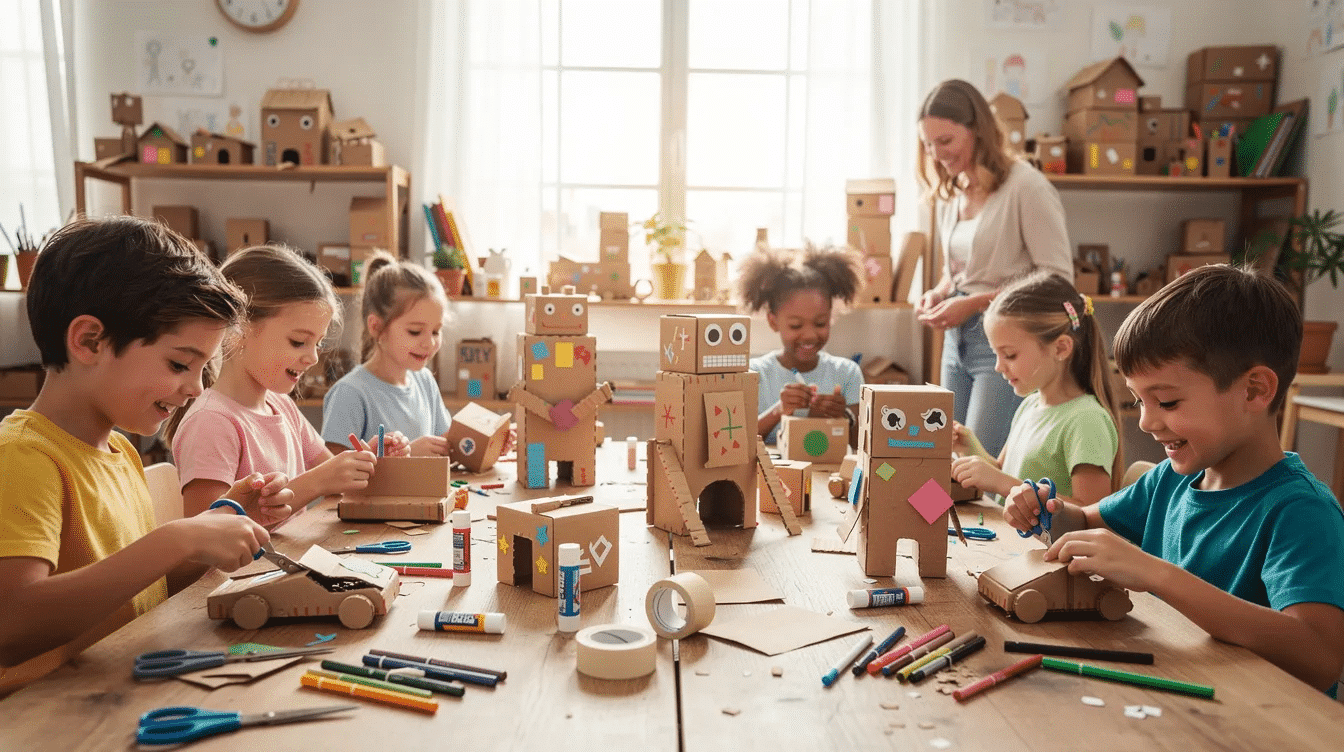
A cereal box robot can be a wearable costume, a tabletop toy, or a funny character for pretend play. Kids decorate the cardboard with buttons, foil, bottle caps, and paper panels, then add arms made from cardboard strips or tubes.
Why It Stands Out
This cereal box craft combines engineering concepts with artistic design and dramatic play. Kids think about shape, balance, symmetry, and how to attach parts so the robot does not fall apart, and space-loving kids might also enjoy complementary rocket ship craft ideas for kids.
It is also a great STEM starter. Children can prepare a simple design, test it, notice what fails, and improve it.
Best For
Best for ages 5-12, especially kids interested in technology, science fiction, building, or costumes.
Key Strengths
- Introduces basic engineering and design thinking
- Encourages role-playing and imaginative scenarios
- Develops planning and problem-solving skills
- Can be worn as a costume or displayed as decorative art
Possible Limitations
- May require more complex cutting and assembly
- Wearable versions need careful sizing, comfort checks, and stronger cardboard
3. Cereal Box Dollhouse
A cereal box dollhouse uses one or more cereal boxes to create rooms for small dolls, figures, or handmade characters. Kids can cut doors, decorate walls, add paper rugs, and make tiny furniture from scraps.
Why It Stands Out
This craft creates a long-lasting toy that grows with a child’s imagination. It supports nurturing play, storytelling, and social-emotional development, making it a natural complement to other preschool 3D art projects.
Kids can make beds from folded cardboard, curtains from fabric, and tables from small jars or lids. They can also create play food for dolls, or use scraps for pretend cooking scenes, and extend pretend play with a safe cardboard sword craft tutorial.
Best For
Best for ages 3-8, especially kids who enjoy nurturing activities, small world play, and storytelling.
Key Strengths
- Promotes social and emotional development through role-play
- Develops fine motor skills through furniture making and decorating
- Encourages narrative thinking and storytelling
- Can be expanded with extra rooms, characters, and accessories
Possible Limitations
- Requires significant time for detailed decoration
- May need adult help for structural modifications
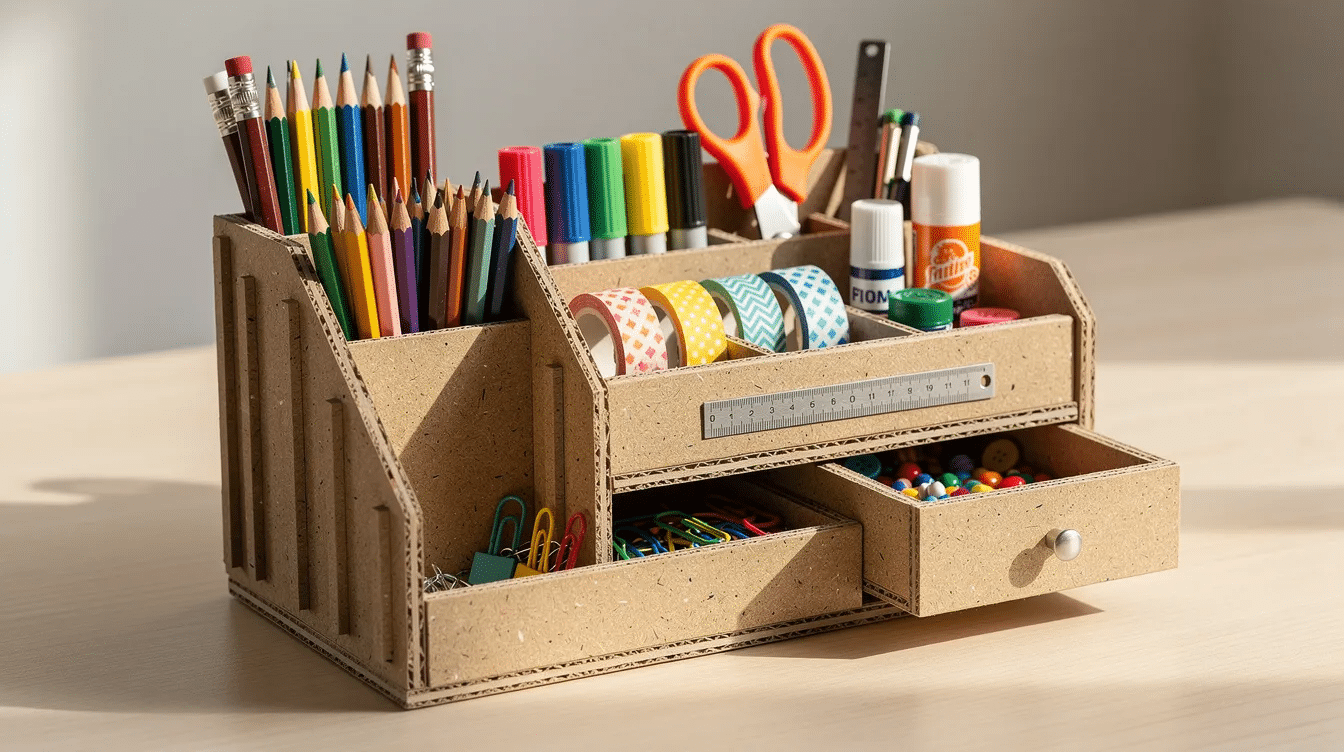
4. Cereal Box Storage Organizer
A cereal box storage organizer turns old cereal boxes into desk storage, art supply holders, or toy bins. Cut the box diagonally, cover it with paper or fabric, and use it to store markers, notebooks, cards, or puzzle pieces.
Why It Stands Out
This project teaches practical life skills while creating something genuinely useful. Cereal boxes can be repurposed into practical items like desk organizers, which help children learn about organization and categorization while keeping their workspace tidy.
It is a good way to get rid of clutter while teaching reuse. Kids can label sections, sort supplies, and display the finished organizer on a desk or shelf.
Best For
Best for ages 6-12, especially kids learning organization or needing desk storage.
Key Strengths
- Teaches organizational skills and responsibility
- Creates a functional item that reduces clutter
- Develops measuring and planning abilities
- Reinforces reuse, recycle habits, and sustainability
Possible Limitations
- Less immediately exciting than toy-focused crafts
- Requires precise measuring and cutting for best results
5. Cereal Box Board Game
A cereal box board game uses the flat cardboard panel as a custom game board. Kids can draw a path, add rules, make cards, and use buttons, beads, or small toys as game pieces.
Why It Stands Out
Kids become game designers. They learn rules, strategy, fair play, scoring, and how to adjust a game when something does not work.
Cereal boxes can be converted into custom puzzles by gluing a picture onto the box and cutting it into pieces. Children can create a marble maze using the front panel of a cereal box and arrange plastic straws or cardboard strips. Creating a cereal box maze is a fun project that teaches basic engineering concepts while providing an engaging play experience for children, similar to many creative crafts about space that blend science and art.
Creative options for repurposing cereal boxes include constructing miniature puzzles, puppet theaters, and aquarium crafts. Cereal boxes can also be transformed into a variety of crafts, including puzzles, mazes, and even aquariums, providing endless creative possibilities for children.
Best For
Best for ages 7-14, especially kids who enjoy puzzles, strategy, or family game nights.
Key Strengths
- Develops logical thinking and rule-making abilities
- Encourages math through counting, scoring, and probability
- Promotes family interaction and social skills
- Creates reusable entertainment that can be modified over time
Possible Limitations
- Requires extra materials such as dice, cards, or tokens
- May need adult guidance for rule development
6. Cereal Box Guitar
A cereal box guitar is a simple string instrument made with a cereal box, rubber bands, and a cardboard tube. Cut a sound hole, stretch rubber bands across it, and attach the tube as the neck.
Why It Stands Out
This craft introduces music while teaching the physics of sound and vibration. Kids can watch how rubber bands move, listen to pitch changes, and explore rhythm.
It works well for musically curious kids and for parents who want a quick project with plenty of joy and noise.
Best For
Best for ages 4-10, especially kids curious about music, sound, or performance.
Key Strengths
- Introduces basic music concepts and rhythm
- Teaches sound and vibration through hands-on experimentation
- Encourages creative expression through music
- Can be decorated with paint, stickers, paper, or fabric scraps
Possible Limitations
- Sound quality is limited compared to real instruments
- Rubber bands may break and need replacement
Quick Comparison of the Best Cereal Box Crafts
Craft | Best For | Main Skill | Adult Help |
|---|---|---|---|
Cereal Box Aquarium | Nature-loving kids and 3D art projects | Spatial thinking | Medium |
Cereal Box Robot | STEM-interested kids and dramatic play | Engineering | Medium-high |
Cereal Box Dollhouse | Nurturing play and storytelling | Social-emotional play | Medium |
Cereal Box Storage Organizer | Organization and practical life skills | Planning | Medium |
Cereal Box Board Game | Strategic thinking and family bonding | Logic | Medium |
Cereal Box Guitar | Music exploration and physics learning | Sound discovery | Low-medium |
DIY activities using cereal boxes can include making puppets, fireman’s hats, and imaginative play food. If your child wants more inspiration, keep a small basket of safe materials nearby so they can grab supplies when ideas appear. |
How to Choose the Right Cereal Box Craft
The best choice depends on your child’s age, interests, attention span, and the materials you already have at home.
Choose Based on Your Child’s Age and Skill Level
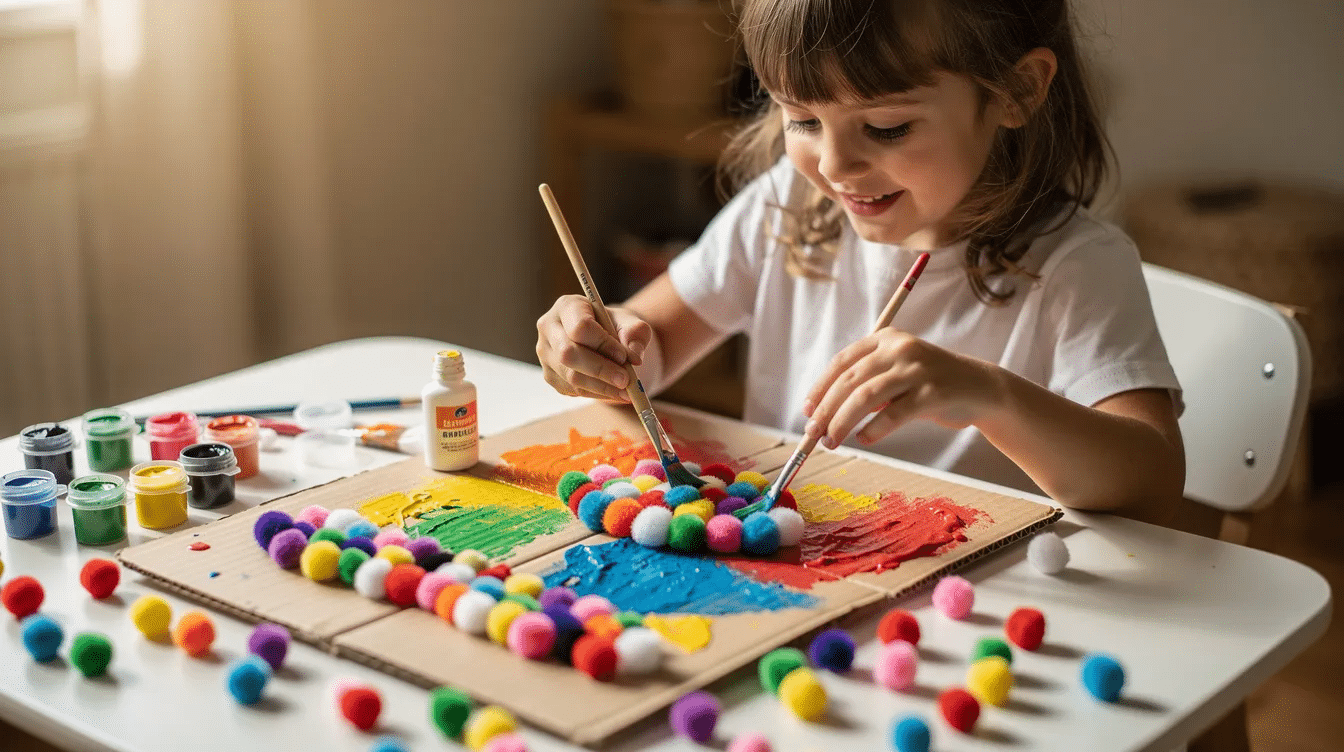
Age determines how much independence is realistic. Toddlers may enjoy painting a box covered in paper or sticking pom poms onto pre-cut shapes. Older kids may enjoy measuring, cutting, and building something more sturdy.
Crafting with kids should focus on the process of creation rather than the final product, encouraging exploration and experimentation. Encouraging independence in children during crafting helps build self-confidence and problem-solving skills, allowing them to lead the creative process with guidance.
Setting realistic expectations for both children and adults during crafting activities can enhance enjoyment and reduce frustration, especially considering children’s developing skills and attention spans.
Choose Based on Your Child’s Interests
Match the craft to what already excites your child.
If your child loves animals, choose the aquarium. If your child is curious about robots, choose the robot. If your child likes music, the guitar is a natural fit. If your child loves storytelling, the dollhouse or puppet theater will bring delight.
This is also a good place to let kids make choices. Ask them to write a comment on the back of the project about what they liked, or take a private family post photo for sharing with relatives.
Choose Based on Available Time and Materials
Before you begin, check your materials. You might already have cheerios boxes, glue, scissors, paint, paper, string, fabric, jars, and recycled lids in a closet or craft drawer.
If you want to save cash, avoid buying specialized supplies unless the project really needs them. A simple cereal box, a few paper scraps, and a little creativity can go a long way.
Which Craft Is Best for You?
Choose cereal box aquarium if your child loves ocean life and detailed art projects.
Choose cereal box robot if your child enjoys building and pretend play.
Choose cereal box dollhouse if your child likes nurturing activities and storytelling.
Choose cereal box storage organizer if your child needs to learn organization skills.
Choose cereal box board game if your family enjoys game nights and strategic thinking.
Choose cereal box guitar if your child is curious about music and sound.
If you are unsure, start with the easiest project using the tools you already have. The value is not in making a perfect craft. The value is in helping kids test ideas, solve problems, and see ordinary cardboard as something new.
Final Thoughts
Cereal box craft ideas for kids are affordable, flexible, and surprisingly educational. Cereal box crafts not only encourage creativity but also help develop fine motor skills and problem-solving abilities in children as they engage in hands-on activities.
The best cereal box craft depends on your child’s interests, age, and available time. Try one project this weekend, then recycle or reuse what you can when the play ends.
With a little glue, paint, and imagination, a breakfast box can become a toy, an instrument, a game, or a memory your kids will hope to make again.