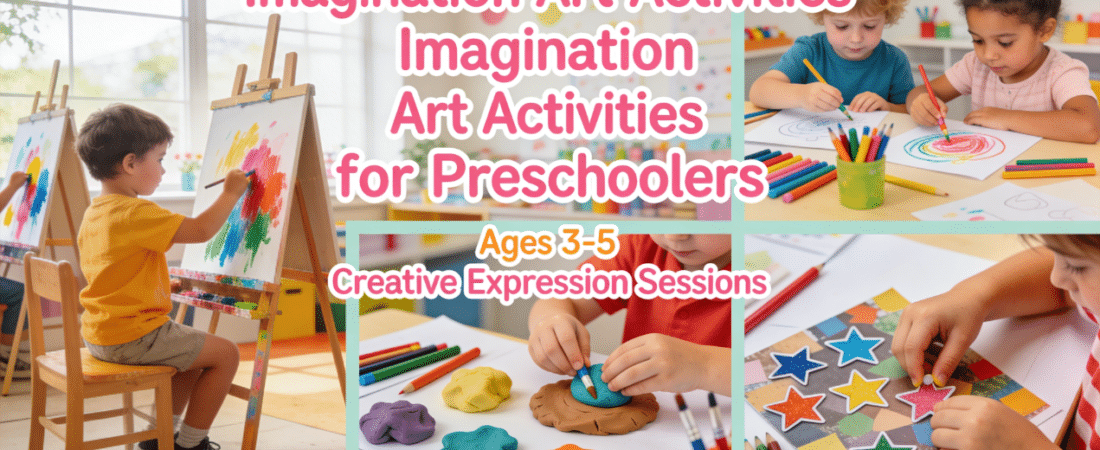

Art isn’t just a way to keep little hands busy—it’s one of the most powerful tools for early childhood development. When preschoolers create art, they’re building fine motor skills, developing problem solving skills, and learning to express emotions they can’t yet put into words. Many of the key benefits of arts and crafts for child development grow out of these early creative experiences. Research suggests the preschool years may be one of the most creative times in a child’s life, making this the perfect window to nurture a child’s imagination through artful play.
The best part? You don’t need expensive supplies or Pinterest-perfect setups, but choosing a few of the best art supplies for young artists can make creativity easier and more enjoyable. Paper plates, cardboard boxes, recycled materials, and everyday items from around your home become the building blocks for imaginative play. A cereal box transforms into a dragon. A paper towel tube becomes a magic wand. Coffee filters turn into butterfly wings.
Throughout this guide, you’ll find art activities designed for the process—the exploration, the storytelling, the “what if?” moments—rather than creating pretty pictures to hang on the fridge. You can also try additional engaging imagination activities to inspire creative thinking alongside these art projects. When we shift focus from product to process, we free preschoolers to experiment, make mistakes, and discover their own creative potential.
- What Imaginative Art Looks Like for Preschoolers
- 12 Imagination Art Activities for Preschoolers
- Storytelling Picture Maps
- Magic Wand and Crown Workshop
- Shape-Shifting Cardboard Creatures
- Color-Mixing Potion Lab
- Shadow Story Silhouette Art
- Nature Kingdom Collages
- DIY Story Puppets and Puppet Theater
- Imagination Boxes: From Spaceships to Submarines
- Musical Painting Adventures
- Rainbow Story Stones
- Paper Plate Imagination Masks
- Time-Travel Postcard Art
- Simple Ways to Spark Imagination During Any Art Activity
- Setting Up an Imagination-Friendly Art Space
- Conclusion: Nurturing Creative Thinkers Through Artful Play
What Imaginative Art Looks Like for Preschoolers

By age four, most preschoolers can hold crayons with a developing grip, use safety scissors with guidance, squeeze glue bottles, and recognize primary colors. They’re beginning to draw shapes intentionally—circles that might be faces, lines that could be roads, scribbles that represent entire stories only they can decode.
At this age, pretend play naturally blends with arts and crafts. A child making a paper crown isn’t just doing a craft—they’re becoming royalty, preparing for a coronation, ruling an imaginary kingdom. When preschoolers create magic wands, animal masks, cardboard castles, or even treasure chest crafts for kids, they’re simultaneously developing hand eye coordination and building the worlds where their stories unfold.
Preschoolers can typically follow one or two step directions, but they still need plenty of freedom and open-ended choices to thrive creatively. Telling a child exactly what colors to use or how their finished project should look can actually limit a child’s creativity. Instead, imaginative art should invite exploration: “What if this box could fly?” or “Who might live in a house made of leaves?”
The goal isn’t copying an example exactly—it’s helping children develop their own ideas, solve problems independently, and tell stories through their creations.
12 Imagination Art Activities for Preschoolers
The following dozen activities combine art projects with imaginative play, giving preschoolers opportunities to create, explore, and invent stories along the way. Each activity includes materials you likely already have, step-by-step guidance, safety considerations, and ideas to extend the play beyond the initial project.
These aren’t rigid recipes—they’re starting points. Let your preschooler’s interests guide the direction, and don’t be surprised when a “space map” becomes an underwater kingdom or a puppet show takes an unexpected turn toward dinosaurs. You can also introduce simple preschool 3D art projects to add another dimension to their creative play.
Storytelling Picture Maps
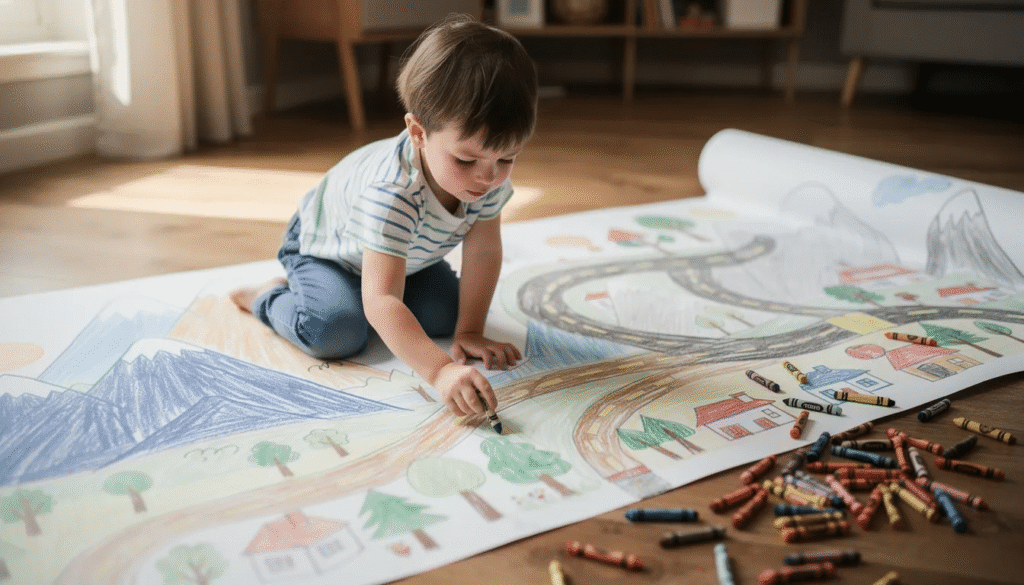
Giant “map” drawings become immersive worlds where preschoolers can move characters, invent adventures, and explore their own creativity. This activity combines drawing, storytelling, and sensory play in one sprawling project.
Materials needed:
- Butcher paper or taped-together construction paper (aim for at least 2 feet by 3 feet)
- Crayons, washable markers, and stickers
- Small toy figures, animals, or cardboard characters
Steps:
- Roll out the paper on a floor or large table and tape corners down to prevent sliding.
- Ask your child what kind of world they want to create—a forest, outer space, an underwater city, a magical kingdom. For children who love the cosmos, try incorporating some of these creative space crafts for kids and adults into your map or as follow-up projects.
- Begin drawing together: roads, rivers, mountains, buildings, caves, or whatever fits the theme.
- Add details with stickers, drawn creatures, and imaginary landmarks.
- Introduce small figures and invite your child to move them around, narrating what happens.
Storytelling prompts to try:
- “Who lives at this purple mountain?”
- “What happens when the bunny reaches the castle?”
- “Is there treasure hidden anywhere on this map?”
This activity encourages kids to think spatially while developing communication skills through narrative play.
Magic Wand and Crown Workshop
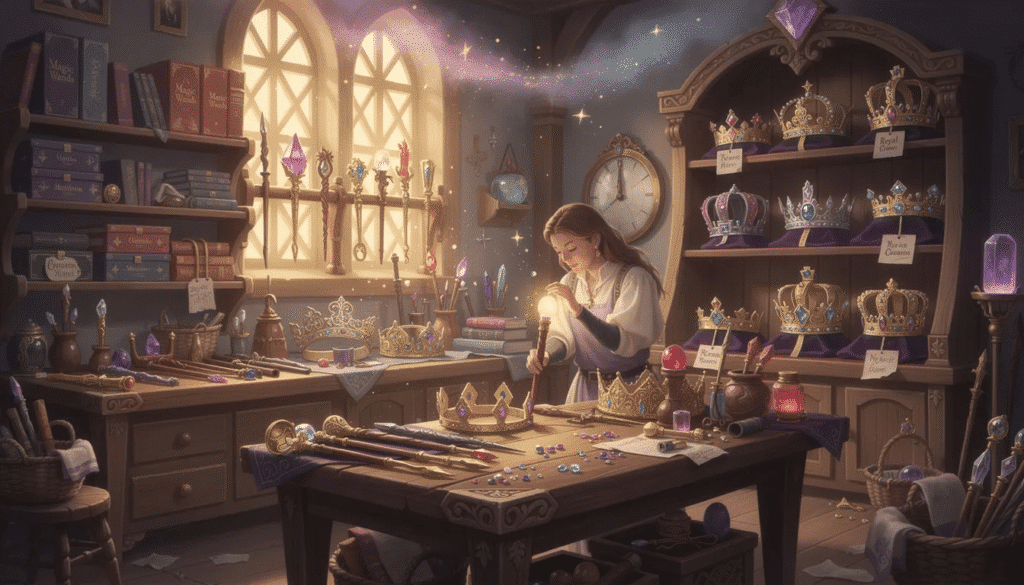
Every preschooler deserves a moment of royal power or magical ability. This craft encourages kids to design their own enchanted accessories—complete with special powers they invent themselves.
Materials needed:
- Cardboard strips (for crowns) and paper towel tubes or craft sticks (for wands)
- Aluminum foil, ribbon, and star-shaped cutouts from paper
- Stick-on gems, sequins, and markers
- Non-toxic glue sticks
Steps:
- For crowns: Cut cardboard strips to fit around your child’s head with overlap for taping. Let children choose a crown shape—pointed peaks, rounded scallops, or their own design.
- For wands: Wrap paper towel tubes or thick craft sticks in foil, leaving space for decoration.
- Set out decorating materials and let children design freely. Ask questions like “What power will your wand have?” or “What does your crown make you ruler of?”
- Once dry, try on the creations and launch into imaginative play.
Play extension ideas:
- Hold a “Royal Parade” around the room
- Create a make-believe coronation ceremony
- Grant wishes to stuffed animals or family members
Safety note: Pre-cut any cardboard pieces to avoid sharp edges, and supervise glue stick use with younger preschoolers who might taste-test supplies.
Shape-Shifting Cardboard Creatures
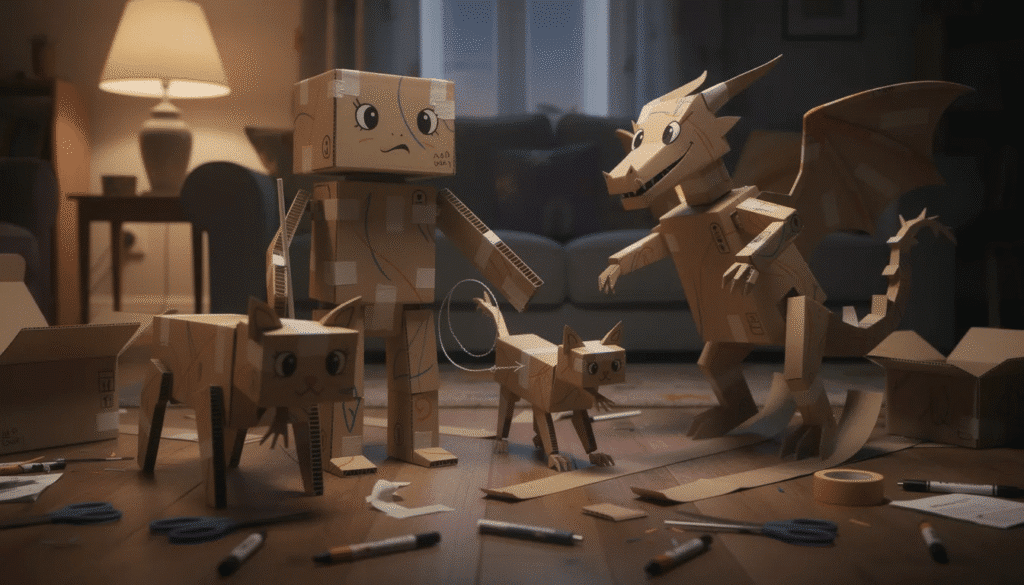
Small shipping boxes and cereal boxes become dragons, robots, friendly monsters, and creatures that exist only in a child’s imagination. This activity is perfect for rainy spring afternoons when energy needs an outlet.
Materials needed:
- Small cardboard boxes (cereal boxes, shipping boxes, tissue boxes)
- Pre-cut cardboard shapes (triangles, circles, rectangles)
- Washable paints or markers
- Googly eyes, pipe cleaners, and construction paper scraps
- Non-toxic glue or tape
Steps:
- Adults should pre-cut basic shapes from cardboard—wings, horns, tails, ears—in various sizes.
- Let children choose a base box and begin attaching shapes with glue or tape.
- Add googly eyes, draw faces, and attach pipe cleaner antennae or arms.
- Once the creature is complete, name it together and decide what special abilities it has.
- Draw a habitat on large paper where the creature lives.
Tips for success:
- Don’t worry about symmetry or “correctness”—a three-winged dragon is perfectly valid
- Use this activity to teach children about different textures by including fabric scraps, foil, or sandpaper in your materials
- Display finished creatures on a shelf as a “creature collection”
This project supports spatial awareness as children figure out how shapes fit together to form their vision, and it pairs well with other colorful craft ideas for a fun weekend when you want to keep the creative momentum going.
Color-Mixing Potion Lab
Transform your kitchen table into a bubbling laboratory where young scientists mix colors to create magical potions with fantastical names and mysterious powers.
Materials needed:
- Clear plastic cups (several per child)
- Droppers or small spoons
- Primary-color liquid watercolors or food coloring diluted in water
- Thick paper or coffee filters for “spell pages”
- Optional: baking soda and vinegar for fizzing potions (adult supervised)
Steps:
- Set up a “potion lab” with cups of red, blue, and yellow water arranged on a washable surface.
- Demonstrate using droppers to transfer small amounts between cups.
- Let children mix colors freely, discovering what combinations create new colors.
- Name each potion together—“dragon breath blue,” “giggle green,” “sunset shimmer.”
- Pour finished mixtures onto thick paper or coffee filters to create abstract “spell pages” as the colors bleed and blend.
Safety guidance: Clearly explain that potions are for looking only, never drinking. Use food coloring if concerned about accidental tasting, and supervise closely throughout. The dish soap and baking soda additions should always be handled by adults.
This activity naturally teaches color mixing while fostering creativity through naming and storytelling.
Shadow Story Silhouette Art
When the sun goes down, this quiet activity combines painting with shadow play for a calm, imagination-rich experience perfect for winding down.
Materials needed:
- Black construction paper
- Safety scissors (for adult use on intricate cuts)
- Watercolor paints in sunset colors (oranges, pinks, purples, yellows)
- White or light-colored paper for backgrounds
- Glue sticks
- Flashlight or lamp
Steps:
- First, have children paint a “sunset sky” background using watercolors on white paper. Let dry.
- While drying, cut simple silhouette shapes from black paper—castles, spaceships, animals, trees, mountains.
- Once backgrounds are dry, glue silhouettes along the bottom edge.
- In a darkened room, use a flashlight to cast the art’s shadow on the wall.
- Tell stories about what’s happening in the shadow scene.
Storytelling tips:
- Ask “What’s happening inside that castle right now?”
- Wonder aloud about what sounds might be heard in the scene
- Let your child move the art slowly to make the shadows “come alive”
This activity connects imagination with basic science concepts about light and shadow while creating beautiful keepsake art.
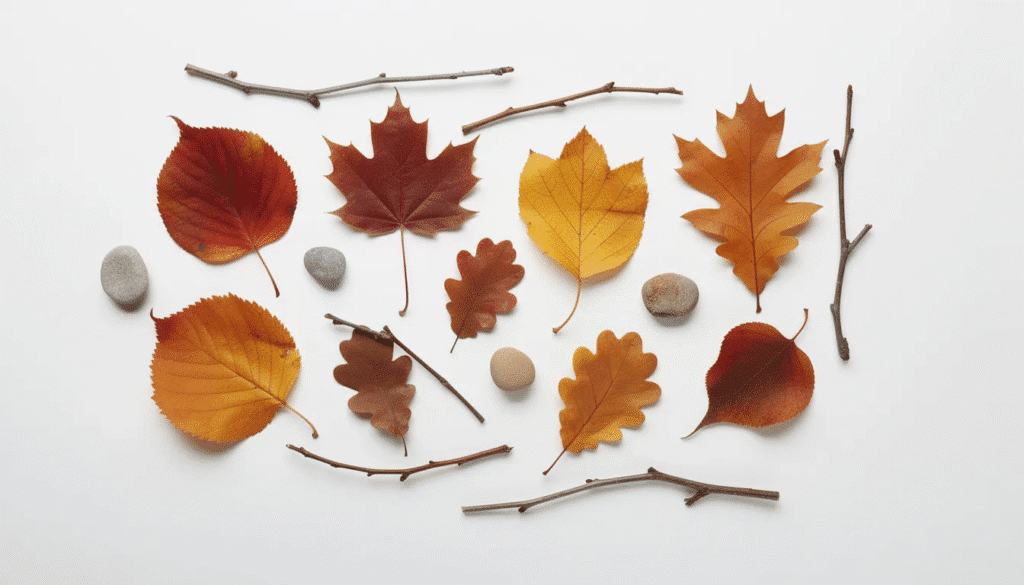
Nature Kingdom Collages
A nature walk becomes the first step in creating magical kingdoms populated by leaf dragons, twig castles, and pebble roads leading to fairy houses. In winter, you can complement this activity with seasonal projects like polar bear craft ideas for kids to keep nature and animals at the center of your art.
Materials needed:
- Collection bag for nature walk
- Cardboard or sturdy paper base
- Crayons and markers
- Glue
- Natural items: leaves, twigs, petals, small stones, seed pods
Steps:
- Take a nature walk together, collecting fallen items along the way.
- Back home, spread out your treasures and sort by type or size.
- On cardboard, begin arranging items to create a “kingdom”—perhaps leaf dragons, twig bridges, or petal flowers in a garden.
- Glue items in place, then add drawn details with crayons (roads, sky, creatures, buildings).
- Describe who lives in the kingdom and what happens there across different seasons.
Environmental respect:
- Only collect items already on the ground
- Avoid taking items from protected areas or living plants
- Return items that contain visible insects to nature
This activity enhances observation skills while connecting children to the natural world and different materials.
DIY Story Puppets and Puppet Theater
Puppetry transforms simple materials into characters with voices, personalities, and adventures—a delightful way to blend crafts with dramatic play.
Materials needed:
- Paper bags or old socks
- Felt scraps, yarn, and fabric pieces
- Markers and crayons
- Googly eyes and buttons
- Large cardboard box for theater (optional)
- Glue
Steps:
- Choose puppet bases—paper bags work well for hand puppets, socks for longer creatures.
- Discuss what character the puppet will become: astronaut, superhero, animal, or entirely invented creature.
- Attach features using glue—felt ears, yarn hair, googly eyes, marker details.
- For a theater: Cut a rectangular “stage window” in a large box and decorate the frame.
- Invent shows together—perhaps a new ending for a familiar story or an entirely original adventure.
Supporting shy children:
- Offer to create a script together before performing
- Let the puppet “speak” first while the child observes
- Start with just two puppets having a simple conversation about favorite foods or colors
Puppet play supports self expression and language development as children give voice to their creations.
Imagination Boxes: From Spaceships to Submarines
Large cardboard boxes become vehicles for adventure—rocket ships exploring distant planets, submarines diving to ocean floors, or time machines visiting dinosaurs.
Materials needed:
- Large cardboard box (appliance or moving boxes work best)
- Markers, crayons, and stickers
- Paper plates (for steering wheels or portholes)
- Aluminum foil for buttons and controls
- “Mission cards” on index cards
Steps:
- Adults should cut entry doors and windows with a box cutter (children away from cutting area).
- Let children decide what vehicle the box will become.
- Draw control panels, buttons, steering wheels, and gauges on the inside.
- Decorate the outside with the vehicle’s features—flames for a rocket, waves for a submarine, badges for a fire truck.
- Create “mission cards” with simple tasks: “Rescue the teddy bear from the moon” or “Find three blue things in the deep ocean.”
Important: Leave plenty of blank space for children to add their own ideas over time. The best imagination boxes evolve as play continues.
Musical Painting Adventures
When music meets painting, preschoolers learn to translate sounds into visual art—a wonderful way to explore how different materials and different textures can express feeling and movement.
Materials needed:
- Large paper (butcher paper or poster board)
- Washable paints in multiple colors
- Various brushes and sponges
- Music player with different genres ready (classical, jazz, upbeat pop)
- Smocks or old shirts
Steps:
- Set up a large painting station with plenty of space for movement.
- Start the first music selection and invite children to paint what they hear.
- When the music changes to a different style, suggest switching colors or brush types.
- Ask questions throughout: “What does this loud drum sound look like on your paper?” or “Does this slow music feel like big swoops or tiny dots?”
- Display finished paintings with notes about which songs inspired which sections.
This activity helps kids connect auditory and visual processing while encouraging creativity through multisensory exploration.
Rainbow Story Stones
Painted stones become storytelling tools that preschoolers can arrange and rearrange to create endless narrative combinations.
Materials needed:
- Smooth, flat stones (collected or purchased)
- Acrylic paints or paint pens (adult-handled for painting, or washable paints for child participation)
- Simple image ideas: sun, moon, house, tree, car, animal, rainbow, heart, weather symbols
- Clear sealant (adult application only)
- Storage bag or small box
Steps:
- Wash and dry stones thoroughly.
- Paint simple images on each stone—keep designs basic so children can interpret them flexibly.
- Allow to dry completely (may take 24 hours).
- Adults apply clear sealant and allow to cure.
- Children arrange stones in a line and create a story moving from stone to stone.
Tips:
- Start with 6-8 stones and add more over time
- Include some “wild card” stones with abstract shapes or colors that can mean anything
- Rotate seasonal symbols throughout the year
Story stones travel well and make excellent quiet activities for waiting rooms or restaurants.
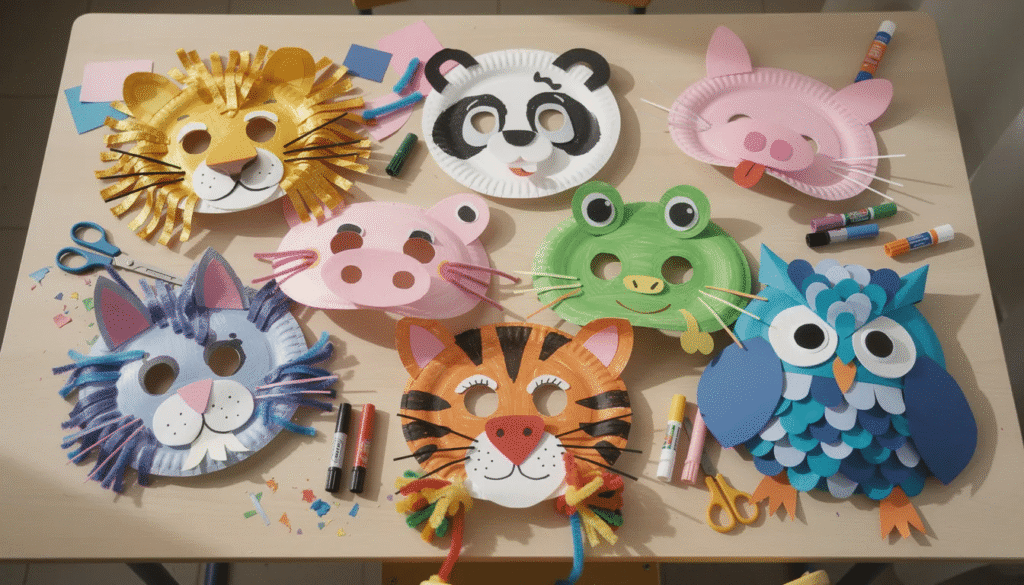
Paper Plate Imagination Masks
A simple paper plate becomes a dragon, astronaut, butterfly, forest creature, or something entirely invented. Mask-making supports role play while developing the small muscles needed for writing.
Materials needed:
- Paper plates (sturdy ones work best)
- Safety scissors (adult use for eye holes)
- Crayons, markers, and paint
- Feathers, yarn, foil, and fabric scraps
- Elastic string or craft sticks for handles
- Glue
Steps:
- Adults cut eye holes appropriate for child’s face.
- Discuss what character the mask will become—real animal, mythical creature, or pure invention.
- Paint or color the base, then add dimensional elements: yarn manes, feather crowns, foil scales.
- Attach elastic string around the back or glue a craft stick handle to the bottom.
- Launch into imaginative play: jungle explorers, outer space parade, or underwater school.
Masks support emotional development by letting children “try on” different identities and express emotions through play.
Time-Travel Postcard Art
Preschoolers create postcards from imaginary places—dinosaur parks, future cities, candy planets—blending drawing with storytelling and early literacy skills.
Materials needed:
- Index cards or cardstock cut to postcard size
- Crayons, markers, and stickers
- Optional: postage stamps and envelopes for actual mailing
Steps:
- Ask your child to imagine a place they’d like to visit—somewhere that doesn’t exist or existed long ago or might exist in the future.
- On one side of the card, draw that place with as much detail as desired.
- Flip the card over. Adults write “Dear _“ and then transcribe the child’s dictated message about their imaginary vacation.
- Address to a relative or friend, or display on a bulletin board “post office.”
- If mailing, let children watch you add stamps and drop the postcard in a mailbox.
Language development bonus: Dictation—where children speak and adults write—builds vocabulary and narrative skills while demonstrating that spoken words can become writing. This is a fun way to connect art with early literacy.
Simple Ways to Spark Imagination During Any Art Activity
Any craft can become an imagination activity when adults ask the right questions and create space for storytelling. The difference between a routine preschool crafts session and one that sparks creativity often comes down to the prompts we offer.
Open-Ended Questions
Ask open-ended questions instead of yes/no prompts:
- “What might happen next in your picture?”
- “Who lives in that house you drew?”
- “Where is this creature going?”
- “What does this color make you think of?”
Theme Rotation
Rotate themes by month or season to keep ideas fresh:
Month | Theme Ideas |
|---|---|
January | Space and stars |
February | Hearts and friendship |
March | Weather and rainbows |
April | Gardens and growing things |
May | Insects and nature |
June | Ocean and beach |
July | Underwater worlds |
August | Adventure and travel |
September | Forest creatures |
October | Friendly monsters |
November | Thankfulness and family |
December | Winter wonderland |
Material Mixing
Mix different materials to invite invention: Combine paper, cardboard, fabric scraps, natural items, and household items in the same activity. When a child sees shaving cream next to pipe cleaners next to sidewalk chalk, their brain starts making unexpected connections.
Fostering creativity isn’t about elaborate setups—it’s about leaving room for “what if?” and following where children’s ideas lead.
Setting Up an Imagination-Friendly Art Space
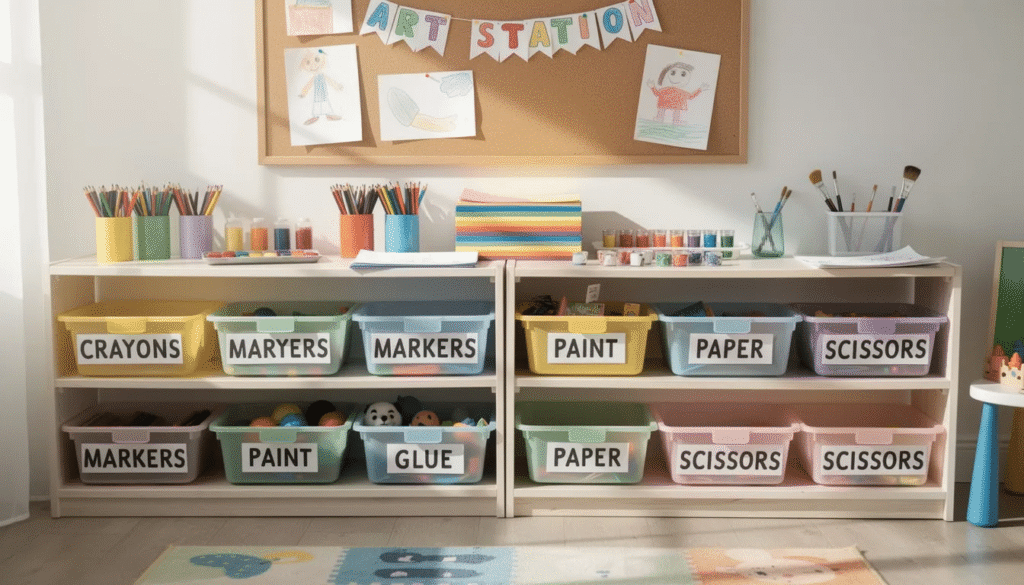
A dedicated art corner—even a small one—tells children that creativity matters and is always available to them. The key is accessibility and organization that supports independence, especially in group settings like creative kindergarten classroom environments where many children share the same space.
Essential Setup Elements
- Reachable bins containing crayons, markers, tape, glue sticks, and scrap paper
- Labels with words AND pictures on each container (supports early literacy while building independence)
- Child-height table or floor space where messes are acceptable
- Smocks made from old adult shirts worn backwards
- Washable surface protection using plastic tablecloths or shower curtain liners
- Display space for finished work—a bulletin board, string line with clothespins, or refrigerator gallery
Quick Cleanup Kit
- Paper towels
- A spray bottle with water
- A small trash bin within reach
Teaching children to wipe up their own spills builds self confidence and responsibility.
Rotation System
Store some materials out of reach and rotate them monthly. When sidewalk chalk reappears after being away for weeks, it feels exciting again.
Displaying Art
Displaying children’s imaginative art—especially work that tells a story rather than just looking “nice”—communicates that their ideas have value.
Conclusion: Nurturing Creative Thinkers Through Artful Play
Imagination art activities give preschoolers far more than entertainment. Through finger painting, cardboard creatures, story stones, and puppet shows, children develop cognitive development pathways that support learning across all domains. They practice problem solving when their glue doesn’t stick. They build self esteem when their ideas become real objects they can hold. They strengthen communication skills when they explain their creations to others, and you can even weave in gentle numeracy through themed activities like a number 9 craft for preschoolers.
Research shows that children who regularly engage in creative activities develop better emotional regulation, stronger reasoning skills, and richer vocabularies than those with limited art exposure. Encouraging creativity now—through low-pressure, process-focused activities—lays a foundation for the creative thinking and overall development children will need throughout their lives.
This week, try one new imaginative art activity with your preschooler. Pull out a cardboard box and ask what vehicle it could become. Set up a color mixing station and invent potion names together. Create a paper plate mask and see what character emerges. Watch how your child’s stories, ideas, and self expression bloom when you give imagination room to grow.