If you teach kindergarten, you know the drill. January brings week-long stretches of snow too deep for the playground. April delivers relentless rain that keeps everyone inside for days. Summer heat waves and poor air quality days are increasingly common. When outdoor recess isn’t an option, five and six-year-olds still need movement, play, and social interaction to stay focused and regulated throughout the school day. In these situations, indoor activities become essential for keeping students engaged and active when outdoor play isn’t possible.
Indoor recess in a kindergarten context typically means a 10–25 minute break held in the classroom, hallway, or multipurpose room. Research shows that consistent recess time—even indoors—reduces misbehavior by 40–60% when activities are well-structured. Movement boosts focus, and play supports language development and social skills that younger kids are actively building. The goal isn’t to replicate the playground but to give children meaningful opportunities for physical activity, creativity, and connection with their peers. Indoor recess activities can also promote stealthy learning through play.
This guide delivers specific, easy-to-set-up indoor recess activities that require mostly basic classroom materials you already have on hand. Whether you need ideas for today or want to build a year-long rotation system, you’ll find practical strategies that work for real kindergarten classrooms.
- Introduction to Indoor Recess
- Benefits of Indoor Recess
- Quick-Start: Go-To Indoor Recess Ideas for Today
- Planning Indoor Recess for Kindergarten: Space, Safety, and Routines
- Movement-Based Indoor Recess Activities for Kindergarten
- Quiet and Calm Indoor Recess Choices for Kindergarten
- Educational Indoor Recess Ideas for Kindergarten
- Social and Imagination Games for Kindergarten Indoor Recess
- Organizing Indoor Recess: Rotations, Choice, and Inclusion
- Indoor Recess Supply List and Prep Tips for Kindergarten Teachers
- Conclusion
Introduction to Indoor Recess
Indoor recess is a vital component of every school day, especially when unpredictable weather keeps students inside. For teachers, having a toolkit of indoor recess ideas ensures that kids stay active, engaged, and happy—even when outdoor play isn’t possible. Indoor recess games can be easily adapted for different age groups, from younger kids just starting school to older students who need more challenging activities. These games and activities not only help students burn off energy, but also support the development of fine motor skills, gross motor skills, and essential social skills. By incorporating a mix of movement, creativity, and teamwork, teachers can create a positive indoor recess experience that keeps students active and learning through play. Whether you’re looking for quick games, hands-on crafts, or group challenges, a well-planned indoor recess helps kids build motor skills, connect with classmates, and make the most of every school day.
Benefits of Indoor Recess
Indoor recess offers a wide range of benefits that go far beyond simply filling time when outdoor play isn’t possible. Regular indoor recess activities help students develop stronger social skills as they learn to share, cooperate, and communicate with their peers. These activities also provide a much-needed brain break, allowing students to recharge and return to classroom learning with improved focus and self confidence. Physical movement during indoor recess supports healthy development and helps manage energy levels, while creative and collaborative games foster problem-solving and teamwork. For teachers, incorporating indoor recess into the school day creates a more balanced classroom environment, reduces restlessness, and supports positive behavior. By making indoor recess a regular part of your routine, you help students thrive both academically and socially, ensuring that every child has the opportunity to grow, play, and succeed—no matter what the weather brings.
Quick-Start: Go-To Indoor Recess Ideas for Today
If you’re searching between lessons and need something you can use this morning, here are seven plug-and-play activities ideal for kindergarten:
Freeze Dance (5–7 minutes, music source needed, loud) – Play age-appropriate songs while kids dance on their carpet spots and freeze when the music stops. Balloon Volleyball (10–15 minutes, 1–2 balloons and paper plates, medium) – Children tap a balloon over a taped line using plates as paddles. Animal Yoga Adventure (5–10 minutes, no materials, quiet) – Guide students through poses like cat-cow, cobra, and downward dog while telling a story. Building Station (10–15 minutes, blocks or building toys in a bin, quiet) – Set out building blocks and let small groups create structures. Play Dough Creations (10–15 minutes, play dough and simple tools, quiet) – Children knead, roll, and shape at a designated table. Storytime Charades (8–10 minutes, picture cards, medium) – One child acts out an animal or character while classmates guess. Simple Obstacle Path (10–15 minutes, painter’s tape and classroom furniture, medium) – Create a quick circuit with shapes to hop on, chairs to crawl under, and lines to balance along.
The rest of this article explains more ideas and how to organize indoor recess so it stays fun and manageable for both you and your students.
Planning Indoor Recess for Kindergarten: Space, Safety, and Routines
Successful indoor recess in kindergarten depends as much on structure and safety as on the specific games you choose. A few minutes of preparation makes the difference between joyful play and classroom chaos.
Rearranging your space: Push tables to the edges of the room to create a central play zone. Use a 6×8 foot carpet as the designated movement area, or mark boundaries with painter’s tape on the floor. Cones or tape lines help children understand where active play happens versus where quiet activities are set up. You can also put dots on the floor to help kids know where to line up or sit during certain activities.
Safety rules in kid-friendly language:
- Feet stay on the floor
- Hands to ourselves
- We freeze when the music stops or the teacher raises a hand
- Walking feet only in the classroom
- Toys stay in their stations
Establishing indoor recess structures and routines ensures students are safe and not disturbing other classes.
Visual schedule: Draw or print simple pictures showing the recess plan on your whiteboard. For example: 5 minutes dance, 8 minutes centers, 3 minutes calming activity. Kindergartners thrive when they know what to expect.
Visual timer: Use a sand timer, digital countdown projected on the board, or a simple kitchen timer to signal when it’s time to switch activities or stations. This reduces the “five more minutes!” negotiations and helps children practice transitions. Using timers for movement breaks can help maintain engagement during calmer activities.
Indoor recess bin: Prepare a grab-and-go container ahead of time. Fill labeled gallon bags or shoeboxes with core materials: balloons, paper plates, crayons, dice, picture cards for charades, a bean bag, and jump rope segments for floor games. Putting materials in labeled bags or bins makes it easy for kids to access and helps keep everything organized. Store this bin where you can access it quickly on any rainy day.
Movement-Based Indoor Recess Activities for Kindergarten
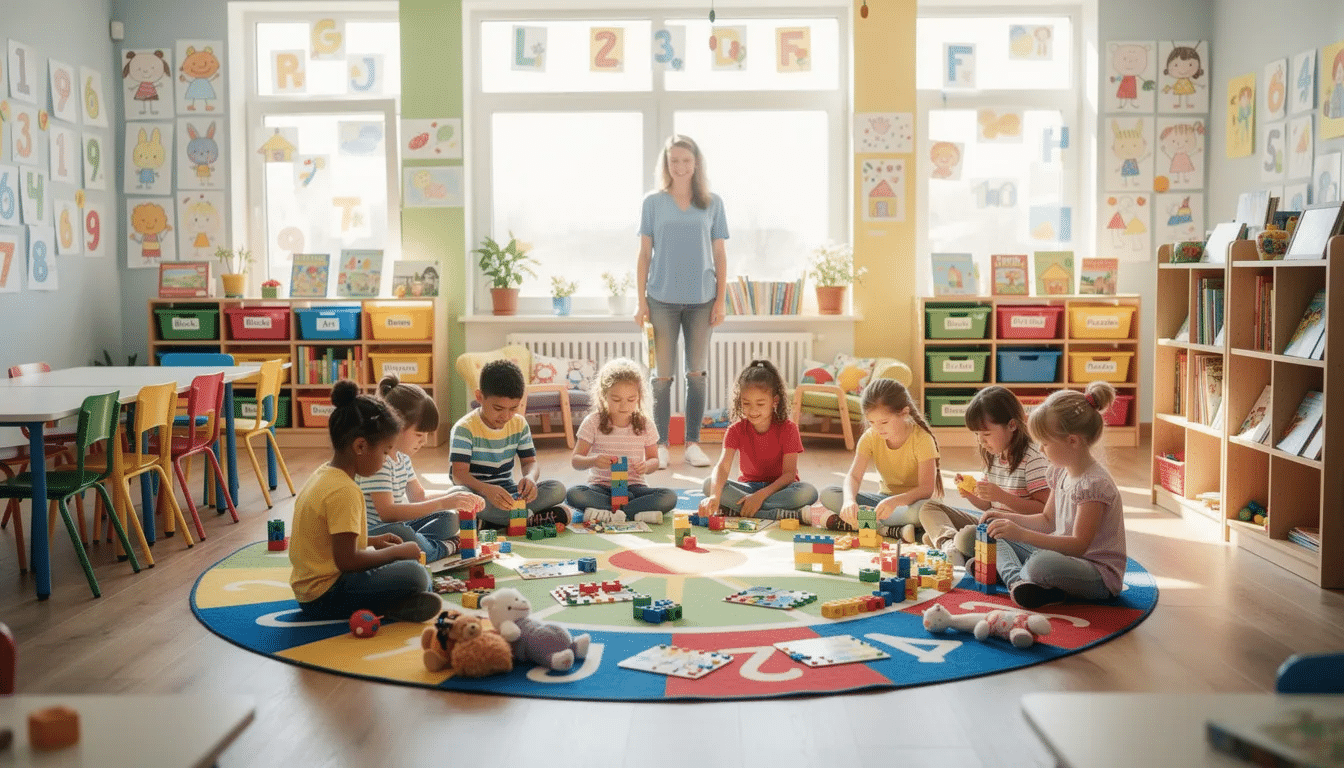
Kindergartners need gross motor movement throughout their day—their bodies aren’t designed to sit still for hours. These activities are designed for small classroom spaces, focusing on safe, low-impact movement like marching, tiptoeing, stretching, and controlled jumping rather than running or tackling. A group game, such as relay races or charades, can engage multiple children at once and promote teamwork and social interaction during indoor recess.
Each game includes the ideal group size and approximate time so you can plan your indoor recess block effectively.
After trying the activities listed above, consider organizing relay races as a fun gross motor group game. Relay races can be adapted for indoor spaces by having children use animal walks or creative movement styles, encouraging coordination, teamwork, and physical engagement.
Active indoor recess also provides opportunities for children to come up with their own ideas on how to get active, fostering creativity and independence.
Dance and Freeze Games
Freeze dance is a great game for the whole class that burns energy while teaching kids to listen for cues. Play age-appropriate songs while children dance around their personal “spot” (a taped X or carpet square). When the music stops, everyone freezes in place.
Add simple prompts to support imagination and following directions:
- “Dance like a robot”
- “Move like a tiny mouse”
- “Stomp like a giant”
- “Float like a cloud”
Create 5–7 minute playlists ahead of time, with at least one calm song at the end to help transition back to learning. A variation called “Color Freeze” adds cognitive challenge: call out a color and kids freeze while touching something in that color within reach of their spot.
Safety tips: No running between spots, no jumping into others’ spaces, and keep music volume low enough so students can hear your voice. This fun way to get students moving works for the whole class in about 5–7 minutes.
Animal Walks and Yoga Adventures
Guide a pretend “trip to the zoo” or “walk through the jungle” where children move like different animals. This activity keeps students active while staying relatively quiet and controlled.
Animal walks to try:
- Bear crawl (hands and feet, bottom in the air)
- Tiptoe like a cat
- Hop like a frog
- Waddle like a penguin
- Slither like a snake
Integrate simple yoga poses with animal names: cat-cow stretches, cobra pose, downward dog, and starfish stretch. Hold each pose for 5–10 seconds. Tell a short story while leading the motions: “We’re hiking up a mountain. Now we see a sleepy cat stretching in the sun. Let’s stretch like the cat!”
This can be done on the classroom carpet with each child staying in their own square to reduce bumping. Benefits include core strength, balance, body awareness, and motor planning skills that support overall development. After several minutes of slow breathing and stretching, children return to instruction calmer and more focused.
Ideal for: Whole class, 5–10 minutes
Balloon and Paper Plate Games
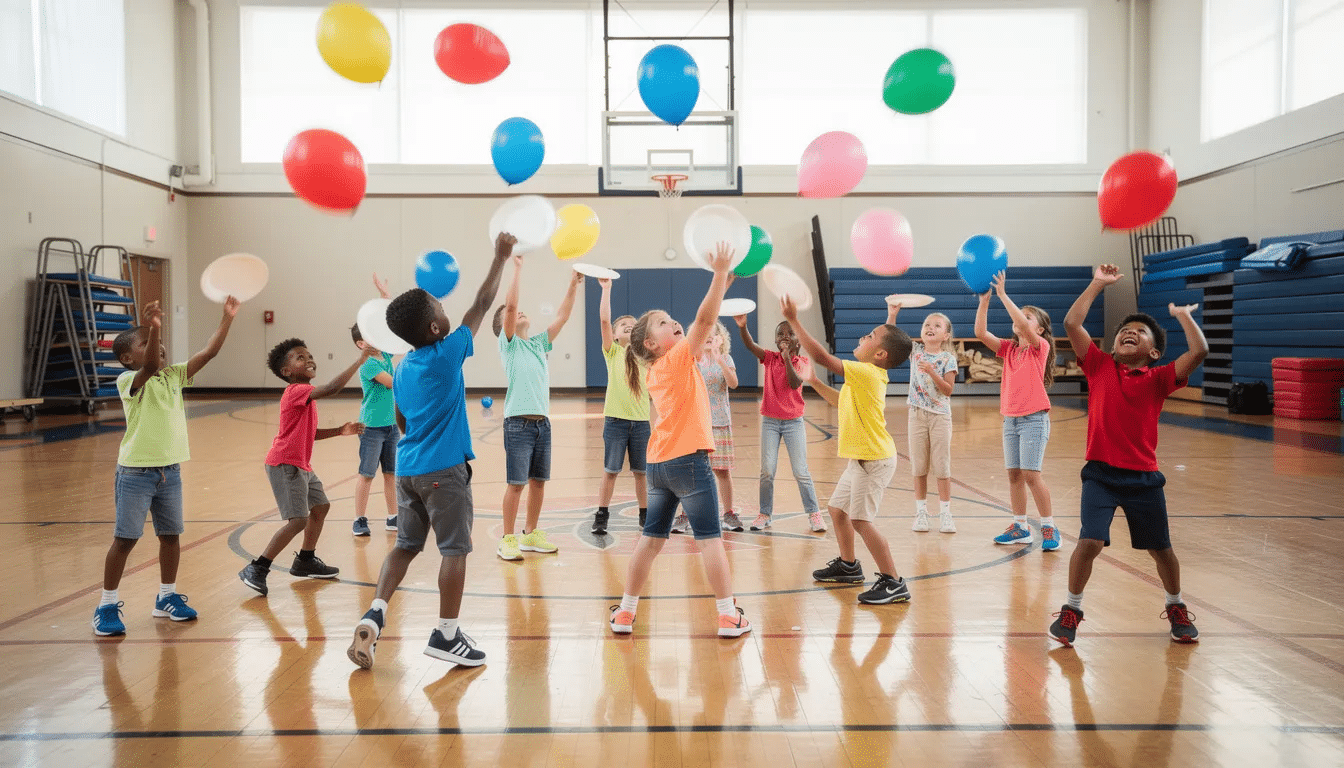
Balloon volleyball is a kindergarten favorite that gets many kids moving without the injury risks of harder balls. Give each child a paper plate as a “paddle” and arrange kids in two lines facing each other over a taped “net” on the floor.
Circle variation: Children stand in a circle keeping one balloon in the air. Before hitting the balloon, they call out a friend’s name—that child must hit it next. This builds social skills and name recognition.
Counting twist: Count together how many taps the group can do before the balloon touches the floor. Try to beat your previous score.
Practical tips:
- Limit to 1–2 balloons at a time
- Remind children to tap gently, keeping balloons above shoulder height
- Always have extra balloons ready in case of popping
- Avoid latex if allergies are a concern
- For an even quieter option, use large pom-poms instead of balloons
Ideal for: Whole class or groups of 8–15, 10–15 minutes
Simple Obstacle and Path Games
Set up an easy obstacle path using items you already have in the room. This gets students moving through a structured course that channels energy productively.
Sample setup:
- Tape shapes on the floor to hop between
- Chairs to crawl under
- A line of dots to tiptoe along
- A “bridge” made from a row of carpet squares
- A bean bag to balance on your head for three steps
Keep the path compact and one-directional, with only 3–4 children on the route at a time to prevent crowding. Use simple commands: “Hop on the stars,” “Touch the wall and turn around,” “Balance along the tape like a tightrope,” “High five the door before you come back.”
Rotate roles so some children walk the path while other students coach from the sidelines, cheering and modeling the motions. The same taped path can be reused on multiple days by changing the story: space walk on Monday, trip through a castle on Wednesday, rescue mission on Friday.
Ideal for: Small groups rotating through, 10–15 minutes
Quiet and Calm Indoor Recess Choices for Kindergarten
Some kindergartners need a calmer option during recess. Sensory overload, fatigue, or noise sensitivity can make high-energy games overwhelming rather than refreshing. Quiet choices ensure every child can recharge in a way that works for their needs.
Set up 3–4 quiet “choice areas” around the room—on a carpet corner, at a back table, on a low shelf—clearly labeled with picture icons. Expectations for these spaces include indoor voices, materials staying at the station, and easy clean-up before the timer ends. Limit each quiet station to 2–4 children to keep the environment peaceful.
Teachers can allow children to choose a quiet option on days when they seem overwhelmed or tired. This isn’t a punishment—it’s teaching kids to recognize and respond to their own needs.
Play Dough and Sensory Trays
A simple play dough center supports fine motor skills while keeping noise levels low. Set out 3–4 colors with rolling pins, plastic cutters, and child-safe tools in shallow trays.
Clear rules:
- Dough stays on the trays
- No mixing colors (if that matters for longevity)
- Tools are shared and returned to the bin
Idea prompts:
- “Make your favorite food”
- “Build a tiny zoo”
- “Roll snakes and make letters of your name”
Add occasional seasonal extras to keep the station fresh: toothpicks for building snowflakes in December, plastic flowers in April, old tissue boxes cut into shapes for building foundations, or a winter-themed project inspired by polar bear craft ideas. Kneading and rolling strengthen the hand muscles needed for writing and cutting—this is indoor recess fun that builds fine motor strength simultaneously.
Ideal for: 2–4 children, 10–15 minutes
Coloring, Drawing, and Simple Crafts
Stock a small art table with quality art supplies for young artists such as crayons, markers, scrap paper, construction paper, child-safe scissors, and glue sticks in labeled bins.
- Coloring seasonal picture pages
- Drawing classroom friends or family members
- Making simple paper crowns or animal hats
- Creating colorful weekend craft collages from scrap paper scraps
Display kindergarten art on a designated bulletin board or string line so children look forward to adding their work. This creates pride in their creations and gives them something to show parents at pickup, and themed projects like easy owl crafts for kids can tie into science or literacy units.
Guidelines for manageability:
- Limit glitter and tiny pieces during recess
- Use trays or placemats to contain mess
- Give a 1–2 minute cleanup warning before time ends
Occasionally link crafts to classroom themes—paper snowflakes in January, paper leaves in October, or an ocean-themed crab paper plate craft for kids—without turning recess into a formal lesson. This keeps free time feeling like genuine play while reinforcing what younger students are learning.
Ideal for: 2–4 children, 10–15 minutes
Puzzles, Building, and Quiet Table Games
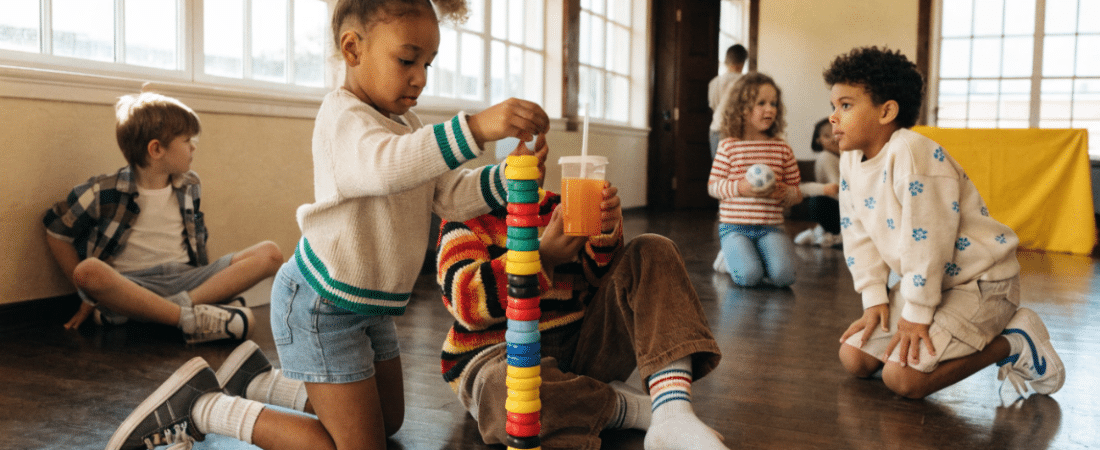
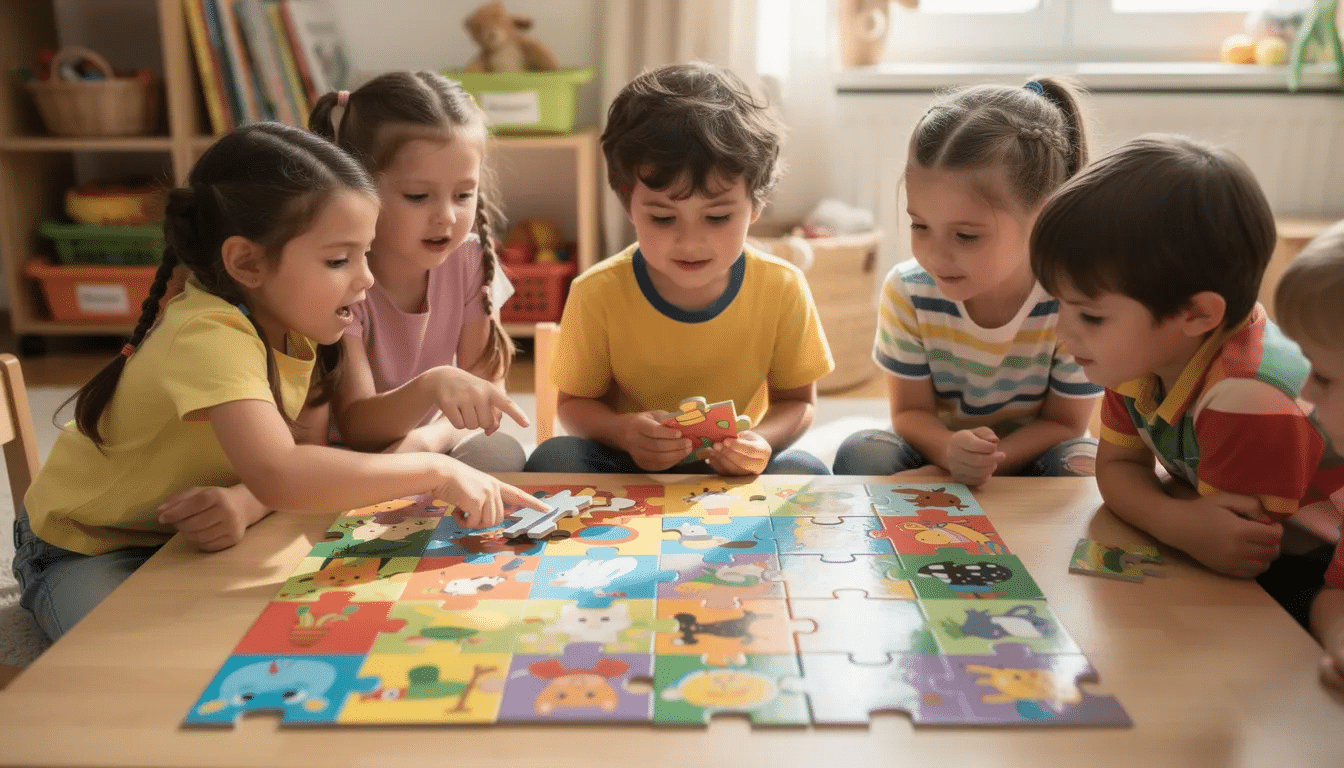
A puzzle and building station provides calm, focused play that develops problem-solving skills. Include 12–24 piece jigsaw puzzles, chunky floor puzzles, wooden blocks, building blocks, and interlocking bricks in separate clear bins.
Choose puzzles at the right difficulty level for 5–6 year olds—challenging enough to engage but not so hard they cause frustration. Look for puzzles with themes kindergartners love: animals, vehicles, community helpers, favorite characters, or other engaging group activities for 5 year olds.
Cooperative goals:
- “Can you and your partner finish this puzzle before the timer?”
- “Can your group build a bridge that holds three toy animals?”
- “Work together to build the tallest tower you can”
Picture-based matching games, simple memory cards, or domino-style card games work well for pairs of kindergartners who aren’t yet reading. Board games designed for younger kids can also fit here if you’ve introduced the rules during a previous lesson.
Store each game or puzzle in its own labeled box or bag. This makes independent cleanup realistic for this age group and prevents the frustration of missing pieces.
Ideal for: 2–4 children, 10–15 minutes
Educational Indoor Recess Ideas for Kindergarten
Indoor recess is the perfect opportunity to blend fun with learning, especially for kindergartners who are eager to explore new concepts through play. Educational indoor recess activities can reinforce academic skills while keeping students engaged and active. Here are some creative ideas to try:
- Alphabet Scavenger Hunt: Hide letter cards around the classroom and have students search for them. When a child finds a letter, they can name it and say a word that starts with that letter, building early literacy and letter recognition.
- Number Hopscotch: Use painter’s tape to create a hopscotch grid on the floor with numbers. As students hop from square to square, ask them to count aloud, identify the number, or solve simple math problems for an added challenge.
- Shape Sorting Relay: Set up bins with different shapes cut from construction paper. Divide students into two teams and have them race to sort shapes into the correct bins, promoting shape recognition and teamwork while getting students moving.
- Story Building Blocks: Provide building blocks labeled with sight words or simple pictures. Challenge students to build towers by stacking blocks in the order of a sentence or story, encouraging both fine motor skills and early reading.
- Pattern Making with Beads or Buttons: Offer trays of colorful beads or buttons and string or pipe cleaners. Students can create repeating patterns, which supports math skills and fine motor development.
- Memory Match Card Games: Use cards with numbers, letters, or classroom vocabulary for a classic memory match game. This activity sharpens concentration and reinforces academic concepts in a playful way.
These educational indoor recess ideas keep learning at the forefront while ensuring students have fun and stay active. By integrating academic skills into your indoor recess routine, you help students make meaningful connections and build confidence in a relaxed, playful setting.
Social and Imagination Games for Kindergarten Indoor Recess
Indoor recess provides natural opportunities for teaching kids turn-taking, sharing, and verbal communication through pretend play and simple group games. These social skills develop through practice, and structured play gives kindergartners a safe space to learn.
These ideas work especially well when the teacher can circulate and model language or help solve small conflicts. Use picture cues, puppets, or props to support children who are still developing English or expressive language. Keep games short with clear starts and stops so kindergarteners don’t lose track of rules.
Kindergarten-Friendly Charades and Guessing Games
Simplified charades using picture cards makes this classic game accessible for younger students who can’t yet read. Create cards showing animals, classroom objects, daily routines, or storybook characters you’ve recently read together.
How to play:
- One student picks a card (with teacher help if needed)
- That one child acts it out without talking
- Classmates guess using sentence frames: “I think you are a…”
- The game continues with a new actor
Theme sets to create:
- Animals (dog, cat, elephant, fish, bird)
- Vehicles (car, airplane, boat, bicycle)
- Community helpers (firefighter, doctor, mail carrier)
- Classroom actions (reading, writing, sleeping, eating)
Play in small groups of 5–6 children for more turns while the rest of the class works at other stations.
Quieter alternative: “What’s Missing?” works well for younger kids who may feel shy performing. Place 5–6 familiar items on a tray, have children close their eyes, remove one item, and let them guess which disappeared. This fun game builds observation and memory skills.
Ideal for: Small groups of 5–6, 8–10 minutes
Pretend Play and Dramatic Corners
A small dramatic play area sparks imagination and role-playing that builds language and social understanding. Rotate themes every few weeks to maintain interest: kitchen corner, doctor’s office, grocery store, post office, veterinarian clinic, or even a cardboard time machine dramatic play setup.
Prop suggestions by theme:
Theme | Props |
|---|---|
Kitchen | Plastic food, pots, plates, aprons |
Doctor | Stuffed animals as “patients,” play stethoscope, bandages |
Grocery | Reusable shopping bags, play money, empty food boxes |
Post Office | Junk mail flyers, envelopes, stamps, mailbox made from old tissue boxes |
Model roles at the start of recess: “You are the chef, you are the customer, you are the cashier.” This helps kindergarteners understand how to join in rather than standing on the sidelines. |
Simple social rules:
- One child at the “cash register” at a time
- Toys stay in the dramatic play area
- Everyone gets a turn with popular items
- Use words to solve problems
Pretend play connects to real-life experiences—going to the doctor, visiting a library, helping in the kitchen—and helps children process feelings about these situations.
Ideal for: 3–5 children, 10–15 minutes
Circle Games for the Whole Class
Simple classroom games bring everyone together and work well at the start or end of an indoor recess block.
Games to try:
- Pass the Smile: One student makes a silly face and “passes” it to the next child, who transforms it into a new expression
- Telephone: Whisper a short phrase around the circle and see how it changes
- Roll the Ball and Say a Name: Roll a soft ball to a classmate while saying their name
- Hot Potato: Pass a bean bag or small object while music plays; when music stops, that child answers a fun question or does a silly action
- Musical Chairs variation: When music stops, everyone sits on their carpet square and freezes like a statue
Seat children in a circle on the carpet with clear personal space markers (tape dots, carpet squares) to prevent crowding. Include listening-and-moving games like “If You’re Wearing Red, Stand Up” or four corners where children move to different areas based on choices.
Keep each round short (2–3 minutes) and switch the leader frequently so many kids get a turn to be “it.” Circle games make good “filler” in the last few minutes of indoor recess before transitioning back to instruction.
Ideal for: Whole class, 5–10 minutes
Organizing Indoor Recess: Rotations, Choice, and Inclusion
Balancing freedom and structure keeps indoor recess manageable for teachers while still feeling like genuine play for children. Too much chaos exhausts everyone; too much control defeats the purpose of a brain break.
Rotation model: Set up 3–4 stations (movement area, building toys station, art table, quiet corner) with small groups rotating every 5–8 minutes during a 20–25 minute indoor recess block. Use picture cards or color-coded name tags to show each child where to start. A bell or chime signals station changes.
Free choice with limits: Post a menu of options with dots or clips showing capacity. For example: “Legos: 4 people” or “Art Table: 3 people.” Children move their name clip to their chosen station. When a station is full, they choose another option.
Inclusion strategies for all learners:
- Provide visual supports showing station rules and expectations
- Partner quieter children with supportive peers
- Offer noise-cancelling headphones for sensory breaks
- Create a “calm corner” with soft items and low stimulation
- Modify competitive games so older kids help younger students rather than eliminating them
- Allow two teams to cooperate against their previous best score rather than against each other
Closing routine: End indoor recess with a 2–3 minute calming activity to reset the class for learning. Options include deep breathing exercises, gentle stretching, soft music, or a short picture book. This transition helps students shift from high energy back to focused attention.
Indoor Recess Supply List and Prep Tips for Kindergarten Teachers
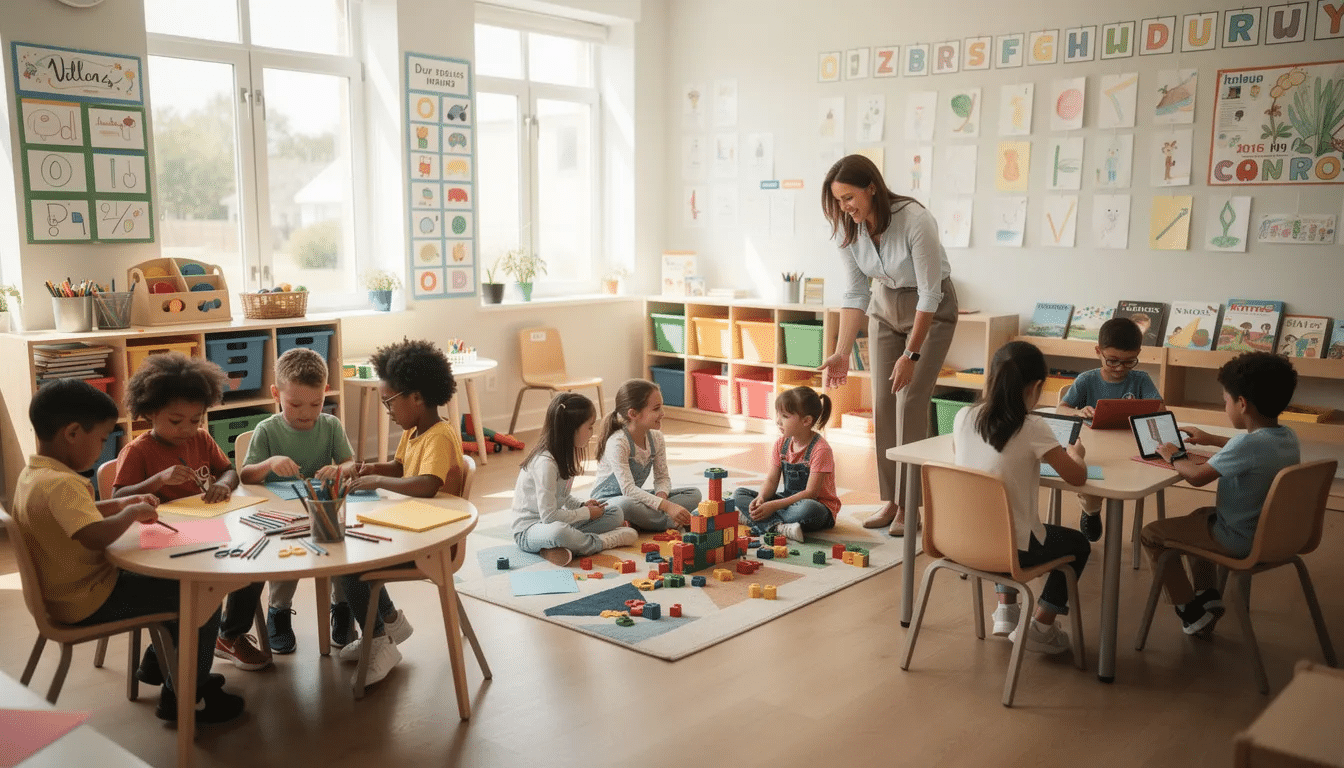
A well-stocked indoor recess system reduces stress throughout the entire school year. Here’s what to gather and how to organize it.
Essential low-cost supplies:
Category | Items |
|---|---|
Movement | Balloons, bean bag, jump rope segments, foam balls |
Games | Dice, picture cards, simple puzzles, memory matching sets |
Art | Crayons, markers, scrap paper, construction paper, glue sticks, child-safe scissors |
Building | Building blocks, interlocking bricks, wooden blocks |
Sensory | Play dough, tissue boxes for building, paper plates |
Grab-and-go organization: Build labeled kits in clear shoeboxes stored on a low shelf, or supplement with ready-made DIY craft kits that come with all the materials prepared: |
- “Balloon Games” – 10 balloons, paper plates, painter’s tape
- “Quiet Games” – dice, picture cards, simple puzzles
- “Art Bin” – crayons, paper, scissors, glue sticks
- “Building Station” – blocks or bricks in a portable container
Family donations: Send a beginning-of-year note asking parents for gently used board games, small toys, or building sets appropriate for a kindergarten classroom. Many families have items their older students have outgrown that work perfectly for indoor recess.
Monthly maintenance: Schedule 5–10 minutes once a month to check supplies. Look for missing puzzle pieces, deflated balloons, dried-out markers, and worn-out materials. Refresh picture cards with current classroom themes to keep games feeling relevant and engaging.
A well-planned indoor recess routine saves teacher energy on stormy days and gives kindergarteners joyful memories along with important motor skills, social skills, and self confidence they carry into the rest of the school year. Start with one or two new activities this week, build your supply bin before the next rainy day arrives, and watch your students thrive—even when outdoor recess isn’t an option.
For more posts on classroom management and teaching strategies, explore activities that match your students’ age group and energy levels. The investment you make in planning indoor recess pays dividends in calmer classrooms, happier children, and smoother school days all year long.
Conclusion
Indoor recess doesn’t have to be a challenge—it’s a chance to spark creativity, movement, and connection in your classroom. With a variety of indoor recess activities, games, and educational ideas, teachers can keep students active, engaged, and learning, no matter the weather outside. By planning ahead and embracing both movement-based and quiet options, you’ll create a positive, inclusive environment where every child can thrive. Remember, indoor recess is more than just a backup plan; it’s an essential part of the school day that supports motor skills, social skills, and self confidence. Try out new ideas, rotate activities, and watch your students grow—one fun, active recess at a time. For more posts and inspiration, keep exploring ways to make every school day joyful and meaningful for your students.