


Looking for ways to spark curiosity and engage your children in meaningful learning? STEM activities for home transform everyday moments into opportunities for discovery. STEM stands for Science, Technology, Engineering, and Mathematics—four interconnected disciplines that shape how we understand and interact with the world around us. With these activities, families can explore STEM together through interactive, hands-on learning.
Family STEM activities can be designed to be engaging and fun for all ages.
In 2024, home learning has become an essential complement to classroom education. Research shows that 70% of parents report STEM activities boost their children’s engagement with learning. The best part? You don’t need expensive kits or specialized equipment. All the activities in this guide use common household items like paper, bottles, pasta, tape, and recycled materials, making them accessible for families with children ages 5 to 12 with appropriate adult supervision. Communities and local groups can also support and enhance STEM learning at home by sharing ideas, hosting events, or partnering to provide additional opportunities.
This article gives you concrete, grab-and-go ideas you can start today. We’ll cover specific projects first, then explain the science behind them so you understand what your kids are actually learning. Many of these activities are designed or recommended by educators to ensure high-quality learning experiences. Each activity takes 15 to 45 minutes—perfect for after school, weekends, or school holidays.
Here’s what you’ll find:
- Chemistry experiments using kitchen supplies
- Engineering challenges with recycled materials, encouraging creative use of available resources
- Physics explorations demonstrating forces and motion
- Math and logic games that feel like play
- Nature-based projects for backyards or balconies

- What Are STEM Activities at Home?
- Setting Up a STEM Space for Kids
- Quick-Start STEM: 10 Activities You Can Do Today
- Simple Science Experiments with Kitchen Supplies
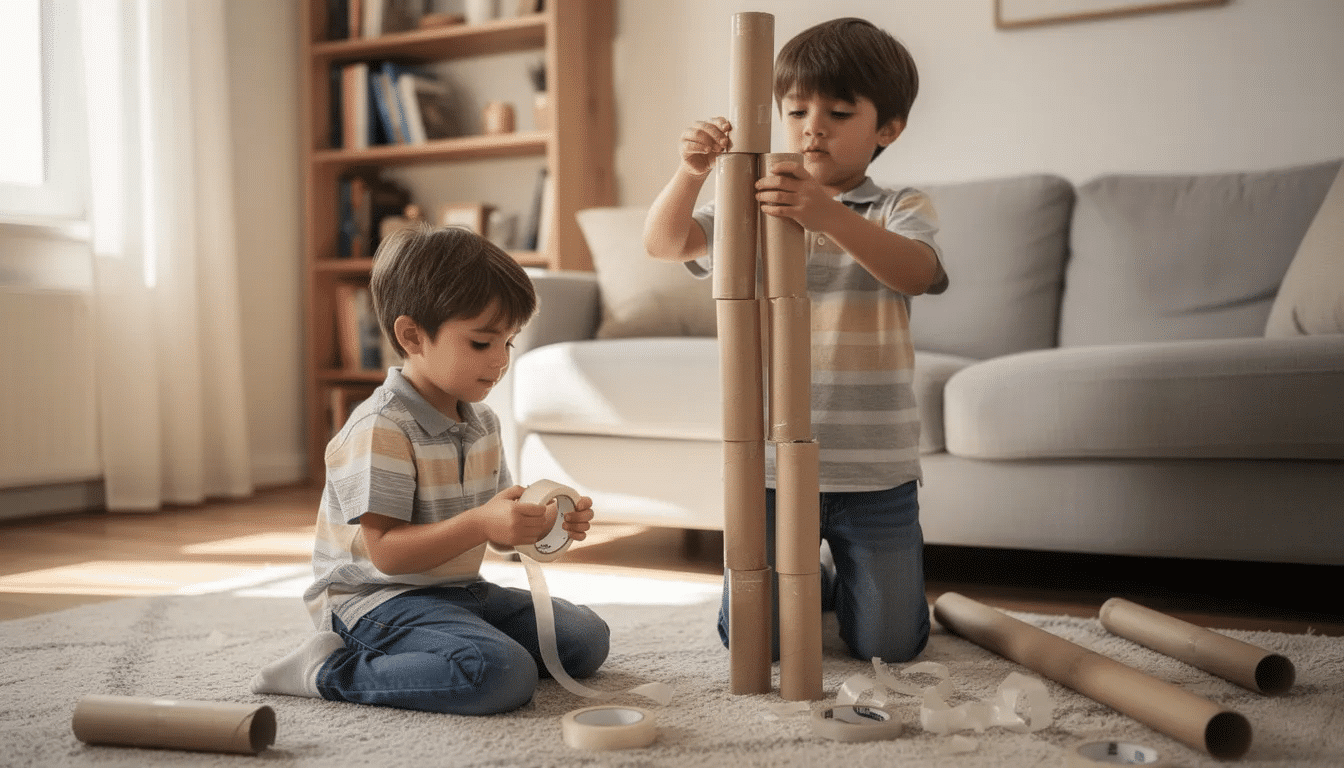
- Engineering Challenges with Recycled Materials
- Math and Logic Games Using Household Items
- Nature and Earth Science Activities in Your Backyard or Balcony
- Keeping STEM Safe, Fun, and Ongoing at Home
What Are STEM Activities at Home?
Home STEM activities are hands on stem projects that let kids explore real science and engineering concepts using items found around the house. Unlike formal classroom experiments with strict procedures and specialized equipment, these projects are flexible, playful, and often rely on recycled materials you’d otherwise throw away.
Strong home activities mix fun elements—slime, rockets, forts—with real principles like forces, chemical reactions, patterns, and problem-solving. When a child builds a pasta tower, they’re not just playing with food; they’re discovering how different structures handle weight and stress, and can determine which designs support the greatest load.
Here are example concepts kids can learn at home:
- Density and layering with a “rainbow in a jar” using liquids of different weights
- Structural engineering by constructing the tallest tower from dry spaghetti and marshmallows
- Simple circuits by creating a coin battery from pennies, zinc washers, and vinegar-soaked paper
- Surface tension by floating a paperclip on water
- Nature Scavenger Hunt: Collecting items from nature to practice classification
The goals of home STEM go beyond memorizing facts:
- Curiosity: Asking “what happens if…?”
- Critical thinking: Analyzing results and adjusting approaches
- Creativity: Finding multiple solutions to open-ended challenges
- Persistence: Learning that failure is part of the process
Setting Up a STEM Space for Kids
Creating a dedicated STEM space at home or in the classroom is a fantastic way to inspire kids to explore, create, and engage with science, technology, engineering, and mathematics every day. You don’t need a fancy lab—just a corner, table, or shelf where hands on STEM projects can come to life.
Start with the basics: Choose a spot that’s easy for kids to access and where a little mess is okay. A kitchen table, a playroom nook, or even a rolling cart can become your STEM headquarters. Stock it with household materials like tape, paper, recycled containers, and simple tools so kids can jump into projects whenever curiosity strikes.
Organization is key: Use bins, baskets, or clear containers to sort supplies by type—think building materials, measuring tools, and creative extras like food coloring or rubber bands. Labeling helps kids find what they need and encourages responsibility for cleanup.
Make it inspiring: Display finished projects, science books, or photos of famous inventors to spark new ideas. Hang up a whiteboard or corkboard for kids to jot down questions, sketch designs, or track their progress on ongoing engineering challenges.
Safety first: Keep sharp tools, hot water, or small parts out of reach for younger children, and set clear rules for using certain materials. Having a dedicated STEM space makes it easier to supervise and ensures everyone can participate safely.
Encourage ongoing exploration: Rotate materials and introduce new challenges regularly to keep kids engaged. Invite them to bring in objects from nature, try different structures, or invent their own experiments. Whether at home or in the classroom, a well-stocked STEM space empowers children to test ideas, solve problems, and discover the excitement of science and engineering in their everyday world.
With a little planning, your STEM space will become the launchpad for creativity, critical thinking, and hands-on learning—helping kids build skills that last a lifetime.
Quick-Start STEM: 10 Activities You Can Do Today
No Prep STEM challenges can be conducted using simple household materials and can be adapted for various age groups and skill levels. These grab-and-go ideas use items most homes already have, and you can also explore ready-made DIY kits for creative projects and educational activities if you prefer all-in-one solutions.
- Balloon-Powered Bottle Car – plastic bottle, skewers, straws, balloon, tape. Test the speed of your car and observe how energy and motion affect its movement.
- DIY Paper Rocket Launcher – printer paper or card, straw, tape, open hallway or backyard
- Rainbow Density Tower – clear glass, honey, dish soap, water, vegetable oil, food coloring, spoon
- Pasta & Marshmallow Tower – dry spaghetti, mini marshmallows, ruler, book for testing
- Magnetic Treasure Hunt – fridge magnets, metal and non-metal items, sorting tray
- Homemade Fog in a Jar – glass jar with lid, hot water, ice cubes, dark backdrop
- Exploding Lunch-Bag Reaction – zip bag, baking soda, vinegar, paper towel, outdoor space
- Egg Osmosis “Naked Egg” – raw eggs, white vinegar, corn syrup, water, clear cups
- Wind-Powered Puff Car – cardboard, drinking straws, bottle caps, tape, reusable straw to blow. Measure the speed of the car and discuss how energy from your breath is converted into motion.
- Unplugged Coding Navigation Game – Use cards or paper to create a simple programming task where family members give each other step-by-step instructions to navigate a room or obstacle course.
- Egg Drop Challenge – Design and build a protective contraption using household materials to prevent a raw egg from breaking when dropped.
- Household Energy Hunt – paper checklist, pencil, access to light switches and appliances
Later sections provide detailed instructions, safety notes, and extension activities for projects like these.
Simple Science Experiments with Kitchen Supplies
Your pantry and fridge hold everything you need for safe, visual science that gets kids thinking about how the world works. Baking soda, vinegar, oil, food coloring, and salt become tools for understanding chemistry and physics.
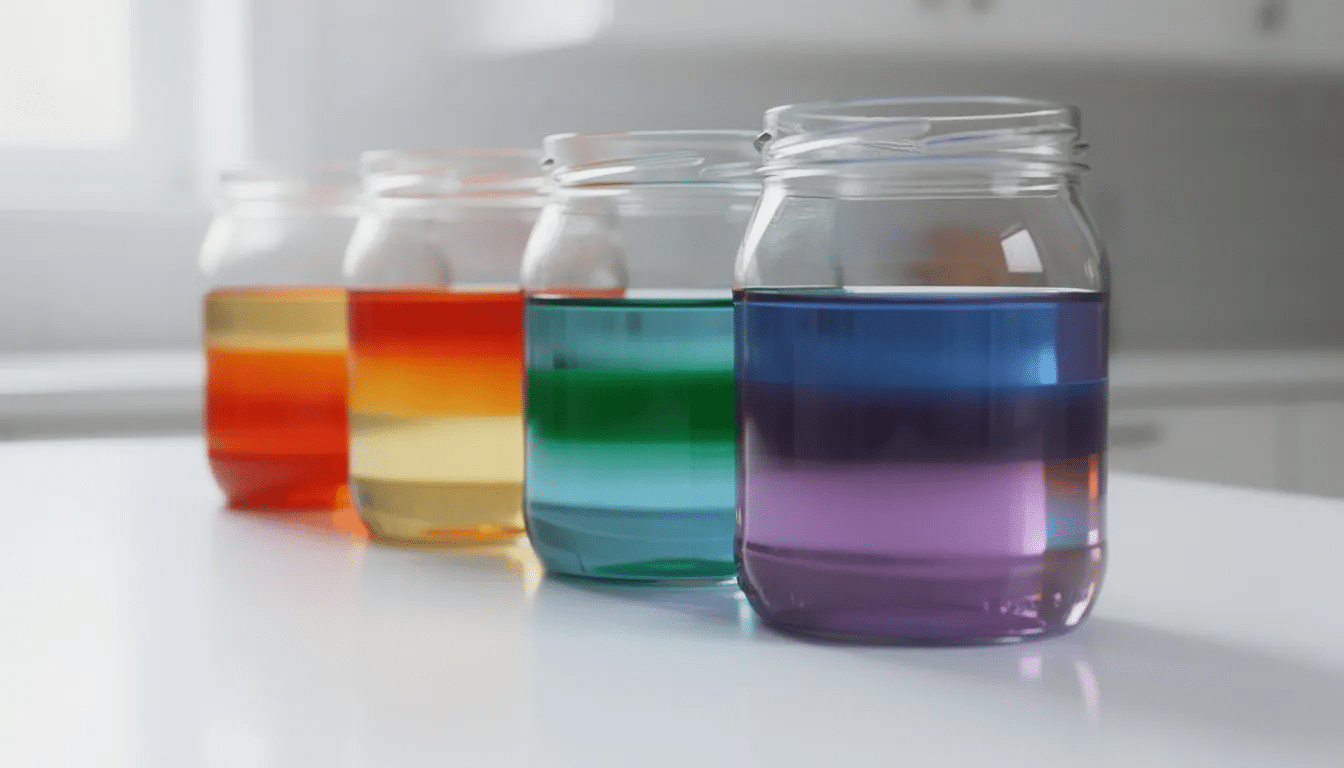
- Color-Changing pH Potion – Boil red cabbage to create an indicator solution, then add vinegar, baking soda, or soapy water to different cups. This activity teaches acids, bases, and how indicators change color based on pH levels. Watch purple liquid turn pink or green depending on what you add.
- Inflating Balloon Reaction – Place baking soda inside a balloon, stretch the balloon over a plastic bottle containing vinegar, and lift. The chemical reaction produces carbon dioxide gas, inflating the balloon without blowing. This demonstrates gas production when acids and bases combine.
- Oil & Water Fireworks in a Jar – Fill a clear glass mostly with water, add vegetable oil, then drop food coloring into the oil layer. Watch colored droplets fall through and create firework patterns as they explore density and immiscible liquids that refuse to mix.
- Salt Crystal Window Ornaments – Dissolve salt in hot water until saturated, suspend a string from a pencil across the jar’s mouth, and wait 24 to 48 hours. Crystallization creates beautiful formations as water evaporates and salt molecules arrange into geometric structures.
- Crystal Growth – Dissolve substances like salt or sugar in hot water to form a saturated solution. As the solution cools and evaporates, crystals form, demonstrating how molecules arrange themselves into solid structures.
- Baking Soda & Vinegar Volcano – Combine baking soda and vinegar in a container to create a foaming eruption. This classic experiment demonstrates gas production through an acid-base reaction.
- Elephant Toothpaste – Mix hydrogen peroxide, dish soap, and yeast to create a dramatic foamy eruption. Adult supervision is required when handling hydrogen peroxide for safety.
- Water Filtration System – Build a simple water filtration system using sand, gravel, and a coffee filter to clean dirty water. This introduces children to environmental engineering concepts and highlights the importance of clean water and water treatment for health and safety.
- Convection in a Cup – Fill a clear cup with cold water, then carefully add a few drops of food coloring to hot water and observe how warmer, less dense water rises while cooler water sinks. This models the same convection currents that drive weather patterns and ocean circulation.
Safety note: Adults should handle hot water, sharp tools, and any stove use. Work on washable surfaces and keep paper towels handy for spills.
Engineering Challenges with Recycled Materials
Building like an engineer means using what you have—cardboard boxes, toilet paper tubes, scrap paper, string, and bottles—to create, test, and improve designs. These challenges teach the engineering design process: define the problem, prototype, test, and refine. Creative use of limited resources encourages kids to think outside the box and make the most of what’s available during engineering challenges.
- Cardboard Marble Run – Use cereal boxes and paper towel tubes to construct a track for marbles. Tape pieces at different angles and observe how gravity pulls marbles down while friction slows them. This iterative design process mirrors how professionals develop products through multiple versions.
- Earthquake-Proof Tower on Jelly – Build a tower from toothpicks and mini marshmallows, then place it on a pan of set gelatin. Shake the pan to simulate seismic activity. Students discover which structures—triangular bracing versus tall and narrow—resist vibration best.
- Bridge from Popsicle Sticks – Construct a bridge using craft sticks and white glue, spanning two books or boxes. Test by adding pennies until it fails. This teaches tension, compression, and how truss designs like Warren or Pratt patterns distribute load. Real-world craft stick bridges can hold 10 to 20 times their own weight.
- Parachute for a Toy Figure – Cut a canopy from a plastic bag or scrap fabric, attach string to corners, and tie to a small toy. Drop from different heights and time the fall. Larger canopies increase air resistance and drag, slowing descent. Experiment with different designs to find what works best.
- Blanket Fort Engineering – Design a structure using sheets, chairs, clips, and string lights. This focuses on spans, support points, and safe indoor construction. Challenge kids to construct a fort that stays up for a full afternoon without collapsing.
- Hand Crank Winch – Build a simple hand crank winch using a spool, string, and a pencil. This activity teaches children about simple machines like pulleys and how they make lifting easier.
- Paper Roller Coaster – Create a roller coaster track from strips of paper and tape. This helps students visualize energy transformation from potential to kinetic as a marble travels along the track.
- Pasta & Marshmallow Tower – Build a tower using pasta and marshmallows. This activity teaches students about structural engineering concepts like tension and compression, and how to balance limited resources for maximum height and stability.
- Wind-Powered Puff Car – Construct a car from a plastic bottle, straws, and bottle caps. Blow through a straw to move the car, making sure to secure the short end of the straw to direct airflow efficiently.
For meaningful testing, measure tower height with a ruler, time parachute drops with a stopwatch, or count coins until a bridge buckles. Recording results helps children see patterns in their data.
Math and Logic Games Using Household Items
Math STEM at home can be active and playful, not confined to worksheets. These activities get children moving while practicing arithmetic, measurement, and logical reasoning through hands-on exploration, much like other engaging group activities for 5 year olds that build social and problem-solving skills.
- Sticky Note Number Hunt – Write numbers on sticky notes and hide them around a room. Kids find pairs that add to a target sum or match multiplication products. This practices arithmetic and number recognition while adding movement and excitement.
- Weight on Other Planets – Use a bathroom scale to find each family member’s Earth weight, then multiply by gravity factors for Mars (0.38), Jupiter (2.34), or the Moon (0.16). This links multiplication practice to space science concepts children find fascinating.
- Pattern Coding with Beads – String beads or cereal pieces following patterns you create or they invent. Introduce “if-then” rules (if red, then two blues follow) to build binary-style thinking and early computer science logic.
- Paper Chain Optimization – Give each child one sheet of paper, scissors, and tape. Challenge them to build the longest possible chain. Measure results and discuss strategies—cutting thinner strips means more links but weaker connections. Try folding or cutting the paper in half first to see how it affects the chain’s length and strength.
- Household Sorting Lab – Gather 20 or more objects and sort by properties like mass, texture, magnetism, or color. Build a simple data table recording each object’s characteristics. This classification work builds statistical reasoning skills used in science and technology.
- Kitchen Math – Practice measuring ingredients and understanding fractions while cooking together. Children can see how halves, quarters, and thirds work in real recipes.
- LEGO Fractions – Use different sizes of LEGO bricks to visually represent and solve fraction problems, making abstract math concepts concrete and hands-on.
Record results using tally marks on paper, simple bar graphs, or comparison charts. Even quick sketches help children see mathematical relationships in their data.
Nature and Earth Science Activities in Your Backyard or Balcony
Even a small balcony or front step can support nature-based STEM. These activities connect children to environmental science, biology, and data collection without requiring acres of green space, and you can extend outdoor learning with creative nature stick crafts that inspire imagination.
- DIY Bird Feeder Design – Transform a plastic bottle or milk carton into a feeder using string and bird seed. Observe which birds visit, when they come, and how they behave. This touches on animal behavior, environmental awareness, and design thinking, and can pair well with owl crafts for kids that connect art and nature.
- Mini Weather Station – Create a jar rain gauge, build a wind vane from a straw and paper, and keep a daily log for a week or more. Teaching data collection over time reveals weather trends and introduces concepts like averages and variability.
- Micro Terrarium in a Jar – Layer soil, small plants, and optionally food scraps in a glass jar with a lid. Observe decomposition and moisture cycling over days. This introduces ecosystems and the life cycle, though hygiene notes apply—wash hands after handling soil.
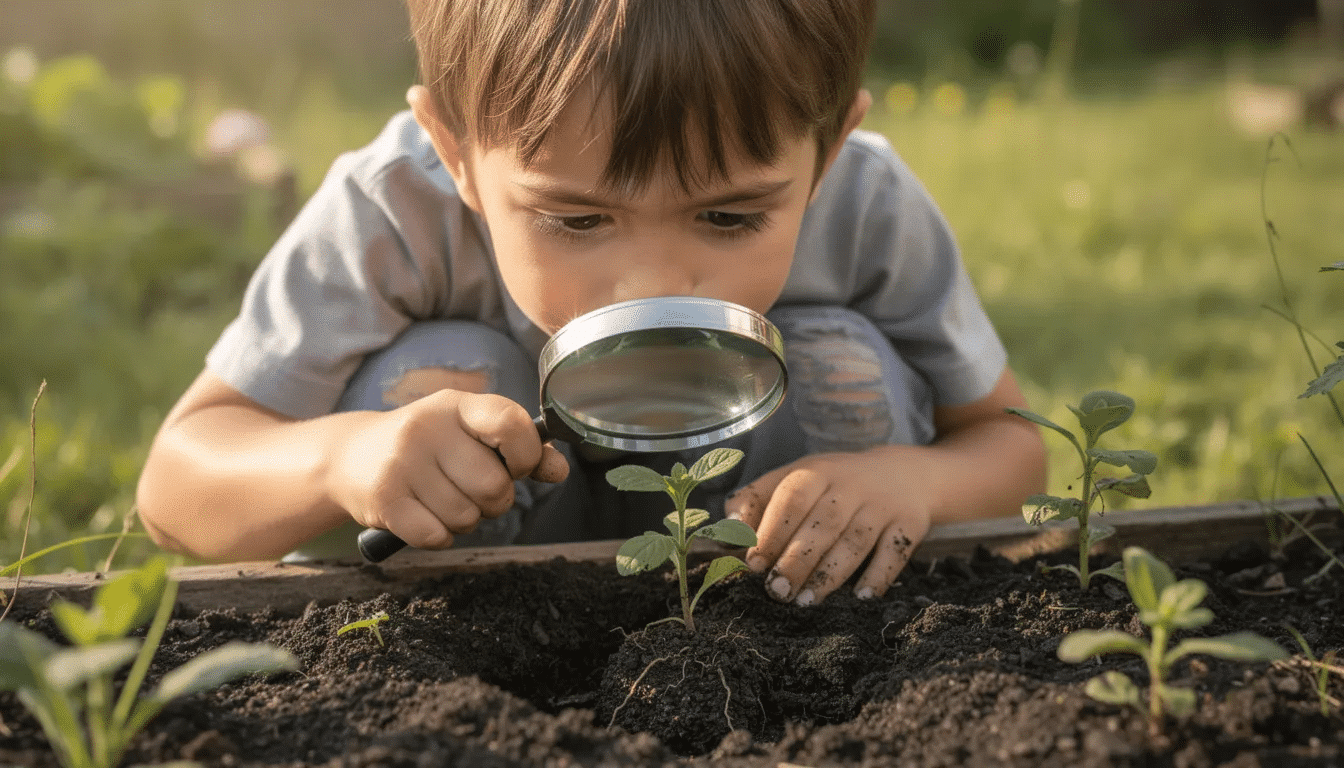
- Soil and Rock Sorting Tray – Collect spoonfuls of soil from different spots and examine with a magnifying glass. Compare texture, moisture, and visible components. When shaken in water, soil separates into layers—sand at the bottom, silt, clay, and organic matter on top—based on particle density.
- Sun Shadow Tracker – Place an upright stick or toy on paper outside. Trace its shadow every hour throughout the day using a pencil. The changing shadow angle demonstrates Earth’s rotation and introduces concepts about how our planet moves through space.
Extension ideas: Sketch nature finds in a journal, photograph progress over several days, or look up local species together online. These additions deepen engagement and build research skills.
Keeping STEM Safe, Fun, and Ongoing at Home
Safety comes first when experimenting at home. Adult supervision is essential when activities involve heat, sharp tools, glass containers, or small parts that pose choking hazards. Work on washable surfaces or head outdoors when things might get messy.
Key guidelines for safe and effective home STEM:
- Set clear rules about not tasting experiments unless specifically food-safe and intended for eating
- Use goggles or old sunglasses for splashy chemistry projects, and aprons or old T-shirts protect clothes
- Have kids participate in cleanup to reinforce responsibility and lab-style habits
- Keep a simple “STEM notebook” dated with sketches, predictions, and results to build scientific thinking over time
- Encourage reflection: ask what surprised them, what they would change next time, and where they see this concept in real life
The real learning happens when families repeat activities with small changes—different materials, adjusted amounts, or alternative designs. Each iteration deepens understanding and builds the kind of persistence that serves children well in school and life.
STEM Activity Planning Tips for Parents and Caregivers
Fitting STEM into busy schedules doesn’t require blocking hours of time. Try 10-minute mini-experiments on weekdays and save longer builds for weekends or school breaks.
Organize a small “STEM bin” with basics that support dozens of projects, and consider setting up a parallel art basket stocked with the best art supplies for young artists to encourage creative exploration alongside science.
Category | Items |
|---|---|
Fasteners | Tape, rubber bands, paper clips, string |
Building | Craft sticks, straws, cardboard scraps |
Tools | Scissors, ruler, markers, pencils |
Supplies | Balloons, food coloring, baking soda |
Mix open-ended challenges (design your own bridge) with guided experiments (follow these exact steps once) to balance creativity with structure. Both approaches build different skills children need, especially when paired with art activities that enhance fine motor skills. |
Involve siblings of different ages by assigning roles that match their abilities; collaborative builds like a cardboard time machine for imaginative play can give everyone a job to do:
- Materials manager (gathering supplies)
- Timer (using a phone or stopwatch)
- Recorder (writing or drawing observations)
- Builder (hands-on construction) who might take the lead on projects like a DIY cardboard sword craft
- Tester (running experiments and measuring)
Start with one activity this weekend. Grab a few household items, set aside 30 minutes, and discover how much learning happens when kids get their hands involved.
The goal isn’t perfection—it’s participation. When children engage with stem activities at home, they develop skills that serve them across every subject and throughout life, whether they’re exploring space-themed crafts and activities or diving into festive holiday craft projects. Create that STEM bin, pick your first experiment, and let curiosity lead the way.