The preschool years, roughly ages 3 to 5, represent a critical window for building foundational science skills. These early years are especially important for developing core science and inquiry skills that set the stage for future learning. During this stage of early childhood, young children are naturally wired to explore, question, and experiment with everything around them. A puddle after rain becomes a laboratory. A pile of leaves transforms into a sorting station. An ice cube in July sparks wonder about why things change.
Here’s the key insight that shapes effective preschool science: science skills are about how children think and explore rather than memorizing facts or vocabulary. When a four-year-old watches an egg sink to the bottom of a clear container of water, she’s practicing observation. When she wonders aloud whether adding salt will change what happens, she’s predicting. These process skills—not rote definitions—form the foundation for lifelong learning.
Children learn best through hands-on experiences, which makes science education in early childhood particularly effective.
These skills show up in concrete, everyday moments: sink-or-float tubs at the water table, magnet play with various objects from around the classroom, observing worms after a spring rain, or watching an ice cube melt in winter sunlight. This article will walk educators and families through the core preschool science process skills, practical activities that build them, and tips for safe, simple implementation that works in any setting.
- Introduction to Preschool Science
- The 7 Core Preschool Science Skills
- Early Learning Standards
- Why Science Skills Matter in Early Childhood
- Designing Everyday Science Experiences for Preschoolers
- Practical Science Activities that Build Core Skills
- Creating a Preschool Science Area or Interest Center
- Supporting Safety, Inclusion, and Family Engagement
Introduction to Preschool Science
Preschool science is a vital foundation for a child’s lifelong journey of discovery. At this early stage, young children are naturally curious about the world around them, and preschool science activities are designed to nurture that curiosity while building essential science concepts. Through hands-on science activities, children develop observation skills, inquiry skills, and scientific thinking—abilities that help them make sense of everyday phenomena.
Introducing kids to basic science concepts doesn’t require a laboratory or expensive equipment. Simple experiments using food coloring, baking soda, and dish soap can transform ordinary moments into exciting science lessons. For example, mixing colors in water or watching baking soda react with vinegar sparks wonder and encourages children to ask questions, make predictions, and draw their own conclusions. These experiences help children understand physical science, life cycles, and other scientific concepts in a fun way that inspires curiosity and critical thinking.
By weaving science into daily routines and play, teachers and families can help children build a strong foundation for future learning. Preschool science is not just about facts—it’s about fostering a love for exploration, encouraging children to observe closely, and empowering them to become confident problem solvers. With the right approach, science becomes an adventure that every child can enjoy.
The 7 Core Preschool Science Skills
Most early learning standards and child development frameworks highlight seven core science process skills that preschoolers can begin developing: observing, comparing, classifying, measuring, communicating, inferring, and predicting. These aren’t advanced scientific concepts reserved for older students—they’re the building blocks of scientific thinking that even three-year-olds can practice daily. Collectively, these are known as preschool science concepts and form the foundation for future learning in science by fostering inquiry skills from an early age.
Children typically develop these inquiry skills gradually between ages 3 and 6, often well before kindergarten entry in August or September of their school district. The progression isn’t linear; a child might excel at observing details while still building comparison skills. That’s completely normal. Preschoolers learn best through hands-on experiences that require minimal explanation from adults.
Each skill below is defined in simple language with concrete preschool examples drawn from real-life activities—water tables, nature walks, block play, and everyday routines. Real scientists use these same skills; preschoolers are simply practicing them at a developmentally appropriate level.
Observing
Observing means using the five senses—seeing, hearing, smelling, tasting, and touching—to notice details about objects and events. It’s the most fundamental of all science skills because everything else builds on what children notice first.
Specific examples bring this to life:
- Watching a caterpillar crawl slowly across a leaf in May
- Feeling the difference between warm water and cold water at the sensory table
- Listening for different bird calls during a playground walk
- Noticing how playdough smells different from modeling clay
Teacher prompts strengthen observation skills without giving away answers. Try asking “What do you notice?” or “What looks different from yesterday?” instead of pointing out what children should see. These open-ended questions encourage children to make their own discoveries.
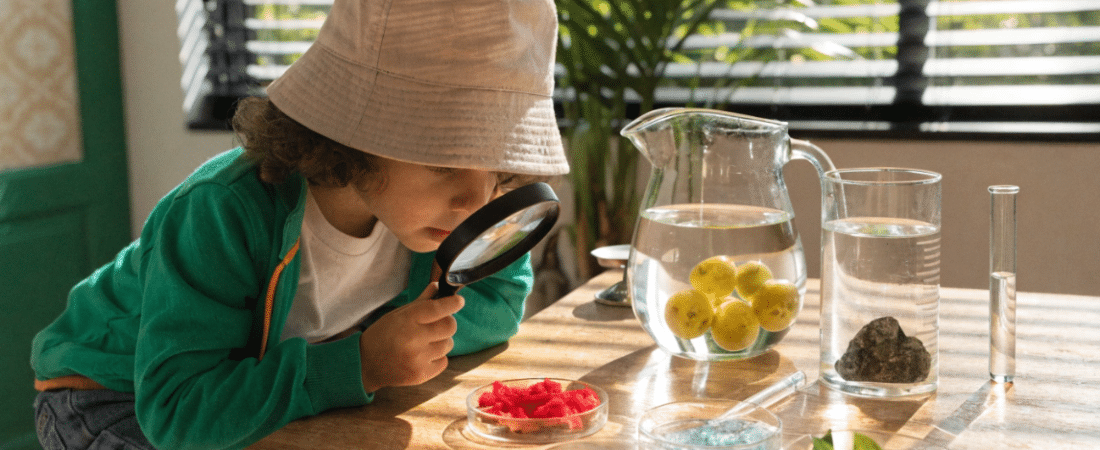
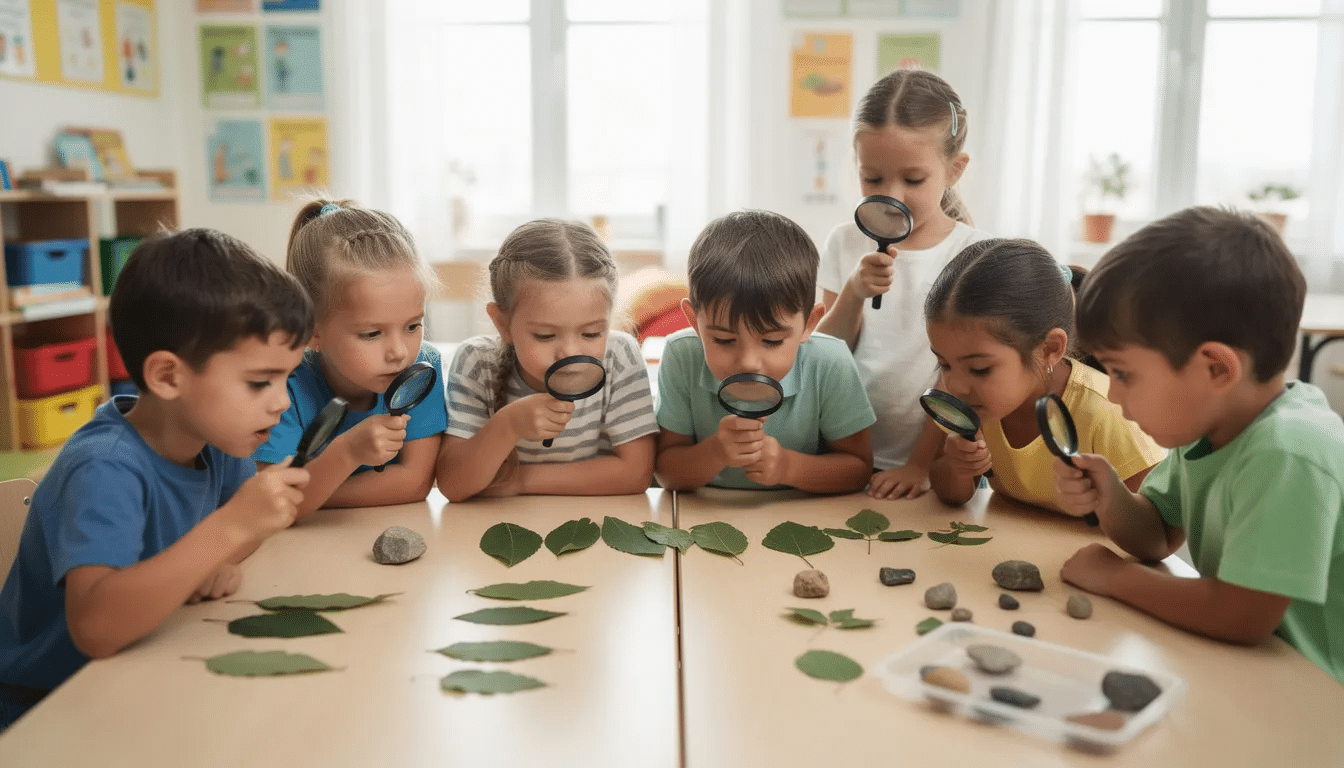
Set up “look closely” stations with magnifying glasses and science tools like mirrors to encourage careful observation. Photos and simple charts can help children revisit and compare their observations over time.
Comparing
Comparing involves looking for similarities and differences in size, color, shape, weight, texture, or behavior. Once children observe, comparing helps them organize what they’ve noticed into meaningful patterns.
Concrete comparisons work best for preschoolers:
- Heavy versus light rocks in a science tray
- Wet sand versus dry sand at the sensory table in June
- Tall versus short plants in a classroom garden
- Loud sounds versus soft sounds during a listening walk
Use real language that children can adopt themselves: bigger, smaller, longer, shorter, louder, softer, rougher, smoother, heavier, lighter. Quick questions like “Which leaf is larger?” or “Which block rolls farther?” give preschoolers immediate practice with comparing.
Classifying
Classifying means sorting and grouping objects based on shared attributes—color, shape, use, where they’re found, or whether something is living versus non-living. This skill connects directly to early math concepts and helps children understand basic science concepts about how the world is organized.
Give children real materials to sort:
- Shells collected from a summer beach trip
- Buttons grouped by number of holes, color, or size
- Pictures of animals separated by where they live (land, water, air)
- Classroom objects sorted by what they’re made of (wood, plastic, metal)
Children usually start by sorting on one visible feature like color. Over time, they progress to more abstract concepts—things that can roll, things we eat, things that are alive. Let children create their own categories first, then ask them to explain how they decided to group items. This builds both critical thinking and communicating skills simultaneously.
Measuring
Measuring answers questions about “how much,” “how long,” “how hot,” or “how many” using both informal methods and simple tools. Preschoolers aren’t ready for precise measurement, but they can absolutely explore measuring concepts through hands on activities.
Practical measuring activities include:
- Using unifix cubes to measure the length of a toy car
- Counting how many cups of water fill a bucket
- Comparing which ramp makes a ball roll farther using tape marks on the floor
- Using tape measures to see who can stretch their arms wider
Concrete tools suitable for preschool include non-breakable rulers, balance scales, measuring cups, sand timers, and simple thermometers under adult supervision. Model measurement language consistently: more, less, equal, heavier, lighter, full, empty, longer, shorter.
Communicating
Communicating means sharing ideas, observations, and results through talking, drawing pictures, acting out discoveries, or early writing. Science learning becomes more powerful when children articulate what they’ve experienced.
Examples of science communication in preschool:
- Children drawing what happened when they mixed red and yellow paint
- Explaining why they think a pumpkin will float before testing
- Dictating captions for photos of an experiment
- Acting out how a caterpillar moves versus how a worm moves
Create science discussion routines, like brief “what we discovered today” circles after simple experiments. Simple science journals with dates work well—“March 3: Our bean seed sprouted”—with picture labels to build early literacy and preschool science together.
Inferring
Inferring uses clues and previous experiences to explain why something happened. It’s a best explanation based on evidence, not a random guess. This skill requires more abstract thinking and develops later than observing or comparing for most preschoolers.
Age-appropriate inferring examples:
- Noticing puddles are gone by afternoon and inferring that the sun dried them
- Seeing a torn leaf and inferring that a bug or animal may have eaten it
- Finding muddy footprints and inferring someone walked through the wet grass
Adult prompts push inferring forward: “What do you think happened?” and “What makes you think that?” help children connect evidence with their ideas. Keep preschool inferences simple and concrete—always connected to what children can see, hear, or remember from direct experience.
Predicting
Predicting means saying what you think will happen next based on patterns and previous experiences. Unlike guessing, predicting involves reasoning from what’s already known.
Clear predicting examples:
- Predicting which object will sink or float before placing it in water
- Guessing how many drops of water will fit on a penny before it overflows
- Wondering if a snowball brought inside in January will melt faster on a plate or in a cup
- Predicting what color will appear when mixing blue and yellow food coloring
Treat “wrong” predictions as normal and valuable. Changing your mind after seeing results is exactly what real scientists do. This builds a positive attitude toward experimentation.
Record predictions with simple charts using children’s names, tally marks, or stickers. After the activity, compare predictions to actual results. This makes the scientific method visible and concrete.
Early Learning Standards
Early learning standards are essential tools that guide teachers in creating meaningful and effective preschool science experiences. These standards outline what young children should know and be able to do, ensuring that science activities are developmentally appropriate and support critical thinking. By following early learning standards, teachers can design lesson plans that include hands-on activities, encourage inquiry, and promote a deep understanding of science concepts.
In preschool science, early learning standards emphasize the importance of exploration and discovery. They encourage teachers to provide opportunities for children to experiment, ask questions, and investigate the world using their senses. This approach not only supports science learning but also helps children develop problem-solving skills, creativity, and confidence.
Aligning science lessons with early learning standards allows teachers to track children’s progress, identify strengths and areas for growth, and adapt their teaching to meet the needs of every child. It also ensures that all children, regardless of background or ability, have access to high-quality science education. By integrating early learning standards into preschool science, educators create a supportive environment where curiosity is celebrated, and every child is encouraged to become an enthusiastic explorer of the world.
Why Science Skills Matter in Early Childhood
Early science skills do far more than prepare children for elementary school science class. These skills support language development, mathematical thinking, problem solving, and social-emotional growth all at once. Through active, hands-on experiences, kids learn scientific concepts by observing, experimenting, and exploring the world around them.
The connections to math are particularly strong:
Science Skill | Related Math Concepts |
|---|---|
Observing | Noticing attributes and patterns |
Comparing | Greater than, less than, equal |
Classifying | Sorting, grouping, categorizing |
Measuring | Counting, quantity, estimation |
Predicting | Pattern recognition, sequencing |
Explaining ideas and listening to peers during science time builds vocabulary, turn-taking, and conversation skills. A child who describes why she thinks a rock will sink is practicing persuasive reasoning. A child who listens to a peer’s different prediction is learning perspective-taking. |
Research since the 2010s consistently shows that rich, play-based preschool science predicts stronger reasoning skills in later grades. When young children learn through inquiry-based activities, they develop increased curiosity, confidence in asking questions, and readiness for STEM learning. These benefits extend well beyond science class—scientific thinking supports reading comprehension, mathematical problem solving, and even social reasoning.
Preschool science curricula should encourage parental involvement through take-home activities and resources to foster a collaborative learning environment.
Designing Everyday Science Experiences for Preschoolers
Classrooms and homes don’t need a laboratory to offer meaningful science experiences. Everyday materials and daily routines provide rich opportunities for young children to practice science skills. The goal isn’t spectacular demonstrations—it’s consistent, playful exploration that helps children understand the world around them. One effective way to introduce kids to science concepts is through engaging, hands-on activities that encourage observation, prediction, and curiosity.
Daily opportunities exist everywhere:
- Observing weather at morning circle time
- Comparing snack foods by texture, color, or taste
- Testing which classroom objects roll versus slide
- Noticing what happens to ice in a lunchbox versus on a sunny windowsill
- Watching shadows change position throughout the day
When using small materials like magnets or household ingredients, supervision is necessary to ensure young children’s safety.
Create a predictable rhythm rather than treating science as a special event. Brief science explorations two or three times a week, plus ongoing access to a small science center, work better than occasional “big” science lessons. Children learn best through repeated, varied experiences with the same concepts. Watching ice melt once is interesting; observing melting in different conditions over weeks builds real understanding.
Practical Science Activities that Build Core Skills
The following activity types require minimal preparation and directly practice core science skills. Each uses common materials—cups, food coloring, cardboard, dish soap, baking soda, recycled containers—that most classrooms and homes already have. These activities include hands on experiments that introduce preschoolers to fundamental scientific concepts like observation, prediction, and cause-and-effect.
For example, cooking experiments can observe how ingredients change when heated or cooled, such as making ice cream in a bag. DIY Slime is made by mixing cornstarch and water to create a substance that acts as both a solid and liquid.
These aren’t step-by-step “recipe” instructions. Instead, they’re high-level directions designed to inspire curiosity and encourage inquiry rather than just producing a “wow” moment that children watch passively, and they fit naturally alongside other creative kindergarten class ideas for engaging learning experiences.
Water, Ice, and Weather Play
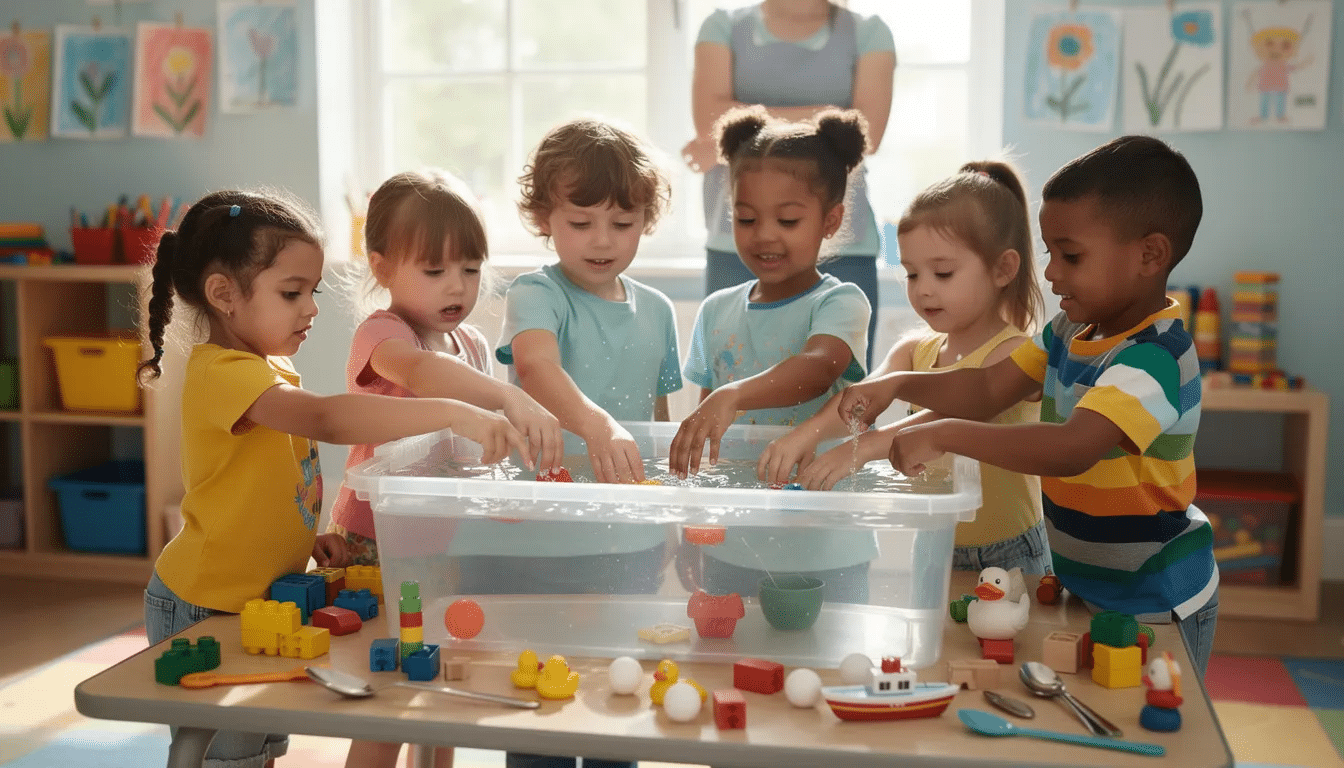
Water tables offer endless possibilities for building observation skills and testing predictions. Set up a simple sink-or-float investigation with spoons, plastic animals, corks, small stones, foil balls, and wooden blocks.
Sink-or-float investigations build multiple skills:
- Predicting: Before placing each object, ask “Will this sink or float?”
- Observing: Watch closely—does it sink fast or slowly?
- Comparing: Which objects behaved similarly?
- Classifying: Sort tested objects into “sinkers” and “floaters”
Ice melting activities extend water play into physical science. Freeze small toys inside ice cubes and time how long they take to melt in different locations (sun versus shade) or different materials (tray versus bowl versus towel). Children can experiment with different methods—adding warm water, using their breath, or placing ice near a heater—to learn about heat transfer through direct experience.
Daily weather charts turn routine into science learning. Use simple symbols for sunny, rainy, cloudy, snowy, and windy. Over a month, children can observe patterns: “It rained three times this week” or “We haven’t seen snow since February.” This builds data collection and pattern recognition skills. Try a rain cloud experiment, such as making a rain cloud in a jar, to show how clouds become heavy with moisture and lead to precipitation.
For more hands-on water play, combining baking soda, vinegar, and dish soap in a container lets children observe a chemical reaction that creates foaming ‘lava’.
Nature Walks and Living Things
Regular short nature walks—even just around a school yard or neighborhood—provide rich opportunities to observe the life cycle of plants and animals. No elaborate field trip required.
Nature walk activities:
- Collecting leaves to sort by shape, size, or color
- Comparing tree bark textures by making rubbings
- Noticing which plants grow in sun versus shade
- Looking for evidence of animals (tracks, holes, chewed leaves)
- Observing seasonal changes in the same location over months
Starting a small class garden or seed-growing project creates ongoing science learning. Plant seeds in clear containers so children can watch roots develop. Measure plant height weekly with unifix cubes or paper strips. Draw changes in simple science journals. These hands on experiences build observing, classifying, and inferring skills while teaching kids about growth and living things.
Ramps, Balls, and Motion
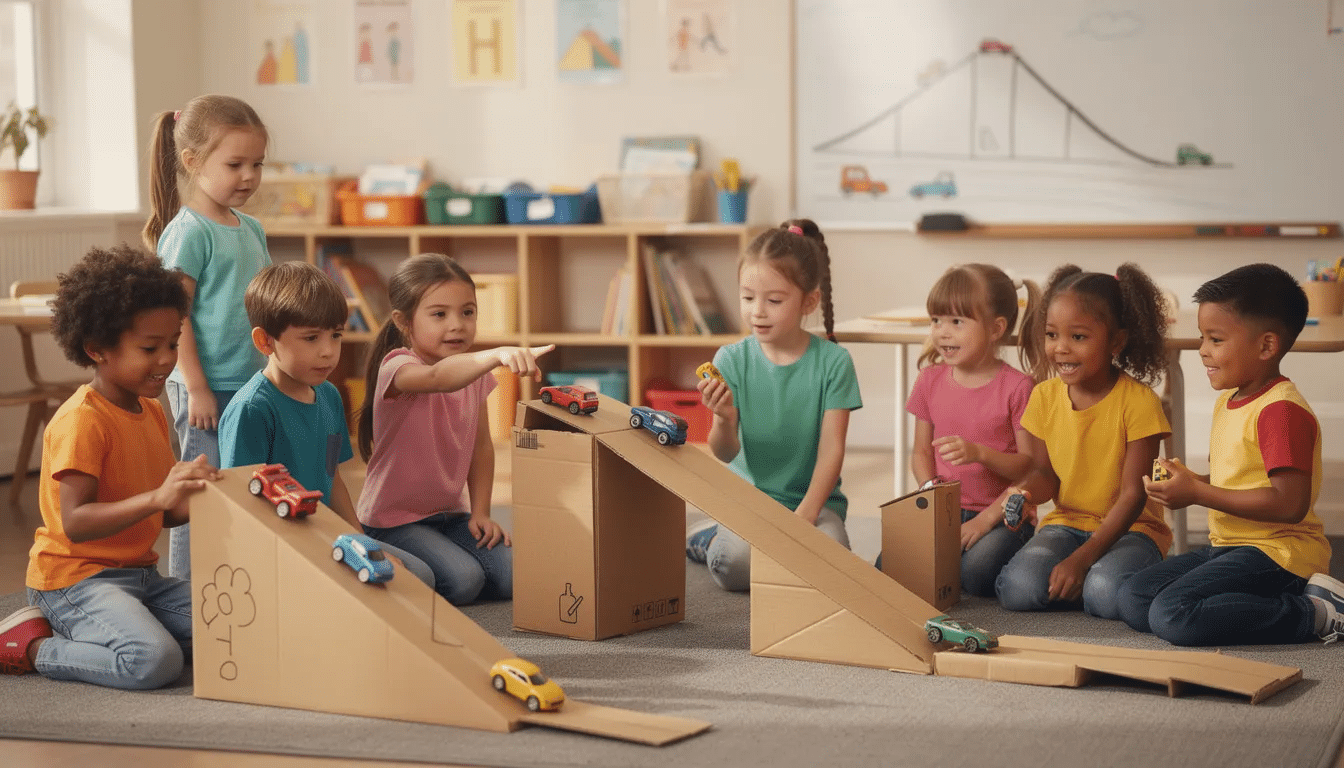
Ramp building introduces physical science concepts through direct manipulation. Use cardboard, wooden boards, or sturdy binders propped on blocks to create ramps of different heights and angles.
Key investigations with ramps:
- Testing which ramp (steep versus gentle) makes objects roll farther
- Comparing different materials on similar surfaces
- Measuring distances with blocks, tape marks, or footsteps
- Testing rough surfaces versus smooth surfaces
Ask questions that push thinking: “Which ball is faster?” “Does a rough ramp or smooth ramp change how the car moves?” “What happens if we make the ramp even steeper?”
Children can record results by marking where objects stopped with tape or small stickers. This connects motion exploration with measuring and communicating—and makes the scientific method tangible.
Magnets, Materials, and Properties of Matter
Magnet exploration fascinates preschoolers and builds classification skills naturally. Provide safe bar or horseshoe magnets with a tray of mixed items: paper clips, craft sticks, fabric scraps, plastic bottle caps, coins, aluminum foil, and rubber bands.
Have children:
- Predict which items the magnet will attract
- Test each item systematically
- Classify items into “magnetic” and “not magnetic” groups
- Infer what types of materials are attracted to magnets
Extend property exploration beyond magnets:
- Comparing playdough versus clay (Which is squishier? Which holds its shape?)
- Testing absorbent versus non-absorbent materials with water droppers
- Examining rough and smooth rocks with magnifying glasses
- Sorting different materials by texture, flexibility, or transparency
These fun activities build hands on experiences with material properties while reinforcing classification and observation.
Light, Shadow, and Color
Light exploration works in any space that can be partially darkened. Use flashlights to create shadows of hands, toys, and cutout shapes. Encourage children to predict how shadows change when the light source moves closer, farther, or to the side.
Color-mixing investigations are both fun science activities and art experiences that pair well with thoughtfully chosen art supplies for young artists. Fill clear cups with water and add primary-color food coloring. Let children predict what color will appear when they combine two colors, then test their predictions with droppers.
Simple vocabulary makes abstract concepts accessible:
- “Light goes through” (transparent materials)
- “Light kind of goes through” (translucent materials)
- “Light stops here” (opaque materials)
Test different objects against a light source and sort them by how they interact with light. Surface tension experiments with dish soap and water add another layer of exploration for children ready for more complexity, just as open-ended preschool 3D art projects add depth to creative, hands-on learning.
Creating a Preschool Science Area or Interest Center
Even a small shelf or tabletop can serve as a dedicated science center available daily for child-led exploration. The science area shouldn’t be a “look but don’t touch” display—it should invite active investigation.
Essential materials for a preschool science center can sit alongside engaging art fine motor skills activities so children move naturally between creative and scientific exploration:
Category | Items |
|---|---|
Observation tools | Magnifying glasses, child-safe mirrors, color paddles |
Measurement tools | Balance scales, measuring cups, tape measures |
Natural objects | Pinecones, rocks, shells, feathers, seed pods |
Recording materials | Clipboards, paper, crayons, simple picture cards |
Specialty items | Magnets, prisms, timers (rotate seasonally) |
Rotate themes monthly or seasonally to maintain interest, and consider incorporating themed DIY kits for creative projects and fun learning that match children’s current science investigations: |
- October: Leaves, seeds, and pumpkin exploration
- January: Magnets and winter materials
- April: Insects, soil, and growing things
- June: Water and beach materials
The science area should use simple picture labels and word cards to connect science learning with literacy. Teachers should model how to use science tools safely and encourage children to record or draw their discoveries—even if the writing is mostly symbolic scribbles at first.
Supporting Safety, Inclusion, and Family Engagement
Preschool science must be safe, inclusive, and connected to children’s home lives and cultures. Without these foundations, even the best activities fall short.
Basic safety practices:
- Constant adult supervision during all science activities
- Use of non-toxic materials and food coloring labeled safe for children
- Clear rules for tools like scissors, droppers, and magnifying glasses
- Child-sized goggles or aprons for messy work
- Regular checks that small objects don’t pose choking hazards
Inclusive practices matter:
- Offer materials that reflect diverse environments (urban, rural, coastal, mountain)
- Adapt tasks for different abilities—some children may need larger materials or verbal rather than written recording
- Validate every child’s ideas and questions, even unconventional ones
- Ensure all children have equal access to exploration time and materials
- Respect that children’s previous experiences shape their understanding
Family engagement strengthens science learning:
- Send home easy experiment ideas like observing moon phases for a week or testing which materials keep an ice cube from melting
- Invite family members to share nature objects from their own environments
- Include science notes in newsletters describing what children are exploring and how families can extend learning at home
- Ask families about their child’s questions and interests to inform classroom investigations
When pre k teachers connect classroom science with home experiences, children understand that scientific concepts aren’t limited to school—they’re part of everyday life.
Consistent, playful practice with these seven science skills helps preschoolers see themselves as capable young scientists. They don’t need expensive equipment or elaborate lesson plans. They need adults who honor their natural curiosity, provide simple experiments with real materials, and ask questions that push thinking forward.
Start small this week. Set out a few objects for a sink-or-float test. Take a five-minute nature walk. Ask “What do you notice?” and wait for answers. Watch how children respond when their ideas are taken seriously—when they’re treated not as students understand science but as real scientists making their own discoveries.
That’s where lifelong learning begins.