

Tired of watching students zone out during revision sessions? Fun studying games combine the best of learning and play—turning worksheets into challenges, facts into competition, and homework into something students actually look forward to. Millions of students and teachers worldwide use fun studying games, highlighting their popularity and effectiveness. This guide walks you through specific game types, real examples, and step-by-step ways to use them today.
Whether you’re a teacher planning classroom activities, a parent supporting homework time at home, or a student looking for better study methods, this article covers practical ideas that work. We’ll explore quiz games, puzzles, board games, apps, and even how to create your own games from existing content. Many platforms offer free options, making it easy for anyone to get started.
Fun studying games are especially powerful during exam seasons—think May–June finals and November–December assessments—when students need to retain large amounts of information quickly. The focus here is on actionable strategies you can start using this week, not abstract theory.
- Why Fun Games Make Studying More Effective
- Types of Fun Studying Games Students Love
- Learning Games for Different Ages
- Digital Fun Studying Games for the Classroom and Home
- Offline Fun Study Games: Board, Card, and Paper Activities
- Designing Your Own Fun Studying Games
- Tips for Using Fun Studying Games Effectively
- Key Takeaways
- Start Playing This Week
Why Fun Games Make Studying More Effective
Gamification transforms revision from something students dread into something they engage with willingly. When studying feels like play, learners show up with energy instead of resistance.
Here’s what makes learning games so powerful:
Points, levels, badges, and leaderboards turn revision into a challenge. Instead of passively reading notes, students actively compete—against themselves, their friends, or the clock. Research shows this kind of engagement boosts motivation significantly, with studies reporting effect sizes of 0.44 for engagement and 0.40 for motivation compared to traditional methods.
Rapid repetition strengthens memory retention. Answering 20–30 questions in 10 minutes forces the brain to retrieve information repeatedly. This active recall is far more effective than simply re-reading content. Meta-analyses confirm that game-based learning produces moderate-to-large effects on cognitive development (g=0.46), meaning students who play educational games outperform peers using traditional study methods.
Games reduce test anxiety. When students “rehearse” exam-style questions in a low-pressure environment, they build confidence. The stakes feel lower during a game, but the skills transfer directly to real exams.
A weekly vocabulary game night where students compete in teams for small rewards—stickers, extra break time, or picking the next activity—can transform how your class approaches revision.
Types of Fun Studying Games Students Love
Different subjects benefit from different game formats. A history timeline game works differently than a math drill, and a science vocabulary puzzle serves a different purpose than a geography simulation. There is a wide variety of fun studying games available, offering multiple formats and options to suit different learning needs and preferences, especially when paired with innovative creative ideas for classroom engagement. Here’s a breakdown of popular study game categories:
Fast-Paced Quiz Games
These games feature multiple-choice or true/false questions under time pressure. Players race to answer correctly before opponents or the clock runs out.
Often, these games require players to take turns answering questions or competing, adding a dynamic and interactive element to the gameplay.
Best for: History dates, science facts, grammar rules, language vocabulary, and numeracy drills.
Puzzle-Based Games
Crosswords, word searches, logic puzzles, and pattern games build skills through problem-solving rather than direct recall.
Best for: Vocabulary building, spelling practice, math problem-solving, and critical thinking.
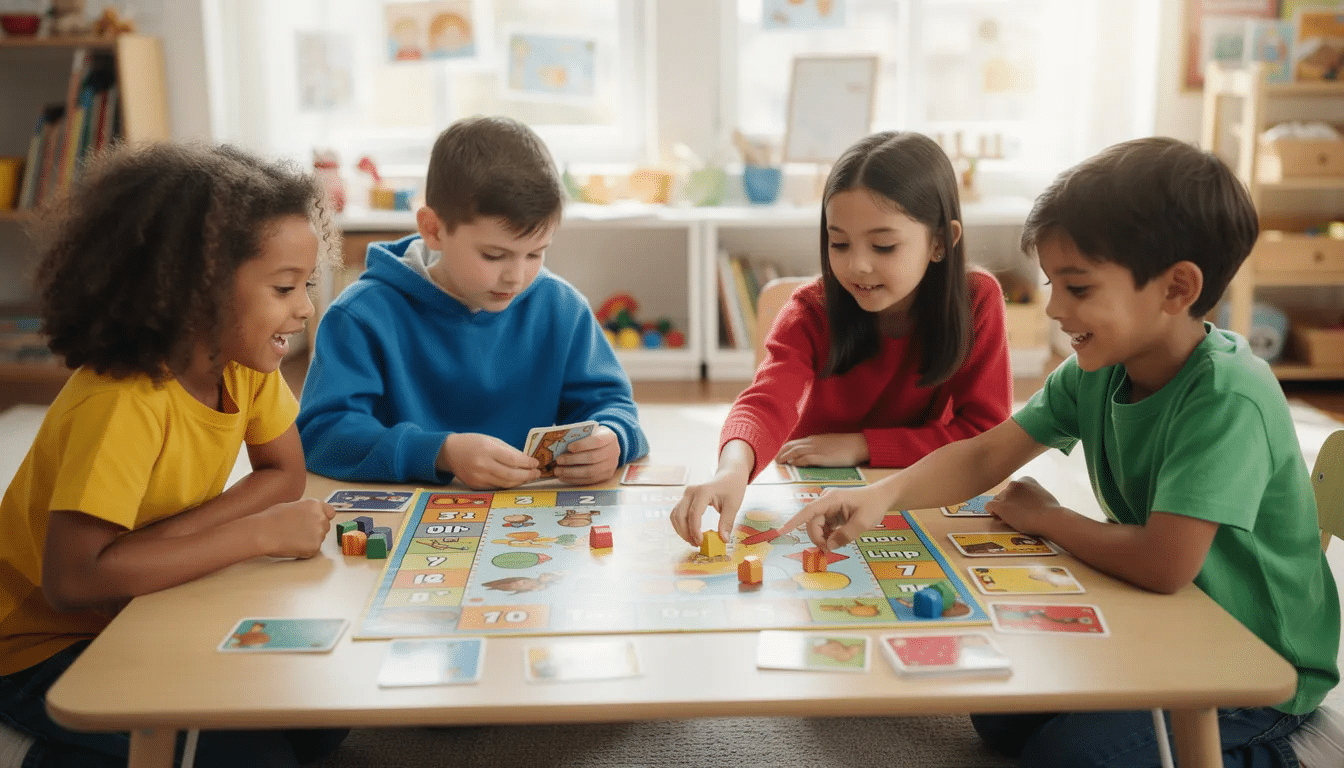
Strategy and Board-Style Games
These involve planning, resource management, or negotiation. Students make decisions that have consequences, learning through experience.
Educational board games provide opportunities for children to learn specific academic content and develop executive functioning skills.
Best for: Math concepts, economics, geography, and life skills like money management.
Example: A world map board game where players must correctly identify countries or capitals to advance, or a card game matching chemical symbols with element names.
Playing educational board games can enhance memory retention through interactive and repetitive practice.
Educational board games can inspire creative problem-solving and encourage students to think outside the box.
Some award-winning educational board games and books promote language development and creativity through play.
Simulation and Role-Play Games
Students act as scientists, historians, business owners, or explorers. They learn complex systems through interactive storytelling and decision-making.
Best for: Understanding historical events, scientific processes, economics, and community dynamics.
Learning Games for Different Ages
Learning games are a fantastic way to make learning fun and meaningful for students at every stage—from group activities for 5 year olds to high schoolers preparing for big exams, and even for families looking to build skills together at home. By turning lessons into interactive activities, teachers and educators can create a classroom or home environment where students are excited to participate, eager to build new skills, and motivated to reach their goals.
For elementary school students, learning games are designed to introduce foundational concepts in math, language, and science in a way that feels like play. Math games help children develop numeracy skills, while language games boost reading and writing abilities. These activities are easy to set up, require minimal prep, and can be played in class or at home—making learning accessible and enjoyable for everyone.
As students move into middle school, learning games become a powerful tool for reinforcing more complex ideas and encouraging teamwork. Interactive history games, science challenges, and math competitions help students deepen their understanding while building important life skills like communication, collaboration, and problem-solving. Teachers can use these games to create a sense of community in the classroom, where every student feels supported and engaged.
High school students benefit from learning games that provide instant feedback and help them master challenging content. Whether it’s preparing for exams, practicing advanced math, or reviewing key historical events, these games allow students to track their progress, identify areas for improvement, and work at their own pace. Digital platforms, such as Google Classroom, make it easy for educators to assign games, monitor results, and offer targeted feedback—helping every learner achieve their best.
Families can also join in the fun with games designed for all ages. Board games, card games, and trivia nights turn study time into a shared experience, building relationships and fostering a love of learning that extends beyond the classroom. Hands-on projects like creative preschool crafts about family are another great way to support children’s education at home while making memories together.
Digital Fun Studying Games for the Classroom and Home
Digital games are easy to access on laptops, tablets, and phones—making them ideal for hybrid learning, homework assignments, and quick classroom activities. Many platforms integrate with tools like Google Classroom, allowing teachers to assign games directly within their existing LMS.
Digital studying platforms offer a range of features such as lesson planning, reporting, and content access to enhance the learning experience. Creating an account, especially a teacher account, allows users to access additional features, manage their progress, and integrate with Learning Management Systems. Online games can be accessed from anywhere, making it easy for students to fit studying into their busy schedules.
Live Quiz Sessions
Teachers can run real-time quiz competitions where students join via a game PIN on their devices. Scores update on a projector or shared screen, creating excitement and friendly competition.
This format works brilliantly for:
- End-of-unit reviews
- Pre-test warm-ups
- Friday recap sessions
The Power of Instant Feedback
One major advantage of digital learning games: students see which answers they got wrong immediately. Teachers can pause and clarify misunderstood topics on the spot, rather than discovering knowledge gaps weeks later on a test.
Self-Paced Homework Games
Many study game platforms let educators assign topic-specific practice for students to complete at home. Whether it’s fractions, photosynthesis, or World War II timelines, learners can play through content at their own pace while the platform tracks progress.
Gamified learning platforms allow users to create personalized online study games that cater to specific learning needs. Platforms like Classmaster and Educaplay allow users to design games that are as challenging or as easy as needed, ensuring all students’ needs are met.
Mixing Solo and Team Modes
Consider balancing:
Mode | Best For | Example Use |
|---|---|---|
Solo practice | Shy students, individual skill-building | Homework assignments, catch-up work |
Team competitions | Collaborative learning, peer teaching | Classroom review sessions |
Small groups | Mixed-ability support | Study groups, tutoring sessions |
Try this routine: Start every Monday lesson with a 5-minute recap game covering the previous week’s material. It’s a great way to check understanding and energize students at the start of class.

Offline Fun Study Games: Board, Card, and Paper Activities
Fun studying games don’t require screens or accounts. Board games, card games, and paper-based activities can be just as powerful—and often easier to set up with minimal prep.
Question-Based Board Games
Create or use board games where players move around a track by answering subject-specific questions correctly. Get a math problem right, advance two spaces. Miss a history question, stay put.
Themes that work well:
- Ancient Egypt exploration
- Space travel through the solar system
- Ecosystem adventures
Card Matching Games
Students match question cards with correct answer cards. This format builds connections between related concepts.
Examples include:
- Vocabulary word ↔ definition
- Formula ↔ worked example
- Historical event ↔ date
- Element name ↔ chemical symbol
Spatial and Pattern Games
Tile-laying or pattern-building games indirectly support math and geometry skills. Players must think spatially to succeed, developing skills that transfer to academic content.
Low-Prep Classroom Activities
You don’t need to buy anything to create engaging study games:
- Jeopardy-style review: Write categories and point values on the whiteboard. Teams choose questions and compete for points.
- Around the World: Students stand in a circle. Two players compete head-to-head on a flashcard question; the winner moves on to face the next player.
- Four Corners: Label corners of the room A, B, C, D. Read multiple-choice questions aloud; students move to their answer.
Designing Your Own Fun Studying Games
Teachers and families can quickly build customized games from existing worksheets, textbooks, and past exams. You don’t need special software or products—just your existing content and a simple structure.
Consulting experts or using expert-designed templates can help ensure your custom games are both effective and engaging. For example, platforms like Legends of Learning offer over 2,000 curriculum-aligned games for subjects like math, history, and science. Legends of Learning’s games also align with various state standards, including Common Core and NGSS.
A Simple Design Process
- Pick a topic (e.g., 7th grade fractions, Spanish vocabulary, Civil War timeline)
- Turn 20–30 practice questions into game cards or quiz items
- Set basic rules for scoring and winning
- Play, adjust, repeat
Keep It Fresh
Mix question types to prevent the experience from feeling repetitive:
- Multiple-choice questions
- Open-ended questions requiring explanation
- Image-based questions (identify this diagram, label this map)
- Quick challenge rounds (answer as many as possible in 60 seconds)
Adjusting Difficulty
Make games work for all learners in your class:
Adjustment | How It Works |
|---|---|
Time limits | Increase pressure for advanced players |
Bonus rounds | Offer harder questions for extra points |
Challenge cards | Create “expert level” cards for students who need more |
Support cards | Include hints or easier versions for struggling learners |
Reuse the Format
Once you’ve designed a game structure that works, reuse it with different content each week. A Friday review game can feature that week’s vocabulary, formulas, or key dates—same rules, new material.
Pro tip: Involve students in game creation. Have them write their own questions based on their reading or notes. This deepens understanding and gives them ownership of the content. Users of this approach often report stronger mastery and engagement.
Tips for Using Fun Studying Games Effectively
Games are most powerful when educators plan them intentionally—not as random time-fillers, but as tools with clear goals. Here’s how to maximize their impact:
Set Clear Learning Objectives
Before every game session, define what success looks like:
- “By the end of this game, students should confidently convert between fractions and decimals.”
- “Players will correctly identify at least 15 countries on a map of Europe.”
- “Students will recall key vocabulary from chapters 3–4.”
Balance Competition with Cooperation
Competition motivates many learners, but it can discourage others. NYU research found that both competitive and collaborative play outperform solo work in enjoyment and performance—but collaboration helps build communication skills and support among team members.
Try these approaches:
- Use team scoring so no individual feels singled out
- Rotate team members to encourage new connections
- Reward effort and improvement, not just top scores
- Celebrate growth: “You improved by 8 points since last week!”
Time It Right
Keep game sessions focused:
- 10–20 minutes is usually ideal for classroom games
- Follow games with a short debrief (3–5 minutes) where students reflect on what they learned and which questions were hardest
- Don’t let games run so long that they lose energy
Track Progress Over Time
Run the same style of game at the start of a unit and again before a test. Students see their own growth in accuracy and speed—powerful motivation that builds confidence.
You might log results in a simple spreadsheet or let students keep their own progress journals.
Make It a Habit
Fun studying games work best when they become a regular part of:
- Weekly lesson plans (Monday warm-ups, Friday reviews)
- Homework routines (one 10-minute game session per night)
- Family study nights (siblings and parents join in)
When games are consistent, students build long-term study habits while actually enjoying themselves. They come to love the process of learning—not just the grades at the end.

Key Takeaways
- Fun studying games combine play with education to boost engagement, motivation, and memory retention
- Different game types serve different subjects—quizzes for facts, puzzles for vocabulary, simulations for complex systems
- Digital games offer instant feedback and easy tracking; offline games need minimal prep and no technology
- You can create custom games from existing worksheets, textbooks, and past exams
- Set clear objectives, balance competition with cooperation, and track progress over time
- Consistent use builds lasting study habits that benefit learners throughout their academic life
Start Playing This Week
You don’t need to overhaul your entire curriculum or buy expensive products. Pick one game format from this guide—a 5-minute Monday quiz, a vocabulary card matching activity, or a Friday Jeopardy review—and try it with your students or children this week.
The research is clear: fun studying games work. They make learning more engaging, more effective, and more enjoyable for everyone involved. Now it’s time to build that experience into your classroom or home routine.