A pull along duck toy proves that the best playthings in the world don’t need batteries, Wi-Fi, or a charging cable. In 2026, this cute classic remains a firm favourite for children aged 1–3 years, and for good reason.
Why a Pull Along Duck Toy Belongs in Every Toddler’s Playroom
Picture a small wooden duck on wheels, trailing behind a toddler on a cotton pull string, wobbling and quacking with every step. That is the pull along duck in its simplest, most joyful form. Pull-along duck toys promote development through interactive play without reliance on screens, and they do it with a charm that electronic busy boards simply cannot replicate.
Pull-along toys enhance gross motor development and promote active play. These toys encourage independent walking in young children, and confidence and independence are built through the successful movement of pull-along toys. Here at Little Button Diaries, we love them because they are inexpensive, beautifully durable, and surprisingly easy to make from scrap wood or upcycled materials.
Quick benefits at a glance:
- Encourages first steps and independent exploration
- Builds coordination between hands and feet
- Sparks imaginative, open-ended play
- Costs very little to purchase or DIY from pine offcuts
Developmental Benefits of Pull Along Toys for Toddlers
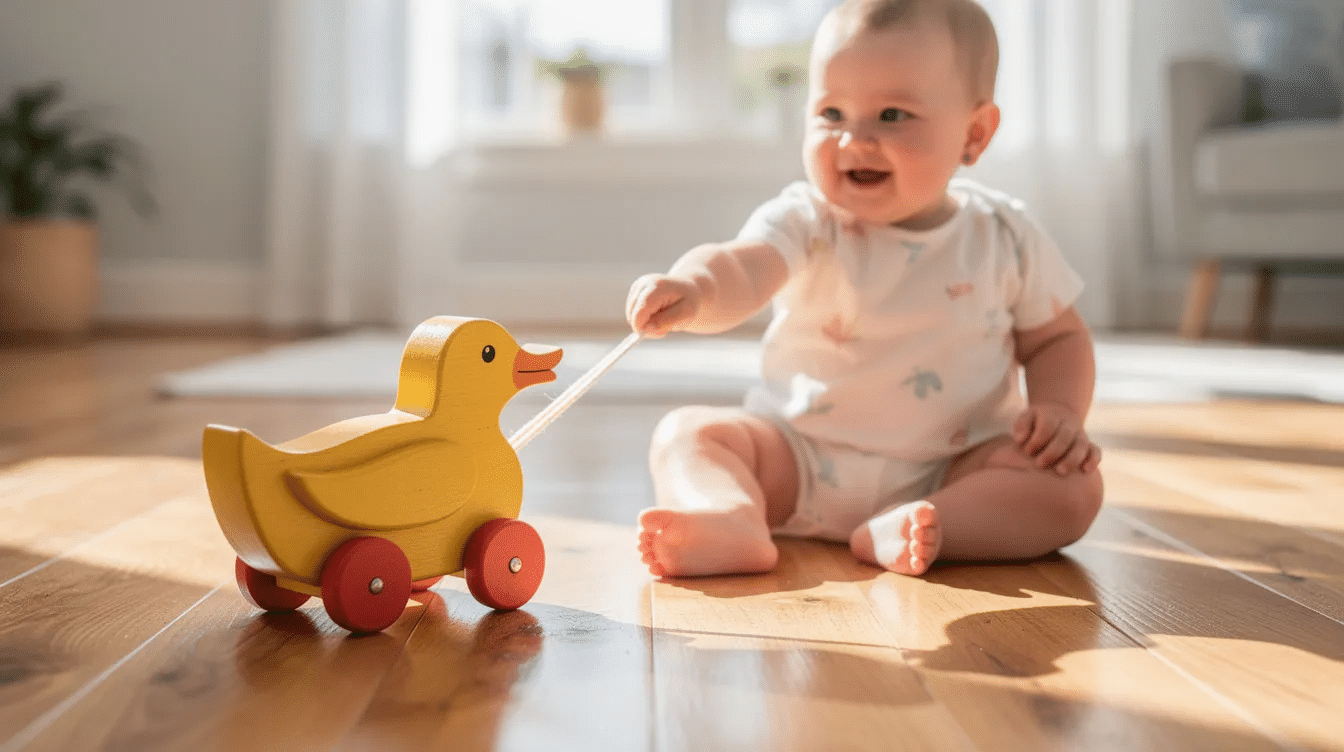
Pull-along toys are particularly engaging for children aged 12 to 24 months, a window when movement and curiosity spread rapidly. Pulling a toy encourages toddlers to walk, run, and explore, strengthening large muscle groups. Research confirms that toddlers who practise controlled movement while managing objects show stronger gait control and even larger vocabularies.
Physical benefits:
- Balance – staying upright while pulling builds core stability and gross motor skills
- Coordination – turning corners, weaving around furniture helps children judge distances and enhances spatial awareness
- Strength – holding the pull string helps children develop finger dexterity and hand-eye coordination, and pull along toys enhance fine motor skills in toddlers
- Feedback loop – interactive toys provide movement feedback that motivates toddlers to keep walking
Cognitive benefits:
- Cause-and-effect sounds teach toddlers about the relationship between actions and outcomes; pull along ducks promote cause and effect understanding
- Problem-solving emerges when the toy catches on a table foot or chair leg
- These toys can ignite curiosity and keep children engaged throughout the process of free play
Social and language benefits:
- Shared play can enrich language development by introducing new vocabulary – naming the beak, tail, wings, or colours
- Pull along toys can help develop social skills during play, especially when siblings take turns
- Imaginative play with toys like pull-along ducks can spark early storytelling skills, and active play with pull-along toys encourages exploration of the environment
By around 12–18 months most toddlers enjoy a simple pull toy; by ages 2–3 they can steer more complex duck trains with ease. Note that the novelty of a quacking or whistling duck can hold attention for far longer than you might expect.
Types of Pull Along Duck Toys: From Whistling Ducks to Wooden Keepsakes
Choosing a pull along duck is more fun than it sounds. Here is a quick guide to the main styles on the market today.
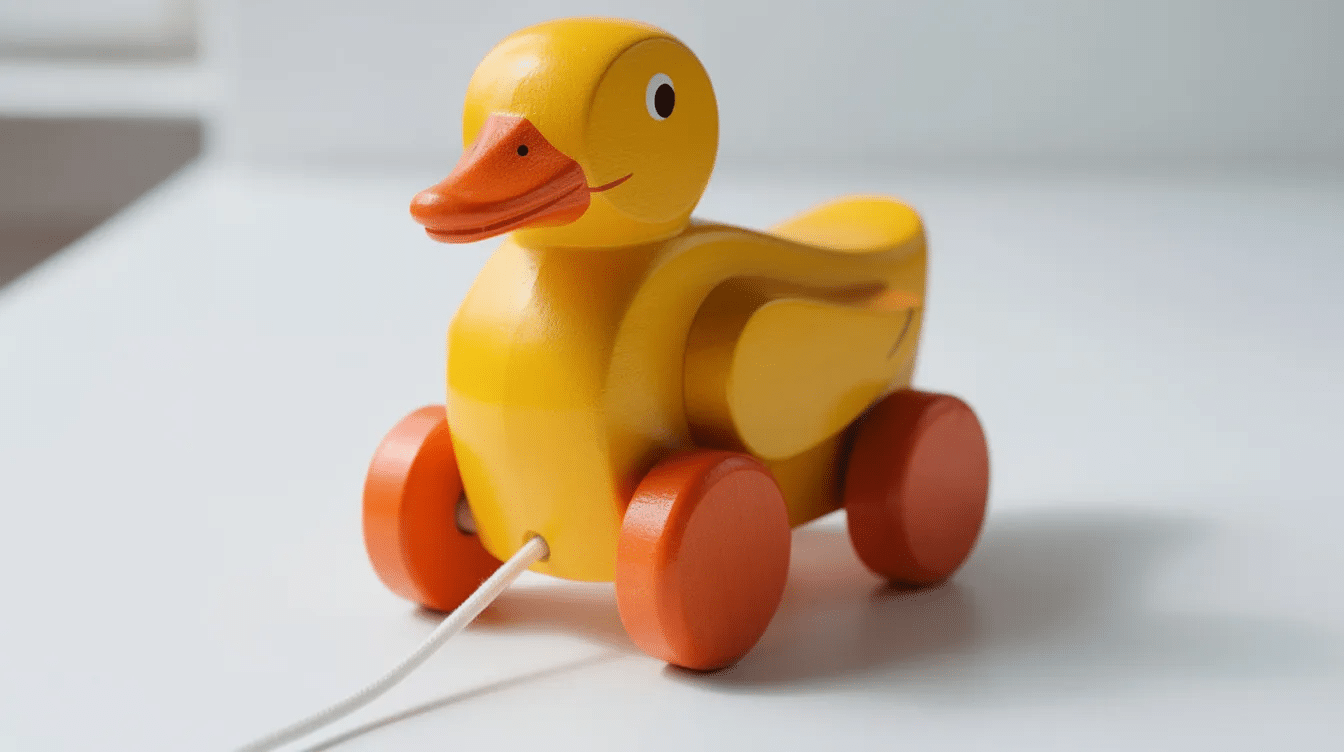
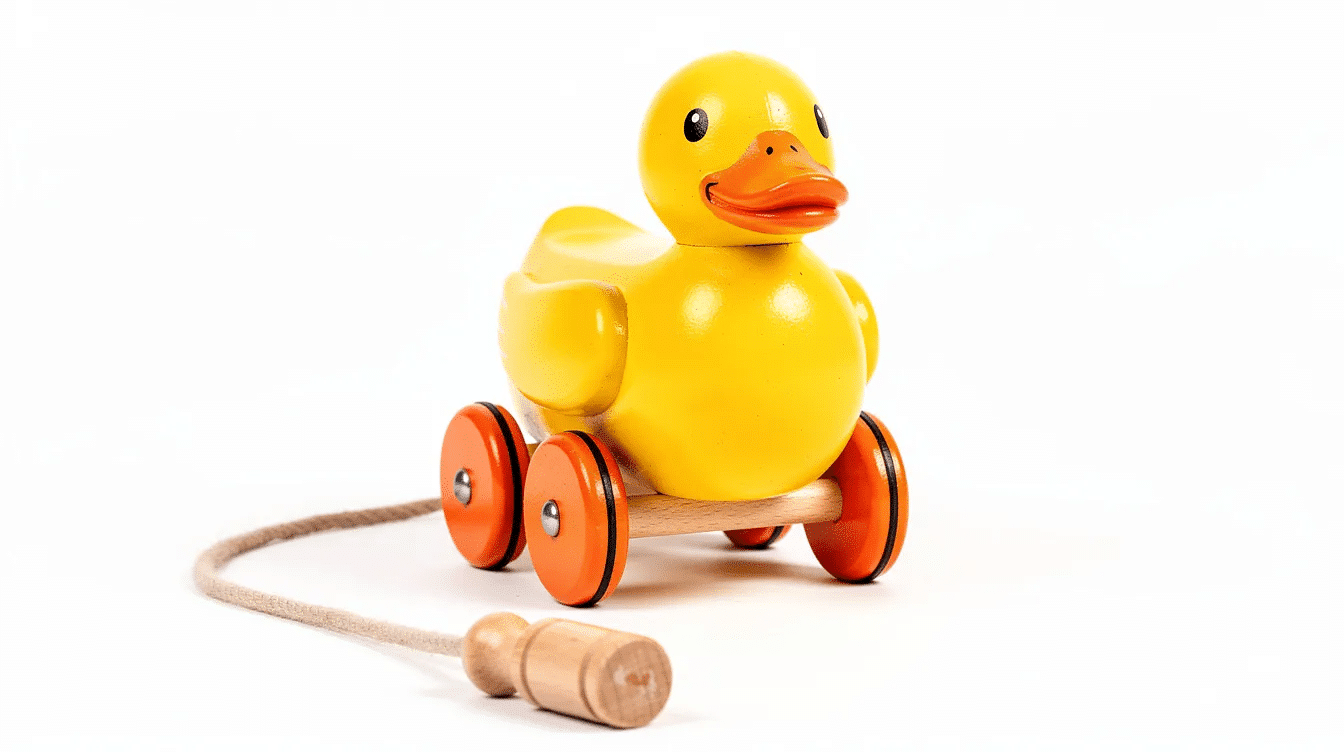
- Classic wooden duck – a solid-wood body, four round wheels, and a cotton string. Ideal for minimalist or Montessori-inspired homes. The pull along duck toy size is approximately 17.13 inches long in many popular models, giving toddlers enough space to walk comfortably.
- Whistling or sound duck – the pull along whistling duck sings and quacks when pulled, using a mechanical air passage or a small sound chip. Some designs feature interchangeable accessories and an on/off switch so parents can slide the sound off at nap time.
- Duck family sets – pull along ducks can include a mother duck and two ducklings, sometimes with numbered eggs for early maths play. These are ideal for children who already walk confidently.
- Recycled plastic or outdoor ducks – lightweight, weather-resistant, and easy to store after a muddy park trip.
- 2-in-1 designs – some designs feature 2-in-1 capabilities that extend play value as children grow; for example, a pull toy that converts into a push walker. Some pull along ducks feature detachable toys for added play.
Pull along duck toys are suitable for children aged 1–3 years, though the idea of a duck parade appeals to kids well beyond that line.
What to Look For When Buying a Pull Along Duck
Before you purchase, run through this checklist. Choosing a pull-along duck toy requires considering age-appropriate design and safety certifications, and choosing a pull-along duck toy involves balancing safety and durability.
- Safety standards – look for toys that meet recognised safety standards like ASTM F963 in the U.S. or EN71 in Europe. Ensure the pull string complies with safety standards to prevent entanglement hazards; cords should not be excessively long for under-3s.
- Age suitability – simpler, stable models suit early walkers (12–18 months); more complex duck trains work for confident walkers aged 2–3.
- Materials – select toys made from non-toxic, durable materials suitable for toddlers. Solid wood is heavier, which means the toy will roll in a straighter line and track better across the house. Look for FSC-certified timber or responsibly sourced pine.
- Wheels – look for sturdy wheels with rubber rims to prevent sliding on hardwood floors. Well-designed pull toys should stay upright and not tip over easily.
- Sound – decide whether you want a quacking or whistling duck; if so, check for a volume control or complete on/off switch.
- Practicalities – easy-to-wipe surfaces, a replaceable pull string, and compact size that fits under a pushchair. Use pull-along toys on flat surfaces and supervise play to avoid hazards.
Budget guide (2025–2026): a simple wooden pull along duck costs roughly £10–£15 / $15–$25. Feature-rich musical ducks or full duck-family trains sit around £25–£35 / $30–$50.
How to Make a Simple Wooden Pull Along Duck (Beginner-Friendly DIY)
This is a classic Little Button Diaries–style DIY project – simple tools, scrap materials, and a finished toy your toddler will adore. Follow these instructions to make your own.
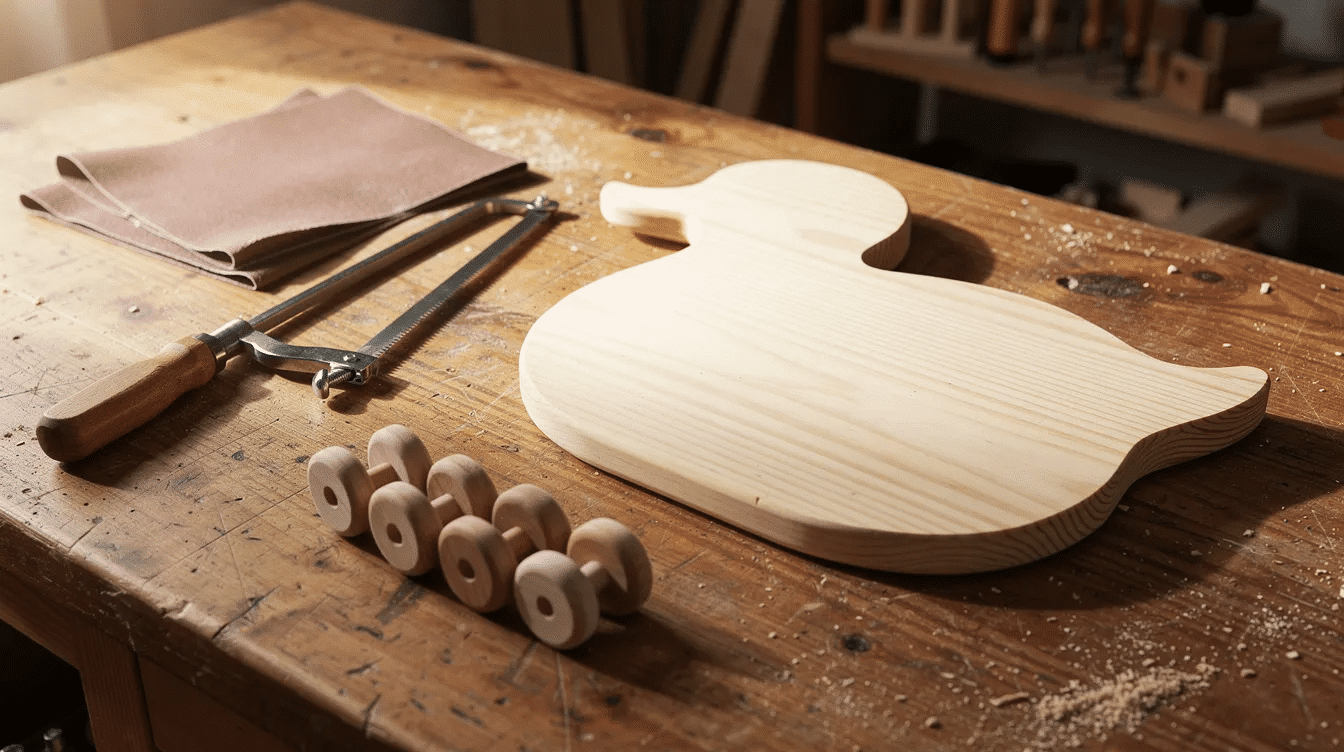
Materials: approximately 20 cm × 10 cm pine offcut (use a 3/4″ thick piece of pine board), 2 wooden wheels about 40–45 mm in diameter (wheels can be made from wooden spools cut in half), a 6–8 mm dowel for the axle, a small screw eye, 60–70 cm cotton string, child-safe paint, and clear non-toxic varnish. Gather all materials before you begin.
Tools: coping saw (or jigsaw), drill with a 6–8 mm bit, sandpaper (120 and 240 grit), pencil, paper template, and a clamp.
Build steps:
- Sketch a duck shape on paper. The duck body should be at least 5 inches long, with a slight taper toward the tail. Trace the template onto your pine board and clamp the board to your worktable.
- Cut the profile using a coping saw. Take your time with the cutting – a steady hand avoids the need to break out filler later. Use a simple jig if you need to hold small pieces steady.
- Drill a 3/8″ hole through the duck’s body for the axle, located about 10–12 mm above the base. Mark the center carefully first. If you want a handle hole on one side, a 35-degree angle works well for that second hole.
- Sand every edge until completely smooth – round the beak and tail generously. Work through 120 grit, then 240 grit, until no rough bit remains.
- Slide the dowel through the axle hole, checking the diameter fits snugly. Press the wheels onto each end; spread a thin layer of glue and let the glue dries fully before testing. The wheels should spin freely.
- Insert a small screw eye into the front of the body. Thread the cotton string through the hook of the screw eye and tie a secure knot. Attach a small wooden ball to the other end as a handle for tiny hands.
- Paint the duck with non-toxic paint for safety – a yellow body, orange beak and wheels, and a bright teal or red pull string to catch a toddler’s eye. Once complete, apply a coat of non-toxic varnish and let it dry overnight.
Write your child’s name and the date on the underside – this little duck may well become a keepsake.
Upcycled Craft: Cardboard Pull Along Duck You Can Make This Weekend
No power tools? No problem. This rainy-day project uses recycling-bin materials and is perfect for the whole family. Check out more easy craft ideas on our blog if you enjoy this kind of making.
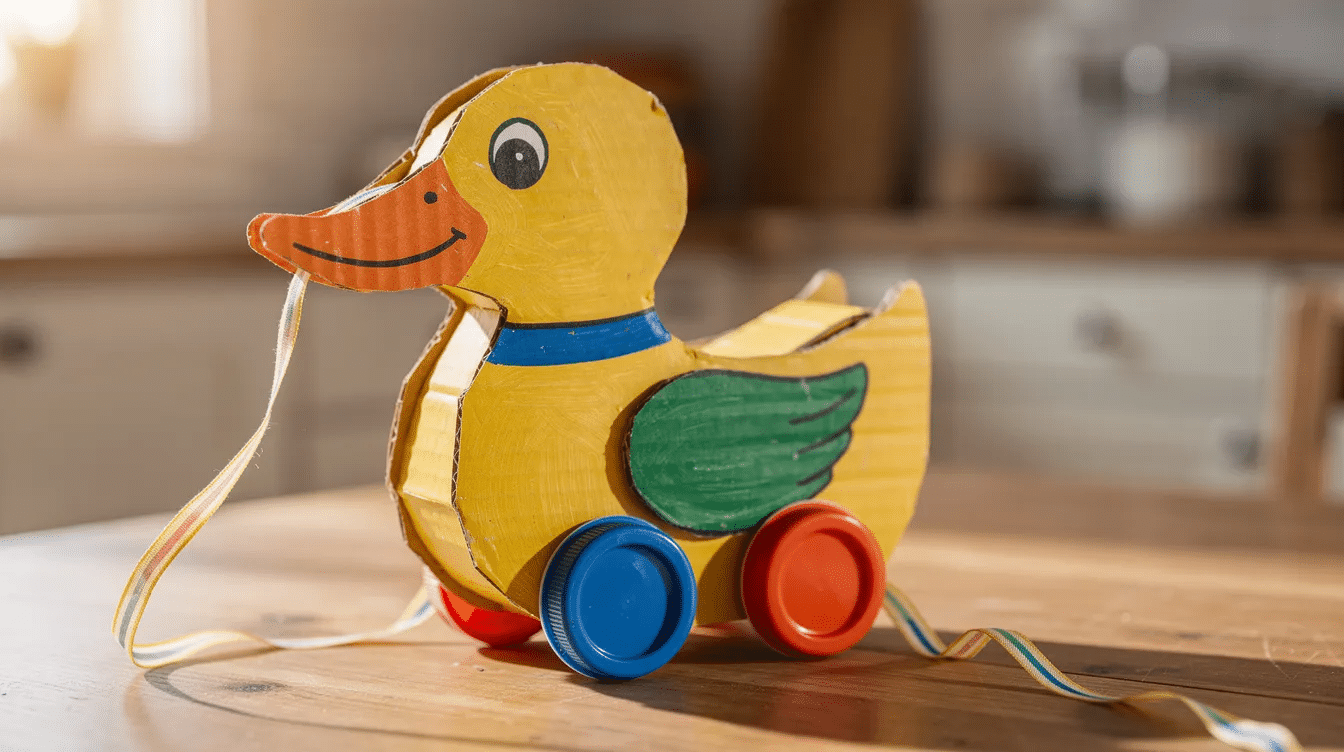
You will need: 2 cereal boxes (or similar card), 4 wide plastic bottle lids for wheels, a bamboo skewer for the axle, masking tape, PVA glue, string or ribbon (about 60 cm long), and poster paints.
Method:
- Cut two matching duck shapes from the card. Slot extra card strips between them for thickness, then tape and glue the layers together.
- Punch two holes on each side for the axle skewers. Push the skewers through, then press bottle lids onto the ends and secure with a blob of hot glue.
- Reinforce the area around the axle holes and the pull string slot with extra layers of card so it won’t break under strain.
- Decorate with your children: collage with magazine scraps, draw feathers, add googly eyes, or stick on paper wings.
- To extend the play, create a larger mother duck and one or two smaller ducklings joined by short lengths of string – a cardboard duck family parade.
Play Ideas and Learning Activities with a Pull Along Duck
These screen-free activity prompts work with any pull along duck, whether shop-bought or homemade.
- Gross motor games – organise a “duck parade” from one room to another. Build a small ramp from sturdy books and let the duck roll down. Weave around cushions as an obstacle course to develop spatial awareness and strengthen every muscle from foot to shoulder.
- Early maths – count how many steps until the duck reaches the sofa. Line up toy ducks and eggs in order. Push numbered blocks into a line and match each to a quack you pretend to make.
- Language and storytelling – invent a story about where the duck travels: to the pond, the park, Grandma’s house. Practise simple instructions like “stop”, “go”, and “turn around.” Name emotions: “duck is tired”, “duck is excited.” This kind of play can spread vocabulary quickly.
- Pretend play – set up a “vet clinic” for a poorly duck with a bandaged wing, a “duck café” where toddlers serve pretend snacks, or a “farmyard” where the pull toy lives alongside other animal toys.
- Outdoor adventures – take the duck to a real duck pond (keep it on the path!). Compare toy ducks with real ones and talk about seasons, weather, and the natural environment around you.
Keeping Your Pull Along Duck Safe, Clean, and Loved for Years
A well-maintained pull toy can be handed down through siblings and even become a long-treasured keepsake.
Cleaning: For wooden ducks, wipe with a slightly damp cloth and mild soap, then dry thoroughly – never soak or submerge. For plastic ducks, warm soapy water and sun-drying work fine.
Inspection checklist (every few weeks):
- Check the pull string knot and screw eye tightness
- Confirm wheels are firmly attached and roll freely without wobbling
- Look for chips in paint that expose rough wood, cracks, or fraying string
- Remove the toy temporarily if any part becomes loose
Storage: Keep away from direct radiators or damp sheds to prevent wood warping. A labelled toy basket or a hook by the front door works well for “walk the duck” outings and saves space in the playroom.
When to repair or retire: Replace frayed strings with fresh cotton cord cut to an age-appropriate length. If wheels crack or the body splits, it is time to store the toy as a memento rather than a plaything. Date the underside (e.g., “Made July 2026”) for future nostalgia.
Little Button Diaries’ Perspective: Why We Love the Humble Pull Toy
Everything we do at Little Button Diaries comes back to one idea: creative, affordable activities that help families play and learn together. A pull along duck toy fits that mission perfectly – it is simple, open-ended, encourages movement and imagination, and can be handmade from everyday materials found around the house.
If you enjoyed this guide, explore our craft activities for kids or browse DIY projects for more weekend inspiration. We would love to see your creations – share photos of your homemade ducks with us on social media and tell us where your toddler’s duck has travelled.
Set aside an afternoon this Sunday to sketch and cut your first little duck. The whole process takes a couple of hours, and your toddler will proudly pull it along for months to come.