
If your little one loves stringing, sorting, and wearing their own creations, pipe cleaner necklaces are about to become your go-to craft. They require almost no setup, cost next to nothing, and keep small hands busy long enough for you to finish a cup of coffee while it’s still warm. In this post we’re walking through everything from a simple starter necklace to themed designs your kids will want to wear all day, plus storage hacks and learning extensions that make the whole activity worth the (very little) effort.
Key Takeaways
- Pipe cleaner necklaces are an easy, low-mess craft perfect for kids aged 3–6 that uses everyday materials most families already have at home. Pipe cleaner necklaces are fun and easy for kids to make, and they can be finished in under 15–20 minutes.
- Threading beads onto a pipe cleaner builds fine motor skills, bilateral hand coordination, color recognition, patterning, and early name recognition when you add letter beads.
- The project is very adaptable – swap beads for pasta, buttons, or paper straws, and try simple loops, cluster charms, or initial pendants to keep things fresh.
- Pipe cleaner necklaces are budget-friendly, easy to store or gift, and can be recycled into brand-new crafts once your child is ready for something different.
- Pipe cleaner crafts improve kids’ attention and focus, making this a meaningful activity wrapped in creative fun.
Simple Pipe Cleaner Necklace for Little Makers
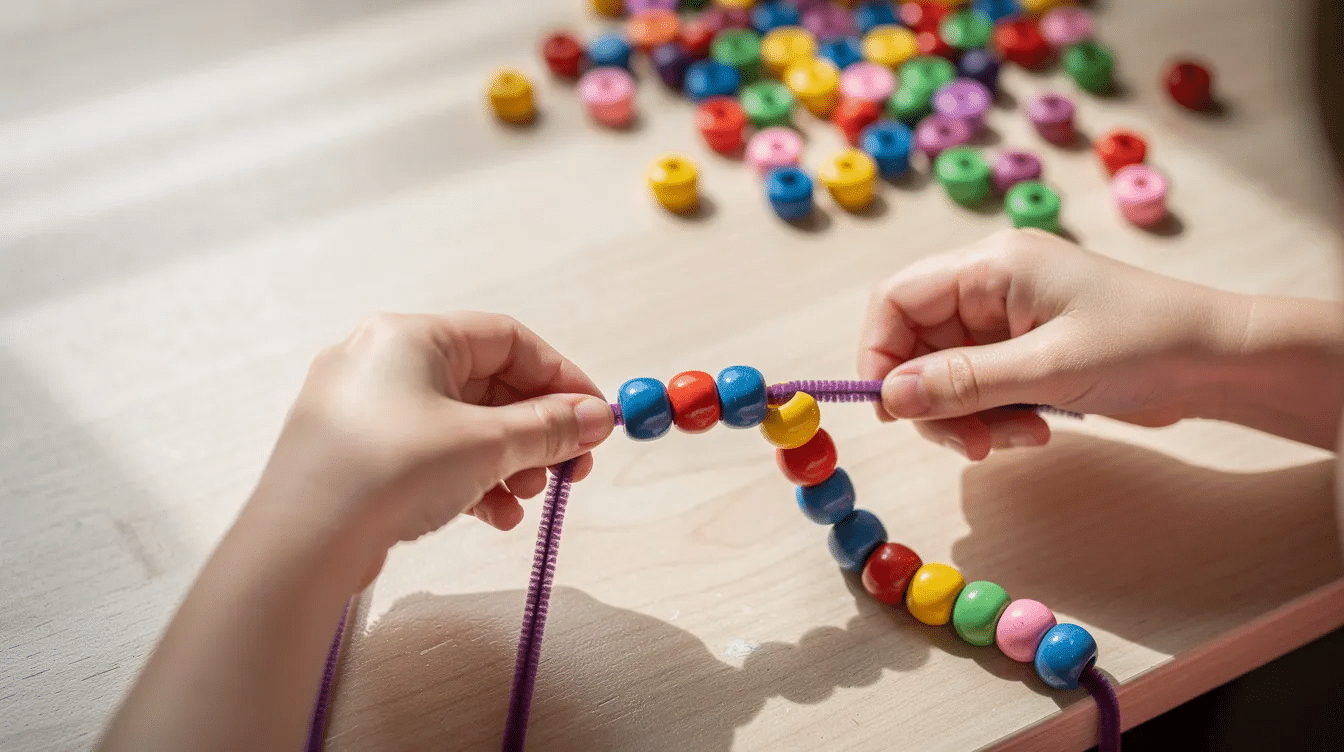
This is the fuss-free, 10-minute starter project every parent needs in their back pocket. One pipe cleaner, a handful of chunky beads, and your child walks away wearing something they made themselves. Crafting with pipe cleaners can be low-mess and accessible for young children, which means you don’t need to lay down a drop cloth or block out an entire afternoon.
What You Need
For one basic pipe cleaner necklace, gather:
Material | Quantity | Notes |
|---|---|---|
Standard pipe cleaners (chenille stems) | 1–2 | Standard pipe cleaners are usually 12 inches long |
Large plastic pony beads | 10–20 | Using large-hole beads is recommended for beginner crafters using pipe cleaners |
Paper straw pieces or dry pasta (optional) | A small handful | Cut straws into 1-inch segments |
Child-safe scissors | 1 pair | For trimming pipe cleaner ends |
Pipe cleaners are colorful, flexible, and easy to shape into jewelry, which is exactly why they work so well for this age group. You won’t need a hot glue gun, thread, or clasps – the wire core does all the heavy lifting.
Step-by-Step Directions
- Measure. Hold a pipe cleaner loosely around your child’s neck to check length. Most preschoolers need about 20–22 inches of total length, so you’ll likely need two pipe cleaners. Twist pipe cleaners together at one end, overlapping about an inch, to create a long necklace.
- Create a stopper. Bend a small loop at one end of the joined pipe cleaner so beads can’t slide off while your child threads.
- Thread. Let your child slide beads onto the open end. Pipe cleaners hold their shape, making it easier for little hands to thread without fumbling with a floppy string or needing a needle. Aim to leave about 2 inches bare at each end.
- Secure. Once beading is done, twist the two bare ends together into a secure loop. This loop slips over the head – no metal clasps needed. Tighten the twist so it stays snug.
- Wear and admire. Simple twisted loops and beaded pendants are good starter designs for kids, and your child just completed their first piece of pipe cleaner jewelry.
A Quick Safety Note
Safety tips for very young children include avoiding small beads due to choking risks. The Consumer Product Safety Commission classifies items that fit inside a small-parts cylinder as hazardous for children under 3. Stick with pony beads or larger for this age group, always supervise threading sessions, and remove necklaces for naps and rough play.
Design Ideas for Little Ones
Help your child plan their own look before they start threading:
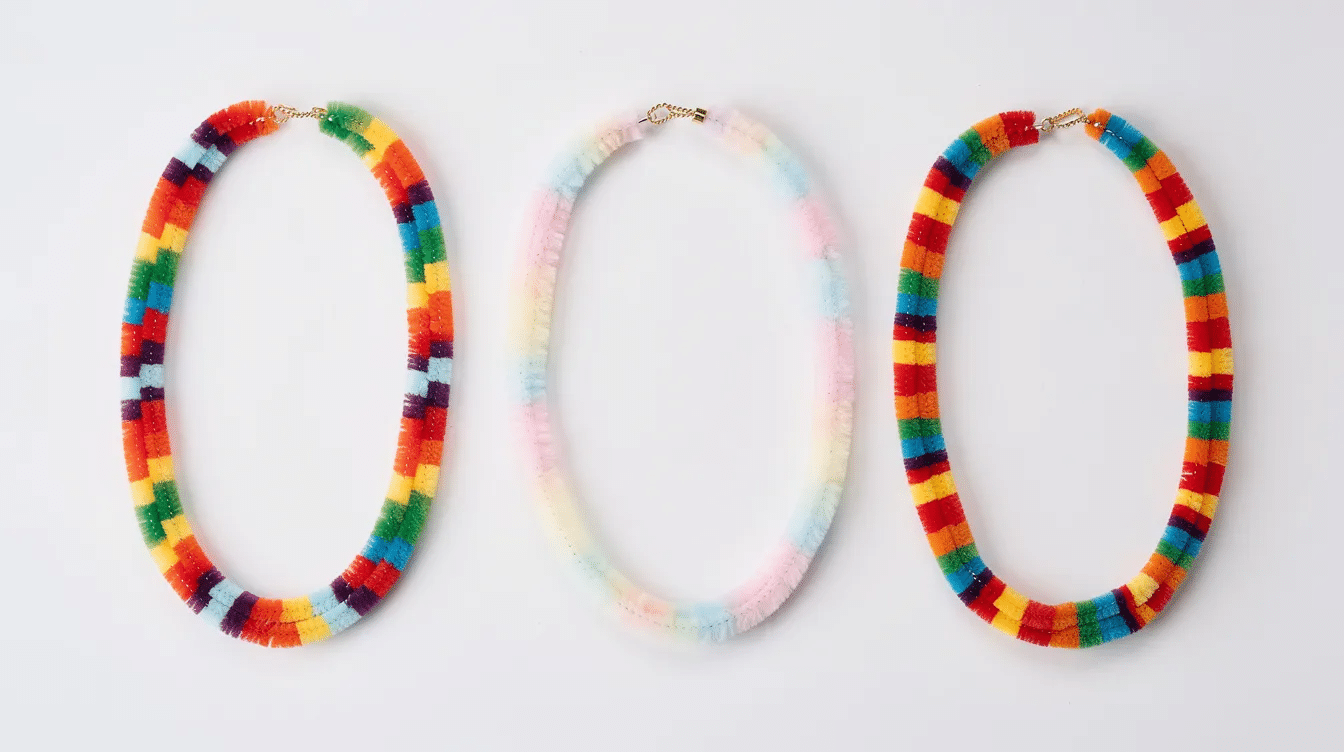
- Rainbow sequence – red, orange, yellow, green, blue, purple, repeat. (For more rainbow inspiration, check out our 20 Fun Rainbow Crafts for Kids.)
- Sunset colors – alternating warm shades of orange, pink, and gold.
- Stripes – three of one color, three of the next.
- Mixed media – alternate a bead with a paper-straw segment or a piece of rigatoni for texture.
Why Pipe Cleaners Beat String for Beginners
If you’ve ever watched a three-year-old try to poke a piece of yarn through a bead hole, you know the frustration. Pipe cleaners can be bent, twisted, coiled, and reshaped without needing tools, and their stiff wire core means beads slide on easily and stay put. Using pipe cleaners for crafts promotes fine motor skills in children – specifically the pincer grasp, bilateral coordination, and wrist stability that support later writing and dressing tasks. String has its place, but for a first necklace, pipe cleaners win every time.
Mini Makers Designs: From Beaded Letters to Party Pipelines
Once your child can make a basic pipe cleaner necklace, it’s time to level up. These mini makers variations keep the activity fresh for weekends, playgroups, and birthday parties – and they’re still simple enough that a preschooler can lead the way.
Letter Pendant Necklace
This one is inspired by kid jewelry trends and doubles as a literacy exercise.
- Take a single pipe cleaner and thread a few beads onto each end for color.
- Bend the middle section into a single initial – an “L,” an “A,” whatever letter your daughter or son connects with. Geometric shapes can be made by twisting pipe cleaners into different forms, and letter shapes are just a step further.
- Twist the ends to secure the letter shape.
- Cut a 1mm chain to desired length for pendants, or simply twist the letter onto a second beaded pipe cleaner necklace so it dangles as a charm.
Pipe cleaner monogram pendants can be made with beads threaded onto the letter shape itself, adding color and weight so the pendant hangs nicely. This is a great way to help kids learn name recognition.
Cluster Charm Design
For slightly older preschoolers (ages 4–6) who love a lot of sparkle:
- Create several tiny pipe cleaner spirals or hearts. Fun techniques for using pipe cleaners include coiling and pinching to create shapes – spirals are made by wrapping a pipe cleaner around a pencil, while hearts are formed by bending in half and curving each side outward.
- Thread 3–5 beads onto each mini shape before closing it.
- Twist them onto a main beaded pipe cleaner necklace to form a chunky, playful centerpiece.
Kids can create themed necklaces based on interests like flowers, animals, or space. A star-shaped charm in silver tinsel pipe cleaner? Instant astronaut jewelry.
Flower Necklace
Creative pipe cleaner designs can include flower pendants and beaded necklaces, and this is the version every craft-loving child will want to try.
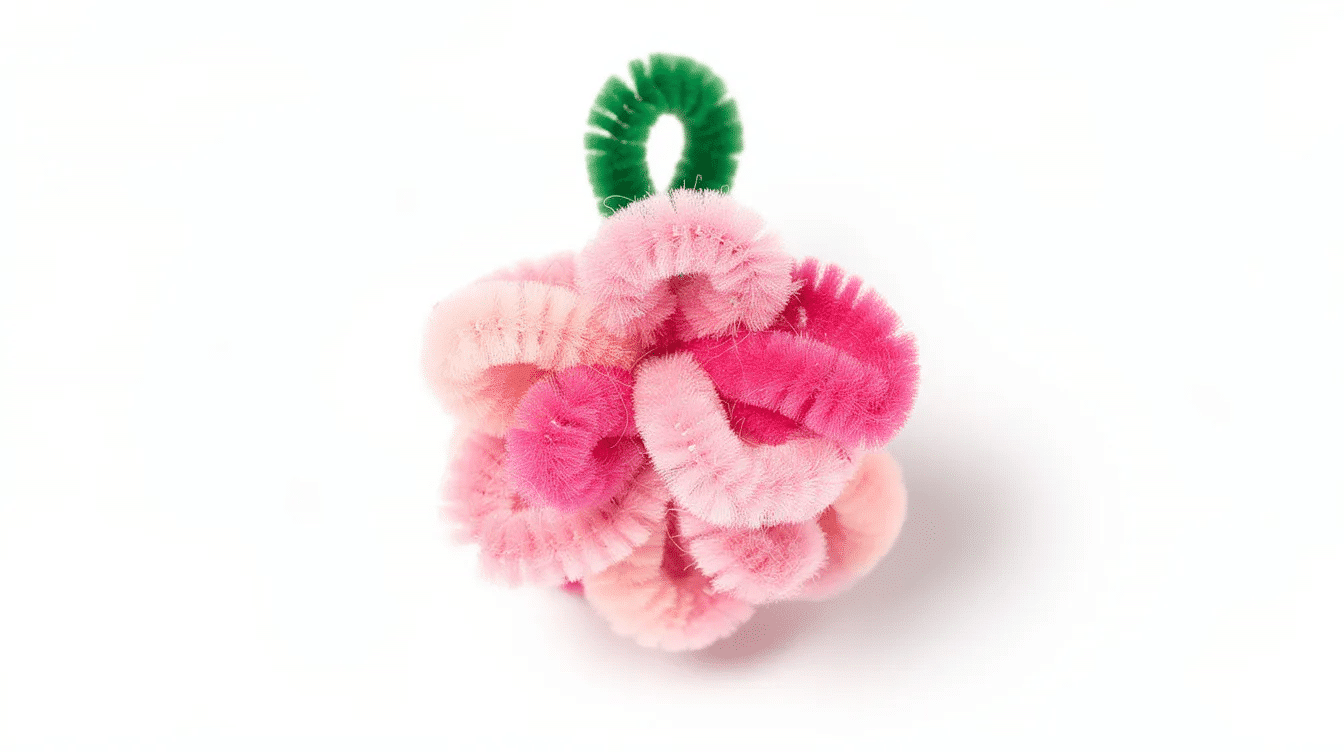
- Use 3 dark green and 9 pink pipe cleaners for flowers. A flower necklace can use 9 pink pipe cleaners – each one folded into a petal loop, then gathered and twisted at the base with a green stem.
- Twist pipe cleaners to create a flower shape for crafts by forming five or six petal loops around a central point.
- The looping technique is useful for making petals and decorative links. Pipe cleaner necklaces can be made with flower links by connecting several small flowers along the necklace length.
- Thread multicolored Perler beads onto a pipe cleaner between each flower link for pops of color.
If your kids enjoyed this, they’ll love our full Pipe Cleaner Flowers tutorial for even more bloom-inspired projects.
Nature Walk Necklace
Pipe cleaners can be used to create themed crafts like gardens or fruit salads, and a nature walk necklace brings the outdoors right into your craft session:
- Thread wooden beads for an earthy palette.
- Cut pieces of brown and green pipe cleaners and coil them between beads.
- Punch a few lightweight leaf shapes from colored card and poke them onto the pipe cleaner.
This works especially well for autumn crafts with nature and november preschool themes.
Birthday-Party Make-and-Take Station
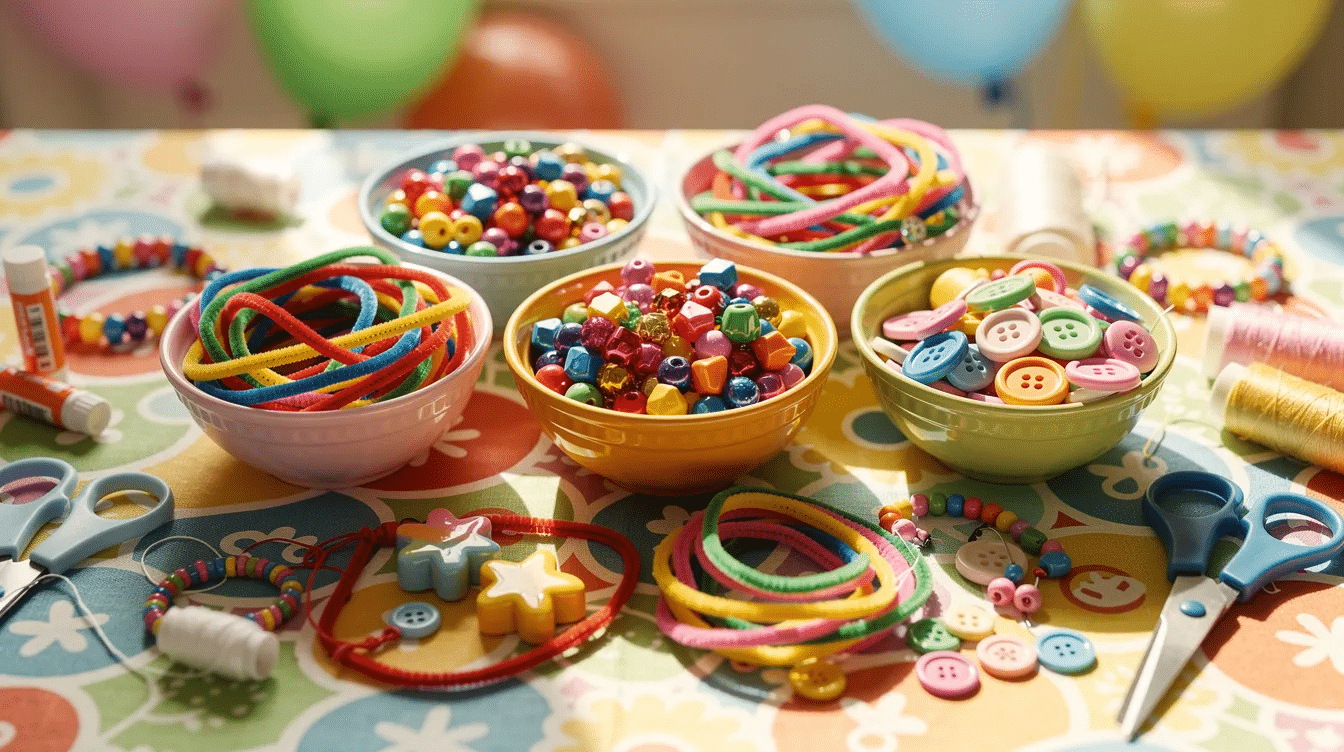
Set out bowls of pipe cleaners, beads, buttons, and cut paper straws on a low table, with pre-measured necklace bases ready to go. Kids can finish a pipe cleaner necklace while cake is being sliced and take it home in a small paper bag as a party favor.
Pro tip: Pre-bend the sharp wire ends of each pipe cleaner before the party so no one gets poked. Label each station bowl with a sign showing the color or material inside – it keeps things organized and gives early readers a chance to practice.
Developmental Notes
Color sorting and repeating patterns on a pipe cleaner help with early maths – ABAB patterns, symmetry, counting groups. Meanwhile, bending shapes encourages problem-solving and hand strength. Research from UNICEF early childhood tools includes threading beads as a fine motor competency benchmark for children ages 3–6, so this isn’t just fun – it’s measurable developmental exercise.
Tips, Storage, and Easy Extensions
This pipe cleaner craft is genuinely low-prep and low-mess, making it realistic for weeknights as well as longer weekend sessions. Here’s how to keep things running smoothly and extend the fun over time.
Setup Tips
- Cover the table with a tray or tea towel to contain runaway beads.
- Decant beads into muffin tins or small bowls sorted by color. This doubles as a color-sorting exercise before threading even begins.
- Pre-bend sharp pipe cleaner ends over so they’re soft before children start threading. A quick fold of the last half-centimeter is enough.
- Keep child-safe scissors nearby for trimming, but handle all cutting yourself for kids under 4.
Quick Troubleshooting
Problem | Solution |
|---|---|
Necklace feels flimsy | Double up by twisting two pipe cleaners together before threading |
Beads won’t fit | Switch to wider pony beads or trim the pile at the tip with scissors |
Child wants to redesign | Gently untwist the ends, slide beads off, and start fresh – most pipe cleaners can be straightened and re-bent once or twice |
Necklace is too short | Add a third pipe cleaner by twisting it onto one end |
Thicker pipe cleaners are easier to manipulate for crafting projects, so if your child is struggling, upgrading from a thin wire stem to a standard 6mm chenille stem can make a lot of difference.
Storage Ideas
Finished pipe cleaner necklaces don’t need a fancy jewelry box:
- Hang them on a low peg rail near the dress-up bin.
- Store them in a labeled shoebox so children can search through and choose one for school runs, pretend play, or a day out.
- Drape them over a small branch in a jar for a “jewelry tree” that looks cute on a shelf.
Easy Extensions
When your family has more time, try these:
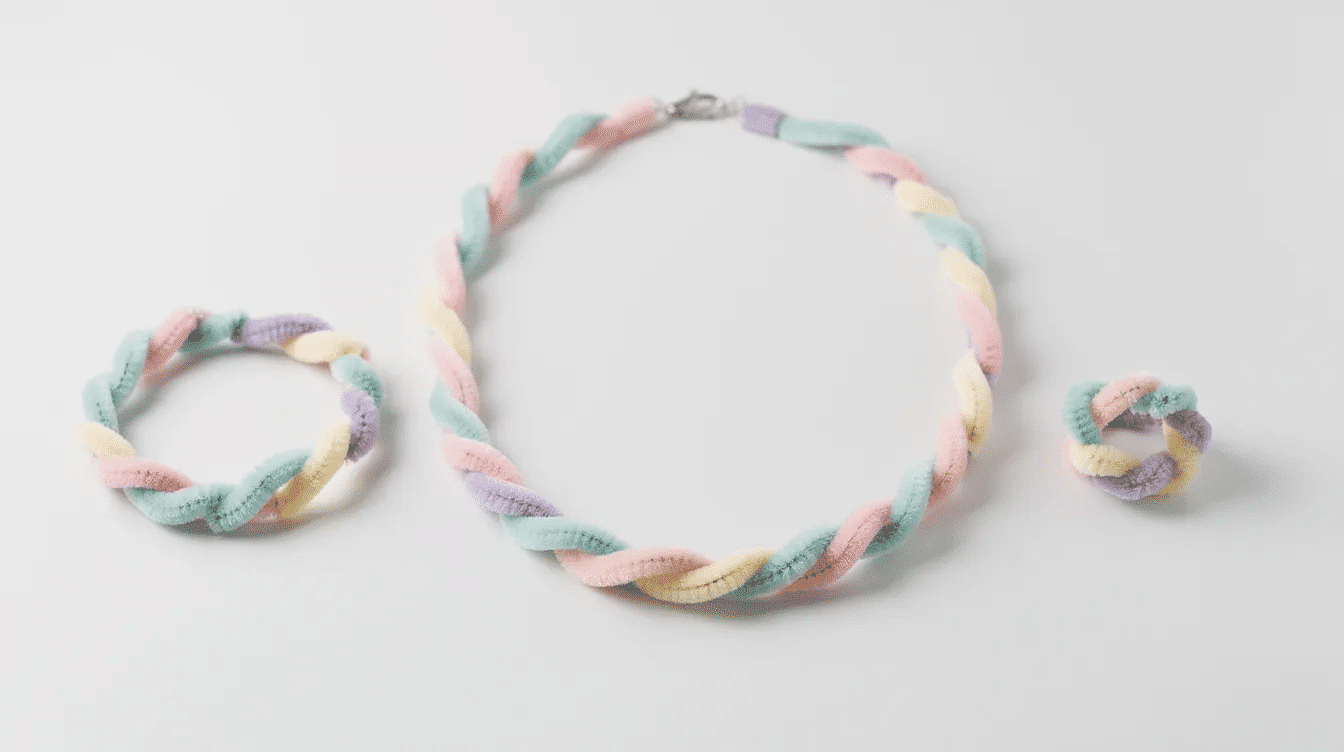
- Full mini makers jewelry set. Turn matching pipe cleaner bracelets and rings into a complete collection. A bracelet needs just one pipe cleaner; a ring needs about half. Suddenly your child has a whole line of pipe cleaner jewelry to share with friends.
- Seasonal themes. Spring flower necklaces with pastel beads, Halloween orange-and-black combos, or winter “icy” blue-and-white designs with sparkle stems. Pipe cleaners can be used to create themed crafts across every season.
- Name bracelets. Use letter beads to spell first names – this supports early literacy while doubling as a personalized gift for grandparents. For more ideas on creative craft activities for kids, we’ve got a whole lot of projects waiting for you.
One Last Thing
We love seeing what your mini makers come up with. If your girls or boys enjoyed making pipe cleaner necklaces, snap a photo and share it with us on social media – it makes our day every single time. And if you’re looking for more things to do with chenille stems, our post on DIY fidget toys for kids uses some of the same supplies in a completely different way.
Thanks for crafting with us. Now go find those pipe cleaners – we knew you had a stash somewhere – and let your little makers get to work.
Mini Makers Pipe Cleaner Necklace FAQ
Got questions beyond the tutorial? These cover the things parents ask us most.
What age is suitable for making a pipe cleaner necklace?
Most pipe cleaner necklace projects here at Little Button Diaries are aimed at ages 3–6 with close supervision. Toddlers around 2 can join in by choosing colors and helping place large beads with an adult’s hand guiding theirs. If you’re looking for even gentler activities for the youngest crafters, our guide to no mess activities for 2 year olds is worth a look. Keep in mind that children develop at their own pace – if your child can hold a bead and push it onto a pipe cleaner, they’re ready.
How long does one pipe cleaner necklace take to make?
A simple beaded pipe cleaner necklace usually takes 10–15 minutes from setup to finished craft. More detailed mini makers designs with letter pendants or cluster charms may take 20–30 minutes depending on the child’s pace. Educational resources suggest 10- to 15-minute increments are ideal attention windows for preschool-aged children, so don’t worry if your child wants to stop and come back later – that’s completely normal.
Can we reuse the beads and pipe cleaners after my child is finished with the necklace?
Absolutely. Beads can be carefully slid off and saved in a jar for future projects. Pipe cleaners can often be straightened and re-bent once or twice before the wire fatigues, making this a frugal, low-waste craft for families who care about getting the most from their supplies. If a pipe cleaner is too bent to reuse as a necklace base, it still works for flat art projects or glue-down collages.
Which pipe cleaners work best for kids’ necklaces?
We recommend standard 6mm chenille stem pipe cleaners at around 12 inches long. Soft high-density fuzzy chenille stems are recommended for crafting because the dense pile covers the wire core, reducing the chance of scratchy ends. Very thin wire pipe cleaners may be too sharp for small children, and thicker “super fluffy” varieties can be harder to thread beads onto. Open your browser and search for “chenille stems 6mm assorted colors” – you’ll find multi-packs for a few dollars that will last dozens of projects.
How can I turn this activity into a learning game?
Try these simple challenges to layer learning into the craft:
- Ask your child to thread beads in repeating ABAB or ABC patterns to build early maths skills.
- Make a pipe cleaner necklace using only “cool” colors (blue, green, purple) or “warm” colors (red, orange, yellow) and discuss why they belong in each group.
- Spell the first letter of their name with a letter-shaped pendant to support early literacy.
- Count how many beads fit on one pipe cleaner, then predict how many will fit on two twisted together. This is a gentle introduction to estimation and addition.
If you’d like to explore more ways that creative projects support development, our article on art and craft benefits for child development digs deeper into the research.
Have a question we didn’t answer? Drop us a reply in the comments or send us an email – we’d love to hear from you. And if you haven’t already, join our community so you never miss a new craft tutorial. Happy making!